

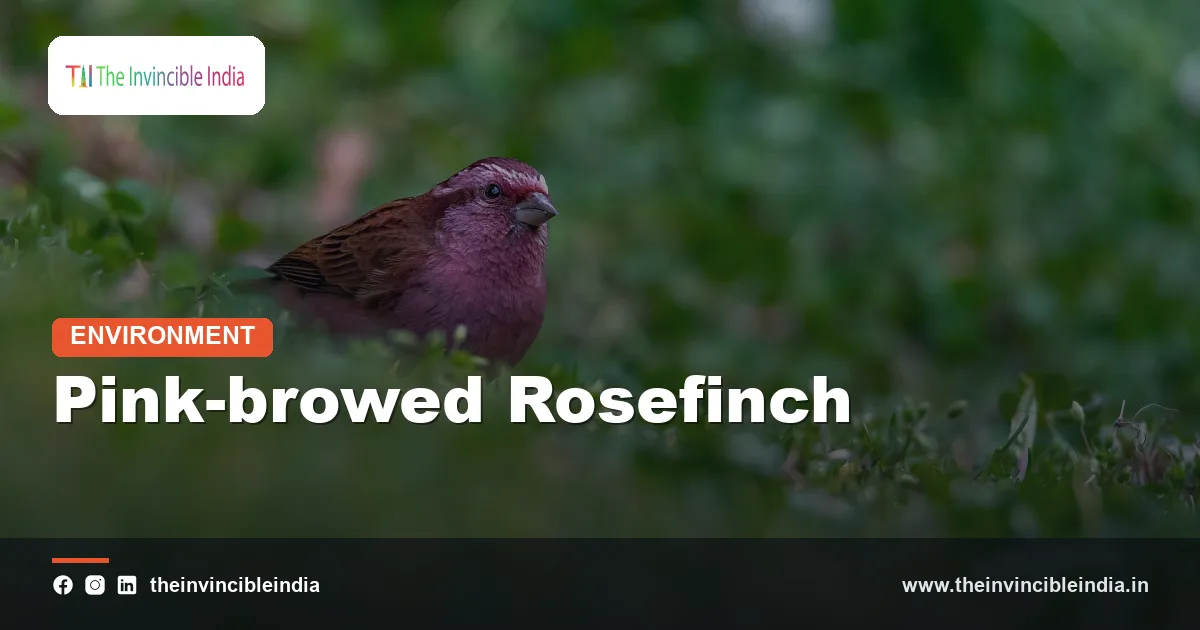
The pink-browed rosefinch (Carpodacus rodochroa) is a small Himalayan finch in which the adult male glows rose-pink over the eyebrow, cheeks, throat and rump, found in scrub, forest edges and rhododendron and juniper slopes at middle and high elevations. The female is a plain, streaked brown bird, so the species shows a marked difference between the sexes.
The pink-browed rosefinch breeds on the open, bushy slopes of the Himalaya and moves to lower elevations in winter, where it can be found in hill gardens, forest clearings and cultivated terraces. Its quiet habits and the camouflage of the female make it less conspicuous than its colour would suggest, but a male in good light is among the prettiest of the Himalayan finches.
| Attribute | Detail |
|---|---|
| Common name | Pink-browed rosefinch |
| Scientific name | Carpodacus rodochroa |
| Family | Fringillidae (finches) |
| Size | About 15 cm in length, with a stout, conical bill |
| Range in India | Himalaya, from Jammu and Kashmir east to Arunachal Pradesh |
| Habitat | Scrub, rhododendron and juniper slopes, forest edges and hill cultivation |
| Diet | Seeds, buds, berries and some insects, mainly taken from the ground and shrubs |
| Movement | Altitudinal migrant that breeds high and descends in winter |
| Conservation status | Least Concern on the IUCN Red List |
Key Takeaways
- The pink-browed rosefinch (Carpodacus rodochroa) is a Himalayan finch in the family Fringillidae that lives in scrub and forest edges across the Indian mountains.
- An adult male pink-browed rosefinch is rose-pink on the brow, cheeks, throat, breast and rump, while the female is brown and streaked with a faint pale eyebrow.
- The pink-browed rosefinch is an altitudinal migrant that breeds at high elevations and moves down to lower slopes in winter.
- The pink-browed rosefinch feeds mainly on seeds, buds and berries, and also takes some insects during the breeding season.
- The pink-browed rosefinch builds a cup-shaped nest in a shrub or low tree and usually lays three to five pale blue-green eggs with dark speckles.
- The pink-browed rosefinch is listed as Least Concern by the IUCN, though its montane habitat is vulnerable to climate change and forest degradation.
What is the pink-browed rosefinch?
The pink-browed rosefinch is a small seed-eating songbird, a true finch in the family Fringillidae, and a member of the genus Carpodacus, whose species are collectively known as rosefinches. Rosefinches are named for the rosy, pink or crimson colour of the adult males, which is produced by pigments taken from the diet.
The genus Carpodacus is distributed across Asia, with many species living in the mountains of the Himalaya and Central Asia. The pink-browed rosefinch is one of the Himalayan species and is widely distributed along the mountain range. It is generally a bird of the open, bushy slopes rather than deep forest.
The English name describes the male, whose pink eyebrow stands out against a dark, streaked head. The female does not share this plumage, which is why the species is often described as sexually dimorphic.
How can you identify a pink-browed rosefinch?
A pink-browed rosefinch is identified by its stout bill, plump shape and, in males, the rose-pink brow, face and rump over a streaked brown back. Females are brown and streaked, with a pale buff eyebrow.
Male
The adult male has a deep rose-pink face, a broad pink eyebrow, a pink throat and breast and a pink rump. The crown and upperparts are streaked with dark brown, tinted pink. The wing feathers are dark with pale edges. The pink fades towards the belly, which is paler.
Female and young
The female pink-browed rosefinch is olive-brown above with dark streaks and buffy below with fine dark streaking. A pale supercilium gives her a more softly marked face than many other female rosefinches. Young birds resemble the female until their first full moult.
Field marks
- A thick, conical bill suited for cracking seeds.
- Rose-pink on the brow, face and rump in adult males.
- Dark streaking on the back and a pale edging to the wing feathers.
- A rather short, slightly notched tail that is often flicked.
Female rosefinches of several species look similar, and separating them often depends on subtle plumage details, voice and range. Photographs from several angles can help.
Where does the pink-browed rosefinch live in India?
The pink-browed rosefinch lives along the length of the Indian Himalaya, from Jammu and Kashmir through Himachal Pradesh, Uttarakhand and Sikkim to Arunachal Pradesh. It breeds mostly at middle and high elevations, often between about 2,700 and 4,000 m, and shelters at lower altitudes in the cold months.
The bird uses several habitats. In summer it is found in open scrub, rhododendron and juniper thickets, bushy slopes and forest edges near the tree line. In winter it descends to lower hills where it can be found in clearings, hill gardens, orchards and terraced fields with hedges and scrub.
It avoids dense, closed forest and alpine ground with no cover at all. The combination of shrubs for shelter and nesting and open ground for feeding is what makes a slope suitable.
Why does the pink-browed rosefinch move to lower altitudes in winter?
The pink-browed rosefinch moves to lower altitudes in winter because snow covers the high slopes and removes the seeds and buds on which it feeds. Lower elevations stay free of deep snow and still offer seeds, berries and shelter.
This movement is an altitudinal migration. Birds do not travel to the plains in large numbers, and most of the shift involves a descent of several hundred to a couple of thousand metres. In some years, harsh weather pushes more birds downslope than usual.
In spring the birds return upslope to their breeding grounds as the snow retreats, following the opening of new buds and seeds. This pattern is shared by many Himalayan birds, including several other finches, thrushes and accentors.
What does the pink-browed rosefinch eat?
The pink-browed rosefinch eats seeds, buds and berries, plus a small amount of insects, particularly during the breeding season. It uses its strong, conical bill to crack open seeds and to nip off soft buds.
The bird feeds both on the ground and in shrubs. It takes grass and herb seeds, the fruits of berry-bearing shrubs and the buds of trees and bushes. Insects and other small invertebrates are mostly provided for the nestlings, which need protein for growth.
Outside the breeding season, pink-browed rosefinches feed in small flocks or pairs, often alongside other finches and buntings. They may visit crop edges and fallow terraces for spilled grain and weed seed.
How does the pink-browed rosefinch breed?
The pink-browed rosefinch breeds in the Himalayan summer, building a cup-shaped nest of grass, moss and fine roots in a low shrub, a bush or a small tree. The nest is often placed a short height above the ground in dense cover.
The female typically lays three to five eggs that are pale blue-green with dark speckles, usually concentrated near the broad end. She incubates the eggs, and the male often stays close, singing from a perch. Both parents feed the chicks once they have hatched.
The male sings from the top of a bush or low tree. The song is a short, simple series of clear whistled notes, repeated at intervals. Singing is mainly done in the early morning and again towards evening.
How does the pink-browed rosefinch differ from similar rosefinches?
The pink-browed rosefinch differs from other rosefinches in the pink eyebrow of the male, the streaked upperparts and its preference for bushy slopes of the Himalaya. The table below compares it with some similar finches.
| Species | Male appearance | Typical habitat in India |
|---|---|---|
| Pink-browed rosefinch | Rose-pink brow, face, throat and rump over a streaked back | Scrub, rhododendron and forest edges of the Himalaya |
| Common rosefinch | Crimson-red head and breast with a brown back | Scrub and fields, widespread in winter across India |
| Beautiful rosefinch | Pink with a silvery crown and a pale forehead | Scrub and open slopes at middle and high elevations |
| Spot-winged rosefinch | Dark rose with white spots on the wing | Forest edges and bushy slopes at higher elevations |
The pink-browed rosefinch is generally darker and more streaked than the common rosefinch. Observers often use range, habitat and voice together with plumage to decide between the species, particularly in the case of females.
What role does the pink-browed rosefinch play in mountain ecosystems?
The pink-browed rosefinch plays a role in mountain ecosystems as a seed eater, a seed disperser of some shrubs and a prey species for hawks and other predators. Its movements link high and low elevations across the seasons.
By eating seeds and berries, the bird consumes plant material and sometimes carries seeds to new sites in its droppings. During the breeding season it contributes to the control of insects by feeding them to its young. It is in turn hunted by small raptors such as sparrowhawks, and its nests may be raided by mammals and corvids.
Because the species depends on shrub-rich slopes and responds to snow and temperature, it can serve as an indicator of change in Himalayan habitats.
Is the pink-browed rosefinch threatened?
The pink-browed rosefinch is not considered threatened and is listed as Least Concern by the International Union for Conservation of Nature (IUCN). It has a wide range along the Himalaya and is fairly common in suitable habitat.
Some pressures exist nonetheless. Scrub and forest edges are affected by grazing, firewood collection, road building and changing land use. Climate change may shift the elevation at which suitable conditions occur, and a warming climate could affect the timing of snow and seed supply. Conserving shrub-rich slopes and forest edges helps this species along with other Himalayan birds.
Where and when can you watch a pink-browed rosefinch in India?
The pink-browed rosefinch can be watched in the Himalaya throughout the year, with males most visible in the breeding season, from late spring through summer, when they sing from the tops of shrubs. In winter the birds are easier to find at lower elevations.
- Visit rhododendron and juniper slopes and forest edges at middle and high elevations in summer.
- Check hill gardens, forest clearings and terraced fields at lower elevations in winter.
- Scan the tops of bushes in the early morning for a singing male.
- Look for the pink eyebrow, pink rump and thick bill, and note the streaked back.
- Observe quietly and from a distance, as the birds flush easily and retreat into cover.
Bottom Line
The pink-browed rosefinch is a rose-coloured Himalayan finch that breeds high on bushy slopes and descends in winter. It is secure at present, and its seasonal movements make it a useful sign of the health of the Himalayan scrub and forest edge.
Frequently Asked Questions
What is a pink-browed rosefinch?
A pink-browed rosefinch is a small Himalayan finch, Carpodacus rodochroa, in which the adult male is rose-pink on the brow, face and rump. The female is brown and streaked. It lives in scrub and forest edges of the Himalaya.
Where is the pink-browed rosefinch found in India?
The pink-browed rosefinch is found along the Indian Himalaya, from Jammu and Kashmir to Arunachal Pradesh. It breeds at middle and high elevations and descends to lower slopes in winter. It prefers bushy ground and forest edges.
What does the pink-browed rosefinch eat?
The pink-browed rosefinch eats seeds, buds and berries, with some insects during the breeding season. It feeds on the ground and in shrubs and cracks seeds with its thick bill. Insects are mainly fed to its nestlings.
Does the pink-browed rosefinch migrate?
Yes, the pink-browed rosefinch makes altitudinal migrations, moving down the mountain slopes in winter and back up in spring. The movement is driven by snow cover and the availability of seeds and berries. It does not usually travel long distances across the plains.
How can you tell a male pink-browed rosefinch from a female?
You can tell a male pink-browed rosefinch from a female by colour. The male is rose-pink on the brow, face, throat and rump, while the female is olive-brown with dark streaks and a faint pale eyebrow. Young birds resemble the female.
Is the pink-browed rosefinch endangered?
No, the pink-browed rosefinch is not endangered and is rated Least Concern by the IUCN. It has a wide range and is fairly common in suitable habitat. Habitat loss and climate change could affect it in the long term.
{“@context”:”https://schema.org”,”@graph”:[{“@type”:”FAQPage”,”mainEntity”:[{“@type”:”Question”,”name”:”What is a pink-browed rosefinch?”,”acceptedAnswer”:{“@type”:”Answer”,”text”:”A pink-browed rosefinch is a small Himalayan finch, Carpodacus rodochroa, in which the adult male is rose-pink on the brow, face and rump. The female is brown and streaked. It lives in scrub and forest edges of the Himalaya.”}},{“@type”:”Question”,”name”:”Where is the pink-browed rosefinch found in India?”,”acceptedAnswer”:{“@type”:”Answer”,”text”:”The pink-browed rosefinch is found along the Indian Himalaya, from Jammu and Kashmir to Arunachal Pradesh. It breeds at middle and high elevations and descends to lower slopes in winter. It prefers bushy ground and forest edges.”}},{“@type”:”Question”,”name”:”What does the pink-browed rosefinch eat?”,”acceptedAnswer”:{“@type”:”Answer”,”text”:”The pink-browed rosefinch eats seeds, buds and berries, with some insects during the breeding season. It feeds on the ground and in shrubs and cracks seeds with its thick bill. Insects are mainly fed to its nestlings.”}},{“@type”:”Question”,”name”:”Does the pink-browed rosefinch migrate?”,”acceptedAnswer”:{“@type”:”Answer”,”text”:”Yes, the pink-browed rosefinch makes altitudinal migrations, moving down the mountain slopes in winter and back up in spring. The movement is driven by snow cover and the availability of seeds and berries. It does not usually travel long distances across the plains.”}},{“@type”:”Question”,”name”:”How can you tell a male pink-browed rosefinch from a female?”,”acceptedAnswer”:{“@type”:”Answer”,”text”:”You can tell a male pink-browed rosefinch from a female by colour. The male is rose-pink on the brow, face, throat and rump, while the female is olive-brown with dark streaks and a faint pale eyebrow. Young birds resemble the female.”}},{“@type”:”Question”,”name”:”Is the pink-browed rosefinch endangered?”,”acceptedAnswer”:{“@type”:”Answer”,”text”:”No, the pink-browed rosefinch is not endangered and is rated Least Concern by the IUCN. It has a wide range and is fairly common in suitable habitat. Habitat loss and climate change could affect it in the long term.”}}]}]}


