

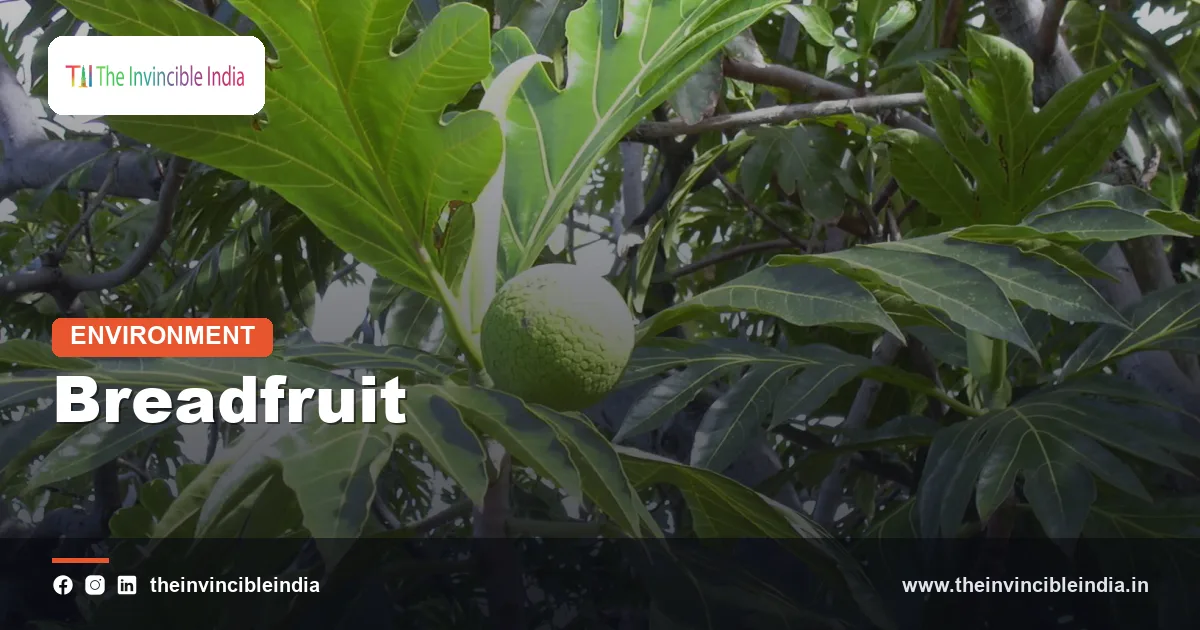
Breadfruit is the large, round, starchy green fruit of a tropical tree, Artocarpus altilis, which is cooked and eaten as a vegetable when mature but unripe, and which in India is grown mainly in Kerala and along the humid southern and island coasts. The tree belongs to the same genus as the jackfruit, and its fruit gets its English name because the cooked flesh is soft, filling and mildly bread-like in texture.
Breadfruit is not native to India; it is a Pacific plant that was carried across the tropics by sailors, settlers and botanical gardens. Today it sits quietly in many backyards in Kerala, coastal Karnataka, Tamil Nadu and the Andaman and Nicobar Islands, where it is valued as a shade tree, a seasonal vegetable and a dependable source of carbohydrate.
| Quick Facts | Details |
|---|---|
| Common name | Breadfruit (known as kadachakka and seemachakka in Malayalam, depending on type and locality) |
| Scientific name | Artocarpus altilis |
| Family | Moraceae (the mulberry, fig and jackfruit family) |
| Origin | Pacific region, with New Guinea and nearby islands regarded as the centre of origin |
| Where grown in India | Kerala, coastal Karnataka, Tamil Nadu, the Andaman and Nicobar Islands and other warm, humid, frost-free areas |
| Part used | Mature unripe fruit, seeds of the seeded type, leaves and wood |
| Products and uses | Curries, stir-fries, chips, boiled and roasted slices, flour; shade, fodder and timber |
| Tree size | Evergreen tree commonly 12 to 20 metres tall with large, deeply lobed leaves |
| Notable fact | The voyage of HMS Bounty in 1787 to 1789 was planned to carry breadfruit plants from Tahiti to the Caribbean |
Key Takeaways
- Breadfruit (Artocarpus altilis) is a starchy tropical fruit that is cooked like a vegetable and belongs to the same genus as the jackfruit.
- Breadfruit originated in the Pacific and reached the Indian coastline through the movement of people and plants across the tropics.
- In India, breadfruit is grown mostly in Kerala and in humid, frost-free coastal and island regions, usually as a backyard tree rather than in large orchards.
- Mature but unripe breadfruit is rich in carbohydrate, low in fat and a good source of potassium and vitamin C.
- Seedless breadfruit trees are propagated from root cuttings or suckers because seedless fruit cannot be grown from seed.
- Breadfruit is considered a useful food-security crop because a single mature tree can bear many heavy fruits over a long season.
What is breadfruit and how does the tree look?
Breadfruit is a multiple fruit, formed when hundreds of tiny flowers on one flower head swell and fuse into a single round or slightly oval fruit. The skin is green and patterned with small hexagonal bumps or soft spines, depending on the variety. Inside, the flesh is creamy white to pale yellow, dense and starchy, with a core running through the centre.
The breadfruit tree is an evergreen that commonly grows 12 to 20 metres tall in good conditions. Its leaves are among the most striking in the Indian garden: large, glossy, dark green and deeply cut into broad lobes, often half a metre long or more. The tree has a straight trunk, a rounded spreading crown and milky latex in the branches and fruit, a trait it shares with figs and jackfruit.
The tree is monoecious, meaning one tree carries both male and female flowers. The male flowers sit on club-shaped spikes that hang from the branches, while the female flowers form the round heads that later become the fruit. Fruits are usually between one and several kilograms in weight, and a heavily laden tree is an impressive sight.
Where did breadfruit come from and how did it reach India?
Breadfruit originated in the Pacific, and botanists generally trace the cultivated plant to New Guinea and nearby islands, where it was selected over thousands of years from a wild relative called breadnut (Artocarpus camansi). Pacific voyagers then carried cuttings and suckers across the ocean, so that breadfruit became a staple on islands from Polynesia to Micronesia.
The plant became famous in European history because of the Bounty expedition. In 1787, HMS Bounty sailed to Tahiti to collect breadfruit plants so that they could be grown in the Caribbean as cheap food for enslaved labourers. The crew mutinied in 1789, and the plants were thrown overboard, but later voyages succeeded in delivering breadfruit to the West Indies.
Breadfruit reached the Indian coastline through the same colonial-era web of botanical exchange that moved crops such as cinchona, rubber and cocoa across oceans. The warm, wet and frost-free climate of the Malabar coast suited the tree well, and it settled into home gardens. It remains a minor crop in national terms, but it is firmly part of the food culture of parts of Kerala.
Where is breadfruit grown in India?
Breadfruit in India is grown mainly in Kerala, where the tree is a familiar sight in village compounds, and it is also found in coastal Karnataka, parts of Tamil Nadu and the Andaman and Nicobar Islands. The tree needs a warm, humid climate with plenty of rain and no frost, which limits it to tropical coastal and island belts and low, wet hill foothills.
Breadfruit does best in deep, well-drained, fertile soils, and it does not tolerate waterlogging for long. Most Indian trees are not planted in commercial orchards. They stand singly or in small numbers near houses, where they receive kitchen water, household compost and little else.
The conditions that suit breadfruit in India can be summarised in a short list.
- Temperature: warm all year round, with frost being fatal or damaging to the tree.
- Rainfall: high, well distributed rainfall, or irrigation in drier spells.
- Soil: deep, fertile, well-drained loam; waterlogged or very saline soils are poor choices.
- Position: open sun with some shelter from strong winds, since the heavy fruits and brittle branches can be damaged in storms.
How is breadfruit eaten in Kerala and other coastal kitchens?
Breadfruit is eaten as a vegetable in India, usually peeled, cut into pieces, boiled, steamed, fried or simmered in a coconut-based curry while still firm and unripe. In Kerala kitchens it is cooked in much the same way as raw jackfruit, yam or raw plantain, and it takes on the flavour of whatever spices and coconut it is cooked with.
Common preparations include the following.
- Thoran: a dry stir-fry with grated coconut, curry leaves, green chilli and mustard seeds.
- Curries and stews: pieces simmered in coconut milk or in a tamarind-based gravy.
- Chips: thin slices fried in coconut oil, similar to banana and jackfruit chips.
- Fritters and roasted slices: slices coated in spiced batter or roasted over a flame with salt and chilli.
- Seed dishes: in the seeded type often called kadachakka, the seeds are boiled or roasted and eaten as a snack or added to curries.
When the fruit is allowed to ripen fully, the flesh turns soft, sweet and fragrant, and it is eaten more like a fruit or used in desserts. Most cooks prefer the firm, mature stage, because the starch is at its best for savoury dishes at that point.
What is the nutrition profile of breadfruit?
Breadfruit is a high-carbohydrate food that provides energy, dietary fibre, potassium and vitamin C, with very little fat and only modest protein. The starch in mature breadfruit is the main reason the fruit is a staple in many Pacific communities, where it plays the role that rice, wheat or potato plays elsewhere.
The nutritional character of breadfruit can be described in general terms, since values vary with variety, maturity and cooking method.
| Component | General position in breadfruit |
|---|---|
| Carbohydrate | The dominant nutrient; mostly starch in the unripe stage and more sugar when ripe |
| Fat | Very low, which makes the flesh light compared with fried potato products when cooked without oil |
| Protein | Modest, though somewhat higher in the seeds of the seeded type |
| Dietary fibre | Moderate, supporting digestion and a feeling of fullness |
| Vitamins and minerals | Useful potassium and vitamin C, with smaller amounts of other minerals |
| Gluten | Naturally gluten-free, so breadfruit flour is used as an alternative flour in some places |
Because breadfruit is dense in carbohydrate, people who monitor blood sugar usually treat it as a starchy staple and watch portion size, in the same way they would with rice or potato.
How does a breadfruit tree grow and bear fruit?
A breadfruit tree grows quickly in warm, wet conditions and, when propagated from a root cutting or sucker, typically begins to bear fruit a few years after planting. The tree can then continue to produce for decades, which is part of the reason it has been called a tree crop for food security.
Most seedless breadfruit cultivars are triploid, which means they have three sets of chromosomes and cannot produce viable seed. They are therefore multiplied vegetatively, using root cuttings, suckers that arise from shallow roots, or tissue culture in laboratories. The seeded type, breadnut, can be grown from seed.
Fruiting usually occurs in one or two main seasons each year in warm, humid regions, and the fruit takes a few months to mature after the flowers appear. A single healthy tree can bear a large number of fruits, so households often share or sell the surplus during the peak weeks.
How do you choose, store and prepare breadfruit?
For cooking, choose a breadfruit that is heavy for its size, firm to the touch, green and free of large soft spots. A fruit that is turning yellow-brown, feels soft and gives off a sweet smell is ripening and is better suited to sweet dishes than savoury curries.
Breadfruit has a short shelf life once picked, so it is best cooked within a day or two. The latex can be sticky, and many cooks rub oil on their hands and the knife before cutting. The usual steps are as follows.
- Cut the fruit into quarters and remove the central core.
- Peel off the rough skin with a sharp knife.
- Slice the flesh into cubes or wedges and keep the pieces in water so that they do not darken.
- Boil, steam, fry or roast the pieces until tender.
Cooked breadfruit can be refrigerated for a short period, and it can also be sliced and dried or turned into flour, which stores far longer than the fresh fruit.
How does breadfruit compare with jackfruit, breadnut and potato?
Breadfruit differs from jackfruit mainly in size, texture and use: breadfruit is smaller, smoother and starchier, while jackfruit is far larger, has a spiky rind and contains sweet fleshy bulbs around large seeds. Both belong to the genus Artocarpus, which is why they share milky latex and a similar leafy tree form.
| Feature | Breadfruit | Jackfruit | Potato |
|---|---|---|---|
| Scientific name | Artocarpus altilis | Artocarpus heterophyllus | Solanum tuberosum |
| Plant type | Evergreen tree | Evergreen tree | Annual herb with underground tubers |
| Fruit appearance | Round, green, bumpy or lightly spiny | Very large, green-yellow, spiky | Underground tuber |
| Main use | Starchy vegetable, flour | Raw as vegetable, ripe as sweet fruit | Starchy vegetable |
| Propagation | Root cuttings, suckers, tissue culture or seed (breadnut) | Seed, grafting | Seed tubers |
Breadnut, the wild-type relative from which the cultivated breadfruit was selected, is seeded and is eaten mostly for its starchy, chestnut-like seeds. In Kerala the common names for the two types overlap in everyday speech, so a local seller may use the same word for forms that botanists would separate.
What other uses does the breadfruit tree have?
Besides its fruit, the breadfruit tree provides shade, leaf fodder, latex and timber. The large leaves are fed to livestock in several tropical regions, and they can also be used as plates or wrappers in traditional cooking in the Pacific.
The wood of the tree is light and reasonably resistant to termites and rot. In the Pacific it has long been used for canoes, house frames and carvings, and it can serve similar purposes wherever mature trees are felled. The sticky latex has been used traditionally to caulk boats and as a household adhesive, and in folk practice various parts of the tree have been used as home remedies.
Because the tree has a dense canopy and a long life, it also helps to cool the surroundings of a house and to stabilise the soil. Gardeners often plant it alongside coconut, banana and spices in the layered home gardens typical of Kerala.
Why does breadfruit matter for food security and the environment?
Breadfruit matters because a perennial tree that gives a heavy, starchy harvest year after year can supply food without the annual ploughing, sowing and replanting that grain crops require. This has attracted the attention of agricultural researchers and food-security advocates in several tropical countries.
The tree is also a lesson in underused food plants. India has many crops that are known only within a small region, and breadfruit is a good example: the plant is productive and nutritious, yet it is rarely sold outside its home belt. Better handling, processing into flour or chips, and wider awareness could allow its surplus to be used more fully.
There are practical challenges. The fruit spoils quickly after harvest, it is bulky to transport, and trees take space and time to mature. Even so, because breadfruit grows well in home gardens and agroforestry systems, it fits easily into mixed plantings that combine food, shade and soil protection.
Bottom Line
Breadfruit is a Pacific tree crop that settled into Indian gardens along the warm, humid coast, especially in Kerala, where its mature fruit is cooked as a starchy vegetable. It is nutritious, long-lived and productive, though it remains a regional and largely backyard food.
Frequently Asked Questions
What is breadfruit?
Breadfruit is the large, round, starchy fruit of the tropical tree Artocarpus altilis, eaten as a vegetable when mature but unripe. It belongs to the mulberry and jackfruit family, Moraceae. The cooked flesh is soft and bread-like, which gives the fruit its name.
Where is breadfruit grown in India?
Breadfruit is grown mainly in Kerala, and also in coastal Karnataka, parts of Tamil Nadu and the Andaman and Nicobar Islands. It needs a warm, humid and frost-free climate. Most trees stand in home gardens rather than in commercial orchards.
Is breadfruit the same as jackfruit?
No, breadfruit and jackfruit are different species, although both belong to the genus Artocarpus. Breadfruit is smaller, rounder and starchier, while jackfruit is much larger, has a spiky rind and holds sweet, fleshy bulbs around its seeds. The two trees look somewhat alike and both produce milky latex.
How do you cook breadfruit?
Breadfruit is cooked by peeling it, removing the core and boiling, steaming, frying or roasting the pieces while the fruit is still firm. In Kerala it is commonly made into a coconut thoran, a curry or fried chips. Ripe, soft breadfruit is sweeter and is eaten more like a fruit.
Is breadfruit healthy?
Breadfruit is a nutritious, high-carbohydrate food that is low in fat and supplies fibre, potassium and vitamin C. It is naturally gluten-free. Because it is starchy, portion size matters for people who watch their blood sugar.
Can breadfruit be grown from seed?
Seeded breadnut can be grown from seed, but most seedless breadfruit cannot, because seedless cultivars produce no viable seed. They are propagated from root cuttings, suckers or tissue culture. A young plant usually takes a few years to begin bearing fruit.
{“@context”:”https://schema.org”,”@graph”:[{“@type”:”FAQPage”,”mainEntity”:[{“@type”:”Question”,”name”:”What is breadfruit?”,”acceptedAnswer”:{“@type”:”Answer”,”text”:”Breadfruit is the large, round, starchy fruit of the tropical tree Artocarpus altilis, eaten as a vegetable when mature but unripe. It belongs to the mulberry and jackfruit family, Moraceae. The cooked flesh is soft and bread-like, which gives the fruit its name.”}},{“@type”:”Question”,”name”:”Where is breadfruit grown in India?”,”acceptedAnswer”:{“@type”:”Answer”,”text”:”Breadfruit is grown mainly in Kerala, and also in coastal Karnataka, parts of Tamil Nadu and the Andaman and Nicobar Islands. It needs a warm, humid and frost-free climate. Most trees stand in home gardens rather than in commercial orchards.”}},{“@type”:”Question”,”name”:”Is breadfruit the same as jackfruit?”,”acceptedAnswer”:{“@type”:”Answer”,”text”:”No, breadfruit and jackfruit are different species, although both belong to the genus Artocarpus. Breadfruit is smaller, rounder and starchier, while jackfruit is much larger, has a spiky rind and holds sweet, fleshy bulbs around its seeds. The two trees look somewhat alike and both produce milky latex.”}},{“@type”:”Question”,”name”:”How do you cook breadfruit?”,”acceptedAnswer”:{“@type”:”Answer”,”text”:”Breadfruit is cooked by peeling it, removing the core and boiling, steaming, frying or roasting the pieces while the fruit is still firm. In Kerala it is commonly made into a coconut thoran, a curry or fried chips. Ripe, soft breadfruit is sweeter and is eaten more like a fruit.”}},{“@type”:”Question”,”name”:”Is breadfruit healthy?”,”acceptedAnswer”:{“@type”:”Answer”,”text”:”Breadfruit is a nutritious, high-carbohydrate food that is low in fat and supplies fibre, potassium and vitamin C. It is naturally gluten-free. Because it is starchy, portion size matters for people who watch their blood sugar.”}},{“@type”:”Question”,”name”:”Can breadfruit be grown from seed?”,”acceptedAnswer”:{“@type”:”Answer”,”text”:”Seeded breadnut can be grown from seed, but most seedless breadfruit cannot, because seedless cultivars produce no viable seed. They are propagated from root cuttings, suckers or tissue culture. A young plant usually takes a few years to begin bearing fruit.”}}]}]}


