

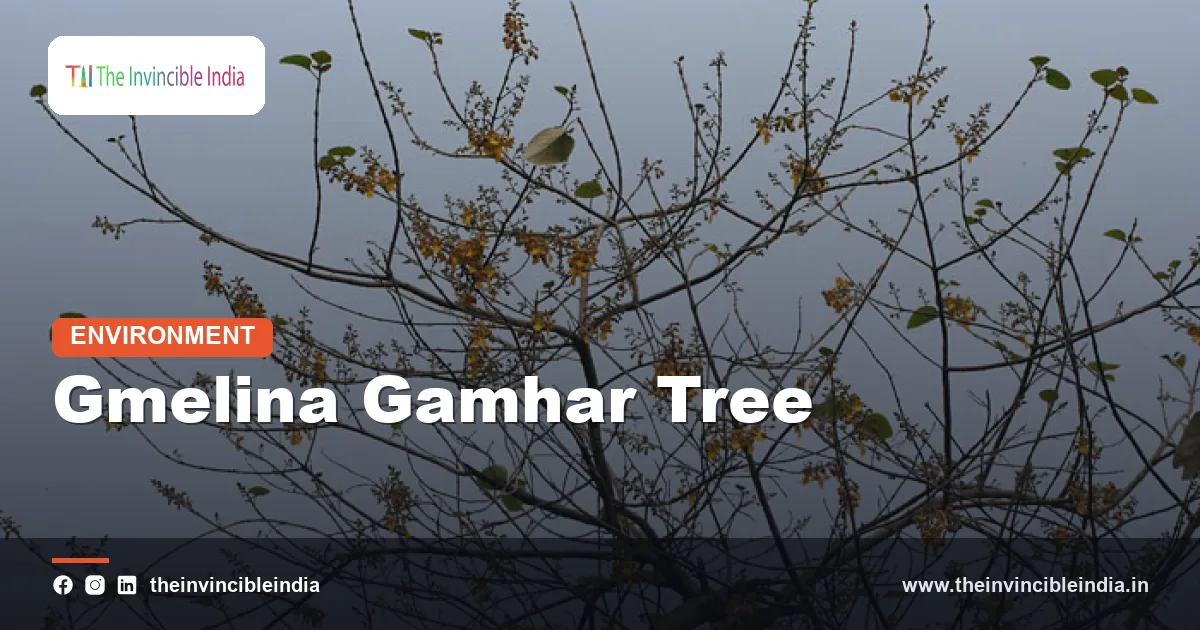
Gamhar is the Hindi name of Gmelina arborea, a fast-growing deciduous tree native to the Indian subcontinent and Southeast Asia, which is planted widely for its pale, light timber used in plywood, furniture, packing cases and matchboxes. The tree is easy to recognise by its heart-shaped leaves, its clusters of yellow-orange flowers and its small fleshy fruits that turn yellow when ripe.
Gamhar is one of the most important farm-forestry and plantation trees in India, because it grows quickly on a range of soils and produces a usable log in a fraction of the time that teak or sal needs. It is also known in other Indian languages by names such as gambhari and kumbil, and in the timber trade simply as gmelina.
| Quick Facts | Details |
|---|---|
| Common names | Gamhar (Hindi), gambhari (Sanskrit), kumbil (Malayalam), gmelina, white teak (trade) |
| Scientific name | Gmelina arborea Roxburgh |
| Family | Lamiaceae (the mint and teak family) |
| Native range | India, Nepal, Bangladesh, Sri Lanka, Myanmar and parts of Southeast Asia and southern China |
| Where grown in India | Natural forests and plantations across peninsular and eastern India, and farm forestry in the plains, especially the Gangetic belt |
| Part used | Timber, roots, leaves, fruit and flowers |
| Products and uses | Plywood, furniture, packing cases, matchwood, pulpwood, fodder, honey plant, Ayurvedic raw material |
| Tree size | Deciduous tree reaching 20 to 30 metres tall under good conditions |
| Notable fact | The timber is light in weight and pale in colour, and the tree is often described as one of the fastest-growing commercial timbers of the region |
Key Takeaways
- Gamhar is the Hindi name for Gmelina arborea, a fast-growing deciduous timber tree of the mint family, Lamiaceae.
- Gmelina arborea is native to India and neighbouring countries, and it has also been planted in Africa, Latin America and Southeast Asia.
- Gmelina timber is pale, light and easily worked, which makes it suitable for plywood, furniture, packing cases and matchwood.
- The gamhar tree can produce harvestable timber in about a decade or so, which is far quicker than slow hardwoods such as teak.
- The root of gamhar, known as gambhari, is a traditional Ayurvedic ingredient listed among the roots of the Dashamoola group.
- Gmelina does best on deep, fertile, well-drained soils and suffers on waterlogged, compacted or very poor ground.
What is the gamhar tree and how do you identify it?
The gamhar tree is a medium to large deciduous tree whose scientific name is Gmelina arborea, and it is identified by its opposite, broadly heart-shaped leaves, which have a pale, hairy underside. The trunk is straight and fairly clean in plantations, and the bark is smooth and greyish, peeling in thin flakes on older trees.
The leaves are typically 10 to 20 centimetres long, dark green above and whitish beneath. In the dry season the tree loses its leaves for a short time, and new foliage appears with the first warmth of spring. Shoots and young twigs are often covered with fine hairs, and the leaf stalk carries small glands near the base of the blade.
The flowers are the most distinctive feature. They are borne in terminal clusters, are yellowish to orange-brown and have a bell-like shape, with an uneven, slightly twisted lip. The fruit is an oval drupe, about the size of a small olive or larger, which is green at first and turns yellow as it ripens. Birds, bats and other animals eat it and help to spread the seeds.
Why is the tree named Gmelina?
The genus name Gmelina honours the German botanist Johann Georg Gmelin, and the species name arborea means tree-like in Latin. The species was described scientifically by the Scottish botanist William Roxburgh, who worked in India in the late eighteenth and early nineteenth centuries.
Gmelina arborea is placed in the family Lamiaceae, which includes mint, basil, sage and, notably, teak. Older botanical books placed gmelina in the verbena family, Verbenaceae, and some Indian forestry texts still use that older classification. The link to teak explains why the timber trade sometimes calls gmelina white teak, even though it is a lighter and much softer wood than true teak.
Where does gamhar grow in India?
Gamhar grows naturally in moist deciduous forests across peninsular and eastern India, and it is planted in many states as a farm and plantation tree. It is native to a wide area of the subcontinent, from the foothills of the Himalaya through the central Indian forests to the Western Ghats and Sri Lanka.
In the plains of northern and eastern India, farmers plant gamhar along field boundaries and in small blocks, especially in Uttar Pradesh, Bihar, West Bengal, Odisha and Assam. Gamhar also appears in plantations in Kerala, Karnataka, Tamil Nadu and Andhra Pradesh. The tree is suited to areas with warm temperatures and adequate rainfall, and it performs best where the soil is deep and well drained.
Outside India, gmelina has been introduced into plantations in West Africa, Latin America and Southeast Asia, where it is used for pulpwood and sawn timber. Its adaptability and early returns have made it a popular choice for reforestation programmes in the tropics.
What is gamhar wood used for?
Gamhar wood is used mainly for plywood, light furniture, packing cases, matchsticks and boxes, because the timber is pale, light in weight and easy to saw, nail and plane. The heartwood is yellowish-white to pale brown, and it does not have a strongly marked difference from the surrounding sapwood.
The wood dries without much warping or cracking, takes paint and polish well and is generally stable once seasoned. Its main drawback is that it is not very durable in contact with soil or in damp outdoor conditions, so it is usually treated if used outside. The main uses are listed below.
- Plywood and veneer: gamhar is a common face and core material for Indian plywood factories.
- Furniture: tables, cots, cabinets, doors and window frames for indoor use.
- Packing cases and crates: the light weight reduces transport costs.
- Matchsticks and splints: soft, even-textured wood is easy to peel and cut.
- Pulp and paper: fast-grown logs and thinnings provide fibre for pulp mills.
- Musical instruments and toys: the wood is easy to carve, so it is also used for small crafts.
How fast does gamhar grow, and when can it be harvested?
Gamhar is among the fastest-growing timber trees of the region, and in good plantations it can reach harvestable size in roughly 8 to 15 years, depending on the soil, the rainfall and the intended product. A farmer who plants gamhar for plywood generally cuts the tree at the younger end of this range, while a planter growing sawlogs lets it stand longer.
This early return is the main reason for the tree’s popularity in farm forestry. A timber species such as teak may take several decades to reach full value, while gamhar fits better into the planning horizon of a small farmer. Growth is strongest in the first few years, when a healthy sapling can add more than a metre of height in a season if weeds are controlled and water is available.
Fast growth has a price, however. Gamhar logs grown quickly are lighter and softer than slow-grown wood, and the trees often need pruning to produce straight, knot-free stems. Plantation managers therefore combine early weeding, fertiliser, pruning and thinning to achieve good-quality logs.
How is gamhar grown in plantations and farm forestry?
Gamhar is grown by raising seedlings or clonal plants in a nursery and planting them at the start of the rainy season in pits on prepared land. The tree needs full sun, regular weeding in its early years and protection from grazing animals, which browse its leaves with enthusiasm.
The most important management points can be summarised as follows.
- Site: deep, fertile, well-drained loam with a neutral to slightly acidic reaction; heavy clay, waterlogged ground and thin, stony soils are poor choices.
- Planting material: seedlings from a good seed source, or clones that have been selected for straight stems and quick growth.
- Spacing: plantations use closer spacing, and farm-forestry rows use wider spacing so that intercrops can be grown between them.
- Care: weeding, watering in the first dry season and pruning of lower branches to produce clear logs.
- Intercropping: pulses, vegetables, turmeric and other short crops can be grown in the early years before the canopy closes.
Because the tree sheds its leaves in the dry season, the leaf litter returns nutrients to the soil, and farmers often value gamhar as a component of agroforestry for that reason.
What are the medicinal and other uses of gamhar?
Gamhar is used in traditional Indian medicine mainly for its root, which is called gambhari in Sanskrit and is one of the ingredients associated with Ayurvedic preparations of the Dashamoola group. The leaves, bark, flowers and fruit are also used in folk practice, but these uses rest largely on tradition, and anyone considering them should consult a qualified practitioner.
The tree has several other uses beyond medicine and timber.
- Fodder: the leaves are lopped and fed to goats and cattle, especially when other fodder is scarce.
- Honey: the flowers produce nectar that attracts bees, and the tree supports apiculture in some regions.
- Fruit: the ripe fruit is sweetish and is eaten by birds, monkeys and other wildlife, and occasionally by people.
- Fuelwood: branches and offcuts are used as firewood, although the calorific value is moderate.
How does gamhar compare with teak and sal?
Gamhar differs from teak and sal chiefly in speed, hardness and durability: it grows much faster, but its wood is lighter, softer and less durable than either of the other two timbers. This explains why gamhar is used for plywood, packing and indoor furniture, while teak and sal are used for heavy construction, outdoor use and high-grade furniture.
| Feature | Gamhar (Gmelina arborea) | Teak (Tectona grandis) | Sal (Shorea robusta) |
|---|---|---|---|
| Family | Lamiaceae | Lamiaceae | Dipterocarpaceae |
| Growth rate | Very fast | Moderate to slow | Slow |
| Wood weight and hardness | Light and soft to moderately hard | Medium weight and hard | Heavy and very hard |
| Colour | Pale yellowish-white to light brown | Golden to dark brown | Brown, darkening with age |
| Durability outdoors | Low without treatment | Very high | High |
| Typical use | Plywood, packing, light furniture, pulp | Premium furniture, shipbuilding, doors | Beams, sleepers, construction |
What problems and limits does gamhar have?
Gamhar has several limits: it is sensitive to waterlogging and frost, its timber is not naturally durable, and fast monoculture plantations can attract pests and diseases. The tree prefers warm conditions and can be damaged by cold snaps, strong winds and prolonged flooding.
Insects such as leaf-eating caterpillars and stem borers can damage plantations, and fungal diseases may affect trees in humid conditions. A planter reduces these risks by selecting a good site, mixing species or blocks of different ages and avoiding very dense, uniform stands over large areas.
There is also a wider ecological question. Plantations of one species do not support the biodiversity of a mixed natural forest. Foresters therefore generally recommend that gamhar be used on farmland, degraded sites and field boundaries where it relieves pressure on natural forests, rather than replacing natural forest cover.
Why does gamhar matter for India’s timber supply?
Gamhar matters because India consumes far more wood than its natural forests can sustainably provide, and fast-growing trees on farmland are a practical way to fill part of the gap. Farm-grown species such as gamhar, poplar, eucalyptus and subabul supply wood-based industries, particularly plywood and paper mills.
Plantation timber from farms also reduces the pressure to cut trees in natural forests, which are protected under forest laws and conservation policy. For a farmer, a gamhar block planted on the edge of a field can act as a savings account that matures in a decade, adding to household income. The tree is thus a small but real part of the story of how India meets its growing demand for wood.
Bottom Line
Gamhar, or Gmelina arborea, is a fast-growing Indian timber tree that gives pale, light wood suited to plywood, furniture and packing. It rewards good soil and care with an early harvest, but it is best used on farmland and plantations, not as a substitute for natural forests.
Frequently Asked Questions
What is gamhar?
Gamhar is the Hindi name for Gmelina arborea, a fast-growing deciduous tree of the mint family that is native to India and neighbouring countries. It is grown mainly for its pale, light timber. The tree has heart-shaped leaves and yellow-orange flowers.
What is gmelina wood used for?
Gmelina wood is used mainly for plywood, light furniture, packing cases, matchsticks and pulp. The timber is pale, light and easy to work with hand and machine tools. It is not very durable outdoors unless it is treated.
How fast does the gamhar tree grow?
The gamhar tree grows very fast and can reach harvestable size in roughly 8 to 15 years in a good plantation. The exact time depends on soil, rainfall and the product being grown. Growth is quickest in the early years if weeds are controlled.
Is gamhar the same as teak?
No, gamhar and teak are different species, although both belong to the family Lamiaceae. Gamhar grows faster, but its wood is lighter, softer and less durable than teak. Gamhar is sometimes called white teak in the timber trade, which can cause confusion.
Where does gamhar grow in India?
Gamhar grows naturally in moist deciduous forests across peninsular and eastern India and is planted in many states, including Uttar Pradesh, Bihar, West Bengal, Odisha, Assam, Kerala and Karnataka. It prefers warm, rainy areas with deep, well-drained soil. Farmers often plant it along field boundaries.
Does gamhar have medicinal uses?
Gamhar has traditional medicinal uses, mainly through its root, which is called gambhari in Ayurveda and is associated with the Dashamoola group of roots. Other parts of the tree are used in folk practice. These uses rest mostly on tradition, so a qualified practitioner should be consulted before use.
{“@context”:”https://schema.org”,”@graph”:[{“@type”:”FAQPage”,”mainEntity”:[{“@type”:”Question”,”name”:”What is gamhar?”,”acceptedAnswer”:{“@type”:”Answer”,”text”:”Gamhar is the Hindi name for Gmelina arborea, a fast-growing deciduous tree of the mint family that is native to India and neighbouring countries. It is grown mainly for its pale, light timber. The tree has heart-shaped leaves and yellow-orange flowers.”}},{“@type”:”Question”,”name”:”What is gmelina wood used for?”,”acceptedAnswer”:{“@type”:”Answer”,”text”:”Gmelina wood is used mainly for plywood, light furniture, packing cases, matchsticks and pulp. The timber is pale, light and easy to work with hand and machine tools. It is not very durable outdoors unless it is treated.”}},{“@type”:”Question”,”name”:”How fast does the gamhar tree grow?”,”acceptedAnswer”:{“@type”:”Answer”,”text”:”The gamhar tree grows very fast and can reach harvestable size in roughly 8 to 15 years in a good plantation. The exact time depends on soil, rainfall and the product being grown. Growth is quickest in the early years if weeds are controlled.”}},{“@type”:”Question”,”name”:”Is gamhar the same as teak?”,”acceptedAnswer”:{“@type”:”Answer”,”text”:”No, gamhar and teak are different species, although both belong to the family Lamiaceae. Gamhar grows faster, but its wood is lighter, softer and less durable than teak. Gamhar is sometimes called white teak in the timber trade, which can cause confusion.”}},{“@type”:”Question”,”name”:”Where does gamhar grow in India?”,”acceptedAnswer”:{“@type”:”Answer”,”text”:”Gamhar grows naturally in moist deciduous forests across peninsular and eastern India and is planted in many states, including Uttar Pradesh, Bihar, West Bengal, Odisha, Assam, Kerala and Karnataka. It prefers warm, rainy areas with deep, well-drained soil. Farmers often plant it along field boundaries.”}},{“@type”:”Question”,”name”:”Does gamhar have medicinal uses?”,”acceptedAnswer”:{“@type”:”Answer”,”text”:”Gamhar has traditional medicinal uses, mainly through its root, which is called gambhari in Ayurveda and is associated with the Dashamoola group of roots. Other parts of the tree are used in folk practice. These uses rest mostly on tradition, so a qualified practitioner should be consulted before use.”}}]}]}


