

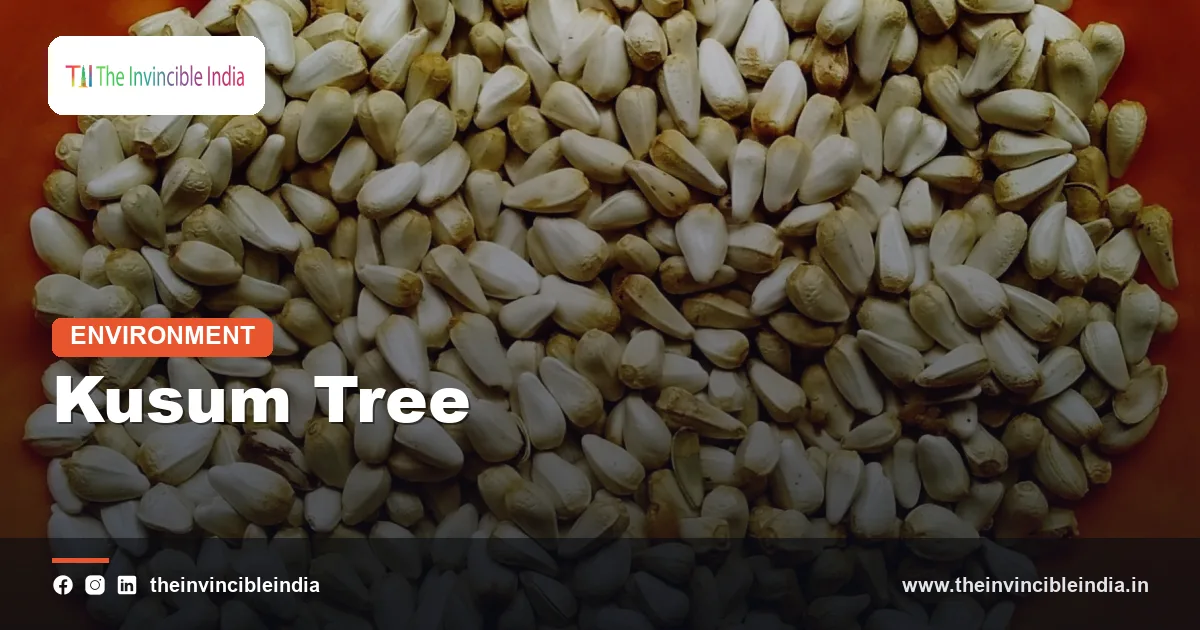
Kusum is the Indian forest tree Schleichera oleosa, a medium-sized deciduous tree of the soapberry family that is famous for the glossy red colour of its young leaves, for being the best host tree for the lac insect that yields kusmi lac, and for its oil-rich seeds. The word kusum also names an unrelated plant, safflower, which is an annual oilseed herb; this article is about the tree.
The kusum tree is native to India and neighbouring parts of South and Southeast Asia, and it grows wild in the deciduous forests of central, eastern and peninsular India. It is important to forest communities in states such as Jharkhand, Chhattisgarh, Odisha and Madhya Pradesh, where it supports lac cultivation, supplies an edible fruit and an oil, and provides one of the hardest firewoods and timbers in the forest.
| Quick Facts | Details |
|---|---|
| Common names | Kusum, kusumb, kosum (Hindi and regional); Ceylon oak (English trade name); kusum tree |
| Scientific name | Schleichera oleosa (the only species in its genus) |
| Family | Sapindaceae (the soapberry and litchi family) |
| Native range | India, Sri Lanka, Nepal, Myanmar, Thailand and neighbouring parts of Southeast Asia |
| Where grown in India | Deciduous forests of Jharkhand, Chhattisgarh, Odisha, Madhya Pradesh, Maharashtra, West Bengal and the peninsula |
| Part used | Seeds (oil), fruit, lac-bearing twigs, wood and bark |
| Products and uses | Kusmi lac, kusum oil, edible fruit, very hard timber, fuelwood and charcoal |
| Tree size | Medium to large deciduous tree, typically 15 to 25 metres tall |
| Notable fact | Kusum is the preferred host of the lac insect that produces kusmi lac, regarded as the finest type of Indian lac |
Key Takeaways
- Kusum is the Indian forest tree Schleichera oleosa, a deciduous member of the soapberry family, Sapindaceae.
- The kusum tree is the best-known host of the lac insect Kerria lacca that produces kusmi lac, a high-quality grade of natural resin.
- Kusum seeds contain a large share of oil, historically known as macassar oil, which is used for lighting, soap, cooking and hair care in rural areas.
- The young leaves of the kusum tree are bright red or pink when they first appear in spring, which makes the tree easy to recognise.
- Kusum wood is extremely hard and heavy and has traditionally been used for oil presses, pestles, ploughs and cart parts.
- The kusum tree is different from kusum the safflower plant and from the solar scheme PM-KUSUM, which only shares the name.
What is the kusum tree?
The kusum tree is a medium to large deciduous forest tree whose scientific name is Schleichera oleosa, and it is the only species in the genus Schleichera. It belongs to Sapindaceae, the family that also includes litchi, rambutan, soapnut (reetha) and longan, which explains the similarity between kusum fruits and small litchis.
The genus is named after the Swiss-German botanist Johann Christoph Schleicher, and the species name oleosa means oily, referring to the oil of the seeds. In English the tree is sometimes called Ceylon oak, a trade name that refers to its hard wood and its occurrence in Sri Lanka, although the tree is not related to the true oaks.
A mature kusum tree usually has a short, thick trunk and a rounded, spreading crown. Its bark is greyish and flakes off in small, rough pieces, and the leaves are compound, with a few pairs of large, glossy leaflets. The tree is long-lived and is often left standing in fields and village commons because of its value to lac growers.
Why are the young leaves of the kusum tree red?
The young leaves of the kusum tree are red because they contain red and pink pigments, called anthocyanins, which are common in the new growth of many tropical trees. The new foliage appears in late winter and spring, and the whole crown can glow coppery red or pink before the leaves mature to a glossy green.
The colour change is a well-known landmark in the Indian forest calendar. In central and eastern India, the sight of a kusum tree in full red flush signals the arrival of spring, along with the bloom of palash, mahua and other deciduous trees. The tree is therefore often noticed even by people who do not know its name.
Scientists suggest that red young leaves may protect the delicate tissues from strong sunlight and from some insects, although the exact benefits vary between species. For the observer, the practical point is that the red flush is a reliable and attractive way to identify the kusum tree.
Where does kusum grow in India?
Kusum grows wild in the dry and moist deciduous forests of central, eastern and southern India, and it is most abundant in the forested plateaus of Jharkhand, Chhattisgarh, Odisha, Madhya Pradesh, Maharashtra and West Bengal. It is also found in the Western Ghats foothills and in parts of the Himalayan lower slopes.
The tree tolerates a range of soils, from sandy loam to clay, provided the drainage is reasonable. It can withstand dry seasons well because of its deep root system, and it grows at low to moderate elevations. Outside India it is found in Sri Lanka, Nepal, Myanmar, Thailand, Indonesia and other parts of Southeast Asia.
In many regions the species is protected informally by communities because of its economic worth. Forest laws and local rules often regulate the felling of trees that are used as lac hosts.
How is kusum linked to kusmi lac?
Kusum is linked to lac because the tree is the preferred host of the lac insect, Kerria lacca, which feeds on the sap of twigs and secretes a resin that is harvested as kusmi lac. Kusmi lac is considered a superior grade because it is lighter in colour and has good quality for use in shellac.
Lac is a natural resin produced by tiny scale insects that settle in dense colonies on the twigs of host trees. In India, the lac insect lives on a few host species, mainly kusum, palash (Butea monosperma) and ber (Ziziphus mauritiana). The product is named after the host and strain: kusmi lac comes from insects raised on kusum, while rangeeni lac is the strain commonly raised on palash and ber.
Lac cultivation is an important rural livelihood in tribal and forest areas, and India is among the leading lac-producing countries in the world. The process is mostly seasonal and uses the standing tree as a farm.
How is kusmi lac cultivated on a kusum tree?
Lac cultivation on kusum begins with inoculation, in which twigs bearing mature female insects, called brood lac, are tied to fresh branches of the host tree. The young insects, called crawlers, move out, settle on the tender twigs and start feeding and secreting resin. After a period of several months, the encrusted twigs are cut and the lac is scraped off.
The kusmi strain is generally raised in two crops each year, commonly known by their Hindi seasonal names, aghani and jethwi. Growers prune the trees before inoculation to produce tender shoots that suit the insects. The raw product, called sticklac, is then processed into seedlac and shellac in factories.
What is lac used for?
Lac is used to make shellac, a natural resin used in varnishes, polishes, sealing wax, electrical insulation, bangles, toys, leather finishes and as a glaze on tablets and some foods. The usefulness of shellac comes from its ability to form a hard, glossy and protective film.
The main applications of lac include the following.
- Wood finishes: shellac polish for furniture, musical instruments and decorative woodwork.
- Traditional crafts: lac bangles and decorated toys, especially in states such as Rajasthan, Jharkhand and Uttar Pradesh.
- Pharmaceutical coating: a glaze on tablets and capsules.
- Food glazing: a surface coating on some fruits and confectionery.
- Industrial uses: sealing wax, adhesives, electrical insulation and varnish.
The lac insect also yields a natural red dye, called lac dye, although synthetic dyes have largely replaced it in modern use.
What is kusum oil and how is it used?
Kusum oil is the oil pressed from the seed kernels of the kusum tree, and it has been used for lighting, soap-making, hair care, cooking in some tribal areas and as a traditional massage oil. In the nineteenth-century European trade it was known as macassar oil and was used as a hair dressing.
The seeds, which are covered with a thin fleshy coat, contain a large share of oil by weight. The traditional method is to collect the seeds in summer, dry them, remove the shell and press the kernels in a wooden or mechanical press. The oil is thick and yellowish.
The residue left after pressing, called seed cake, is commonly used as manure or fuel in rural areas. Kusum oil has also been studied as a possible biodiesel feedstock, although it remains a minor resource compared with edible oils from crops.
Is the kusum fruit edible?
Yes, the kusum fruit is edible, and the thin, sour-sweet pulp around the seed is eaten fresh or used in chutneys by forest communities. The fruit is small, oval and about the size of a small olive or a little larger, and it ripens in the hot months of summer.
The fruit is usually collected from the forest and sold in local markets in parts of Chhattisgarh, Jharkhand and Odisha. Its flavour is tangy, and it has a slightly astringent character. The seeds inside are the part used for oil, and they are not eaten raw.
What is kusum wood used for?
Kusum wood is used for oil presses, pestles, mallets, cart wheels, ploughs and tool handles because it is extremely hard, heavy and tough. The heartwood is reddish brown, and the timber resists wear and splitting, which suits it to parts that endure heavy friction and impact.
The wood is difficult to saw and plane, and it does not season easily without splitting, so it is not a common choice for furniture. It is, however, a first-class fuel, burning with a strong heat, and it is used to make charcoal. The main wood uses are listed here.
- Oil presses and rice-pounding implements: the hardness resists wear.
- Cart wheels, ploughs and farm tools: strong and long-lasting.
- Rollers, mallets and handles: tough enough to withstand impact.
- Fuelwood and charcoal: high heat output.
Because kusum trees are valuable as lac hosts, they are usually not cut for timber while they are productive.
Is kusum the same as safflower or PM-KUSUM?
No, the kusum tree is a different plant from safflower, and it has no connection with the government scheme PM-KUSUM beyond the name. The shared name is a common source of confusion, so it helps to separate the three clearly.
| Name | What it is | Key feature |
|---|---|---|
| Kusum (tree) | Schleichera oleosa, a forest tree of the soapberry family | Red young leaves, lac host, oil-rich seeds |
| Kusum (safflower) | Carthamus tinctorius, an annual oilseed herb of the daisy family | Orange-yellow flowers, edible oil and dye |
| PM-KUSUM | A government scheme for solar energy in agriculture | Solar pumps and farm solar plants; the name is an acronym |
In many Hindi-speaking areas, kusum or kusumbh refers to the safflower plant and its orange flowers, which have been used as a dye and for oil. The tree is called kusum in forest regions and in lac-growing communities, so the context decides which plant is meant.
Why does the kusum tree matter?
The kusum tree matters because it supports lac cultivation, supplies oil and fruit and provides durable wood, all of which contribute to the income and daily life of forest-dwelling communities. A single standing tree can serve as a long-lived, renewable source of cash from lac crops.
The tree also contributes to the ecology of deciduous forests, giving shade, leaf litter and food for birds and animals. Its red spring flush adds to the seasonal colour of the landscape. Protecting kusum trees, and planting new ones in suitable areas, helps to sustain both the lac industry and the forest cover on which many communities depend.
Bottom Line
Kusum, or Schleichera oleosa, is an Indian deciduous tree recognised by its red young leaves and valued as the premier host for kusmi lac, as well as for its seed oil, fruit and hard wood. It should not be confused with kusum the safflower or with the PM-KUSUM solar scheme.
Frequently Asked Questions
What is the kusum tree?
The kusum tree is Schleichera oleosa, a medium to large deciduous forest tree of the soapberry family that is native to India and neighbouring countries. It is known for the red colour of its young leaves and its role as a lac host. Its seeds also yield an oil.
Why is the kusum tree important for lac?
The kusum tree is important for lac because it is the preferred host of the lac insect Kerria lacca that produces kusmi lac. Kusmi lac is regarded as a high-quality type of natural resin. Lac growers inoculate the twigs of kusum with brood lac and harvest the resin after several months.
Is kusum the same as safflower?
No, the kusum tree and safflower are different plants that share a common name in Hindi. The tree is Schleichera oleosa, a forest tree of the soapberry family, while safflower is Carthamus tinctorius, an annual oilseed herb of the daisy family. The context usually shows which plant is meant.
What is kusum oil used for?
Kusum oil is pressed from the seed kernels of the kusum tree and is used for lighting, soap-making, hair care and, in some tribal areas, cooking. It was once exported as macassar oil for use as a hair dressing. The oil is thick and yellowish.
Where does the kusum tree grow in India?
The kusum tree grows in the deciduous forests of central, eastern and peninsular India, notably in Jharkhand, Chhattisgarh, Odisha, Madhya Pradesh, Maharashtra and West Bengal. It tolerates seasonal dryness and a range of soils. It is also found in Sri Lanka, Nepal and Southeast Asia.
Is the kusum fruit edible?
Yes, the kusum fruit is edible, and its thin, tangy pulp is eaten fresh or made into chutney by forest communities. The fruit ripens in the summer months. The seeds are not eaten raw and are used mainly for oil.
{“@context”:”https://schema.org”,”@graph”:[{“@type”:”FAQPage”,”mainEntity”:[{“@type”:”Question”,”name”:”What is the kusum tree?”,”acceptedAnswer”:{“@type”:”Answer”,”text”:”The kusum tree is Schleichera oleosa, a medium to large deciduous forest tree of the soapberry family that is native to India and neighbouring countries. It is known for the red colour of its young leaves and its role as a lac host. Its seeds also yield an oil.”}},{“@type”:”Question”,”name”:”Why is the kusum tree important for lac?”,”acceptedAnswer”:{“@type”:”Answer”,”text”:”The kusum tree is important for lac because it is the preferred host of the lac insect Kerria lacca that produces kusmi lac. Kusmi lac is regarded as a high-quality type of natural resin. Lac growers inoculate the twigs of kusum with brood lac and harvest the resin after several months.”}},{“@type”:”Question”,”name”:”Is kusum the same as safflower?”,”acceptedAnswer”:{“@type”:”Answer”,”text”:”No, the kusum tree and safflower are different plants that share a common name in Hindi. The tree is Schleichera oleosa, a forest tree of the soapberry family, while safflower is Carthamus tinctorius, an annual oilseed herb of the daisy family. The context usually shows which plant is meant.”}},{“@type”:”Question”,”name”:”What is kusum oil used for?”,”acceptedAnswer”:{“@type”:”Answer”,”text”:”Kusum oil is pressed from the seed kernels of the kusum tree and is used for lighting, soap-making, hair care and, in some tribal areas, cooking. It was once exported as macassar oil for use as a hair dressing. The oil is thick and yellowish.”}},{“@type”:”Question”,”name”:”Where does the kusum tree grow in India?”,”acceptedAnswer”:{“@type”:”Answer”,”text”:”The kusum tree grows in the deciduous forests of central, eastern and peninsular India, notably in Jharkhand, Chhattisgarh, Odisha, Madhya Pradesh, Maharashtra and West Bengal. It tolerates seasonal dryness and a range of soils. It is also found in Sri Lanka, Nepal and Southeast Asia.”}},{“@type”:”Question”,”name”:”Is the kusum fruit edible?”,”acceptedAnswer”:{“@type”:”Answer”,”text”:”Yes, the kusum fruit is edible, and its thin, tangy pulp is eaten fresh or made into chutney by forest communities. The fruit ripens in the summer months. The seeds are not eaten raw and are used mainly for oil.”}}]}]}


