

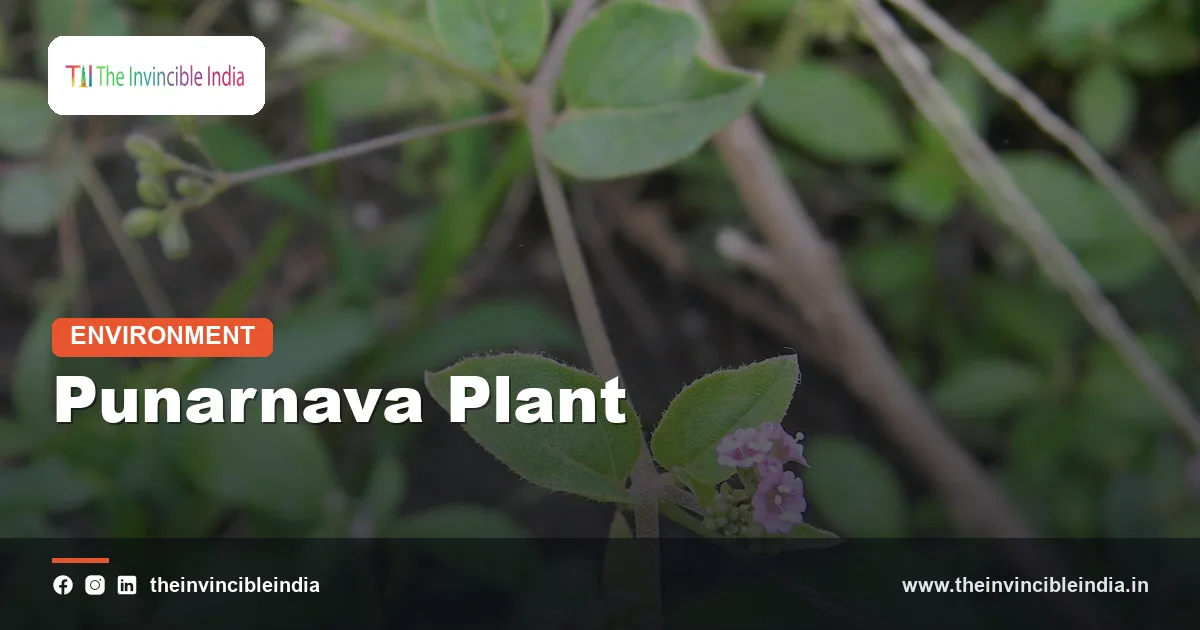
The plant punarnava, scientifically Boerhavia diffusa, is a sprawling perennial monsoon herb of the four-o’clock family that grows as a common weed across India and is one of the best-known rejuvenating plants of Ayurveda. Its Sanskrit name means “that which renews itself”, a reference to the way the dry, withered plant sprouts again from its root with the first rains.
Punarnava is easy to overlook, since it creeps along roadsides, fields and wasteland with small leaves and tiny pink flowers. Yet it is eaten as a leafy vegetable in several regions and is used in traditional medicine as a diuretic and liver tonic. This article explains the botany, names, traditional uses and cautions, and treats all medicinal uses as traditional, not proven. 30 October 2026
| Attribute | Detail |
|---|---|
| Common names | Punarnava, red spiderling, spreading hogweed |
| Scientific name | Boerhavia diffusa |
| Family | Nyctaginaceae (the four-o’clock or bougainvillea family) |
| Where found in India | Throughout the plains, wastelands, roadsides and cultivated fields, from the plains to lower hills |
| Plant type | Spreading perennial herb with a thick taproot |
| Parts used | Whole plant, especially the root and leaves |
| Main uses | Leafy vegetable and traditional Ayurvedic medicine |
| Notable facts | Revives in the monsoon after drying in summer; sticky fruits cling to animals and clothing |
Key Takeaways
- Punarnava (Boerhavia diffusa) is a spreading perennial herb of the Nyctaginaceae family that grows wild throughout India.
- The Sanskrit name punarnava means “renewing again”, because the plant dries in the hot season and regrows from its root after the monsoon arrives.
- Ayurveda traditionally uses punarnava as a diuretic, an anti-swelling herb and a liver and kidney tonic, though these uses are traditional and not proven by strong modern clinical evidence.
- The leaves of punarnava are eaten as a cooked green vegetable in several parts of India, including Kerala, Maharashtra and Bengal.
- The plant is named after the Dutch physician Herman Boerhaave, who is honoured in the genus name Boerhavia.
- Anyone considering medicinal use of punarnava should consult a qualified Ayurvedic practitioner or doctor, particularly during pregnancy or when taking medicines.
What is punarnava?
Punarnava is a low-growing perennial herb, Boerhavia diffusa, found in warm regions around the world and widely used in the Indian system of medicine called Ayurveda. In India it is both a common weed of waste ground and a respected medicinal plant.
The plant belongs to the Nyctaginaceae family, which also includes the ornamental bougainvillea and the four-o’clock flower. The genus name Boerhavia honours Herman Boerhaave, an eighteenth-century Dutch physician and botanist. The species name diffusa means “spreading”, describing the way the branches sprawl across the ground.
Because it is so widespread, punarnava has acquired many local names and is sometimes confused with related species. The most commonly used form in Ayurveda is Boerhavia diffusa, though other species of Boerhavia are sometimes sold under the same name in the herbal trade.
Why is the plant called punarnava?
The plant is called punarnava because the Sanskrit words puna, meaning “again”, and nava, meaning “new”, together describe a plant that renews itself. Its above-ground parts wither in the dry season, but the thick root survives and sends up fresh shoots when the rains return.
Ayurvedic writers also connect the name to the idea of bodily renewal, since the plant is traditionally believed to help revive the body. This is a symbolic and traditional interpretation and is not a scientific claim. In Ayurvedic literature, punarnava is also called shothaghni, meaning “that which removes swelling”, and is classed among herbs used for oedema.
Two forms are mentioned in classical writings, usually called white (shveta) and red (rakta) punarnava, which differ in flower colour and in the colour of the stem. Botanists do not always agree on the exact species behind each name, and the red-flowered form is the one commonly seen in the field.
What does punarnava look like?
Punarnava looks like a prostrate or ascending herb with slender, often reddish stems, small oval leaves and clusters of tiny pink flowers. The stems can spread up to a metre or more from the central taproot.
Stems and leaves
The stems are thin, branched and sometimes purplish, with slightly swollen joints. The leaves are arranged in opposite pairs, and the two leaves of a pair are often unequal in size. They are oval to rounded, usually 2 to 5 centimetres long, green on the upper side and paler or whitish beneath. The margins are often slightly wavy or tinged with red.
Flowers and fruits
The flowers are tiny, usually pink to reddish and grouped in loose clusters at the ends of long, thin stalks. They open in the morning and are easy to miss because of their size. After flowering, the plant forms small, club-shaped, ribbed fruits that are sticky with glands. These sticky fruits cling to animal fur, human clothing and footwear, which is how the plant spreads.
Roots
The root is long, thick, fleshy and yellowish-brown, and it stores the energy that allows the plant to regrow each year. The root is the part most prized in Ayurvedic preparations.
Where does punarnava grow in India?
Punarnava grows throughout India, from the Gangetic plains to the Deccan plateau, the coastal belts and the lower slopes of the hills. It prefers open sunny places, especially disturbed ground such as field edges, roadsides, railway tracks, gardens and abandoned plots.
The plant is most visible during and just after the monsoon, when it forms green mats across waste land. It tolerates a wide range of soils, from sandy to loamy, and survives drought through its taproot. Outside India, Boerhavia diffusa is found throughout the tropics and subtropics of Asia, Africa and the Americas, where it is regarded as a weed in some regions and a food or medicinal plant in others.
What are the names of punarnava in Indian languages?
Punarnava is known by its Sanskrit name in many Indian languages, with local variants in the regions where the plant is eaten or used. The Hindi name is punarnava, and the Sanskrit names also include shothaghni and varshabhu, the latter meaning “born in the rains”.
| Language | Name |
|---|---|
| Sanskrit | Punarnava, Shothaghni, Varshabhu |
| Hindi | Punarnava, Gadahpurna |
| Bengali | Punarnava |
| Marathi | Ghetuli, Vasuchi bhaji |
| Tamil | Mookirattai |
| Malayalam | Thazhuthama |
| Telugu | Atikamamidi |
These names are helpful when buying the plant or reading classical texts, but it is worth remembering that herbal dealers sometimes use the same name for more than one species. Verifying the botanical name on a product label is therefore a good habit.
How is punarnava used in Ayurveda?
Punarnava is used in Ayurveda mainly as a diuretic, an anti-swelling herb and a tonic for the liver and kidneys. It is described in classical Ayurvedic texts and appears in many traditional formulations, but these uses are traditional and have not been confirmed by large modern clinical trials.
Traditional preparations include a decoction of the root, a fresh juice, a powder and fermented medicines. Well-known classical formulations that carry the name include Punarnavadi kashayam, Punarnavasava and Punarnavadi mandura, which are prepared and sold by Ayurvedic manufacturers. These are traditionally used for conditions such as swelling, anaemia and digestive complaints, always under the guidance of a practitioner.
Traditional uses at a glance
- As a diuretic to promote urine flow and to relieve swelling.
- As a liver and kidney tonic in traditional practice.
- As a support for digestion and appetite in classical formulations.
- As an anti-inflammatory plant for joint swelling in folk medicine.
- As a general rejuvenating herb, in the Ayurvedic sense of rasayana.
It is important to read these as the claims of a tradition. Medicinal use of punarnava should only be undertaken after consulting a qualified Ayurvedic physician or a doctor, because dosage, preparation and suitability depend on the individual.
What does modern research say about punarnava?
Modern research on punarnava consists mostly of laboratory and animal studies that suggest some biological activity, but large well-designed human trials are scarce. Scientists have therefore not established the effectiveness or safety of the plant for any medical condition.
Chemical analysis shows that the plant contains compounds such as punarnavine, an alkaloid, and a group of plant chemicals called boeravinones, along with flavonoids and other substances. Researchers have examined these compounds for effects on inflammation, urine flow and liver protection in cells and animals. Findings from such studies do not necessarily carry over to humans, and they are not a basis for self-treatment.
Because the research is incomplete, health authorities generally advise that herbal products be used with caution, bought from reliable manufacturers and discussed with a healthcare professional, especially for people with kidney disease, heart conditions or those who are pregnant or breastfeeding.
Is punarnava eaten as a vegetable?
Yes, punarnava leaves are eaten as a cooked leafy vegetable in several parts of India and are valued as a seasonal monsoon green. The tender shoots and leaves are collected before the plant flowers heavily.
In Kerala, the plant known as thazhuthama is cooked with coconut, green chilli and spices as a thoran, a dry stir-fried dish. In Maharashtra the leaves are sold as vasuchi bhaji or ghetuli and cooked with lentils or onions. In parts of eastern India, the leaves are fried or added to simple curries. The taste is mild and slightly bitter-earthy, and the leaves reduce greatly when cooked.
As with any wild-gathered green, it is wise to identify the plant correctly, wash it thoroughly and gather it from clean places away from roadside pollution, pesticides or sewage.
How does punarnava compare with similar herbs?
Punarnava is often grouped with other traditional herbs used for swelling and urinary complaints, and the table below sets out how it compares with two other common Indian plants in the same broad category of traditional use.
| Feature | Punarnava | Gokhru | Varuna |
|---|---|---|---|
| Scientific name | Boerhavia diffusa | Tribulus terrestris | Crateva nurvala |
| Plant form | Spreading herb | Low spiny creeper | Small tree |
| Part commonly used | Root and whole plant | Fruit and root | Bark |
| Traditional focus | Swelling, liver, kidney | Urinary system, vigour | Urinary stones and flow |
| Also eaten as food | Yes, leaves | Rarely | Rarely |
How can you grow and identify punarnava?
You can identify punarnava by its opposite, unequal oval leaves, thin reddish stems, tiny pink flower clusters and sticky club-shaped fruits. It is easiest to spot in the rainy season, when the plant is at its greenest.
Growing it is simple, since the plant propagates by seed and root cuttings and needs very little care. A sunny spot with light, well-drained soil is enough, and the plant will spread by itself once established. In a garden it may become weedy, so removing flower heads before the sticky fruits form helps control spread.
- Sow seeds or plant root pieces at the start of the monsoon.
- Keep the soil lightly moist during early growth.
- Avoid overwatering in the dry season, when the plant naturally rests.
- Harvest tender shoots for food, and leave some plants to flower for the next season.
Bottom Line
Punarnava is a humble creeping weed that has earned a place in Indian kitchens and in the Ayurvedic tradition because of its ability to renew itself every monsoon. Its medicinal reputation rests on tradition, not on proven clinical evidence, so any health use should be discussed with a qualified practitioner.
Frequently Asked Questions
What is punarnava?
Punarnava is a spreading perennial herb, Boerhavia diffusa, that grows wild across India. It is used as a leafy vegetable in some regions and as a traditional Ayurvedic herb. The name means “that which renews itself”.
Why is it called punarnava?
It is called punarnava because the plant dries in summer and regrows from its root after the monsoon. The Sanskrit words puna and nava mean “again” and “new”. Ayurvedic writers also link the name to traditional ideas of renewal in the body.
What is punarnava used for in Ayurveda?
In Ayurveda, punarnava is traditionally used as a diuretic, an anti-swelling herb and a liver and kidney tonic. These uses come from classical texts and folk practice and are not proven by strong clinical trials. Consult a qualified practitioner before using it as medicine.
Is punarnava safe to eat?
The tender leaves of punarnava are eaten as a cooked vegetable in several Indian regions. The plant should be correctly identified, gathered from a clean place and washed well. People who are pregnant, have kidney or heart conditions or take medicines should ask a doctor before eating it often or taking supplements.
Where does punarnava grow?
Punarnava grows throughout India on roadsides, field edges, wasteland and gardens, and it is most visible during the monsoon. It tolerates many soil types and survives drought through a deep taproot. The plant also occurs across the tropics worldwide.
What does punarnava look like?
Punarnava is a low, spreading herb with thin reddish stems and small oval leaves in unequal pairs. It carries tiny pink flowers in loose clusters on long, slender stalks. The small club-shaped fruits are sticky and cling to clothes and fur.
{“@context”:”https://schema.org”,”@graph”:[{“@type”:”FAQPage”,”mainEntity”:[{“@type”:”Question”,”name”:”What is punarnava?”,”acceptedAnswer”:{“@type”:”Answer”,”text”:”Punarnava is a spreading perennial herb, Boerhavia diffusa, that grows wild across India. It is used as a leafy vegetable in some regions and as a traditional Ayurvedic herb. The name means “that which renews itself”.”}},{“@type”:”Question”,”name”:”Why is it called punarnava?”,”acceptedAnswer”:{“@type”:”Answer”,”text”:”It is called punarnava because the plant dries in summer and regrows from its root after the monsoon. The Sanskrit words puna and nava mean “again” and “new”. Ayurvedic writers also link the name to traditional ideas of renewal in the body.”}},{“@type”:”Question”,”name”:”What is punarnava used for in Ayurveda?”,”acceptedAnswer”:{“@type”:”Answer”,”text”:”In Ayurveda, punarnava is traditionally used as a diuretic, an anti-swelling herb and a liver and kidney tonic. These uses come from classical texts and folk practice and are not proven by strong clinical trials. Consult a qualified practitioner before using it as medicine.”}},{“@type”:”Question”,”name”:”Is punarnava safe to eat?”,”acceptedAnswer”:{“@type”:”Answer”,”text”:”The tender leaves of punarnava are eaten as a cooked vegetable in several Indian regions. The plant should be correctly identified, gathered from a clean place and washed well. People who are pregnant, have kidney or heart conditions or take medicines should ask a doctor before eating it often or taking supplements.”}},{“@type”:”Question”,”name”:”Where does punarnava grow?”,”acceptedAnswer”:{“@type”:”Answer”,”text”:”Punarnava grows throughout India on roadsides, field edges, wasteland and gardens, and it is most visible during the monsoon. It tolerates many soil types and survives drought through a deep taproot. The plant also occurs across the tropics worldwide.”}},{“@type”:”Question”,”name”:”What does punarnava look like?”,”acceptedAnswer”:{“@type”:”Answer”,”text”:”Punarnava is a low, spreading herb with thin reddish stems and small oval leaves in unequal pairs. It carries tiny pink flowers in loose clusters on long, slender stalks. The small club-shaped fruits are sticky and cling to clothes and fur.”}}]}]}


