

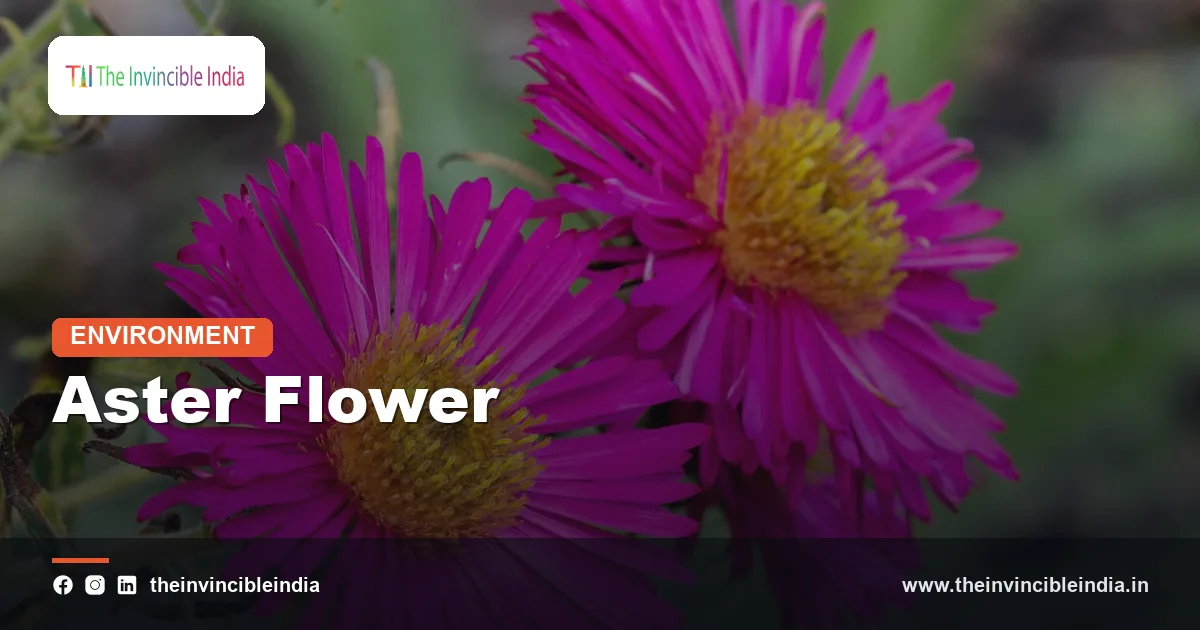
The aster is a daisy-like flowering plant of the sunflower family (Asteraceae) whose name means star in Greek, and in Indian gardens the word usually refers to the China aster (Callistephus chinensis), a hardy cool-season annual grown for cut flowers, garlands and beds. A flower head of the aster is not one flower but a tight cluster of many small florets, with a yellow centre ringed by colourful petal-like rays in purple, pink, red, blue or white.
This guide explains what an aster is, how the China aster differs from the true asters and the Michaelmas daisy, where and when asters are grown in India, how they are cultivated, and what problems affect them. It sticks to stable botanical and horticultural facts. Last updated: 30 October 2026.
| Attribute | Details |
|---|---|
| Common names | Aster, China aster, garden aster, Michaelmas daisy (for related perennial asters), star flower |
| Scientific name | Callistephus chinensis (China aster); Aster and related genera (true and perennial asters) |
| Family | Asteraceae (the daisy or sunflower family) |
| Origin | China aster: China and Korea; true asters: mainly Eurasia and North America |
| Where grown in India | Plains and hills of Karnataka, Maharashtra, West Bengal, Tamil Nadu, Uttar Pradesh, Himachal Pradesh and many other states |
| Flowering season | Winter and early spring in the plains (roughly December to March); summer and monsoon in the hills |
| Main uses | Cut flowers, loose flowers for garlands and decoration, bedding and pot plants |
| Notable facts | The genus Callistephus has only one species; the name aster comes from the Greek word for star |
Key Takeaways
- The aster is a member of the family Asteraceae, and its flower head is a composite of many tiny florets rather than a single bloom.
- The aster most commonly grown in Indian gardens is the China aster (Callistephus chinensis), which is native to China and Korea.
- The word aster comes from the Greek word for star, describing the star-shaped outline of the flower head.
- In the plains of India the China aster is a winter annual, sown in late monsoon or early autumn and flowering from about December to March.
- The China aster is highly susceptible to the soil-borne fungal disease Fusarium wilt, so crop rotation and disease-free seed are important.
- Michaelmas daisies are perennial asters, named after the feast of St Michael on 29 September, when they flower in cooler countries.
What Is an Aster?
An aster is a flowering plant in the daisy family whose composite flower heads have a central disc of tiny tubular florets surrounded by a ring of ray florets that look like petals. The plant gets its name from the Greek word aster, meaning star, and the radiating petals of many species do resemble a star.
The family Asteraceae is one of the largest families of flowering plants, and it includes sunflower, marigold, chrysanthemum, zinnia, dahlia and daisy. In all of them what looks like one flower is actually a head made of many small flowers. This arrangement is efficient for pollination, because an insect landing on a single head can visit dozens of florets in a few seconds.
The common name aster is used loosely. It can mean the China aster of garden beds, the true asters of the genus Aster, and the perennial North American asters now placed in genera such as Symphyotrichum. Understanding which plant is being discussed prevents a good deal of confusion.
What Is the Difference Between the China Aster and the Michaelmas Daisy?
The China aster is an annual that is replanted from seed every year, while the Michaelmas daisy is a perennial aster that returns each year from the same root and flowers in autumn. The two plants are in the same family but belong to different genera, and they suit different gardens.
| Feature | China aster | Michaelmas daisy |
|---|---|---|
| Botanical name | Callistephus chinensis | Aster and Symphyotrichum species and hybrids |
| Life cycle | Annual | Perennial |
| Native region | China and Korea | Eurasia and North America |
| Typical flower | Large, often double, many colours | Smaller, single, daisy-like, usually purple, blue or pink |
| Main use in India | Cut flowers, garlands and winter beds | Mostly hill-station and cool-climate gardens |
| Propagation | Seed | Division of clumps or cuttings |
The name Michaelmas comes from the feast day of St Michael the Archangel on 29 September. In northern Europe the perennial asters bloom around that date, which is how they got the name. In India the Michaelmas daisy is a specialist plant of cooler hill gardens, while the China aster is the everyday garden and market flower.
Where Did the Aster Come From?
The China aster originated in China and Korea, and it was introduced to Europe in the eighteenth century, when seeds were sent to France by missionaries. From Europe the plant was bred into the large, double-flowered forms that now dominate gardens, and it spread to India through botanical and horticultural exchange.
The genus Callistephus is monotypic, which means it contains only one species. The name combines Greek words for most beautiful and crown, a reference to the flower head. The species name chinensis simply records the plant’s origin in China.
True asters of the genus Aster are native mainly to Eurasia. Some wild asters grow in the Himalaya, in alpine meadows and open slopes, where they flower in summer and monsoon. Many North American asters were reclassified into new genera in the twentieth and twenty-first centuries, which is why books of different dates may use different names for the same plant.
What Does an Aster Look Like?
The China aster is a branching plant that grows about 30 to 90 cm tall, depending on the variety, with toothed, oval leaves and flower heads that range from about 5 to 12 cm across. The stems are upright and somewhat hairy, and each stem usually carries one flower head or a few of them.
- Flower forms: single, semi-double, double, pompon, quilled, incurved and anemone-centred types are all grown.
- Colours: white, pink, rose, red, lavender, purple, blue and violet, with yellow centres in single forms.
- Height classes: dwarf varieties for pots and beds, and tall varieties for cut flowers.
- Leaves: alternate, coarsely toothed and slightly rough.
- Fruit: a small, dry seed with a tuft of hairs, typical of the daisy family.
Breeders have developed many forms over the last two centuries. Tall, long-stemmed varieties are grown for the cut-flower trade, while compact varieties are grown as bedding plants and in pots.
Where Is the Aster Grown in India?
The aster is grown commercially in several Indian states, including Karnataka, Maharashtra, West Bengal, Tamil Nadu and Uttar Pradesh, and as a garden flower throughout the country. It is grown as a loose flower for garlands and decoration, as a cut flower for bouquets, and as a bedding plant in parks and house gardens.
In the plains the crop is mainly a winter flower, but growers also raise it at different times of the year in cooler uplands, where the plant can bloom in summer and the monsoon. The plant tolerates a wide range of conditions, though it prefers mild temperatures, bright light and fertile, well-drained soil.
The aster is one of several commercial flowers in India, alongside marigold, rose, jasmine, tuberose, chrysanthemum and gladiolus. It is valued because it produces a lot of colour from a small area in about four months, and because the flowers fit well into mixed garlands and decorations.
When Should Asters Be Sown in India?
In the plains of India, China aster seeds are usually sown between about July and October, so that the plants flower in winter, and in the hills seeds are sown in early spring for summer flowers. The exact date depends on local climate, and growers often stagger sowings to extend the flowering period.
Sowing and transplanting
Aster seeds are normally sown in a nursery bed or in trays, and the seedlings are moved to the field when they are about four to six weeks old and have several true leaves. Seed is small and fine, so it is sown shallowly and kept evenly moist. Seedlings are planted with generous spacing so that air can circulate and disease is reduced.
Season guide
- Plains: sow in monsoon or early autumn; flowers appear in winter and early spring.
- Hills: sow in late winter or spring; flowers appear in summer and the rains.
- Pots and balconies: sow in autumn for winter colour in most of the country.
How Are Asters Grown and Cared For?
Asters grow best in full sun with fertile, well-drained, slightly acidic to neutral soil, regular but moderate watering and a balanced fertiliser. The plant needs at least five to six hours of direct sunlight a day to flower well, and it does poorly in waterlogged ground.
- Soil preparation: mix in well-rotted compost or farmyard manure before planting.
- Spacing: about 25 to 30 cm between plants for standard varieties.
- Watering: keep the soil evenly moist but not soggy; avoid wetting the leaves late in the day.
- Pinching: removing the growing tip of young plants encourages branching and more flowers.
- Staking: tall varieties need support to keep stems upright.
- Harvest: cut flowers early in the day when the heads are fully coloured but not yet fully open.
The crop is generally ready to flower about three to four months after sowing. Regular removal of faded blooms keeps new flowers coming. Cut aster stems last about a week in a vase if kept in clean water.
What Pests and Diseases Affect the Aster?
The most serious problem of the China aster is Fusarium wilt, a soil-borne fungal disease that makes plants yellow, wilt and die, and the plant is also affected by aster yellows, leaf spots, aphids and leaf-eating insects. Fusarium wilt is caused by a form of the fungus Fusarium oxysporum that persists in the soil for years.
Common problems
- Fusarium wilt: sudden wilting and yellowing; prevented by crop rotation, resistant varieties and clean seed.
- Aster yellows: a phytoplasma disease spread by leafhoppers that causes yellowing and distorted flowers.
- Aphids: small sap-sucking insects that weaken young shoots and may spread viruses.
- Leaf spots and blight: fungal diseases favoured by wet foliage and crowded plants.
- Powdery mildew: a white coating on leaves in cool, humid weather.
Good practice includes avoiding planting asters in the same bed year after year, choosing wilt-tolerant varieties, using clean seed and keeping the garden free of weeds that harbour insects.
What Are Asters Used For?
Asters are used mainly as ornamental plants, supplying cut flowers for bouquets, loose flowers for garlands and decoration, and colour for beds, borders and pots. In India the loose flowers are often strung into garlands and used in weddings, religious offerings and festive decoration, often alongside marigold.
Asters also attract bees and butterflies, which helps pollination in nearby gardens. Many wild and perennial asters are valuable late-season nectar plants. The plants are not generally grown for food, and the China aster is not an important medicinal plant.
In Western flower traditions the aster is the birth flower for September and is associated with patience and affection. This symbolism is a cultural convention and varies between countries.
Bottom Line
The aster is a bright, adaptable daisy-family flower that makes the Indian winter garden colourful. For most Indian gardeners the plant is the China aster, an annual that rewards fertile soil, full sun, clean seed and careful rotation, while the perennial Michaelmas daisy suits cooler hill gardens.
Frequently Asked Questions
What does the word aster mean?
The word aster means star in Greek. It describes the star-like outline of the flower head, with its radiating petal-like rays around a central disc.
Is the aster the same as the Michaelmas daisy?
No, the aster and the Michaelmas daisy are related but not identical. The Michaelmas daisy is a perennial aster that blooms in autumn, while the common garden aster in India is the annual China aster, Callistephus chinensis.
When do asters bloom in India?
Asters bloom mostly in winter and early spring in the plains of India, from about December to March. In the hills, asters sown in spring flower in summer and during the rains.
Is the aster an annual or a perennial?
The China aster is an annual, so it completes its life cycle in one season and must be grown from seed each year. True and Michaelmas asters are perennials that return each year from the same rootstock.
Why do aster plants wilt and die suddenly?
Aster plants most often wilt and die suddenly because of Fusarium wilt, a fungal disease that lives in the soil. Rotating the crop, using wilt-tolerant varieties and sowing clean seed in fresh soil reduce the risk.
Can asters be grown in pots?
Yes, asters can be grown in pots, especially dwarf varieties, if the pots have drainage holes and receive several hours of direct sun. A rich, light potting mix and regular watering will keep the plants flowering for several weeks.
{“@context”:”https://schema.org”,”@graph”:[{“@type”:”FAQPage”,”mainEntity”:[{“@type”:”Question”,”name”:”What does the word aster mean?”,”acceptedAnswer”:{“@type”:”Answer”,”text”:”The word aster means star in Greek. It describes the star-like outline of the flower head, with its radiating petal-like rays around a central disc.”}},{“@type”:”Question”,”name”:”Is the aster the same as the Michaelmas daisy?”,”acceptedAnswer”:{“@type”:”Answer”,”text”:”No, the aster and the Michaelmas daisy are related but not identical. The Michaelmas daisy is a perennial aster that blooms in autumn, while the common garden aster in India is the annual China aster, Callistephus chinensis.”}},{“@type”:”Question”,”name”:”When do asters bloom in India?”,”acceptedAnswer”:{“@type”:”Answer”,”text”:”Asters bloom mostly in winter and early spring in the plains of India, from about December to March. In the hills, asters sown in spring flower in summer and during the rains.”}},{“@type”:”Question”,”name”:”Is the aster an annual or a perennial?”,”acceptedAnswer”:{“@type”:”Answer”,”text”:”The China aster is an annual, so it completes its life cycle in one season and must be grown from seed each year. True and Michaelmas asters are perennials that return each year from the same rootstock.”}},{“@type”:”Question”,”name”:”Why do aster plants wilt and die suddenly?”,”acceptedAnswer”:{“@type”:”Answer”,”text”:”Aster plants most often wilt and die suddenly because of Fusarium wilt, a fungal disease that lives in the soil. Rotating the crop, using wilt-tolerant varieties and sowing clean seed in fresh soil reduce the risk.”}},{“@type”:”Question”,”name”:”Can asters be grown in pots?”,”acceptedAnswer”:{“@type”:”Answer”,”text”:”Yes, asters can be grown in pots, especially dwarf varieties, if the pots have drainage holes and receive several hours of direct sun. A rich, light potting mix and regular watering will keep the plants flowering for several weeks.”}}]}]}


