

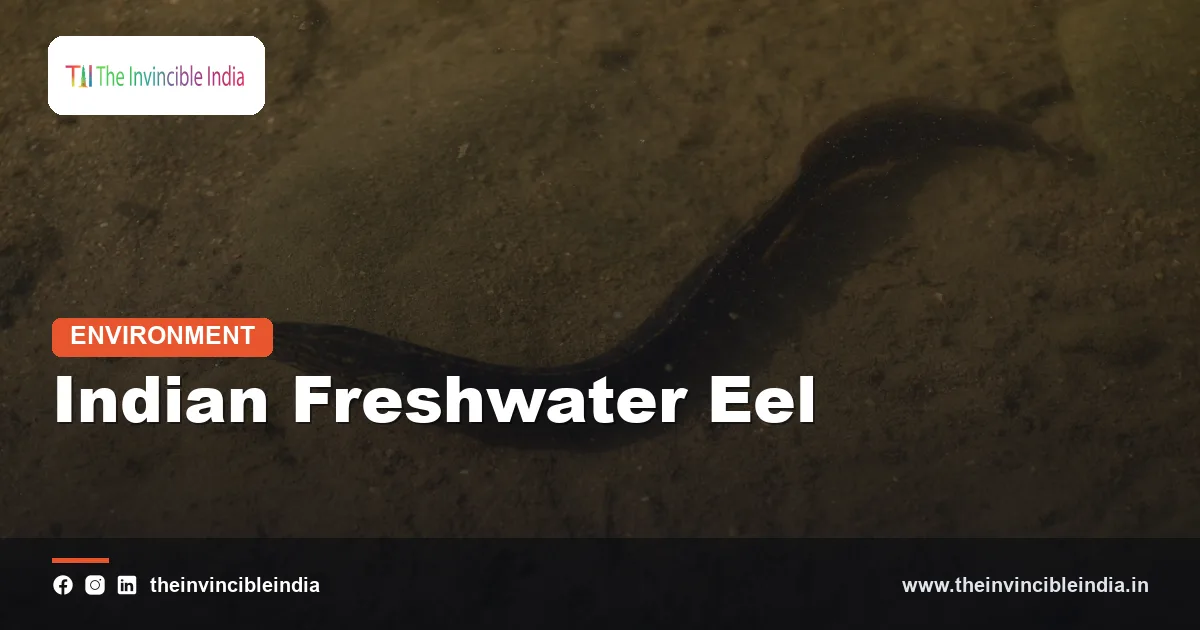
The Indian freshwater eel is a snake-like, bony fish of the genus Anguilla that spends most of its life in Indian rivers, lakes, estuaries and ponds but migrates to the sea to breed, a life pattern that scientists call catadromy. Three species of true freshwater eel are reported from Indian waters, led by the Indian mottled eel, Anguilla bengalensis, and all of them are long-lived, nocturnal predators that begin life as transparent larvae drifting in the ocean.
The freshwater eel is one of the most misunderstood fish in the country. Many people use the word “eel” for any long, slippery, snake-shaped fish, yet the true freshwater eel belongs to a very different group from the swamp eels and spiny eels of Indian paddy fields and marshes. This article explains what the Indian freshwater eel is, how it lives and migrates, where it is found, and why it matters to river ecosystems.
| Attribute | Detail |
|---|---|
| Common names | Indian mottled eel, Bengal eel, freshwater eel; “baam” in several Hindi and Bengali-speaking regions |
| Scientific name | Anguilla bengalensis (Indian mottled eel); other Indian species include Anguilla bicolor and Anguilla nebulosa |
| Family and order | Anguillidae, order Anguilliformes (true eels) |
| Life pattern | Catadromous: grows in fresh water, breeds in the sea |
| Body form | Elongated, scaleless-looking skin, continuous dorsal-caudal-anal fin, no pelvic fins |
| Typical adult length | From about 50 cm to well over a metre in large females |
| Activity | Mostly nocturnal; hides in burrows, crevices and under stones by day |
| Habitat in India | Rivers, streams, reservoirs, lagoons and estuaries, especially along the peninsular and eastern rivers |
| Conservation concern | Several Anguilla species are assessed as Near Threatened on the IUCN Red List; barriers and overfishing are key pressures |
Key Takeaways
- The Indian freshwater eel is a true eel of the genus Anguilla, and it is catadromous, meaning it grows up in fresh water but travels to the sea to spawn.
- Swamp eels such as the Gangetic mud eel (Monopterus cuchia) and spiny eels such as Mastacembelus are not true eels, even though people in India often call them eels.
- A freshwater eel begins life as a transparent, leaf-shaped larva called a leptocephalus, which drifts in the ocean before changing into a glass eel and entering estuaries.
- The Indian mottled eel, Anguilla bengalensis, is a nocturnal predator that feeds on fish, crabs, prawns, frogs and insects, and it can live for many years in the same river stretch.
- Dams, weirs, sand mining, water pollution and the collection of juvenile eels all reduce the numbers of freshwater eels that can complete their migration.
- Because the freshwater eel links rivers to the sea, its presence is a sign that a river still has an open, connected route to the coast.
What is a freshwater eel?
A freshwater eel is a fish of the family Anguillidae that lives in rivers and lakes as a juvenile and adult but is born in the sea. Its body is long and cylindrical, its skin is slimy and appears scaleless because the scales are tiny and buried, and a single fin runs around the tail from the back to the belly. Freshwater eels have no pelvic fins, and their small pectoral fins sit just behind the head.
The genus Anguilla contains about 16 species worldwide, found in the Atlantic, Indian and Pacific oceans and their rivers. Only a few occur in the Indian Ocean region. The freshwater eel of the Indian subcontinent belongs to the tropical group, which differs in important ways from the better-known European and American eels of the Atlantic.
Eels are bony fish, not snakes, and they breathe through gills. They can, however, survive out of water for a considerable time if their skin stays moist, because they can absorb some oxygen through the skin. This ability lets a freshwater eel wriggle across wet ground to bypass a small barrier or move between ponds after rain.
Which freshwater eel species live in India?
Three Anguilla species are generally reported from Indian waters: the Indian mottled eel (Anguilla bengalensis), the Indian shortfin or two-coloured eel (Anguilla bicolor) and the mottled longfin eel (Anguilla nebulosa). Records of each vary by river and coast, and fish surveys of Indian rivers are uneven, so the exact distribution of each species is still being refined.
| Species | Common name | Key identifying feature | Where reported |
|---|---|---|---|
| Anguilla bengalensis | Indian mottled eel, Bengal eel | Marbled brown and olive skin; dorsal fin begins well ahead of the anal fin | Rivers and estuaries of peninsular and eastern India, and neighbouring countries |
| Anguilla bicolor | Shortfin eel, two-coloured eel | Plain dark back and pale belly; dorsal fin begins close to the anal fin | Coastal rivers and lagoons, particularly the west and south coasts |
| Anguilla nebulosa | Mottled longfin eel | Mottled pattern with a long dorsal fin | Reported from a few rivers and streams of the Indian region |
The simplest field test separates longfin from shortfin eels. In a longfin eel, the dorsal fin starts clearly in front of the anal fin, while in a shortfin eel the two fins start at nearly the same point along the body. Biologists use the distance between the two fin origins as a standard measurement when they identify a freshwater eel.
How does the freshwater eel migrate and breed?
The freshwater eel migrates by leaving its river as a mature “silver eel” and swimming to deep ocean waters to spawn, after which the adults are believed to die, and the larvae drift back toward the coast. This one-way breeding journey is called a catadromous migration, and it is the opposite of the pattern followed by salmon, which are born in rivers and grow in the sea.
The life cycle of a tropical Anguilla eel has several distinct stages.
- Egg and leptocephalus larva: Eggs hatch at sea into a flat, transparent, leaf-shaped larva called a leptocephalus, which feeds on tiny particles of marine snow and drifts on ocean currents.
- Glass eel: Near the coast, the larva transforms into a transparent, cylindrical glass eel that swims into estuaries and river mouths, often on the incoming tide.
- Elver: As pigment appears, the young fish becomes an elver and starts to move upstream, climbing wet rocks and weirs.
- Yellow eel: The growth stage may last many years, during which the fish lives in a stable home range in a river, pond or lake and feeds heavily.
- Silver eel: When sexually maturing, the eel’s belly turns silvery, its eyes enlarge, and it stops feeding before the downstream spawning migration.
The exact spawning areas of the Indian Ocean freshwater eels are poorly documented. The famous mystery of the Sargasso Sea belongs to the Atlantic eels, and the breeding grounds of the Indian species are believed to lie in deep tropical Indian Ocean waters rather than being precisely mapped. Because eels have never been observed spawning in the wild, much of the cycle is inferred from the capture of larvae and from tagging studies on related species.
What does a freshwater eel look like?
An Indian freshwater eel looks like a long, muscular, snake-shaped fish with a small head, a wide mouth, small eyes and a body that is mottled brown, olive or grey above and paler below. The Indian mottled eel gets its name from the marbled pattern on its back and sides.
Several physical details help identify a freshwater eel in the field.
- The gill openings are small slits on each side of the head, set low near the pectoral fins.
- The jaws carry many small, sharp teeth, and the lower jaw often projects slightly.
- The nostrils form short tubes, which help the eel locate food by smell.
- The skin is thick and slimy, with minute embedded scales arranged in a woven pattern that is visible only under magnification.
- The eyes are small in growing eels but enlarge noticeably as the fish turns silver for migration.
Adult size varies with sex and habitat. Males generally stay smaller, while females grow much larger and can exceed a metre in length in favourable waters. Large females were once regularly reported from big rivers, reservoirs and tanks, but today such large individuals are less often encountered.
Where is the freshwater eel found in India?
The freshwater eel is found in India mainly in perennial rivers, streams, reservoirs, estuaries and coastal lagoons that remain connected to the sea, with records from the peninsular rivers, the Western Ghats streams and the east-coast river systems. Eels are more often found in rocky and well-vegetated sections where they can hide during the day.
The freshwater eel is widespread but patchy across its range. It has been recorded in the Indian subcontinent, Sri Lanka, Bangladesh, Myanmar and parts of Southeast Asia, and a related subspecies occurs along the east African coast. Within India, the best habitat tends to be unobstructed lower river reaches with deep pools, boulders and undercut banks.
Eels prefer cover. During the day, a freshwater eel often rests in a burrow, among tree roots, inside rock crevices or beneath debris. At night, it moves out to feed in shallow water, sometimes travelling short distances over wet banks. This habit makes eels hard to survey, and fishers and local communities are often the best source of records.
What does the freshwater eel eat?
The freshwater eel is a carnivore and opportunistic predator that eats small fish, crabs, freshwater prawns, snails, frogs, aquatic insects and worms. Larger eels take proportionately bigger prey, including other fish and sometimes carrion.
The freshwater eel hunts mostly by smell and touch rather than sight. Its tube-shaped nostrils pick up faint chemical traces, and its sensitive skin detects vibrations in the water. After seizing prey with its many small teeth, the eel may twist its body in a spiral to tear off pieces or to force a struggling animal into its mouth.
The feeding habits of the freshwater eel place it high in the local food web. In a healthy river, eels control populations of crabs and small fish and, in turn, are preyed upon when young by larger fish, herons, otters and crocodilians. During the long migration, the adult eel stops feeding altogether and relies on stored body fat.
Are swamp eels the same as freshwater eels?
No, swamp eels and spiny eels are not true freshwater eels, even though they look similar and share the common name “eel.” True freshwater eels belong to the order Anguilliformes, while swamp eels belong to the order Synbranchiformes and spiny eels to the family Mastacembelidae, which is placed in a related group.
Confusion between these groups is common in Indian markets and aquarium shops, so the differences are worth stating clearly.
| Feature | True freshwater eel (Anguilla) | Gangetic mud eel (Monopterus cuchia) | Spiny eel (Mastacembelus) |
|---|---|---|---|
| Group | Anguilliformes | Synbranchiformes | Family Mastacembelidae, related to Synbranchiformes |
| Breeding | Migrates to the sea | Breeds in fresh water, often in burrows | Breeds in fresh water |
| Pectoral fins | Present, small | Absent | Present, small |
| Distinct feature | Continuous dorsal, tail and anal fin | No paired fins; gills reduced, uses air | Row of small spines along the back and a fleshy snout |
| Typical habitat | Rivers connected to the sea | Marshes, paddy fields, ditches | Rivers, streams, floodplain wetlands |
The Gangetic mud eel, Monopterus cuchia, can breathe air through its mouth lining, which allows it to survive in muddy, oxygen-poor water and burrows. Spiny eels, such as the zig-zag eel, Mastacembelus armatus, carry small spines on the back. None of these groups make a spawning trip to the sea, and none have the leptocephalus larval stage that defines the true freshwater eel.
Is the freshwater eel threatened?
Yes, freshwater eels face growing threats worldwide, and several Anguilla species, including some found in the Indian region, are assessed as Near Threatened or higher on the IUCN Red List. The decline of the species is driven by habitat loss, river barriers, overfishing and pollution.
The main pressures on the Indian freshwater eel are listed below.
- Dams and barrages: Concrete structures block both the upstream movement of juvenile eels and the downstream run of silver eels. Even low weirs can prevent young eels from reaching suitable habitat unless eel-friendly passes exist.
- Turbines and irrigation intakes: Silver eels migrating downstream can be injured or killed in hydropower turbines and diverted into irrigation canals.
- Overfishing and juvenile collection: Intensive fishing of adult eels and the capture of glass eels and elvers for farming trade in the wider Asian region have reduced recruitment.
- Pollution and siltation: Pesticides, industrial effluents and sediment from sand mining degrade the hiding places and food supply of the freshwater eel.
- Wetland drainage: Reclamation of floodplains and mangroves removes nursery habitat in estuaries.
- Climate and ocean change: Shifts in ocean currents and temperatures may disrupt the drift of larvae back to coasts.
Eels reproduce only once in a lifetime and take years to mature, so a population that loses many adults before spawning recovers slowly. This life-history trait makes the freshwater eel particularly vulnerable to even moderate levels of fishing pressure.
How do people use the freshwater eel in India?
People in India use the freshwater eel mainly as a food fish in small-scale, local fisheries, and it is eaten in several coastal and eastern regions, although it is not a mainstream commercial species nationally. In many places, the flesh is prized for being rich and fatty, but cultural preferences vary widely, and in some communities, eels are avoided because they resemble snakes.
The freshwater eel is generally caught using baited hooks, traps, cast nets and bamboo or wicker baskets set in streams, tanks and tidal channels. Because eels hide in burrows and move at night, fishers often set lines in the evening and check them at dawn.
Globally, the demand for eel meat, especially in East Asia, drives a large aquaculture industry that depends on wild-caught glass eels. That trade is a principal reason for the international concern about eel stocks, and conservation groups call for traceable and sustainable sourcing. In India, the more immediate issue for the freshwater eel is the loss of connected river habitat rather than large-scale export.
Why does the freshwater eel matter to river ecosystems?
The freshwater eel matters because it connects freshwater and marine ecosystems, moves nutrients between them and indicates whether a river system remains open and healthy. Few Indian fish travel such a long path through their lives, so the eel acts as a living measure of river connectivity.
A freshwater eel also plays a role as predator and prey. As a nocturnal hunter, it controls the numbers of crabs, small fish and amphibians. When young, it feeds birds and larger fish. Its migration carries energy stored in the river to the sea, and its larvae bring marine productivity back to estuaries.
For conservation planners, protecting the freshwater eel brings broader benefits. Measures that help eels, such as fish passes, free-flowing river stretches, protected estuaries and mangroves, and limits on sand mining, also support hilsa, mahseer, prawns and many other species that depend on connected waters.
How can freshwater eels be protected?
Freshwater eels can be protected by keeping rivers connected, regulating the capture of juveniles and adults, restoring estuarine habitat and improving the scientific knowledge of Indian species. These steps cost little compared with the biodiversity and fisheries benefits they provide.
- Install fish ladders, eel passes or gaps in barrages so that elvers can move upstream.
- Design turbines and intakes with screens and bypass channels so that silver eels can pass downstream.
- Protect mangroves, lagoons and estuaries where glass eels arrive and settle.
- Limit the capture of glass eels and elvers and monitor any trade in juvenile eels.
- Survey Indian rivers regularly, record the species present, and use DNA methods to confirm identifications.
- Involve fishing communities, who hold valuable knowledge of eel movements and seasons.
Bottom Line
The Indian freshwater eel is a true Anguilla eel that lives in rivers but breeds in the sea, a rare life pattern among Indian fish. It is not the same as the swamp eels or spiny eels of paddy fields, and its survival depends on open, clean, connected rivers and estuaries.
Frequently Asked Questions
What is a freshwater eel?
A freshwater eel is a snake-shaped fish of the genus Anguilla that grows in rivers and lakes but migrates to the sea to spawn. In India, the best-known species is the Indian mottled eel, Anguilla bengalensis.
Is the Indian freshwater eel a snake?
No, the Indian freshwater eel is a bony fish, not a snake. It breathes with gills, has fins, and belongs to the order Anguilliformes, while snakes are reptiles.
Where do Indian freshwater eels breed?
Indian freshwater eels breed in the sea, in deep ocean waters that are not yet precisely mapped. The adults leave rivers as silver eels, and the transparent larvae later drift back to the coast.
What is the difference between a true eel and a swamp eel?
A true eel such as Anguilla migrates to the sea to breed and has small pectoral fins, while a swamp eel such as Monopterus cuchia breeds in fresh water and has no paired fins. The two belong to different fish orders.
What do freshwater eels eat?
Freshwater eels eat small fish, crabs, prawns, snails, frogs and aquatic insects. They hunt mostly at night using their sense of smell and touch.
Are freshwater eels endangered in India?
Several freshwater eel species of the Indian region are assessed as Near Threatened on the IUCN Red List, mainly because of dams, overfishing and habitat loss. Detailed population counts for Indian rivers are limited, so more survey work is needed.
{“@context”:”https://schema.org”,”@graph”:[{“@type”:”FAQPage”,”mainEntity”:[{“@type”:”Question”,”name”:”What is a freshwater eel?”,”acceptedAnswer”:{“@type”:”Answer”,”text”:”A freshwater eel is a snake-shaped fish of the genus Anguilla that grows in rivers and lakes but migrates to the sea to spawn. In India, the best-known species is the Indian mottled eel, Anguilla bengalensis.”}},{“@type”:”Question”,”name”:”Is the Indian freshwater eel a snake?”,”acceptedAnswer”:{“@type”:”Answer”,”text”:”No, the Indian freshwater eel is a bony fish, not a snake. It breathes with gills, has fins, and belongs to the order Anguilliformes, while snakes are reptiles.”}},{“@type”:”Question”,”name”:”Where do Indian freshwater eels breed?”,”acceptedAnswer”:{“@type”:”Answer”,”text”:”Indian freshwater eels breed in the sea, in deep ocean waters that are not yet precisely mapped. The adults leave rivers as silver eels, and the transparent larvae later drift back to the coast.”}},{“@type”:”Question”,”name”:”What is the difference between a true eel and a swamp eel?”,”acceptedAnswer”:{“@type”:”Answer”,”text”:”A true eel such as Anguilla migrates to the sea to breed and has small pectoral fins, while a swamp eel such as Monopterus cuchia breeds in fresh water and has no paired fins. The two belong to different fish orders.”}},{“@type”:”Question”,”name”:”What do freshwater eels eat?”,”acceptedAnswer”:{“@type”:”Answer”,”text”:”Freshwater eels eat small fish, crabs, prawns, snails, frogs and aquatic insects. They hunt mostly at night using their sense of smell and touch.”}},{“@type”:”Question”,”name”:”Are freshwater eels endangered in India?”,”acceptedAnswer”:{“@type”:”Answer”,”text”:”Several freshwater eel species of the Indian region are assessed as Near Threatened on the IUCN Red List, mainly because of dams, overfishing and habitat loss. Detailed population counts for Indian rivers are limited, so more survey work is needed.”}}]}]}


