

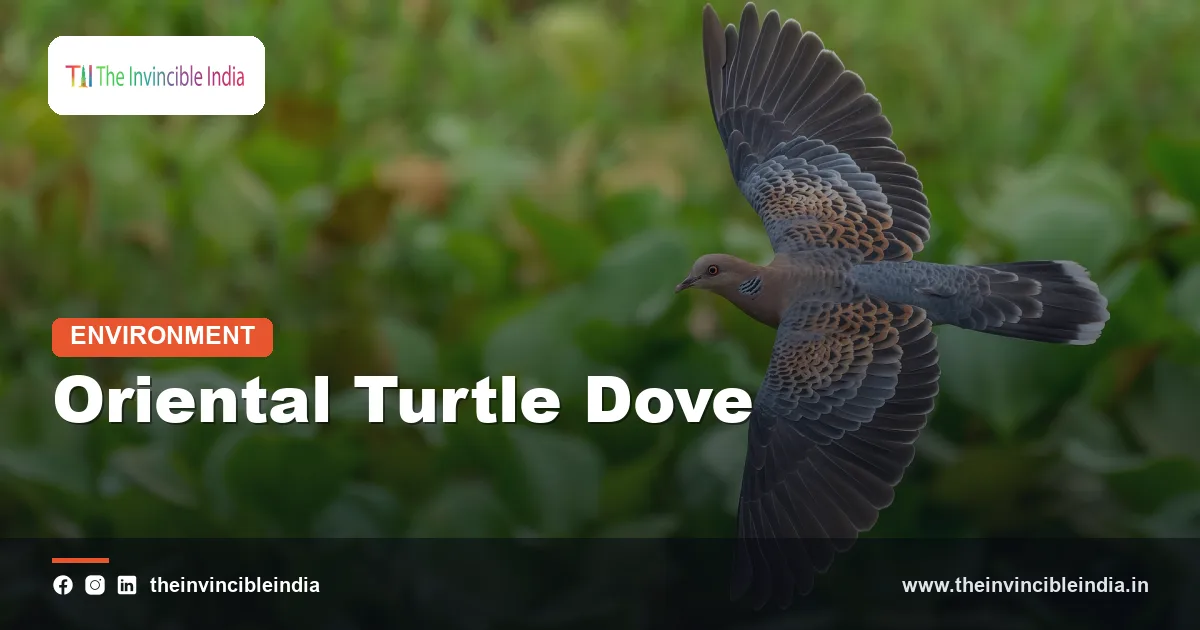
The oriental turtle dove (Streptopelia orientalis), also called the rufous turtle dove, is a plump, medium-large dove of Asia that is recognised by the scaly, black-centred and rufous-edged feathers of its back and a patch of black-and-blue-grey stripes on each side of the neck. In India the oriental turtle dove is both a widespread winter visitor from the north and a breeding resident of the Himalayan hills and some other regions, so it can be met in forests, fields and village edges in many seasons.
The oriental turtle dove spends most of its day on the ground or in the lower branches, picking up grain and seeds in small flocks, and it announces itself with a soft, rolling coo. This explainer covers how to identify the oriental turtle dove, where it lives, how it migrates, what it eats, how it nests, how it differs from other Indian doves and what its conservation status is.
| Quick Facts: Oriental Turtle Dove | |
|---|---|
| Common name | Oriental turtle dove (also rufous turtle dove) |
| Scientific name | Streptopelia orientalis |
| Family and order | Columbidae (pigeons and doves), order Columbiformes |
| Size | Roughly 30-35 cm long; a stocky, long-tailed dove larger than a spotted dove |
| Key field marks | Scaly rufous-and-black back, striped blue-grey and black neck patch, pinkish-brown underparts, dark tail with a pale tip |
| Status in India | Winter visitor in the plains and hills; resident breeder in the Himalayas and some other regions |
| Habitat | Open woodland, forest edges, scrub, farmland, orchards and gardens, from the plains to the mountains |
| Diet | Seeds, grain, small fruits and shoots, mostly picked from the ground |
| IUCN status | Least Concern |
Key Takeaways
- The oriental turtle dove (Streptopelia orientalis) is a plump Asian dove with a scaly rufous-and-black back and a striped black and blue-grey patch on the side of the neck.
- The oriental turtle dove reaches many parts of India in winter from breeding grounds to the north, while other populations stay and breed in the Himalayan hills.
- The oriental turtle dove is a seed eater that feeds mostly on the ground on grain, weed seeds, fallen fruit and tender shoots.
- The oriental turtle dove builds a thin platform of twigs in a tree or shrub and usually lays two white eggs, which both parents incubate and feed with crop milk.
- The oriental turtle dove is easily confused with the spotted dove and the Eurasian collared dove, but its scaly back and striped neck patch separate it.
- The IUCN lists the oriental turtle dove as Least Concern because it is widespread, although hunting and loss of wooded habitat affect local numbers.
What is the oriental turtle dove?
The oriental turtle dove is a species of dove in the family Columbidae that breeds across a broad belt of Asia, from Siberia and the Himalayas to Japan, and winters in southern and south-eastern Asia, including India. The species belongs to the genus Streptopelia, the group of “turtle doves” and collared doves that also includes the spotted dove, the laughing dove, the red collared dove and the Eurasian collared dove.
The word “turtle” in the name has nothing to do with the reptile. It is an old English form that imitates the purring call of doves, and it comes from the Latin turtur. The scientific name Streptopelia comes from Greek words meaning “collar dove”, and orientalis simply means “of the east”.
The oriental turtle dove is larger and heavier-bodied than most of the doves found around Indian houses, and it often looks darker and more richly coloured at a distance. Its rufous tones have given it the alternative name rufous turtle dove, which is the name many Indian field guides prefer.
How can you identify an oriental turtle dove?
The easiest way to identify an oriental turtle dove is to look for a scaly-looking back and wings, where each dark feather has a broad rusty or rufous-brown edge, together with a patch of black and blue-grey stripes on the side of the neck. The head and breast are a soft pinkish-brown or greyish-vinous colour, the belly is paler, and the rump and lower back are grey.
In flight the oriental turtle dove shows a dark tail with a pale grey or whitish band at the tip, and the underwing looks dark. The eye has an orange to reddish iris, the bill is dark and the legs are pinkish red. Males and females look very much alike, and young birds are duller, with less distinct neck patches and buff edges on the feathers.
Field marks to check
- A scaled pattern on the upperparts, created by dark centres and rusty edges on the feathers.
- A neck patch of alternating black and blue-grey stripes, which is smaller and less chequered in young birds.
- A grey rump and a dark tail with a pale terminal band, easy to see when the bird takes off.
- A pinkish-brown breast fading to a paler belly, with no black collar ring around the neck.
Where does the oriental turtle dove live in India?
The oriental turtle dove lives across much of India, with wintering birds reported from the northern plains and Himalayan foothills to central India and the peninsula, and resident birds in the Himalayan hills and some other forested regions. The bird favours open woodland, forest clearings, scrub, farmland, orchards and gardens, and it avoids very dense, unbroken forest and treeless deserts.
Several subspecies are recognised, and their ranges help explain why the dove behaves as both a visitor and a resident in India.
- S. o. meena breeds in the northern part of Asia, including Siberia and Central Asia, and moves south to winter in the Indian subcontinent. It is the form most often described as the winter visitor.
- S. o. erythrocephala is the form found in the Himalayas and the hills of northern and north-eastern India, where it breeds and moves up and down the slopes with the seasons.
- S. o. agricola is the form associated with the plains and lower hills of parts of eastern and central India and neighbouring countries, where it is largely resident.
The exact limits of these subspecies are debated and the ranges overlap in winter, so regional bird lists and recent field guides should be consulted for local detail. A dove seen in a Himalayan oak forest in summer and one seen in a wheat field in the plains in January may well belong to different populations of the same species.
Does the oriental turtle dove migrate to India?
Yes, the oriental turtle dove migrates to India in large numbers in winter, because northern breeding populations leave their cold breeding grounds in autumn and move south. Birds typically arrive in India from around September and October, stay through the winter months, and begin the return journey north by March and April.
Migration in this dove is partial. Some individuals travel long distances across mountain passes, while others make short altitudinal movements, descending from high forests to lower valleys when snow covers the ground. In the Himalayas it is therefore common to see more oriental turtle doves at lower elevations in winter than in summer.
Winter flocks of the oriental turtle dove are usually small, from a few birds to a few dozen, and they gather wherever food is plentiful, such as harvested wheat and mustard fields, stubble and threshing grounds. They roost together in trees at night and disperse to feed in the morning and again in the late afternoon.
What does the oriental turtle dove eat?
The oriental turtle dove eats mainly seeds and grain, supplemented by small fruits, berries, buds and tender plant shoots, and it finds most of its food by walking over bare or stubble-covered ground. A flock typically moves in a slow, deliberate walk with a bobbing head, picking up items one at a time.
In Indian farmland the dove takes spilled wheat, rice, millet, maize and pulses, as well as the seeds of many weeds. In forests it feeds on fallen seeds, wild fruits and the seeds of grasses and herbs. Like other pigeons and doves, it swallows small stones and grit, which help grind hard seeds in the muscular gizzard, and it drinks by sucking water without lifting its head, a trait shared by the whole pigeon family.
Because it consumes many weed seeds along with waste grain, the oriental turtle dove is generally harmless to agriculture. Large flocks of doves can occasionally damage newly sown fields, but the oriental turtle dove is usually too scattered and too shy to cause serious loss.
How does the oriental turtle dove breed?
The oriental turtle dove breeds by building a small, loose platform of twigs in a tree or shrub, where the female usually lays two white eggs. The nest is so flimsy that the eggs can sometimes be seen from below, a feature common to many doves. It is placed on a fork or horizontal branch, often at a moderate height, in woodland or at the edge of cultivation.
Both parents share the incubation, which lasts roughly two weeks, and both feed the young. Dove chicks are fed on crop milk, a nutritious secretion produced in the lining of the crop of both parents, rather than on insects as in many songbirds. As the chicks grow, seeds are gradually added to their diet, and they leave the nest after about two weeks and are soon able to fly.
In the Himalayas the breeding season generally runs through spring and summer, and in other parts of the range the timing varies with local climate and food supply. A pair may raise more than one brood in a season if conditions are good.
What does the oriental turtle dove sound like?
The oriental turtle dove has a soft, low, rolling coo, delivered in a repeated series of rhythmic notes that is deeper and more mellow than the calls of the smaller doves. The song is usually given from a perch in a tree and is heard most often in the breeding season, though winter birds also call at times.
The coo has often been written out in human syllables, with a typical pattern of a slightly rising first note followed by lower repeated notes. Written renderings differ from one observer to another, so the best way to learn the call is to listen to recordings. The sound carries well in quiet forest, which helps birdwatchers locate the species even when the bird is hidden in foliage.
When flushed from the ground, the oriental turtle dove often takes off with a clatter of wings, flies a short distance and perches in a tree, where it sits upright and stares back. This habit makes it a useful bird to watch for beginners, since it usually allows a second look.
How is the oriental turtle dove different from other Indian doves?
The oriental turtle dove differs from other Indian doves mainly in size and pattern: it is larger than the spotted dove and has a scaly rufous back and a striped neck patch instead of a solid black collar or a spotted collar. Comparing a few features side by side makes the identification straightforward.
| Species | Size and build | Key distinguishing features |
|---|---|---|
| Oriental turtle dove | Large, stocky, about 30-35 cm | Scaly rufous-and-black back, striped black and blue-grey neck patch, pinkish-brown underparts |
| Spotted dove | Medium, about 30 cm | Brown back with pale spots, broad black collar covered in white spots, common near human settlements |
| Eurasian collared dove | Medium, about 32 cm | Pale sandy-grey colour, narrow black half-collar on the back of the neck, no scaly pattern |
| Laughing dove | Small, about 27 cm | Pinkish with a patch of dark spots on the upper breast, a “laughing” call |
| European turtle dove | Smaller, about 27 cm | Scaly back like the oriental but with a neck patch of black and white stripes; a rarer visitor to north-western India |
The European turtle dove (Streptopelia turtur) is the species most similar to the oriental turtle dove in plumage, but it is smaller and has white rather than blue-grey bars in the neck patch. Because the two overlap only in the north-west, most turtle doves seen across India are oriental.
Is the oriental turtle dove threatened?
No, the oriental turtle dove is not globally threatened, and the International Union for Conservation of Nature (IUCN) lists it as a species of Least Concern because it has a very large range and a large population. However, the species faces local pressures in different parts of its range.
- Hunting: doves and pigeons are shot or trapped for food in several Asian countries, and migrating flocks are especially vulnerable at known stopover points.
- Habitat change: clearing of open woodland and hedgerows, and the replacement of mixed farming by intensive monoculture, reduce nesting sites and food.
- Pesticides: seed-eating birds can be harmed by treated seed and chemical residues in grain.
- Climate and weather: changes in snowfall and temperature in the Himalayas and in northern Asia may alter the timing and routes of movement.
In India, wild birds are protected under the Wild Life (Protection) Act, 1972, and the legal status of individual species depends on the schedules of the Act as amended. Hunting of wild birds without legal sanction is an offence, and anyone interested in the legal position of a particular species should consult the current schedules.
Where and when can you watch the oriental turtle dove in India?
The best time to watch the oriental turtle dove in India is from November to February, when winter visitors are present, and the best places are open farmland edges, orchards, forest clearings and woodland paths in the early morning. The bird is often found where trees and open ground meet, since it nests and roosts in trees but feeds on the ground.
Tips for birdwatchers
- Walk slowly along farm tracks and forest roads in the first hours after sunrise, scanning bare ground and low branches.
- Listen for the soft coo before looking, as the bird often calls before it is seen.
- Check each dove carefully: look for the scaly back, the striped neck patch and the pale-tipped tail before confirming the species.
- Use binoculars rather than approaching closely, because the bird is wary and flushes easily.
- Record the date, place and habitat, and share sightings through citizen-science platforms so that regional distribution maps stay accurate.
Hill sanctuaries and national parks in the Himalayan states, as well as well-wooded rural areas in the northern plains, are reliable places to look. Good birding etiquette matters: keep distance from nests, avoid playback of recorded calls during the breeding season and stay on marked paths.
Why does the oriental turtle dove matter?
The oriental turtle dove matters because it is part of the seed-dispersal and food-web machinery of Indian woodlands and farmland, and because its seasonal movements help scientists track changes in climate and land use. As a seed eater it consumes weed seeds and spilled grain, and as a prey species it supports hawks, falcons and other raptors.
Migrant birds such as the oriental turtle dove also show how India is connected to the rest of Asia ecologically. Birds that breed in Siberia or Central Asia depend on the food and shelter they find in Indian fields and groves each winter, which means that the health of the Indian countryside affects birdlife across a whole continent. Protecting hedgerows, village groves and patches of native woodland therefore helps this dove and many other birds at the same time.
Bottom Line
The oriental turtle dove is a handsome, shy, seed-eating dove that adds rufous colour and a soft coo to Indian winters and Himalayan summers. It is not threatened globally, but it depends on open woodland, farmland edges and safe feeding grounds, which makes it a good indicator of the quality of the Indian countryside. Learning to separate it from the spotted dove and the Eurasian collared dove is one of the first useful skills for a beginner birdwatcher.
Frequently Asked Questions
What is an oriental turtle dove?
The oriental turtle dove (Streptopelia orientalis) is a medium-large Asian dove with a scaly rufous-and-black back and a striped black and blue-grey patch on the side of the neck. It is also called the rufous turtle dove, and it is a winter visitor and, in the Himalayas, a resident breeder in India.
Is the oriental turtle dove found in India?
Yes, the oriental turtle dove is found in India as a winter visitor to many regions and as a breeding resident in the Himalayan hills. Northern breeding populations arrive from about September and October and leave by March and April.
How can I tell an oriental turtle dove from a spotted dove?
The oriental turtle dove is larger and has a scaly rufous-and-black back with a striped black and blue-grey neck patch, while the spotted dove has a brown back with pale spots and a black collar covered in white spots. The spotted dove is also far more common around human settlements.
What does the oriental turtle dove eat?
The oriental turtle dove eats mainly seeds and grain, along with small fruits, buds and tender shoots, picked up from the ground. In Indian farmland it feeds on spilled wheat, rice, millet and many weed seeds.
How many eggs does the oriental turtle dove lay?
The oriental turtle dove usually lays two white eggs in a loose platform of twigs in a tree or shrub. Both parents incubate the eggs for about two weeks and feed the chicks on crop milk.
Is the oriental turtle dove endangered?
No, the oriental turtle dove is listed as Least Concern by the IUCN because it has a very large range and a large population. Local numbers can fall because of hunting and the loss of open woodland and hedgerows.
{“@context”:”https://schema.org”,”@graph”:[{“@type”:”FAQPage”,”mainEntity”:[{“@type”:”Question”,”name”:”What is an oriental turtle dove?”,”acceptedAnswer”:{“@type”:”Answer”,”text”:”The oriental turtle dove (Streptopelia orientalis) is a medium-large Asian dove with a scaly rufous-and-black back and a striped black and blue-grey patch on the side of the neck. It is also called the rufous turtle dove, and it is a winter visitor and, in the Himalayas, a resident breeder in India.”}},{“@type”:”Question”,”name”:”Is the oriental turtle dove found in India?”,”acceptedAnswer”:{“@type”:”Answer”,”text”:”Yes, the oriental turtle dove is found in India as a winter visitor to many regions and as a breeding resident in the Himalayan hills. Northern breeding populations arrive from about September and October and leave by March and April.”}},{“@type”:”Question”,”name”:”How can I tell an oriental turtle dove from a spotted dove?”,”acceptedAnswer”:{“@type”:”Answer”,”text”:”The oriental turtle dove is larger and has a scaly rufous-and-black back with a striped black and blue-grey neck patch, while the spotted dove has a brown back with pale spots and a black collar covered in white spots. The spotted dove is also far more common around human settlements.”}},{“@type”:”Question”,”name”:”What does the oriental turtle dove eat?”,”acceptedAnswer”:{“@type”:”Answer”,”text”:”The oriental turtle dove eats mainly seeds and grain, along with small fruits, buds and tender shoots, picked up from the ground. In Indian farmland it feeds on spilled wheat, rice, millet and many weed seeds.”}},{“@type”:”Question”,”name”:”How many eggs does the oriental turtle dove lay?”,”acceptedAnswer”:{“@type”:”Answer”,”text”:”The oriental turtle dove usually lays two white eggs in a loose platform of twigs in a tree or shrub. Both parents incubate the eggs for about two weeks and feed the chicks on crop milk.”}},{“@type”:”Question”,”name”:”Is the oriental turtle dove endangered?”,”acceptedAnswer”:{“@type”:”Answer”,”text”:”No, the oriental turtle dove is listed as Least Concern by the IUCN because it has a very large range and a large population. Local numbers can fall because of hunting and the loss of open woodland and hedgerows.”}}]}]}


