

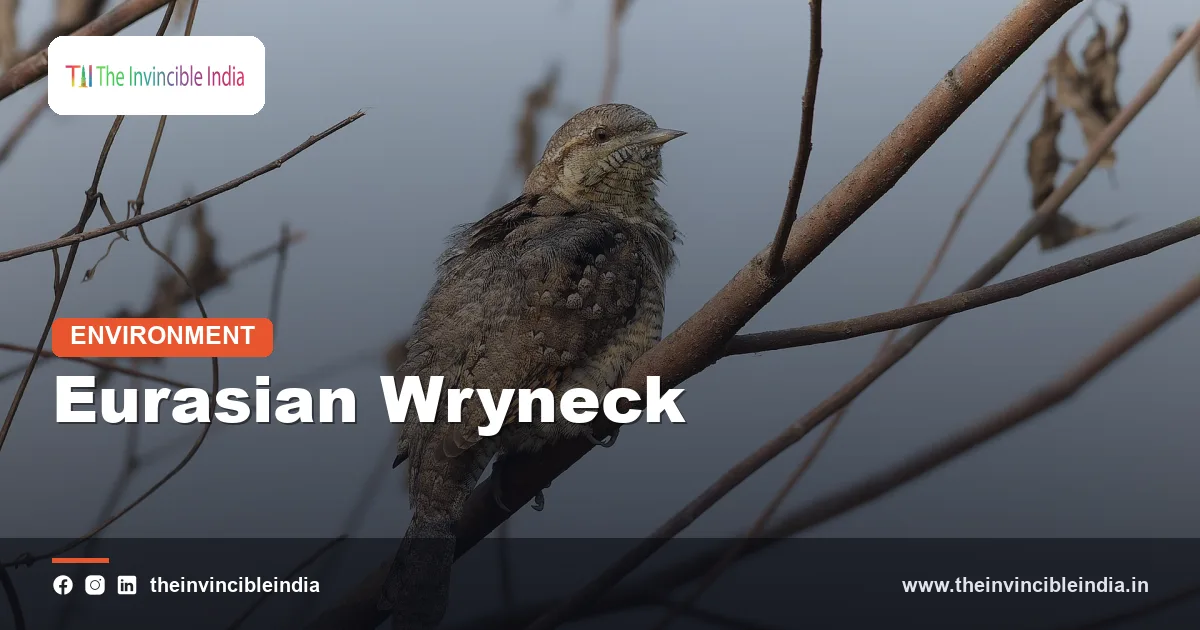
The Eurasian wryneck (Jynx torquilla) is a small, cryptically patterned woodpecker that, unlike most of its relatives, feeds on the ground, and it is best known for twisting its neck almost like a snake when it is alarmed. In India the Eurasian wryneck is mainly a winter visitor to fields, scrub and open woodland, with a breeding population in the western Himalayas, and it is easy to overlook because its bark-like plumage blends perfectly with grass and soil.
The Eurasian wryneck does not drum on trees, does not prop itself on its tail and has a long, sticky tongue that it uses to lick up ants and their pupae. This explainer covers how to recognise the Eurasian wryneck, where it lives in India, why it twists its neck, what it eats, how it nests and what its conservation status is.
| Quick Facts: Eurasian Wryneck | |
|---|---|
| Common name | Eurasian wryneck (also northern wryneck or simply wryneck) |
| Scientific name | Jynx torquilla |
| Family and order | Picidae (woodpeckers and allies), subfamily Jynginae, order Piciformes |
| Size | Roughly 16-17 cm long, about the size of a large sparrow or a small thrush |
| Key field marks | Grey-brown plumage finely vermiculated like bark, dark stripe from the crown down the back, barred long tail, short pointed bill |
| Status in India | Winter visitor across much of the country; breeds in the western Himalayas |
| Habitat | Open woodland, scrub, orchards, farmland, hedges and gardens |
| Diet | Mainly ants and ant pupae, along with other small insects and spiders |
| IUCN status | Least Concern |
Key Takeaways
- The Eurasian wryneck (Jynx torquilla) is a woodpecker relative that has soft tail feathers, a short bill and bark-patterned plumage, and it does not drum or excavate holes like a typical woodpecker.
- The Eurasian wryneck gets its name from its habit of twisting its head and neck in a slow, snake-like motion and hissing when it is threatened at the nest or when handled.
- The Eurasian wryneck feeds largely on ants and their pupae, which it picks up with a very long, sticky tongue, usually while hopping on the ground.
- The Eurasian wryneck is chiefly a winter visitor to India, arriving in autumn and leaving by spring, though a breeding population lives in the western Himalayas.
- The Eurasian wryneck nests in existing cavities, such as old woodpecker holes, natural hollows or nest boxes, and lays a large clutch of white eggs.
- The IUCN lists the Eurasian wryneck as Least Concern globally, even though numbers have fallen sharply in parts of western Europe.
What is the Eurasian wryneck?
The Eurasian wryneck is a small bird in the woodpecker family, Picidae, that breeds across a vast stretch of Europe and Asia and winters in Africa and southern Asia, including India. It belongs to a small group called the wrynecks, in which only two species exist: the Eurasian wryneck and the red-throated wryneck (Jynx ruficollis) of Africa.
Wrynecks are placed in their own subfamily, Jynginae, because they differ from true woodpeckers in several ways. Their tail feathers are soft and not stiffened for propping against a trunk, their bill is short and slender instead of chisel-shaped, and they seldom hammer on wood. They still share the key woodpecker foot arrangement, with two toes pointing forward and two backward, which helps them cling to bark.
The scientific name Jynx comes from the Greek iynx, the name of a bird used in ancient love charms. In ancient Greece a wryneck was said to be bound to a wheel and spun to bring back a lover, and this is the origin of the English word “jinx”. The species name torquilla comes from the Latin for “to twist”, and refers to the neck movement.
How can you identify a Eurasian wryneck?
You can identify a Eurasian wryneck by its bark-like grey-brown plumage, which is finely barred and speckled, together with a dark brown stripe running from the crown down the back, a long, barred tail and a short, pointed bill. The throat and breast are buff with narrow dark bars, and the belly is pale. The sexes look almost identical.
The bird is slightly larger than a sparrow, with a slim body and a rounded head that looks small for its length. In flight the wryneck is undulating but weak, with a floppy, slightly woodpecker-like action, and it shows a long tail with several dark bars. When it lands, it often perches crosswise on a branch like a songbird instead of clinging upright to a trunk.
Features that separate the wryneck from similar birds
- Unlike a true woodpecker, the wryneck rarely climbs trunks and does not use its tail as a prop.
- Unlike a lark or pipit, the wryneck has a pointed bill, a long barred tail and a dark back stripe.
- Unlike a nightjar, which also has bark-like plumage, the wryneck is active by day and feeds on the ground by hopping.
- Its camouflage is so good that a still wryneck on a branch or on the ground can be missed from a few metres away.
Where does the Eurasian wryneck live in India?
The Eurasian wryneck is found across much of India in winter, from the Himalayan foothills and northern plains to central and peninsular India, while a smaller breeding population occupies the western Himalayas. Winter birds favour open, lightly wooded country with plenty of ground cover and access to ant colonies.
Typical Indian habitats include scrub jungle, thorn forest, orchards, mango groves, farm boundaries, hedges and large gardens. In the Himalayas, breeding birds are found in open forests of oak, deodar and pine, at middle elevations, and in summer the Eurasian wryneck is a typical sight in clearings and forest edges in states such as Jammu and Kashmir and Himachal Pradesh.
Different subspecies are recognised across the wider range. The breeding race of the western Himalayas is generally known as himalayana, while winter visitors come from more northerly populations. Bird atlases and local checklists give more detail on which form is likely in a given region, and the identification of subspecies in the field is difficult.
Why does the Eurasian wryneck twist its neck?
The Eurasian wryneck twists its neck as a defensive display, turning and stretching its head slowly in different directions while hissing and swaying, so that it resembles a snake and frightens away predators. The display is most often seen at the nest, where an intruder looking into the cavity may see a hissing, writhing head instead of a harmless bird.
The movement is made possible by a very flexible neck, which allows the bird to rotate its head through a wide arc. Combined with ruffled head feathers and a hiss that sounds like a snake, the display can deter squirrels, other birds and curious humans. If handled, a wryneck may also feign death, going limp and closing its eyes before suddenly flying away.
The same flexibility helps the bird in everyday life. Peering into crevices, probing in leaf litter and checking the insides of cavities are easier for a bird that can swivel its head. The odd posture gave rise to the English name wryneck, in which “wry” means twisted.
What does the Eurasian wryneck eat?
The Eurasian wryneck eats mainly ants, especially their eggs, larvae and pupae, which it collects by flicking out a long, sticky tongue into ant nests and along ant trails. It will also take termites, small beetles, caterpillars, flies, spiders and occasionally berries and seeds.
The wryneck is a specialist in this food. Its tongue is much longer than the bill and is coated with sticky saliva, so ants adhere to it as it darts in and out. This feeding method is similar to that of anteaters and some other woodpeckers, but unlike most of its relatives the wryneck usually feeds on the ground, hopping with its tail raised and pecking at the soil.
In India the wryneck can often be seen near anthills, on lawns, along field bunds and under trees where ant trails cross bare soil. By removing large numbers of ants and other insects, the bird takes a small part in controlling their populations, though its overall effect on agriculture is minor.
Does the Eurasian wryneck migrate to India?
Yes, the Eurasian wryneck migrates to India in large numbers, because most breeding populations in northern Asia move south in autumn to escape the cold and the disappearance of insect prey. Winter birds begin to appear from about September and October and usually leave by March and April.
Wrynecks migrate mostly at night and travel alone or in loose groups instead of tight flocks. During the day they stop in suitable habitat to rest and feed, and a single bird may be found in a garden, a roadside tree or a field edge for a few days before moving on. Each individual usually spends the winter alone, defending a small feeding area.
Because the bird is so well camouflaged and silent in winter, it is often seen only when it is flushed from the ground. A bird-ringing station or a patient observer may record far more wrynecks than casual sightings would suggest, so the true numbers wintering in India are probably higher than records imply.
How does the Eurasian wryneck breed?
The Eurasian wryneck breeds in an existing cavity, such as a natural tree hole, an abandoned woodpecker or barbet nest or a nest box, and does not excavate its own hole. The female lays a clutch of roughly seven to ten white eggs, and no nesting material is added except what happens to be in the hole.
Both parents incubate the eggs for around two weeks and both feed the chicks, mostly with ants and pupae, until the young fledge after about three weeks. The male announces his territory with a loud, repeated, nasal call written as a series of ringing “kyee” notes that rises slightly and is heard in spring. A second brood is sometimes raised if conditions are good.
The wryneck often competes with other cavity-nesting birds, such as tits, starlings and sparrows, and may be driven away from a good hole. Loss of old trees and dead wood is therefore one of the main reasons why the species has declined in parts of Europe, and it is one reason why conserving old orchard and woodland trees is useful.
How does the Eurasian wryneck differ from a true woodpecker?
The Eurasian wryneck differs from a true woodpecker in its soft tail, short bill, ground-feeding habits and lack of drumming, even though both belong to the same family. Comparing it with two familiar Indian species helps clarify the differences.
| Feature | Eurasian wryneck | Typical woodpecker (such as the lesser golden-backed woodpecker) |
|---|---|---|
| Tail | Long, soft and barred, not used as a prop | Stiff, pointed and pressed against the trunk for support |
| Bill | Short, slim and pointed | Strong and chisel-like |
| Feeding | Mostly on the ground, licking ants | On trunks and branches, hammering for grubs |
| Nest | Uses an existing cavity, adds no lining | Excavates its own hole |
| Drumming | Does not drum | Drums to proclaim a territory |
| Defence | Neck-twisting and hissing display | Alarm calls and flight |
The wryneck’s perching habit also differs: it sits across a branch like a passerine instead of upright against it. These traits make it look more like a songbird than a woodpecker at first glance.
Is the Eurasian wryneck threatened?
No, the Eurasian wryneck is not globally threatened, and the International Union for Conservation of Nature (IUCN) lists it as Least Concern because of its enormous breeding range across Europe and Asia. Regional populations, however, have declined, and the bird has become rare or extinct as a breeder in several western European countries.
The main reasons for the declines are well understood, and most apply to the breeding grounds more than to India.
- Loss of nesting trees: felling of old orchards, hedgerow trees and dead wood removes the cavities that the bird relies on.
- Fewer ants and insects: intensive farming, pesticide use and the removal of grassland patches reduce the ant colonies the species needs.
- Climate and weather: cold, wet springs can reduce insect supply and chick survival, and changing seasons may disturb migration timing.
- Hazards on migration: small migrants face risks from habitat loss at stopover sites and, in some countries, from hunting.
In India the wryneck is protected as a wild bird under the Wild Life (Protection) Act, 1972, and it benefits from the general protection of woodland, scrub and farmland edges. Keeping old trees, hedges and patches of uncultivated ground helps it, along with many other insect-eating birds.
Where and when can you watch the Eurasian wryneck in India?
The best time to watch the Eurasian wryneck in India is from October to March, and the best places are open scrub, orchards, garden lawns and field edges with old trees, particularly in the north and the central plains. A patient search of ground under trees, in the early morning or late afternoon, gives the best chance.
Tips for finding a wryneck
- Scan the ground and the lower branches carefully, because a motionless wryneck looks like a piece of bark.
- Look near anthills and ant trails, where the bird feeds.
- Walk slowly and stop often; a wryneck usually flies a short distance when disturbed and lands on a low branch, giving a second look.
- Watch for the odd perching posture across a branch, and check for the long barred tail when the bird flies.
- Avoid disturbing nest holes in the western Himalayan breeding season, and never use call playback near a nest.
Hill stations and orchard belts in the western Himalayas offer the chance to see breeding birds in summer, while the plains and hills hold winter visitors. A good camera or a pair of binoculars and a field guide are enough to record the species, and uploads to citizen-science platforms add valuable data on its winter distribution.
Why does the Eurasian wryneck matter?
The Eurasian wryneck matters because it is an insect-eating indicator of healthy orchards, old trees and ant-rich grassland, and because it ties India ecologically to breeding grounds in Europe and northern Asia. The loss of the species from a landscape usually signals the loss of nesting cavities and ants, which are important for many other creatures.
The wryneck also carries a cultural curiosity. Its odd behaviour and its place in ancient Greek love magic make it one of the few birds whose name has given English the word “jinx”. For a modern Indian birdwatcher, spotting a motionless, bark-coloured wryneck in a winter garden is a reminder of how much quiet migration passes through the country each year.
Bottom Line
The Eurasian wryneck is a modest-looking but remarkable bird: a ground-feeding woodpecker relative with a snake-like defence display, a taste for ants and a long migratory journey that brings it to Indian fields every winter. It is safe globally, but it relies on old trees, uncultivated corners and plentiful insects, which makes it a useful sign of a healthy countryside.
Frequently Asked Questions
What is a Eurasian wryneck?
The Eurasian wryneck (Jynx torquilla) is a small woodpecker relative with bark-patterned grey-brown plumage that feeds on the ground and twists its neck like a snake when alarmed. In India it is mainly a winter visitor, with a breeding population in the western Himalayas.
Why is it called a wryneck?
The Eurasian wryneck is called a wryneck because it twists and stretches its head and neck slowly in different directions when threatened, and the word wry means twisted. The display, which is combined with hissing, makes the bird look like a snake.
What does the Eurasian wryneck eat?
The Eurasian wryneck eats mainly ants, especially their larvae and pupae, which it collects with a long, sticky tongue. It also takes termites, small beetles, caterpillars and spiders.
Does the Eurasian wryneck migrate to India?
Yes, the Eurasian wryneck migrates to India in winter from breeding grounds in northern Asia, arriving from about September and October and leaving by March and April. It travels mostly at night and usually winters alone.
How is the Eurasian wryneck different from a woodpecker?
The Eurasian wryneck has a soft tail, a short pointed bill and a habit of feeding on the ground, and it does not drum or excavate nest holes. A typical woodpecker has a stiff tail, a chisel-like bill and feeds on trunks.
Is the Eurasian wryneck endangered?
No, the Eurasian wryneck is listed as Least Concern by the IUCN because of its very large range across Europe and Asia. However, its numbers have fallen in parts of western Europe because of the loss of old trees and ant-rich habitat.
{“@context”:”https://schema.org”,”@graph”:[{“@type”:”FAQPage”,”mainEntity”:[{“@type”:”Question”,”name”:”What is a Eurasian wryneck?”,”acceptedAnswer”:{“@type”:”Answer”,”text”:”The Eurasian wryneck (Jynx torquilla) is a small woodpecker relative with bark-patterned grey-brown plumage that feeds on the ground and twists its neck like a snake when alarmed. In India it is mainly a winter visitor, with a breeding population in the western Himalayas.”}},{“@type”:”Question”,”name”:”Why is it called a wryneck?”,”acceptedAnswer”:{“@type”:”Answer”,”text”:”The Eurasian wryneck is called a wryneck because it twists and stretches its head and neck slowly in different directions when threatened, and the word wry means twisted. The display, which is combined with hissing, makes the bird look like a snake.”}},{“@type”:”Question”,”name”:”What does the Eurasian wryneck eat?”,”acceptedAnswer”:{“@type”:”Answer”,”text”:”The Eurasian wryneck eats mainly ants, especially their larvae and pupae, which it collects with a long, sticky tongue. It also takes termites, small beetles, caterpillars and spiders.”}},{“@type”:”Question”,”name”:”Does the Eurasian wryneck migrate to India?”,”acceptedAnswer”:{“@type”:”Answer”,”text”:”Yes, the Eurasian wryneck migrates to India in winter from breeding grounds in northern Asia, arriving from about September and October and leaving by March and April. It travels mostly at night and usually winters alone.”}},{“@type”:”Question”,”name”:”How is the Eurasian wryneck different from a woodpecker?”,”acceptedAnswer”:{“@type”:”Answer”,”text”:”The Eurasian wryneck has a soft tail, a short pointed bill and a habit of feeding on the ground, and it does not drum or excavate nest holes. A typical woodpecker has a stiff tail, a chisel-like bill and feeds on trunks.”}},{“@type”:”Question”,”name”:”Is the Eurasian wryneck endangered?”,”acceptedAnswer”:{“@type”:”Answer”,”text”:”No, the Eurasian wryneck is listed as Least Concern by the IUCN because of its very large range across Europe and Asia. However, its numbers have fallen in parts of western Europe because of the loss of old trees and ant-rich habitat.”}}]}]}


