

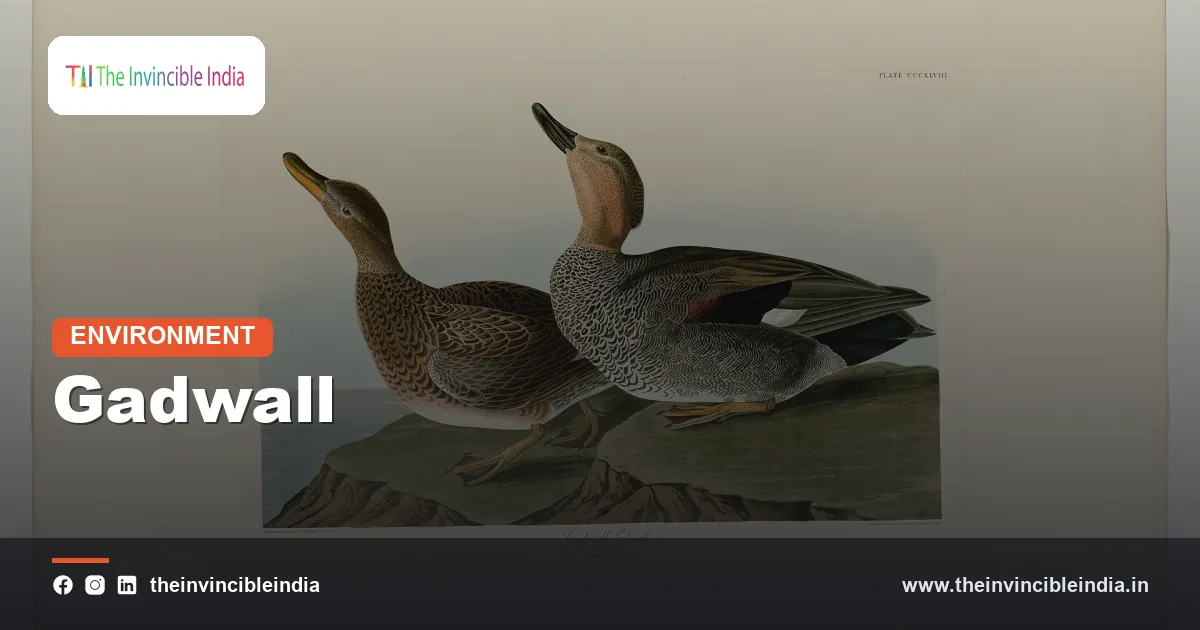
The gadwall (Mareca strepera) is a medium-sized dabbling duck, subtly patterned in grey and brown with a white wing patch, that breeds across the temperate north and spends the winter on lakes, reservoirs and wetlands across India. Often overshadowed by flashier ducks such as the northern shoveler and the northern pintail, the gadwall is easy to overlook, yet it is one of the commonest and most widespread winter ducks of the Indian subcontinent.
This guide explains what the gadwall is, how to recognise males and females, where and when the species appears in India, what it eats, how it breeds and migrates, and how it is faring in a changing wetland landscape. For Indian birdwatchers, learning to appreciate the fine, vermiculated patterning of a male gadwall is one of the quiet pleasures of a winter wetland visit.
Quick Facts
| Attribute | Detail |
|---|---|
| Common name | Gadwall |
| Scientific name | Mareca strepera (earlier called Anas strepera) |
| Family | Anatidae (ducks, geese and swans) |
| Group | Dabbling duck |
| Length | About 46 to 56 cm |
| Wingspan | About 84 to 95 cm |
| Breeding range | Temperate Europe, Central Asia, Siberia and North America |
| Time in India | Roughly October to March or April |
| IUCN status | Least Concern |
Key Takeaways
- The gadwall (Mareca strepera) is a medium-sized dabbling duck that breeds in the temperate Northern Hemisphere and winters widely across India’s lakes, reservoirs and wetlands.
- The male gadwall is mostly grey with a black rear end, while the female is mottled brown with orange-sided bill, and both sexes show a white patch on the wing.
- The gadwall feeds mainly on submerged aquatic plants and algae, which it takes by dabbling at the surface and up-ending in shallow water.
- The gadwall is a winter visitor to India from roughly October to March or April and is recorded at famous wetlands such as Keoladeo National Park and Chilika Lake.
- The gadwall is not threatened, and the IUCN lists it as Least Concern because its global population is large and has generally been stable or increasing.
- The gadwall depends on healthy shallow wetlands with submerged vegetation, so drainage, pollution and disturbance of Indian jheels affect it directly.
What is the gadwall?
The gadwall is a dabbling duck of the family Anatidae, a group of ducks that feed at or just below the water surface rather than diving deep. It is slightly smaller and slimmer than a mallard, with a rounded head and a steeper forehead than many other ducks. In recent classifications the gadwall sits in the genus Mareca, together with the wigeons, although older books place it in the genus Anas.
The gadwall is one of the world’s most widespread ducks. It breeds across temperate parts of Europe, Asia and North America and winters in warmer regions, including southern Europe, Africa, South Asia and Mexico. Its understated plumage helps it blend in with reeds and muddy shallows, and its quiet habits mean it rarely draws attention.
How do you identify a gadwall?
A gadwall is identified by the male’s finely patterned grey flanks, brownish head, black rear end and dark bill, and by the female’s mottled brown plumage with an orange-sided bill, with both sexes showing a small white square on the wing. The white patch, called a speculum, is most visible in flight but is often seen as a flash of white on a resting bird.
The male in breeding plumage looks grey from a distance but, at close range, shows delicate wavy lines across the body, a chestnut patch on the wing and a black tail area. The female resembles a smaller, slimmer female mallard, and she can be confusing until the orange edge to the bill and the white speculum are noticed. After the breeding season the male moults into a duller eclipse plumage that looks more like the female.
Key field marks
- Male: grey body with fine vermiculation, brownish head, black rear and a dark bill.
- Female: brown and buff mottling, with orange along the sides of the bill.
- Both sexes: a white speculum on the secondary wing feathers.
- Rounded head with a steep forehead and a relatively slim body.
- Legs and feet in shades of yellow or orange.
- Voice: the male gives a low, nasal, burp-like note, and the female gives a quack higher than a mallard’s.
How is the gadwall different from similar ducks?
The gadwall differs from similar ducks mainly in its subdued grey plumage, white wing patch and slimmer build. The comparison below shows how a gadwall differs from two ducks that it may be confused with at a busy Indian wetland.
| Feature | Gadwall | Mallard | Eurasian wigeon |
|---|---|---|---|
| Male head | Brownish, plain | Glossy green | Chestnut with a cream forehead |
| Male body | Finely patterned grey | Grey with chestnut chest | Pinkish chest, grey flanks |
| Wing patch | White square | Blue, edged with white | White forewing patch in males |
| Size | Medium, slim | Larger, heavier | Smaller, short bill |
| Female bill | Orange sides, dark centre | Mostly orange | Short, bluish-grey |
With practice, the gadwall’s smooth outline, slim neck and lack of any bright colour become its signature. Seen in good light, the intricate pattern on the male is one of the most elegant among Indian ducks.
Behaviour helps as well. A gadwall swims with its body riding fairly high and its tail held slightly raised, and it moves calmly through a flock of busier ducks. When a flock is flushed, gadwalls often rise with a distinctive flash of white on the inner wing, which is a quick way to separate them from the many brown ducks that look alike on the water.
Where is the gadwall found in India?
The gadwall is found in India across freshwater and brackish wetlands from the Himalayan foothills and the northern plains to the Deccan, Gujarat and the south, with the largest concentrations in big lakes, marshes and reservoirs. It is a regular winter visitor to well-known sites such as Keoladeo National Park in Rajasthan, Chilika Lake in Odisha, Nal Sarovar in Gujarat and Harike Wetland in Punjab.
The species prefers shallow water with plenty of submerged and floating vegetation. It also uses village ponds, irrigation reservoirs, oxbow lakes and sewage-fed wetlands where food is available. Within a mixed flock of ducks, the gadwall is often found at the margins, feeding quietly and moving less boisterously than the more abundant species.
- North India: Haryana, Punjab, Delhi region and Uttar Pradesh wetlands.
- West India: Rajasthan jheels and Gujarat lakes and coastal wetlands.
- East India: Chilika Lake and the floodplain wetlands of Bihar and West Bengal.
- South India: reservoirs and lakes in Karnataka, Andhra Pradesh and Tamil Nadu, in smaller numbers.
When does the gadwall arrive in India?
The gadwall arrives in India in autumn, with the first birds usually appearing in October, and it remains until about March or April before heading north to breed. Numbers peak in the cold months from December to February, when wetlands across the north and west hold large mixed flocks of migratory waterfowl.
Arrival timing varies with weather, water levels and the conditions along the flyway. Early autumn rains that fill wetlands can attract the first birds sooner, while dry years may delay or reduce numbers at traditional sites. Pair bonds in many ducks form on the wintering grounds, so late-winter wetlands often show courting displays as the season advances.
What does the gadwall eat?
The gadwall eats mainly plant material, especially submerged aquatic vegetation, algae, leaves and seeds, with some small invertebrates taken opportunistically. It feeds by dabbling at the surface, by upending in shallow water so that the tail points skyward and, less often, by diving briefly. The gadwall is also known to take food brought to the surface by diving birds such as coots.
The role of submerged plants in the gadwall’s diet links the species directly to water quality. Clear, shallow wetlands support dense underwater vegetation, while heavily polluted or silted water often loses it. Because gadwalls rely on this plant growth, they are a useful indicator of wetland health, as the loss of submerged vegetation quickly shows up in duck counts.
A wintering gadwall spends much of the day feeding in the shallows, often in the early morning and evening, and rests in the middle of the lake or along sheltered banks at midday. Large wetlands with both open water for safe roosting and shallow margins for feeding therefore hold the biggest flocks. Where reed beds, floating vegetation and open water exist side by side, the gadwall is usually present in good numbers.
How does the gadwall breed?
The gadwall breeds in the northern summer on freshwater marshes, lake edges and river deltas, making a nest on dry ground well hidden among dense vegetation, often some distance from open water. The female alone builds the nest, lines it with down, lays a clutch of cream-coloured eggs and incubates them for roughly three and a half weeks.
Ducklings leave the nest soon after hatching and feed themselves under the mother’s watch. Most Indian gadwalls are visitors, so breeding is not a feature of the Indian year, though occasional breeding is reported in the far north. The birds seen in India breed mainly in Central Asia, Siberia and neighbouring regions, and ringing recoveries have linked wintering birds in South Asia to those distant areas.
Why is the gadwall important for Indian wetlands?
The gadwall is important for Indian wetlands because its presence and numbers reflect the condition of shallow freshwater habitats, and because it takes part in the wetland food web as a plant-eater and as prey. Waterbird counts such as the Asian Waterbird Census, coordinated by Wetlands International since the 1980s and supported in India by organisations including the Bombay Natural History Society (BNHS), use ducks like the gadwall to assess wetland health.
Wetlands that attract gadwalls also support fish, amphibians, insects and other waterbirds, and they recharge groundwater, buffer floods and provide livelihoods. Protecting these sites under mechanisms such as the Ramsar Convention helps migratory ducks and the people who depend on the same water. India has designated a growing number of Ramsar sites, among them Keoladeo and Chilika, which are major wintering grounds for ducks.
Is the gadwall threatened?
The gadwall is not threatened, and the International Union for Conservation of Nature (IUCN) classifies it as Least Concern because its range is huge and its global population is large and, in recent decades, generally stable or increasing. In India it remains a common winter duck at suitable wetlands.
Nevertheless, local pressures can affect winter populations.
- Draining and encroachment of wetlands for farming and construction.
- Pollution from sewage, industrial waste and agricultural runoff that kills submerged plants.
- Illegal hunting and trapping of migratory waterfowl.
- Disturbance from boats, fishing and other human activity.
- Disease outbreaks such as avian influenza, which can affect wild waterbirds and domestic poultry.
Securing wetlands, controlling pollution and enforcing wildlife law are the main ways to keep wintering ducks safe.
Birdwatchers can help the gadwall in simple ways: by keeping a respectful distance from roosting flocks, by recording counts on open platforms such as eBird, and by supporting local efforts to keep village ponds and lakes clean. Such records build a long-term picture of how winter duck numbers change from year to year.
Bottom Line
The gadwall is a modest but elegant dabbling duck that winters in large numbers on Indian wetlands after breeding in the temperate north. It is secure as a species, but it depends on clean, shallow waters rich in submerged plants. Watching a flock of gadwalls on a winter morning is a simple way to appreciate the health of a wetland.
Frequently Asked Questions
Is the gadwall a migratory duck in India?
Yes, the gadwall is a migratory duck that visits India as a winter guest. It arrives from about October, peaks from December to February and leaves by March or April to breed in Central Asia, Siberia and other northern regions.
How can you tell a male gadwall from a female?
A male gadwall is mostly finely patterned grey with a brownish head and black rear end, while a female is mottled brown with orange along the sides of her bill. Both sexes show a white wing patch, and the male in eclipse plumage looks more like the female.
What does the gadwall eat?
The gadwall eats mainly submerged aquatic plants, algae, leaves and seeds, with a few small invertebrates. It feeds by dabbling at the surface and upending in shallow water, and it sometimes takes plants brought up by diving birds such as coots.
Where can you see gadwalls in India?
Gadwalls can be seen in winter at freshwater and brackish wetlands across India, including Keoladeo National Park, Chilika Lake, Nal Sarovar and Harike Wetland. They are most common in the north and west, with smaller numbers in the south.
How is the gadwall different from the mallard?
The gadwall is smaller and slimmer than the mallard and lacks the male mallard’s glossy green head. It has a white wing patch instead of the mallard’s blue one, and the female gadwall has orange only along the sides of the bill.
Is the gadwall an endangered species?
No, the gadwall is not endangered, and the IUCN lists it as Least Concern. Its global population is large and has generally been stable or increasing, although wetland loss, pollution and hunting can affect local numbers in India.
{“@context”:”https://schema.org”,”@graph”:[{“@type”:”FAQPage”,”mainEntity”:[{“@type”:”Question”,”name”:”Is the gadwall a migratory duck in India?”,”acceptedAnswer”:{“@type”:”Answer”,”text”:”Yes, the gadwall is a migratory duck that visits India as a winter guest. It arrives from about October, peaks from December to February and leaves by March or April to breed in Central Asia, Siberia and other northern regions.”}},{“@type”:”Question”,”name”:”How can you tell a male gadwall from a female?”,”acceptedAnswer”:{“@type”:”Answer”,”text”:”A male gadwall is mostly finely patterned grey with a brownish head and black rear end, while a female is mottled brown with orange along the sides of her bill. Both sexes show a white wing patch, and the male in eclipse plumage looks more like the female.”}},{“@type”:”Question”,”name”:”What does the gadwall eat?”,”acceptedAnswer”:{“@type”:”Answer”,”text”:”The gadwall eats mainly submerged aquatic plants, algae, leaves and seeds, with a few small invertebrates. It feeds by dabbling at the surface and upending in shallow water, and it sometimes takes plants brought up by diving birds such as coots.”}},{“@type”:”Question”,”name”:”Where can you see gadwalls in India?”,”acceptedAnswer”:{“@type”:”Answer”,”text”:”Gadwalls can be seen in winter at freshwater and brackish wetlands across India, including Keoladeo National Park, Chilika Lake, Nal Sarovar and Harike Wetland. They are most common in the north and west, with smaller numbers in the south.”}},{“@type”:”Question”,”name”:”How is the gadwall different from the mallard?”,”acceptedAnswer”:{“@type”:”Answer”,”text”:”The gadwall is smaller and slimmer than the mallard and lacks the male mallard’s glossy green head. It has a white wing patch instead of the mallard’s blue one, and the female gadwall has orange only along the sides of the bill.”}},{“@type”:”Question”,”name”:”Is the gadwall an endangered species?”,”acceptedAnswer”:{“@type”:”Answer”,”text”:”No, the gadwall is not endangered, and the IUCN lists it as Least Concern. Its global population is large and has generally been stable or increasing, although wetland loss, pollution and hunting can affect local numbers in India.”}}]}]}


