

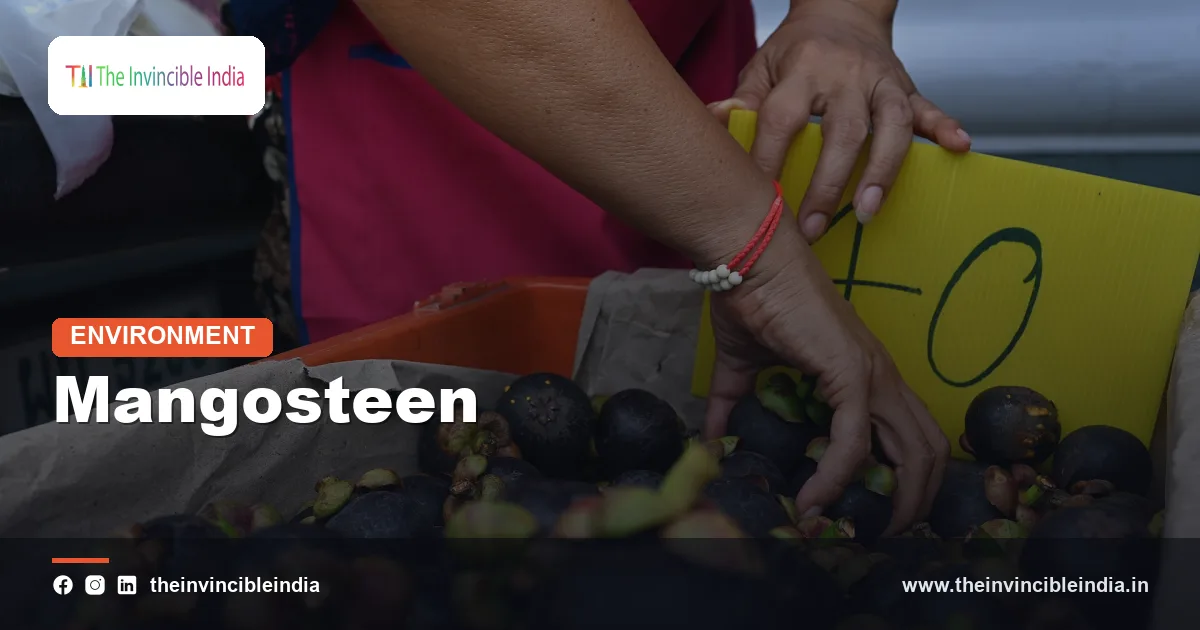
The mangosteen (Garcinia mangostana) is a slow-growing tropical evergreen tree, and the name also refers to its fruit: a round, purple-rinded fruit with soft, sweet-tart white segments, often called the “queen of fruits”. In India the mangosteen is grown in small, carefully tended orchards in Kerala, the southern tip of Tamil Nadu, the lower slopes of the Nilgiris, coastal Karnataka and the Andaman and Nicobar Islands, and it remains a rare and relatively expensive fruit.
The mangosteen is not related to the mango, despite the similar-sounding name. It belongs to the Clusiaceae family, which also includes the kokum and the Malabar tamarind that Indian kitchens use as souring agents. This explainer covers what the mangosteen is, where it grows in India, how it is cultivated, what the fruit contains and why it is so difficult to grow in large quantities.
| Attribute | Detail |
|---|---|
| Scientific name | Garcinia mangostana |
| Family | Clusiaceae (also called Guttiferae) |
| Common nickname | Queen of fruits |
| Native region | Malay Archipelago and Maluku (Moluccas), Southeast Asia |
| Main Indian growing areas | Kerala, Kanyakumari (Tamil Nadu), Nilgiris foothills, coastal Karnataka, Andaman and Nicobar Islands |
| Tree height | Typically 6 to 15 metres in cultivation, occasionally taller |
| Time to first fruit | About 7 to 10 years from seed, sometimes longer |
| Fruit season in India | Mostly the monsoon months, roughly May to September depending on location |
| Fruit size | About 4 to 7 centimetres across, with a thick purple rind |
Key Takeaways
- The mangosteen (Garcinia mangostana) is a tropical evergreen tree native to Southeast Asia and is unrelated to the mango.
- Mangosteen trees in India are grown mainly in Kerala, Kanyakumari in Tamil Nadu, the Nilgiris foothills, coastal Karnataka and the Andaman and Nicobar Islands.
- A mangosteen tree usually takes seven to ten years or more to bear its first fruit, which is why the fruit is scarce and costly.
- Every cultivated mangosteen tree is female and produces seed without fertilisation, so trees are genetically almost identical clones of one another.
- The edible part of a mangosteen is the white, juicy aril inside a thick purple rind, and the number of segments matches the number of lobes on the fruit’s base.
- Mangosteen seeds lose viability within a few weeks, so the tree cannot be easily stored or shipped as seed and is raised mostly from fresh seedlings.
What Is a Mangosteen?
A mangosteen is the fruit of Garcinia mangostana, a dense, dark-leaved evergreen tree that belongs to the same genus as kokum and gamboge. The tree has a neat, conical crown, thick leathery leaves that are glossy above and paler beneath, and a trunk that exudes a yellow latex when cut.
The fruit is about the size of a small orange or a large lime. A mature fruit has a smooth, hard, dark purple rind with a small green star-shaped cap of sepals at the stem end. Inside, four to eight white segments sit in a ring, like the sections of a tiny citrus, and only some of them contain a seed. The soft, translucent flesh melts in the mouth and tastes sweet with a mild acidic edge.
Why Is the Mangosteen Called the Queen of Fruits?
The mangosteen is called the queen of fruits because of its delicate flavour, its attractive appearance and a popular story that Queen Victoria of Britain was fond of it. The story is widely repeated, but historians regard it as folklore rather than documented fact, so it should be treated as a traditional tale.
The nickname is also used in contrast to the durian, which is sometimes called the king of fruits in Southeast Asia. Because the two fruits ripen in the same season in Malaysia and Thailand, they are often sold side by side and paired in conversation, one famous for its pungent smell and the other for its gentle fragrance.
Where Does the Mangosteen Grow in India?
The mangosteen grows in India mainly in the humid, low-lying and mid-elevation tropical belts of the south, including Kerala, the Kanyakumari district of Tamil Nadu, the foothills of the Nilgiris, parts of coastal Karnataka and the Andaman and Nicobar Islands. These regions combine high rainfall, warm temperatures and the absence of a long dry season.
In Kerala, small orchards and home gardens in districts such as Kollam, Thiruvananthapuram and Pathanamthitta carry mangosteen trees, many of them decades old. In Tamil Nadu, the Courtallam area, the Kanyakumari plantations and the Government fruit stations in the lower Nilgiris, such as Burliar and Kallar, have long grown the tree. Trials and scattered plantings have also been reported in other humid regions, including parts of the northeast, but the northeast is not a major commercial source of the fruit, and a mangosteen from that region is uncommon.
India’s total mangosteen output is tiny compared with that of Thailand, Indonesia or Malaysia. Most Indian fruit is sold locally or in nearby cities during a short season, and it is rarely exported.
What Climate and Soil Does a Mangosteen Tree Need?
A mangosteen tree needs a hot, humid, frost-free climate with well-distributed rainfall, deep and fertile soil that drains well but holds moisture, and protection from strong sun and wind when young. It is one of the fussiest fruit trees in the tropics, and this fussiness is the main reason it remains rare in India.
- Temperature: The tree does best between about 20 and 30 degrees Celsius. Cold snaps and frost damage or kill it.
- Rainfall and humidity: Even, abundant rain and high humidity are essential. A long dry season stresses the tree, while heavy rain just before harvest can cause rind and flesh disorders.
- Soil: Deep, organic-rich loam or lateritic soils with good drainage are preferred. Waterlogging and heavy clay are both harmful.
- Shade: Young seedlings need partial shade for the first few years, often provided by banana plants or coconut palms.
- Root system: The mangosteen has a weak, shallow root system with a poorly developed tap root, which makes it sensitive to transplanting and drought.
Because of these needs, the mangosteen is generally grown as an intercrop under coconut and areca palms in the southern states, where the canopy supplies natural shade and humidity.
How Is the Mangosteen Propagated and Grown?
The mangosteen is propagated mainly by fresh seed, because the seed forms without fertilisation and produces a seedling that is essentially a clone of the mother tree. This process is called apomixis. It means a farmer does not need a male tree, and it also means that almost every mangosteen tree in the world is genetically very similar.
Seeds must be sown within days of being taken from the fruit, since they are recalcitrant and lose viability quickly when dried or stored. Seedlings grow extremely slowly, often only a few centimetres in the first year, and are kept in nurseries for two or more years before being planted out. Grafting and approach-grafting on related Garcinia rootstocks have been tried to shorten the waiting period, with mixed results.
After planting, a mangosteen tree needs steady care:
- Regular watering in dry spells during the first years.
- Mulching with coconut husk or leaf litter to hold moisture.
- Organic manure and balanced fertiliser each year once the tree is established.
- Light pruning to remove dead and crossing branches.
Planting distances of about 8 to 10 metres are usual, as mature trees spread widely and cast dense shade.
Why Does a Mangosteen Tree Take So Long to Bear Fruit?
A mangosteen tree takes so long to bear fruit because its seedlings grow very slowly and its root system develops gradually, so a tree raised from seed commonly needs seven to ten years before its first crop. Some trees take longer, and yields stay modest even after fruiting begins.
A mature tree in good conditions may produce a few hundred fruits per season, but the yield varies sharply from year to year. Many growers report alternating heavy and light crops. This long wait, combined with the cost of nursery care and land, makes the fruit expensive. The long gestation also discourages new planting, since a farmer must wait nearly a decade for returns.
What Does the Mangosteen Contain, and Is It Healthy?
The edible mangosteen aril is mostly water, with natural sugars, some dietary fibre, vitamin C and small amounts of folate and minerals, so it is a nutritious fresh fruit but not a miracle food. Its calorie content is modest compared with many tropical fruits.
The thick purple rind contains a group of plant compounds called xanthones, including alpha-mangostin and gamma-mangostin, along with tannins. Laboratory studies have examined these compounds for antioxidant and anti-inflammatory activity. However, evidence that eating mangosteen or taking mangosteen supplements prevents or treats disease in people is limited, and many commercial health claims go well beyond the research. Anyone with a medical condition should rely on qualified medical advice rather than juice or extract products.
In traditional use across Southeast Asia, dried rind has been used in remedies for diarrhoea and skin complaints, and the rind and bark have also been used as a source of tannin and dye.
How Do You Choose and Eat a Mangosteen?
To eat a mangosteen, press the rind gently at the equator of the fruit until it cracks, twist the two halves apart and lift out the white segments with your fingers, discarding the bitter, staining rind. A ripe fruit feels slightly springy and gives a little under firm pressure.
- Choose fruit with a deep purple, glossy rind and a fresh green cap. Avoid fruit with a rock-hard rind, which often means the flesh is dry or overripe.
- Count the lobes on the base of the fruit, which indicates the number of segments inside. Larger segments are sweeter, and the largest segment usually holds a seed.
- Open the fruit carefully. The rind’s reddish-purple juice stains clothing and fingers.
- Eat the segments fresh, chilled or added to fruit salads and desserts. Do not eat the rind.
The fruit keeps for a few days at room temperature and for up to about two weeks in a cool place. Because the rind darkens and hardens with age, buyers should check the fruit’s weight and the freshness of the green cap.
How Does the Mangosteen Compare With Its Relatives?
The mangosteen differs from its Indian relatives in the genus Garcinia in that it is eaten fresh as a sweet fruit, while relatives such as kokum and Malabar tamarind are mainly used as sour cooking ingredients. The table below compares the best-known Garcinia species found in India.
| Species | Common names | Main use | Typical region |
|---|---|---|---|
| Garcinia mangostana | Mangosteen | Sweet fresh fruit | Kerala, southern Tamil Nadu, Nilgiris foothills, Andaman and Nicobar Islands |
| Garcinia indica | Kokum | Sour rind used in curries, drinks and kokum butter | Konkan coast and Western Ghats |
| Garcinia gummi-gutta | Malabar tamarind, kudampuli | Dried souring agent in fish curries | Kerala and the Western Ghats |
| Garcinia xanthochymus | Gamboge, false mangosteen | Sour fruit and yellow resin | Eastern Himalayas, northeast India and Western Ghats |
Because all these trees share the habit of slow growth and a yellow latex, they are also valued as shade and ornamental trees in the humid tropics.
What Are the Challenges and Future of Mangosteen in India?
The main challenges for the mangosteen in India are its slow growth, sensitivity to weather, short shelf life and the small scale of planting. Climate change adds further risk, because erratic monsoon rainfall and heat waves directly affect flowering and fruit quality.
- Physiological disorders: Excess rain around ripening can cause yellow latex to leak into the flesh and rind, a defect known as gamboge disorder, which makes the fruit unsellable.
- Short shelf life: Fruit deteriorates within days to weeks, limiting long-distance transport.
- Pests: Fruit flies and sucking pests can damage fruit, and international trade has long been affected by quarantine rules against fruit flies.
- Land pressure: Home-garden orchards are often cleared for housing and cash crops, reducing old trees.
Researchers and horticulture departments see potential in promoting the mangosteen as a high-value intercrop under coconut and areca. Better nursery methods, rainfall-protection techniques and cold storage would help the small number of growers who already cultivate it.
Why Has Mangosteen Trade Been Restricted?
Mangosteen trade has been restricted mainly because fresh fruit can carry fruit flies, which led some importing countries to require quarantine treatment before allowing sales. The United States, for example, did not allow fresh mangosteen imports for many years and began accepting irradiated fruit from Thailand and other countries only from 2007.
For Indian growers, such rules matter less because most of the crop is sold within the country. Still, any plan to supply distant markets or export the fruit would need packing houses, cold chains and pest-control treatments. A fruit that spoils quickly and weighs little per piece is also costly to transport by road, which is another reason that most mangosteen is sold near where it grows.
Bottom Line
The mangosteen is a slow, demanding and rewarding tropical fruit tree whose Indian orchards are small but valuable, mostly in Kerala, southern Tamil Nadu and the Nilgiris foothills. Its seven to ten year wait for the first fruit and its need for steady humidity explain why the “queen of fruits” is still a luxury in Indian markets.
Frequently Asked Questions
Is the mangosteen related to the mango?
No, the mangosteen is not related to the mango. The mangosteen belongs to the family Clusiaceae, while the mango belongs to the cashew family, Anacardiaceae, and the two trees differ in leaves, flowers and fruit structure.
Where is mangosteen grown in India?
Mangosteen is grown in India mainly in Kerala, the Kanyakumari district of Tamil Nadu, the Nilgiris foothills, coastal Karnataka and the Andaman and Nicobar Islands. These areas have the warm, humid, evenly rainy climate the tree requires.
How long does a mangosteen tree take to fruit?
A mangosteen tree usually takes about seven to ten years to produce its first fruit when grown from seed. Some trees need longer, and the long wait is a major reason the fruit is expensive.
When is mangosteen in season in India?
Mangosteen is in season in India mainly during the monsoon months, roughly from May to September depending on the location. Fruit from the Kerala plains usually appears earlier than fruit from higher parts of the Nilgiris foothills.
Can you eat the purple rind of a mangosteen?
No, the purple rind of a mangosteen is not eaten as food. The rind is bitter and stains heavily, though it contains tannins and xanthones that have been studied in laboratories and used traditionally in some Southeast Asian remedies.
Why is mangosteen so expensive?
Mangosteen is expensive because the tree grows slowly, bears fruit only after several years, yields unevenly and produces fruit that spoils quickly. Limited planting area and careful hand harvesting also raise the price in Indian markets.
{“@context”:”https://schema.org”,”@graph”:[{“@type”:”FAQPage”,”mainEntity”:[{“@type”:”Question”,”name”:”Is the mangosteen related to the mango?”,”acceptedAnswer”:{“@type”:”Answer”,”text”:”No, the mangosteen is not related to the mango. The mangosteen belongs to the family Clusiaceae, while the mango belongs to the cashew family, Anacardiaceae, and the two trees differ in leaves, flowers and fruit structure.”}},{“@type”:”Question”,”name”:”Where is mangosteen grown in India?”,”acceptedAnswer”:{“@type”:”Answer”,”text”:”Mangosteen is grown in India mainly in Kerala, the Kanyakumari district of Tamil Nadu, the Nilgiris foothills, coastal Karnataka and the Andaman and Nicobar Islands. These areas have the warm, humid, evenly rainy climate the tree requires.”}},{“@type”:”Question”,”name”:”How long does a mangosteen tree take to fruit?”,”acceptedAnswer”:{“@type”:”Answer”,”text”:”A mangosteen tree usually takes about seven to ten years to produce its first fruit when grown from seed. Some trees need longer, and the long wait is a major reason the fruit is expensive.”}},{“@type”:”Question”,”name”:”When is mangosteen in season in India?”,”acceptedAnswer”:{“@type”:”Answer”,”text”:”Mangosteen is in season in India mainly during the monsoon months, roughly from May to September depending on the location. Fruit from the Kerala plains usually appears earlier than fruit from higher parts of the Nilgiris foothills.”}},{“@type”:”Question”,”name”:”Can you eat the purple rind of a mangosteen?”,”acceptedAnswer”:{“@type”:”Answer”,”text”:”No, the purple rind of a mangosteen is not eaten as food. The rind is bitter and stains heavily, though it contains tannins and xanthones that have been studied in laboratories and used traditionally in some Southeast Asian remedies.”}},{“@type”:”Question”,”name”:”Why is mangosteen so expensive?”,”acceptedAnswer”:{“@type”:”Answer”,”text”:”Mangosteen is expensive because the tree grows slowly, bears fruit only after several years, yields unevenly and produces fruit that spoils quickly. Limited planting area and careful hand harvesting also raise the price in Indian markets.”}}]}]}


