

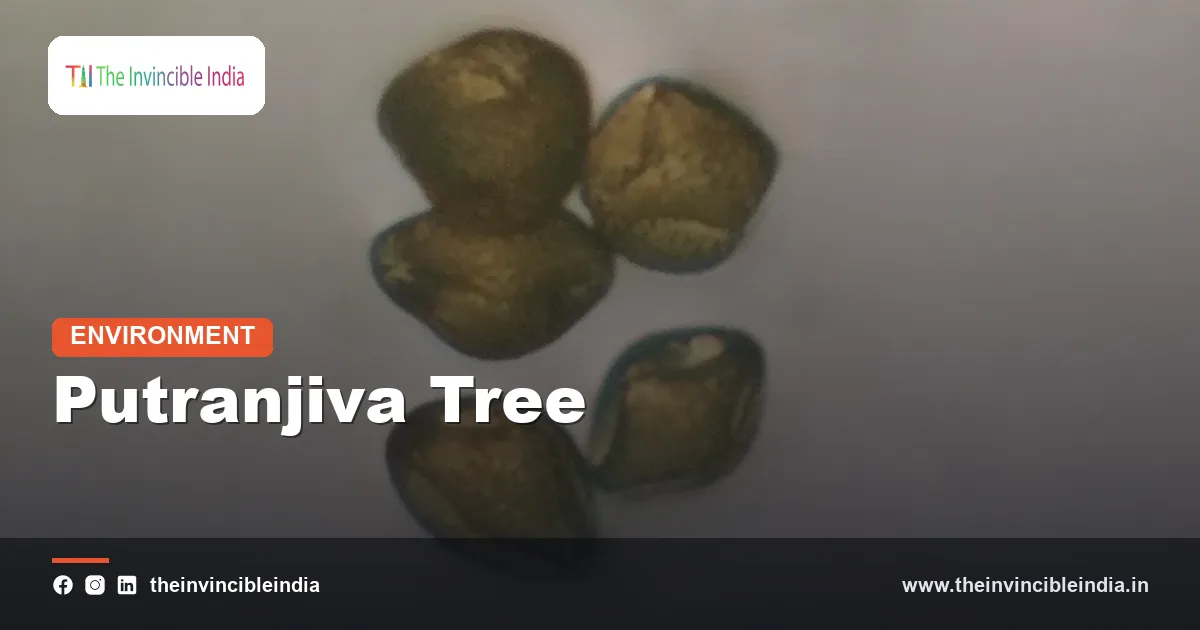
The putranjiva is the evergreen Indian tree Putranjiva roxburghii, known in English as the child-life tree because its hard, grooved seed stones are strung into protective necklaces for children. The name comes from Sanskrit, where putra means son or child and jiva means life, and the tree has long been associated with the hope of healthy children and long life in many parts of northern and eastern India.
Beyond its cultural role, putranjiva is a handsome, shade-giving tree with glossy dark leaves and drooping branches, widely planted along roads, in gardens and in temple and school compounds. This explainer describes what putranjiva is, how to recognise it, where it grows, why its seeds became a symbol of protection, how it is used in traditional medicine, and what role it plays in Indian urban greenery.
Quick Facts: Putranjiva
| Scientific name | Putranjiva roxburghii (also treated as Drypetes roxburghii by many botanists) |
|---|---|
| Family | Putranjivaceae (earlier placed in Euphorbiaceae) |
| Common names | Putranjiva, child-life tree, lucky bean tree; jiyapota in Hindi |
| Meaning of the name | Sanskrit putra (son, child) plus jiva (life) |
| Plant type | Evergreen, medium-sized, dioecious tree with a dense, rounded crown |
| Typical height | Usually about 10 to 15 metres in mature trees |
| Range | Plains and lower hills of India, also Sri Lanka, Nepal, Myanmar and parts of Southeast Asia |
| Best-known use | Seed stones strung as protective necklaces and rosaries; avenue and shade tree |
| Conservation concern | Not regarded as rare; widely planted in towns and villages |
Key Takeaways
- Putranjiva roxburghii is an evergreen Indian tree whose name means “child life” in Sanskrit, reflecting a long-held belief that its seeds protect children.
- The hard, grooved stones of the putranjiva fruit are threaded into garlands that families traditionally place around the necks of infants and young children.
- Putranjiva trees are dioecious, which means male and female flowers grow on separate trees and only the female trees produce the olive-sized fruits.
- The putranjiva tree tolerates heat, dust and moderate drought, which is why it is a common choice for roadside and avenue planting in Indian towns.
- In Ayurveda and folk medicine, parts of the putranjiva tree are traditionally used for fever, cold and joint complaints, but these uses are not proven cures.
- The belief in putranjiva beads is a cultural and spiritual tradition and is not backed by clinical evidence of protection against illness.
What is putranjiva?
Putranjiva is a medium to large evergreen tree, scientifically named Putranjiva roxburghii, that belongs to the small plant family Putranjivaceae. Many modern botanists merge the genus into Drypetes and write the name as Drypetes roxburghii, but the older name Putranjiva roxburghii is still the one most often seen in Indian floras, nursery lists and forest department records.
The species is named after William Roxburgh, the Scottish botanist who worked in Calcutta in the late eighteenth and early nineteenth centuries and described a large number of Indian plants. Putranjiva has an unusual bark and leaf structure for a tree of the plains: its thin, grey bark is smooth to slightly rough, and the crown is broad and rounded, with branches that tend to droop at the tips.
Because the tree keeps its leaves throughout the year, it provides steady shade and a dark green canopy even in the hot months. English-language names such as child-life tree and lucky bean tree are translations or loose adaptations of the Indian names rather than formal botanical terms.
How can you identify a putranjiva tree?
A putranjiva tree can be identified by its glossy, dark green, leathery leaves with wavy edges, its drooping branch tips and its pale, olive-like fruits that hold a single hard stone. These features together distinguish it from most other shade trees of Indian roads.
Leaves and crown
The leaves of putranjiva are simple and arranged alternately along the twig. Each leaf is oblong to lance-shaped, roughly 5 to 12 centimetres long, with a glossy upper surface and a pale underside. The margins are slightly wavy and finely toothed, which gives the foliage a rippled look in the wind. Young leaves are paler and may show a faint reddish or bronze tint before they harden.
Flowers and fruits
Putranjiva flowers are small, greenish and easy to overlook. Male flowers appear in dense clusters on one tree, while female flowers appear singly or in small groups on another tree. Flowering is mostly in the spring months, and the fruits ripen later, typically around the early monsoon season. The fruit is a small drupe, often about the size of an olive, usually pale or greyish-white and covered with fine hairs when young.
The seed stone
Inside the soft outer layer of each fruit is a single stone with a rough, ridged and slightly grooved surface. This stone is the part used for beads. Once cleaned and dried, it becomes very hard, which is why the beads last for years without breaking.
Where does putranjiva grow in India?
Putranjiva grows naturally in the moist and dry deciduous forests and plains of India, and it is cultivated widely in cities, towns and villages across the country. It is found in the Gangetic plains, the central Indian belt, the Western Ghats foothills and parts of eastern and southern India, usually at low to moderate elevations.
Outside India the species occurs in Sri Lanka, Nepal, Bangladesh, Myanmar and parts of Southeast Asia, which shows that it is a tree of the tropical Asian monsoon belt. It prefers well-drained soil and does best with seasonal rainfall, but established trees cope with long dry periods.
The tree is common in older avenue plantings of northern Indian cities and in the compounds of temples, schools, hospitals and government buildings. Planners favour it because it casts dense shade, stays green all year and does not need heavy maintenance once established.
Why is putranjiva called the child-life tree?
Putranjiva is called the child-life tree because the Sanskrit name combines putra (child) and jiva (life), and Indian tradition holds that the tree and its seeds bring protection and long life to children. The belief is old and widespread, and it is part of a broader set of Indian customs in which particular plants are linked to family welfare.
In popular tradition, a necklace of putranjiva beads is placed on a newborn or toddler to ward off the evil eye, illness and misfortune. Some families keep a single bead or a small garland as a household charm. The tradition is also tied to hopes for having children: in some regions, couples wishing for a child have been advised to plant, tend or worship a putranjiva tree, and the tree is sometimes planted near homes for this reason.
These beliefs are cultural and devotional rather than scientific. There is no clinical evidence that wearing putranjiva beads prevents disease, and parents should not treat the beads as a substitute for vaccination, nutrition or medical care. What the tradition does show is how deeply a single tree species can be woven into family life and ritual.
How are putranjiva beads made and used?
Putranjiva beads are made by collecting ripe fruits, removing the soft outer pulp, cleaning and drying the stones, and then drilling or threading them into necklaces or rosaries. The natural grooves on each stone give the beads a distinctive, slightly textured look that is easy to recognise.
The common forms of putranjiva beads are listed below.
- Child necklaces: a short string of beads, sometimes mixed with silver or coloured thread, placed around the neck of an infant or young child.
- Mala or rosary: a longer string, used by some devotees for counting prayers or mantras, valued because the stones are durable and plain in appearance.
- Single charm beads: one bead tied to a thread, worn on the wrist or hung in the home.
- Craft use: beads strung into simple jewellery and handicrafts in some markets, often sold near temples and fairs.
Beads are sold at religious shops and herbal stores, and their price is usually modest. Buyers should be aware that some strings sold under the name may be mixed with look-alike seeds, since many Indian trees produce small hard stones that can resemble putranjiva when sanded and polished.
What are the traditional medicinal uses of putranjiva?
In Ayurveda and folk medicine, putranjiva leaves, bark, fruits and seeds are traditionally used for conditions such as fever, common cold, joint pain and certain women’s health complaints, but these are historical practices and not proven treatments. Classical and regional herbal texts mention the plant, and practitioners in several states still prepare decoctions or pastes from its parts.
Reported traditional preparations include a leaf decoction taken during seasonal fever and cold, a bark or leaf paste applied to sore joints, and fruit or seed preparations used in some folk remedies for women. Laboratory studies on extracts of the plant have looked at properties such as anti-inflammatory and antioxidant activity, but such studies are early and are mostly done on cells or animals.
It is important not to treat these claims as medical advice. No standard medicine is made from putranjiva, and large doses of any plant extract can cause harm. Anyone who wants to use a herbal preparation should consult a registered Ayurvedic practitioner or a doctor, particularly for children, pregnant women and people already on medication.
Is putranjiva a good shade and avenue tree?
Yes, putranjiva is considered a good shade and avenue tree for Indian towns because it is evergreen, forms a dense crown, tolerates dust and heat, and needs little care once it has established roots. These traits make it a reliable choice for places where deciduous trees would leave the ground bare for part of the year.
The comparison below summarises the main reasons why urban planners and nurseries recommend it.
| Feature | What it means for planting |
|---|---|
| Evergreen foliage | Shade and greenery are available all year, including the hot summer months |
| Dense, rounded crown | Good canopy cover over footpaths, school grounds and parking areas |
| Dust and pollution tolerance | Glossy leaves cope with the dusty, polluted air of busy roads better than many delicate species |
| Moderate drought tolerance | Established trees survive dry spells with little watering |
| Slow to moderate growth | Trees take time to mature, so planters need patience |
| Dioecious habit | Only female trees drop fruits; male trees give shade without fruit litter |
One practical point is that planters usually cannot tell the sex of a young tree. Fruits fall from female trees during the early monsoon and can make the ground messy for a short period, which is a minor drawback near footpaths and parked vehicles.
What wildlife and ecological value does putranjiva have?
Putranjiva has moderate ecological value because its dense evergreen canopy offers nesting and roosting space for birds and its small fruits and flowers add to the food supply of urban wildlife. In towns where many street trees are exotic species, a native tree such as putranjiva helps keep the local plant community intact.
Birds such as common mynas, bulbuls and parakeets often use evergreen trees of this kind for shelter, particularly in the hot season when shade matters for them as much as for people. Insects visit the small flowers, and the leaf litter enriches the soil beneath the tree. The leaves are also reported to be lopped as fodder for goats and cattle in some rural areas during lean periods.
As a native species of the Indian plains, putranjiva fits well in biodiversity-friendly planting plans. Urban forestry guidance in India increasingly encourages the use of native trees over fast-growing exotics, and putranjiva is among the species that suit this approach.
How do you grow and care for a putranjiva tree?
A putranjiva tree is grown from seed or sapling, planted in well-drained soil at the start of the monsoon, and watered regularly for the first two or three years until its roots are established. After that, it needs little attention beyond occasional pruning to shape the crown.
- Propagation: seeds are the usual method. The stones have a hard coat and can be slow and uneven to germinate, so nurseries often soak or scarify them to speed things up.
- Planting time: the rainy season, so that young plants receive natural moisture while they settle in.
- Sunlight: full sun to light shade; saplings tolerate some shade, but growth is better in open light.
- Soil: adaptable, from loam to lighter soils, provided water does not stand around the roots.
- Spacing: because the crown becomes broad, avenue trees are planted with generous gaps, and not too close to buildings.
- Pruning: light trimming of dead or crossing branches is enough; heavy pruning is rarely needed.
The tree grows slowly to moderately, so quick shade should not be expected in the first few years. Gardeners who want fruit and beads should plant several saplings, since a single tree may turn out to be male.
What are the other uses of putranjiva?
Besides beads and medicine, the other uses of putranjiva include timber for small objects, leaves as fodder and the tree as an ornamental. The wood is hard and fine-grained, and it is reported to be used for tool handles, small implements and simple carved items, though it is not a major commercial timber in India.
The ornamental and cultural use is perhaps the most visible. Garden designers value the tree for its deep green foliage, and many Indian families plant it at home for its tradition rather than for any economic return. In this way putranjiva sits at the point where horticulture, religion and everyday life meet.
Does putranjiva have any cautions or conservation concerns?
Putranjiva has no major conservation concern at present because it is widely planted and common in India, but wild forest populations are affected, as with many native trees, by clearing of land and urban expansion. Planting it in towns and villages is generally considered beneficial for local green cover.
The main cautions relate to use. Bead strings sold in markets should be treated as cultural items and not as medical devices, and small children should not be allowed to chew or swallow loose beads, as they are a choking hazard. Herbal products made from the tree should be used only under professional guidance.
Bottom Line
Putranjiva is a hardy, evergreen native tree that combines practical value as a shade and avenue tree with a rich cultural role as the child-life tree. Its seed beads express a deep Indian tradition of protecting children, while its medicinal reputation remains a matter of traditional use rather than proven science.
Frequently Asked Questions
What is putranjiva called in English?
Putranjiva is called the child-life tree in English, and sometimes the lucky bean tree. The Sanskrit name means “child life”, and its Hindi name is jiyapota.
Why are putranjiva beads given to children?
Putranjiva beads are given to children because Indian tradition holds that they protect against the evil eye and bring long life. This is a cultural belief and not a clinically proven effect, so the beads should never replace vaccination or medical care.
What is the scientific name of putranjiva?
The scientific name of putranjiva is Putranjiva roxburghii. Many botanists now also write it as Drypetes roxburghii, and it belongs to the family Putranjivaceae.
Is putranjiva a good tree to plant near the house?
Yes, putranjiva is a good tree to plant near the house if there is enough space for its broad crown. It gives dense evergreen shade and tolerates dust and heat, although fruit may fall from female trees in the early monsoon.
Does putranjiva have medicinal uses?
Putranjiva is used in Ayurveda and folk medicine for complaints such as fever, cold and joint pain. These are traditional uses, not proven cures, and anyone considering a herbal preparation should consult a qualified practitioner.
Why do some putranjiva trees not produce fruit?
Some putranjiva trees do not produce fruit because the species is dioecious, with male and female flowers on separate trees. Only female trees bear the fruits that contain the stones used for beads.
{“@context”:”https://schema.org”,”@graph”:[{“@type”:”FAQPage”,”mainEntity”:[{“@type”:”Question”,”name”:”What is putranjiva called in English?”,”acceptedAnswer”:{“@type”:”Answer”,”text”:”Putranjiva is called the child-life tree in English, and sometimes the lucky bean tree. The Sanskrit name means “child life”, and its Hindi name is jiyapota.”}},{“@type”:”Question”,”name”:”Why are putranjiva beads given to children?”,”acceptedAnswer”:{“@type”:”Answer”,”text”:”Putranjiva beads are given to children because Indian tradition holds that they protect against the evil eye and bring long life. This is a cultural belief and not a clinically proven effect, so the beads should never replace vaccination or medical care.”}},{“@type”:”Question”,”name”:”What is the scientific name of putranjiva?”,”acceptedAnswer”:{“@type”:”Answer”,”text”:”The scientific name of putranjiva is Putranjiva roxburghii. Many botanists now also write it as Drypetes roxburghii, and it belongs to the family Putranjivaceae.”}},{“@type”:”Question”,”name”:”Is putranjiva a good tree to plant near the house?”,”acceptedAnswer”:{“@type”:”Answer”,”text”:”Yes, putranjiva is a good tree to plant near the house if there is enough space for its broad crown. It gives dense evergreen shade and tolerates dust and heat, although fruit may fall from female trees in the early monsoon.”}},{“@type”:”Question”,”name”:”Does putranjiva have medicinal uses?”,”acceptedAnswer”:{“@type”:”Answer”,”text”:”Putranjiva is used in Ayurveda and folk medicine for complaints such as fever, cold and joint pain. These are traditional uses, not proven cures, and anyone considering a herbal preparation should consult a qualified practitioner.”}},{“@type”:”Question”,”name”:”Why do some putranjiva trees not produce fruit?”,”acceptedAnswer”:{“@type”:”Answer”,”text”:”Some putranjiva trees do not produce fruit because the species is dioecious, with male and female flowers on separate trees. Only female trees bear the fruits that contain the stones used for beads.”}}]}]}


