

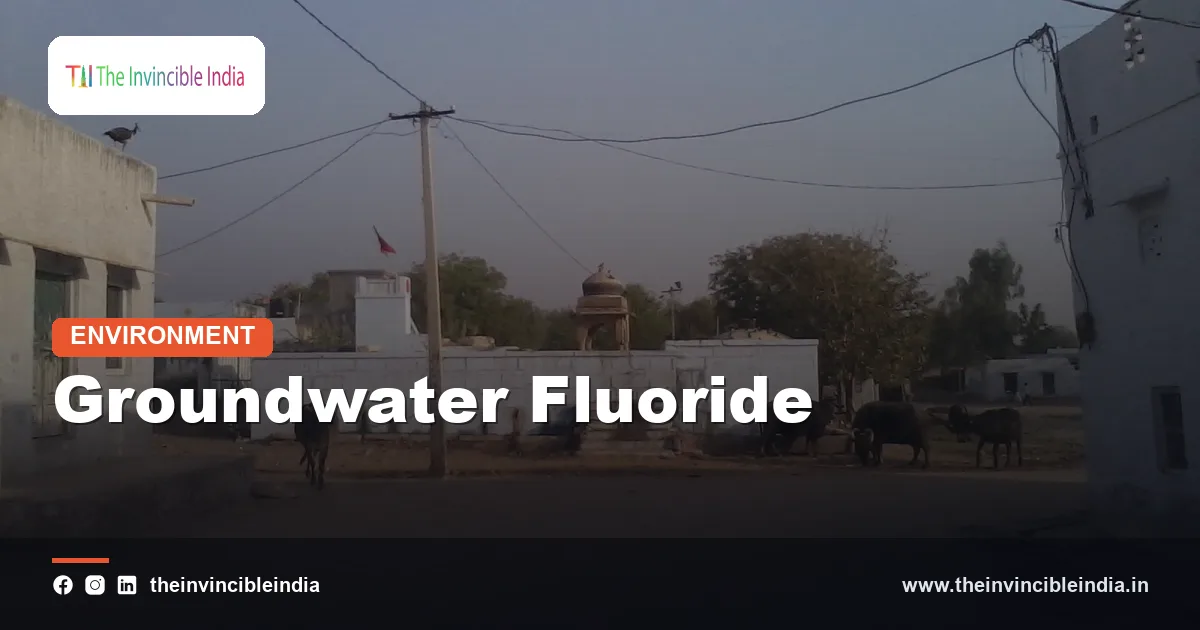
Groundwater fluoride is the dissolved fluoride found naturally in well water, and in many parts of India it occurs at levels well above the safe limit, causing fluorosis, a disease that mottles teeth and, in severe cases, cripples bones and joints. Unlike arsenic, fluoride is useful in small doses because it strengthens teeth, but the gap between a helpful and a harmful amount is narrow, and large parts of India’s hard-rock interior sit on the wrong side of it.
This explainer covers where fluoride in groundwater comes from, why the dry granite and gneiss regions of Rajasthan, Gujarat, Andhra Pradesh and Telangana are so affected, the BIS and WHO limits, the difference between dental and skeletal fluorosis, and the main ways to remove fluoride or avoid it. It was last reviewed on 2 November 2026.
| Attribute | Detail |
|---|---|
| What it is | Dissolved fluoride in groundwater above the level safe for long-term drinking |
| Main origin | Geogenic (natural): fluoride-bearing minerals in granite, gneiss and other rocks dissolve into water |
| Limits | BIS: 1.0 mg/L acceptable, up to 1.5 mg/L permissible where no alternative source exists; WHO guideline: 1.5 mg/L |
| Most affected states | Rajasthan, Gujarat, Andhra Pradesh, Telangana, Karnataka, Tamil Nadu, Punjab, Haryana, Madhya Pradesh, Uttar Pradesh and others |
| Disease | Dental fluorosis, skeletal fluorosis and non-skeletal effects |
| First reported in India | Andhra Pradesh, in the 1930s |
| Main treatment methods | Nalgonda technique, activated alumina, reverse osmosis, bone char and safe-source supply |
| National programme | National Programme for Prevention and Control of Fluorosis (NPPCF), started 2008 |
Key Takeaways
- Fluoride in Indian groundwater is mostly natural, released from minerals in granite, gneiss and other hard rocks, and it is concentrated by hot, dry climates and alkaline water.
- The Bureau of Indian Standards sets an acceptable limit of 1.0 mg/L and a permissible limit of 1.5 mg/L where no alternative source exists, and the WHO guideline is 1.5 mg/L.
- Levels slightly above the limit mainly stain and pit teeth (dental fluorosis), while long exposure to high levels harms bones and joints (skeletal fluorosis), which can be crippling and cannot be cured.
- Many states are affected, with Rajasthan, Gujarat, Andhra Pradesh, Telangana, Karnataka and Tamil Nadu among those with the most contaminated habitations.
- Boiling does not remove fluoride, and it can concentrate it, so safe water must come from a different source or a proper defluoridation process.
- Solutions include safe surface water, rainwater harvesting, defluoridation plants and good nutrition with calcium, vitamin C and other protective nutrients.
What Is Groundwater Fluoride and Why Does It Matter?
Groundwater fluoride is fluoride dissolved in underground water, and it matters because the amount people drink every day decides whether it protects or damages their health. In very small amounts, fluoride helps to prevent tooth decay, which is why some countries add it to public water supplies at about 0.5 to 1.0 mg/L. Above about 1.5 mg/L, however, it begins to harm teeth, and at higher levels over many years it affects bones.
In India the issue is not about adding fluoride but about too much of it occurring naturally. Millions of people, mainly in rural areas, depend on hand pumps and bore wells for drinking water, and in many hard-rock regions the only nearby groundwater is high in fluoride. Fluoride has no colour, taste or smell in water, so people cannot detect it without testing.
The problem is largely a rural, poor-people’s disease. Children and adults in affected villages often show visible tooth damage, and in the most severe areas many adults develop painful, stiff joints and deformed limbs.
Where Does Fluoride in Groundwater Come From?
Fluoride in groundwater comes mainly from fluoride-bearing minerals in rocks, such as fluorite, apatite and fluoride-rich micas, which dissolve slowly into water that moves through them. This is called geogenic contamination, since it arises from the geology and not from pollution.
The rocks most associated with high fluoride are granites, granitic gneisses and some pegmatites, which are common across the Deccan and Peninsular plateau and parts of Rajasthan. Alluvial and sedimentary aquifers can also carry fluoride where the sediments came from such rocks or where the water has evaporated.
Several conditions make fluoride more likely to build up:
- Alkaline water: High pH and high bicarbonate favour the release of fluoride from minerals.
- Low calcium: Calcium combines with fluoride to form insoluble fluorite, so soft, calcium-poor water can hold more dissolved fluoride.
- Hot, dry climate: Evaporation in arid and semi-arid regions concentrates salts, including fluoride, in shallow groundwater.
- Long contact time: Slow-moving water that stays for long in rock dissolves more fluoride.
- Heavy pumping: Falling water tables can draw deeper, fluoride-rich water into wells, and irrigation return flow can add salts that raise levels.
Human sources exist but are minor in comparison. Industrial emissions from brick kilns, aluminium smelters, fertiliser plants and coal burning can add fluoride locally, and some phosphate fertilisers contain it, but most contamination across India is natural.
Which Indian States Are Affected by Fluoride in Groundwater?
Fluoride above the safe limit has been reported in groundwater in many Indian states, with Rajasthan, Gujarat, Andhra Pradesh, Telangana, Karnataka and Tamil Nadu among the most affected. Fluorosis was first reported in India in the 1930s in Andhra Pradesh, and surveys since then have shown the problem to be widespread across the country’s dry and hard-rock regions.
| Region | Geological and climatic setting | Notes |
|---|---|---|
| Rajasthan | Arid climate, granites, gneisses and alluvium | Among the largest numbers of affected habitations, in nearly all districts |
| Gujarat | Semi-arid, with hard-rock and alluvial aquifers | Affected districts in the north, Saurashtra and Kutch regions |
| Andhra Pradesh and Telangana | Granite and gneiss terrain of the Deccan | Nalgonda district became the best-known example, with severe skeletal fluorosis |
| Karnataka and Tamil Nadu | Crystalline rocks and dry interior districts | Pockets across Tumkur, Kolar, Chitradurga, Dharmapuri and Krishnagiri |
| Punjab and Haryana | Alluvial plains with evaporation and irrigation | Fluoride mainly in the south-west, in dry and canal-irrigated districts |
| Uttar Pradesh, Madhya Pradesh, Maharashtra, Odisha, Bihar and others | Mixed geology | Local pockets, often linked to granites or arid zones |
The Ministry of Jal Shakti has recorded fluoride-affected habitations in a large number of districts, and government reports have long treated fluoride and arsenic as the two chemical contaminants most important to drinking water programmes. Exact figures change as habitations are surveyed and as new schemes cover them, so numbers in reports should be read as snapshots.
What Are the Safe Limits for Fluoride in Drinking Water?
The safe limit for fluoride in drinking water in India is 1.0 mg/L as the acceptable level, with up to 1.5 mg/L permissible only where no alternative source is available, as per Bureau of Indian Standards specification IS 10500. The World Health Organization guideline value is 1.5 mg/L. One milligram per litre is the same as one part per million.
The BIS arrangement has two tiers. Water at or below 1.0 mg/L is regarded as acceptable to consumers. Between 1.0 and 1.5 mg/L the water is permissible only if nothing better exists, which recognises that rural supplies in dry regions often have no alternative. Above 1.5 mg/L, the water is not considered safe for long-term drinking.
The limit is low because people in hot climates drink more water, and so consume more fluoride from the same concentration. This is one reason that some researchers argue India’s standards should be applied with caution in the hottest regions. Nutrition also matters: people who have diets low in calcium and vitamin C, as is common among poor rural populations, show greater damage at the same fluoride intake.
What Is Fluorosis and How Does It Harm the Body?
Fluorosis is the disease caused by long-term intake of too much fluoride, and it harms the teeth first and, with heavier or longer exposure, the bones and soft tissues. It develops slowly and builds up with every year of exposure.
Dental fluorosis
Dental fluorosis affects children whose teeth are still forming, usually under the age of about eight. It begins as white, chalky flecks on the enamel and progresses to yellow and brown stains, pitting and rough, brittle teeth in severe cases. It is mainly a cosmetic and social problem, although severely affected teeth can wear and decay. Because the damage is done while the teeth develop, it cannot be reversed once the teeth have erupted.
Skeletal fluorosis
Skeletal fluorosis occurs after many years of high intake, typically with water well above 3 mg/L. Fluoride builds up in bones, which become denser but more brittle, and ligaments harden. Early signs are vague aches, stiffness of the back and pain in the joints that are often mistaken for arthritis. Over time, the spine and large joints can stiffen, limbs can bend, and the person may be unable to walk or work. In children, the condition can cause genu valgum, the knock-knee deformity seen in some villages of Nalgonda and elsewhere.
Non-skeletal effects
High fluoride intake has also been linked to stomach problems, muscle weakness, fatigue and, in some studies, effects on the thyroid and kidneys. Some research has suggested that very high fluoride exposure may affect children’s cognitive development, but the evidence at the lower levels relevant to most water supplies is debated and still being studied.
Skeletal fluorosis is not curable once established. Treatment aims to stop further intake by switching to safe water, to improve nutrition with calcium, vitamin D and vitamin C, and to manage pain and mobility.
Why Are Rajasthan, Gujarat, Andhra Pradesh and Telangana So Affected?
Rajasthan, Gujarat, Andhra Pradesh and Telangana are heavily affected because they combine fluoride-rich granitic rocks or arid-zone sediments with hot, dry weather and heavy dependence on groundwater. Each ingredient helps the others.
In Rajasthan, the arid climate and low rainfall mean little recharge to dilute groundwater, and evaporation concentrates salts. Deep-water tables and long distances from rivers force villages to depend on a single bore well. In Gujarat, a combination of hard-rock aquifers and over-extraction, especially in the north, has deepened the problem.
In Andhra Pradesh and Telangana, the ancient granite and gneiss of the Deccan carry fluoride-rich minerals, and the soft, alkaline groundwater is low in calcium. Nalgonda district in Telangana gave its name to a defluoridation technique after its fluorosis was documented in detail in the 1970s and later. Groundwater is the main water source in this region because rivers are seasonal.
Over-pumping can make things worse. As water tables fall, wells reach water that has been in contact with rock for longer, and it often contains more fluoride. For this reason, groundwater depletion and groundwater quality are closely linked problems.
How Can Fluoride Be Removed from Drinking Water?
Fluoride can be removed from drinking water by chemical precipitation, adsorption on special media, or membrane filtration, at either household or community scale. Simple boiling does not work, and it increases the concentration because water evaporates while fluoride stays behind.
| Method | How it works | Strengths | Limits |
|---|---|---|---|
| Nalgonda technique | Alum and lime are added, forming flocs that trap fluoride, and the water is settled and filtered | Low cost, developed in India by the National Environmental Engineering Research Institute (NEERI), suited to villages | Leaves sludge, needs correct dosing, adds some aluminium and sulphate |
| Activated alumina | Fluoride adsorbs onto alumina granules in a column | Effective, can be regenerated | Needs pH control, regeneration chemicals and skilled upkeep |
| Reverse osmosis | Water is forced through a membrane that blocks fluoride and other ions | Removes many contaminants at once | Wastes water, costs more, needs electricity, strips useful minerals |
| Bone char and other adsorbents | Charred bone or other media bind fluoride | Cheap and locally made in some areas | Acceptability, taste and handling concerns |
| Safe-source supply | Piped surface water, protected sources or rainwater instead of the contaminated well | Avoids contamination entirely | Needs infrastructure and funds |
Experience shows that community plants often fail when no one is trained or paid to run them, and spent media and sludge need safe disposal. Household filters are easier to operate but are costly for poor families and need replacing at regular intervals.
What Can Be Done at the Household and Community Level?
At the household and community level, the best protection is to know the fluoride level of the water, use a safer source for drinking and cooking, and improve nutrition. Several simple steps reduce harm.
- Test the source: Check handpumps and bore wells through local public health laboratories and mark unsafe sources.
- Use safe water for drinking and cooking: Food cooked in high-fluoride water absorbs it, so safe water is needed for cooking as well as drinking.
- Harvest rainwater: Rainwater has almost no fluoride and can be stored or used to dilute contaminated water, and recharge structures can improve groundwater quality over time.
- Improve nutrition: Calcium from milk, curd, green leafy vegetables and ragi, together with vitamin C from fruits such as amla and guava, and adequate vitamin D, reduce the harm fluoride does to bones and teeth.
- Be careful with other fluoride sources: Brick tea, some fluoride toothpastes swallowed by small children, and food cooked over high-fluoride coal can add to intake.
- Seek early diagnosis: Health workers can screen children for dental signs and adults for early skeletal symptoms so that exposure is stopped early.
Community participation is critical. Villages that own and manage their own water source, test it regularly and understand the cause of fluorosis have been more successful in sustaining interventions than those depending on one-time installations.
What Is India Doing About Fluoride in Groundwater?
India deals with groundwater fluoride mainly through its rural drinking water programmes and the National Programme for Prevention and Control of Fluorosis, which was launched in 2008. The programme supports surveys, laboratory facilities, diagnosis, treatment and health education in affected districts.
Drinking water schemes have long prioritised fluoride- and arsenic-affected habitations. The Jal Jeevan Mission, begun in 2019, aims to deliver tap water to every rural household and gives priority to quality-affected areas, favouring surface-water-based or multi-village schemes where local groundwater is unsafe. The Central Ground Water Board maps groundwater quality, and state public health engineering departments handle testing and treatment plants.
Progress has been real but uneven. Many habitations have been covered by safe sources, but new contamination emerges as water tables fall, and treatment plants frequently stop working. Experts call for regular water-quality surveillance, better operation and maintenance, care in drilling deeper, and joint work between water, health and agriculture departments.
Bottom Line
Groundwater fluoride is a natural contaminant that turns a life-giving resource into a source of lifelong disability in many dry and hard-rock parts of India. The limits are clear at 1.0 to 1.5 mg/L, the disease is preventable, and the technology to remove fluoride exists. What decides the outcome is whether safe water reaches affected villages reliably, whether plants are kept running, and whether groundwater is managed so that falling water tables do not make quality worse.
Frequently Asked Questions
What is the permissible limit of fluoride in drinking water in India?
The Bureau of Indian Standards sets an acceptable limit of 1.0 mg/L for fluoride in drinking water, with up to 1.5 mg/L permissible where no alternative source exists. The World Health Organization guideline value is 1.5 mg/L. Water above 1.5 mg/L is not considered safe for long-term use.
What causes high fluoride in Indian groundwater?
High fluoride in Indian groundwater is caused mainly by natural dissolution of fluoride-bearing minerals in granite, gneiss and similar rocks. Alkaline, calcium-poor water, a hot dry climate and long contact between water and rock make it worse. Industrial and fertiliser sources contribute only locally.
What is the difference between dental and skeletal fluorosis?
Dental fluorosis affects the enamel of children’s developing teeth, causing white flecks, brown stains and pitting. Skeletal fluorosis affects bones and joints after many years of high intake, causing stiffness, pain and deformity. Dental damage is mostly cosmetic; skeletal damage can be crippling and is irreversible.
Which Indian states have the most fluoride in groundwater?
Rajasthan, Gujarat, Andhra Pradesh, Telangana, Karnataka and Tamil Nadu are among the most affected states, with significant pockets also in Punjab, Haryana, Uttar Pradesh and Madhya Pradesh. The problem is concentrated in hot, dry regions and areas with granite and gneiss rocks.
Does boiling water remove fluoride?
Boiling does not remove fluoride, and it can raise the concentration because some water evaporates. Fluoride has to be removed by methods such as the Nalgonda technique, activated alumina or reverse osmosis, or avoided by switching to a safe source such as piped surface water or rainwater.
Can fluorosis be cured?
Fluorosis cannot be cured once teeth are stained or bones are damaged, but it can be prevented and its progress can be stopped. Switching to safe water and improving nutrition with calcium, vitamin C and vitamin D help limit damage, and treatment focuses on pain relief and mobility.
{“@context”:”https://schema.org”,”@graph”:[{“@type”:”FAQPage”,”mainEntity”:[{“@type”:”Question”,”name”:”What is the permissible limit of fluoride in drinking water in India?”,”acceptedAnswer”:{“@type”:”Answer”,”text”:”The Bureau of Indian Standards sets an acceptable limit of 1.0 mg/L for fluoride in drinking water, with up to 1.5 mg/L permissible where no alternative source exists. The World Health Organization guideline value is 1.5 mg/L. Water above 1.5 mg/L is not considered safe for long-term use.”}},{“@type”:”Question”,”name”:”What causes high fluoride in Indian groundwater?”,”acceptedAnswer”:{“@type”:”Answer”,”text”:”High fluoride in Indian groundwater is caused mainly by natural dissolution of fluoride-bearing minerals in granite, gneiss and similar rocks. Alkaline, calcium-poor water, a hot dry climate and long contact between water and rock make it worse. Industrial and fertiliser sources contribute only locally.”}},{“@type”:”Question”,”name”:”What is the difference between dental and skeletal fluorosis?”,”acceptedAnswer”:{“@type”:”Answer”,”text”:”Dental fluorosis affects the enamel of children’s developing teeth, causing white flecks, brown stains and pitting. Skeletal fluorosis affects bones and joints after many years of high intake, causing stiffness, pain and deformity. Dental damage is mostly cosmetic; skeletal damage can be crippling and is irreversible.”}},{“@type”:”Question”,”name”:”Which Indian states have the most fluoride in groundwater?”,”acceptedAnswer”:{“@type”:”Answer”,”text”:”Rajasthan, Gujarat, Andhra Pradesh, Telangana, Karnataka and Tamil Nadu are among the most affected states, with significant pockets also in Punjab, Haryana, Uttar Pradesh and Madhya Pradesh. The problem is concentrated in hot, dry regions and areas with granite and gneiss rocks.”}},{“@type”:”Question”,”name”:”Does boiling water remove fluoride?”,”acceptedAnswer”:{“@type”:”Answer”,”text”:”Boiling does not remove fluoride, and it can raise the concentration because some water evaporates. Fluoride has to be removed by methods such as the Nalgonda technique, activated alumina or reverse osmosis, or avoided by switching to a safe source such as piped surface water or rainwater.”}},{“@type”:”Question”,”name”:”Can fluorosis be cured?”,”acceptedAnswer”:{“@type”:”Answer”,”text”:”Fluorosis cannot be cured once teeth are stained or bones are damaged, but it can be prevented and its progress can be stopped. Switching to safe water and improving nutrition with calcium, vitamin C and vitamin D help limit damage, and treatment focuses on pain relief and mobility.”}}]}]}


