

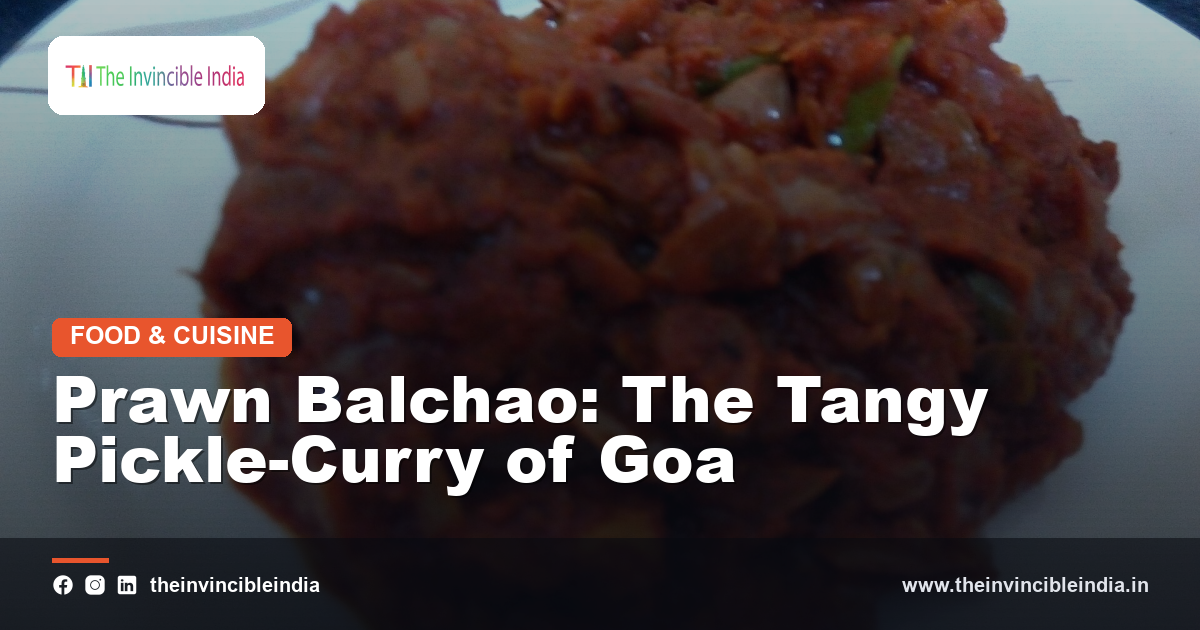
Prawn balchao, also spelled prawn balchão and sometimes called Goan prawn pickle or balchao de camarão, is a fiery, sour and slightly sweet preparation from the Indian state of Goa in which prawns are cooked in a thick masala of red chillies, vinegar, onions and spices. The result sits halfway between a curry and a pickle, which explains its popular description as a pickle-curry. Like many dishes of the coast, it carries traces of the Portuguese era alongside older Konkan cooking habits, and the regional cuisines of India offer few better examples of how trade and local ingredients combine. This guide explains what prawn balchao is, how it is made and why it remains a treasured Goan classic.
Quick answer: Prawn balchao is a Goan dish of prawns cooked in a hot, tangy masala of dried red chillies, vinegar, onions, ginger, garlic and spices until the gravy turns thick and oily like a pickle. It is also known as balchão de camarão and reflects the Portuguese-era influence on the cuisine of Goa on India’s western coast. Its sourness and heat help it keep for days, and it is traditionally eaten with pao, rice or Goan fish curry.
Key Takeaways
- Prawn balchao is a signature seafood preparation of Goa, a state on the western coast of India.
- It is also written balchão and known as balchão de camarão in Portuguese-influenced Goan usage.
- The masala is built from dried red chillies, vinegar, onions, ginger, garlic, cumin, pepper and other spices.
- Vinegar, traditionally made from coconut toddy, supplies the sharp sourness that defines the dish.
- The gravy is cooked down until thick and oily, which gives the dish its pickle-like character and helps it keep.
- Prawn balchao is commonly eaten with Goan bread (pao), steamed rice, sannas or a simple fish curry.
Read on for the ingredients, method, serving customs, and cultural role in detail.
Quick Facts
| Detail | Information |
|---|---|
| Dish | Prawn balchao (balchão de camarão, Goan prawn pickle) |
| State | Goa, western India |
| Type | Seafood pickle-curry, side dish |
| Main ingredient | Prawns (shrimp) |
| Key flavourings | Dried red chilli, vinegar, onion, ginger, garlic, spices |
| Taste | Hot, sour, slightly sweet and oily |
| Usually served with | Pao, steamed rice, sannas, fish curry |
| Cultural role | Goan home cooking, festive tables and Catholic and Hindu coastal kitchens |
What is prawn balchao?
Prawn balchao is a Goan preparation in which cleaned prawns are fried and then simmered in a thick, tangy and fiery masala until the sauce clings to each piece like a pickle. It is neither a thin curry meant to be ladled over rice nor a true preserved pickle meant to sit in a jar for months, but something between the two. The sauce is dark red, glossy with oil and sharply sour from vinegar, with a deep heat from dried chillies. A small portion is usually enough for a whole meal because the flavour is so concentrated. Prawn balchao is therefore best understood as a condiment-like main dish, one that enriches plain rice or bread with a single spoonful of intensely flavoured seafood.
What are the other names and spellings of prawn balchao?
Prawn balchao is also written as prawn balchão, with the Portuguese tilde, and is described in Goan and Portuguese-influenced usage as balchão de camarão, where camarão means shrimp or prawn. In English-language menus it often appears as Goan prawn pickle, prawn pickle curry or simply balchao. Spellings such as balchow and balchaô are also seen on printed menus. The word balchao is applied to other dishes in the same style, so the prawn is usually named explicitly to avoid confusion with fish or pork versions. These alternative names matter because they help readers recognise the same dish across cookbooks, restaurant menus and family recipes. Whatever the spelling, the term points to a sour, hot and long-lasting seafood preparation from the Goan coast.
Where does prawn balchao come from?
Prawn balchao comes from Goa, the small coastal state on the Konkan shoreline of western India that was under Portuguese rule for several centuries. The dish is widely regarded as a product of that long meeting of cultures, in which Portuguese preserving methods and fondness for vinegar met local seafood, coconut and chillies. Food writers often connect the name balchao to similar pickled and preserved preparations known in other Portuguese-influenced regions of Asia, though the exact route of the word and the technique is debated and should be treated with caution. What is certain is that balchao is firmly part of Goan home cooking today, claimed by Catholic and Hindu families alike. Its origin therefore lies in a coastal world shaped by sea trade, fishing and cultural exchange.
Prawn Balchao in the Setting of Goan Cuisine
Goan cuisine is built on rice, coconut, fish, vinegar, kokum and chillies, and prawn balchao sits comfortably within that tradition. Everyday Goan meals usually revolve around a fish curry and rice, with side dishes of fried fish, vegetable preparations and pickles that add sharpness and heat. Balchao fills the role of both pickle and seafood side in a single dish. The influence of Portuguese cooking can be seen in the use of vinegar, spiced red pastes and bread, while the dependence on coconut and local spices reflects the older Konkan base. Because Goa has communities that follow different religions and customs, the same sour-and-spicy approach appears in varied household versions. Prawn balchao therefore illustrates the layered character of Goan food, in which borrowed and indigenous elements are woven together.
What ingredients go into prawn balchao?
Prawn balchao is made from prawns, onions, tomatoes, ginger, garlic, dried red chillies, vinegar, oil and a handful of whole and ground spices. The spices usually include cumin, black pepper, cloves, cinnamon and turmeric, ground into a smooth paste with the chillies and vinegar. Many cooks add a little sugar or jaggery to soften the sourness, and a pinch of salt completes the seasoning. Curry leaves and green chillies appear in some family versions, while tamarind is occasionally used to deepen the tang. Coconut oil or another cooking oil is used generously because the oil helps preserve the dish and carries the flavour of the masala. The ingredient list is short, yet the proportions and the quality of the chillies and vinegar decide the final character.
The Role of Vinegar in Balchao
Vinegar is the defining ingredient of prawn balchao, giving it the sharp sourness that separates it from other prawn curries. In traditional Goan kitchens the vinegar is made from fermented coconut palm toddy, which has a mellow, slightly fruity acidity unlike harsher industrial vinegars. The vinegar is used to grind the dried chillies into a paste, so the masala is sour from the very beginning, and it is often added again during cooking. Acidity also acts as a preservative, which explains why balchao keeps better than a coconut-based curry. When the vinegar is reduced with the oil and spices, the sauce becomes concentrated, glossy and complex. In this way vinegar is both a flavouring and a practical tool, central to why the dish behaves like a pickle.
The Chillies and the Balchao Masala
The balchao masala is a ground paste of dried red chillies, vinegar, garlic, ginger and spices, and it supplies both the colour and the heat of the dish. Goan cooks often choose long, deep red chillies that give a rich colour without overwhelming fire, sometimes mixing them with hotter varieties to adjust the strength. The chillies are soaked in vinegar and ground until smooth, so the paste is thick and brilliantly red. This approach is related to other Goan red pastes used to marinate fish and meat, though balchao has its own balance of sour, sweet and hot notes. A well-made masala is cooked slowly in oil until the raw smell disappears and the oil rises to the surface. The masala is therefore the heart of the dish, carrying its identity.
How is prawn balchao cooked?
Prawn balchao is cooked in stages: the prawns are lightly fried, an onion and tomato base is sautéed, the ground masala is cooked in oil, and everything is simmered together until thick. First the cleaned prawns are seasoned with salt and turmeric and fried briefly so they stay firm. In the same oil, chopped onions are cooked until golden, followed by ginger, garlic and tomatoes. The balchao masala is then added and cooked patiently until the oil separates. The prawns return to the pan with a little vinegar and sugar, and the mixture simmers until the sauce becomes dark, sticky and aromatic. Overcooking is avoided because prawns toughen quickly. The method shows how careful timing and slow reduction create a rich dish from a modest set of ingredients.
Choosing and Cleaning the Prawns
Good prawn balchao begins with fresh prawns, ideally of medium to large size, cleaned and deveined before cooking. Goan coastal markets traditionally sell prawns in several sizes, and cooks select them according to the dish: small ones for stir-fries and fillings, and larger ones for preparations such as balchao where each piece should remain visible. The shells are removed, the dark vein is taken out, and the prawns are washed and drained well so that excess water does not dilute the sauce. Some cooks leave the tails on for appearance. Dried or salted prawns are sometimes used in related balchao-style preparations, though fresh prawns are preferred for the classic version. Fresh, well-handled prawns give a sweet, firm bite that stands up to the strong masala.
Why is prawn balchao called a pickle-curry?
Prawn balchao is called a pickle-curry because it combines the sour, oily and long-lasting nature of a pickle with the cooked, saucy form of a curry. The generous oil, vinegar and chilli paste form a protective coating around the prawns, slowing spoilage when the dish is stored in a clean, dry container. Cooks often say that balchao tastes better on the second or third day, when the prawns have absorbed the masala and the flavours have mellowed and deepened. Unlike a true pickle, it is not made with raw, salted ingredients left to mature, and it is usually not kept for months. It is eaten as a main flavour component of a meal rather than as a small side. The name captures this in-between character precisely.
Balchao Beyond Prawns
Balchao is a method as much as a single recipe, and the same sour-hot masala is used with other ingredients in Goan kitchens. Fish such as mackerel and kingfish can be prepared in balchao style, and pork versions are known in some Goan Catholic households. Dried fish and shrimp are also treated this way in coastal communities. In some homes, eggs and vegetables are cooked in a similar tangy masala, showing how adaptable the preparation is. The prawn version is probably the best known because the sweetness of prawns balances the sharp sauce so well. Understanding balchao as a technique helps explain why the word appears on so many menus across the state. Each version keeps the vinegar, chilli and oil framework while changing the main ingredient.
What is prawn balchao served with?
Prawn balchao is usually served with Goan pao, steamed rice, sannas or alongside a simple fish curry and rice. Pao is the soft Goan bread roll, and a spoonful of balchao tucked inside makes a satisfying snack or light meal. With rice, the dish works as a strongly flavoured accompaniment, and a little goes a long way. Sannas, the soft steamed rice cakes of Goa, soak up the gravy beautifully. Because balchao is so concentrated, it is often paired with mild, cooling dishes that balance its heat, such as plain dal, curd or a coconut-based curry. Sliced onions and lime on the side are common additions. These pairings show that balchao is meant to be one bright, intense element within a wider meal.
Prawn Balchao in Goan Festive and Family Life
Prawn balchao appears on Goan tables at celebrations and at ordinary family meals, valued for being rich, shareable and easy to keep. Goan Catholic households prepare it for occasions such as Christmas and feast days alongside other traditional dishes, while many Hindu coastal families also cook seafood balchao in their own style. Because it can be made ahead and stores well, it suits gatherings and gifting among relatives. Recipes are often handed down within families, each with a particular balance of sweetness and sourness that is jealously guarded. Cooking it is a skill associated with the confident handling of chillies and vinegar. Through such customs, prawn balchao connects food, memory and community in the social life of Goa.
How Does Prawn Balchao Compare with Other Indian Prawn Dishes?
Prawn balchao differs from most other Indian prawn dishes in being vinegar-based, pickle-like and intensely sour rather than creamy or coconut-heavy. Bengal’s prawn preparations, for example, often use mustard or coconut milk, while Kerala and Mangalore prawn curries rely on coconut and tamarind. Maharashtrian coastal cooking offers its own tangy, spicy prawn dishes, and its traditions share the Konkan coast with Goa. Compared with these, balchao stands out for its use of vinegar and for its pickle-like thickness. Such comparisons show how the same ingredient, prawns, can be transformed by regional preferences for souring agents, fats and spices. Balchao represents the Goan answer, shaped by its particular history.
Tips for a Well-Balanced Balchao
A well-balanced prawn balchao depends on controlling sourness, sweetness, heat and oil so that no single element dominates. Cooks usually add sugar or jaggery gradually and taste as the sauce reduces, adjusting vinegar at the end if needed. The prawns should be added late and cooked briefly, since long simmering makes them rubbery. Using a heavy pan helps the masala fry evenly, and patience at the stage when the oil separates is considered essential. Stored in a clean, dry glass jar and reheated gently, balchao keeps well for several days in a cool place or refrigerator. Clean, dry spoons prevent spoilage. These habits reflect the practical wisdom of Goan kitchens, where flavour and preservation are managed together.
Prawn Balchao Today
Prawn balchao today remains one of the most recognisable dishes of Goa, served in home kitchens, village restaurants and city menus across the state and beyond. Visitors often encounter it as a pickled-prawn accompaniment to pao, and many seaside restaurants list it as a regional speciality. Jars of ready-made balchao are sold as souvenirs and gifts, bringing the flavour to people far from the coast. Chefs sometimes reinterpret it in modern ways, using it as a filling, a topping or a spread, yet the core elements of vinegar, chilli and prawns stay constant. Food writers cite it as a clear example of Goa’s blend of Portuguese influence and local taste. Prawn balchao continues to represent the bold, sour and spicy character of Goan cooking.
Sources & Further Reading
- Ministry of Culture, Government of India (indiaculture.gov.in).
- Ministry of Tourism, Government of India (tourism.gov.in).
Frequently Asked Questions
What is prawn balchao?
Prawn balchao is a Goan dish of prawns cooked in a hot, sour masala of dried red chillies, vinegar, onions and spices until the gravy becomes thick and pickle-like. It is also written balchão or called balchão de camarão.
Is prawn balchao a curry or a pickle?
Prawn balchao is both, which is why it is called a pickle-curry. It is cooked like a curry but is oily, sour and concentrated like a pickle, so it keeps longer than ordinary prawn curries.
Why is vinegar used in prawn balchao?
Vinegar gives prawn balchao its signature sourness and also acts as a preservative. Traditional Goan cooks use vinegar made from coconut toddy to grind the chillies and to season the finished dish.
How long does prawn balchao last?
Prawn balchao keeps for several days when stored in a clean, dry container in a cool place or refrigerator, and many people feel it tastes better after a day or two. Always use a dry spoon and reheat gently to keep it safe.
What is prawn balchao eaten with?
Prawn balchao is eaten with Goan pao, steamed rice, sannas or alongside a fish curry and rice. Because the flavour is intense, a small portion is usually enough.
Is prawn balchao very spicy?
Prawn balchao is typically hot as well as sour, though the level of heat varies by family recipe and by the chillies used. Cooks can reduce the heat by choosing milder red chillies and adding a little sugar or jaggery.


