

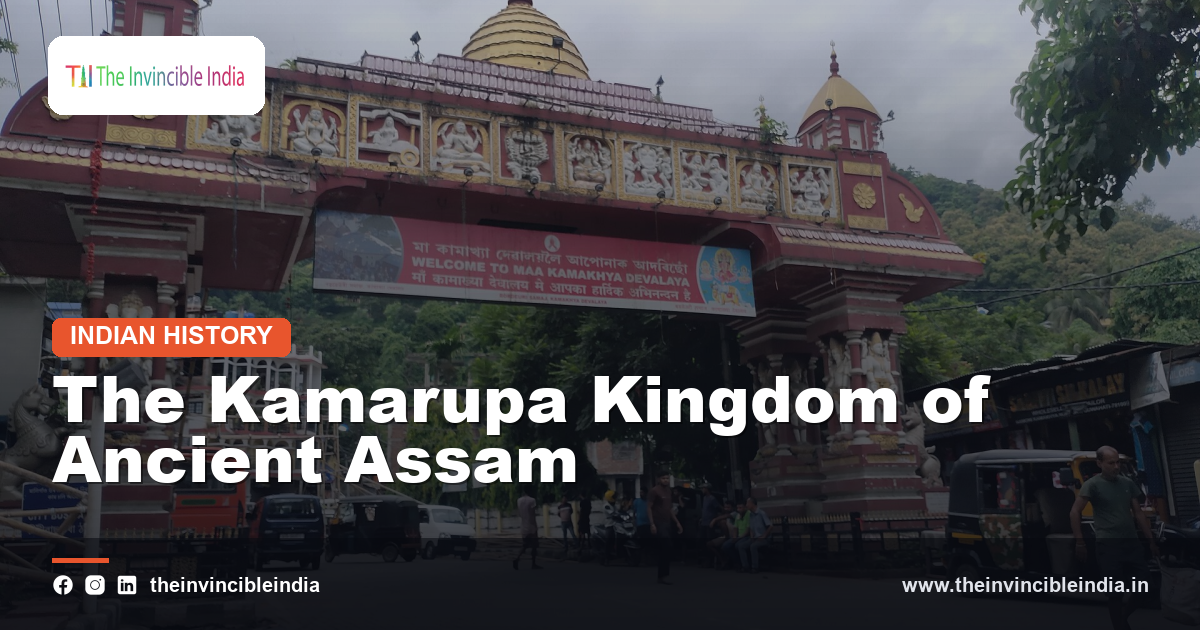
Kamarupa was the ancient kingdom of the Brahmaputra valley of present-day Assam and the adjoining regions of north-eastern India, flourishing roughly from the fourth to the twelfth century. Over this long span the kingdom was ruled in turn by three principal dynasties, generally known as the Varman, the Mlechchha and the Pala, who governed the valley through the ancient and early medieval periods. Its best-known ruler was Bhaskaravarman of the Varman line, a contemporary of the north Indian emperor Harshavardhana and a figure described in the accounts of the Chinese pilgrim Xuanzang, who visited the region. Kamarupa is associated with the region known as Pragjyotisha and with the celebrated Kamakhya temple near present-day Guwahati. As an ancient Indian kingdom of the classical age, Kamarupa belongs to the same broad era as the great power described in our guide to the Gupta Empire. Because much of the history rests on inscriptions and accounts, this guide keeps to general terms where the record is uncertain.
Quick answer: Kamarupa was the ancient kingdom of the Brahmaputra valley of present-day Assam, flourishing roughly from the fourth to the twelfth century. It was ruled in turn by the Varman, Mlechchha and Pala dynasties, and its best-known king was Bhaskaravarman, a contemporary of Harshavardhana who was described in the accounts of the Chinese pilgrim Xuanzang. The kingdom is associated with the region of Pragjyotisha and with the celebrated Kamakhya temple near present-day Guwahati, and it is known chiefly from inscriptions and the accounts of travellers.
Key Takeaways
- Kamarupa was the ancient kingdom of the Brahmaputra valley of present-day Assam, flourishing roughly from the fourth to the twelfth century.
- It was ruled in turn by three principal dynasties, generally known as the Varman, the Mlechchha and the Pala.
- Its best-known ruler was Bhaskaravarman of the Varman line, a contemporary of the emperor Harshavardhana.
- The Chinese pilgrim Xuanzang visited the region and described Kamarupa in his accounts.
- Kamarupa is associated with the ancient region known as Pragjyotisha and with the celebrated Kamakhya temple near present-day Guwahati.
- The kingdom is known chiefly from inscriptions and the accounts of travellers rather than from a continuous chronicle.
Read on for the history, culture, and legacy in detail.
Quick Facts
| Detail | Information |
|---|---|
| Kingdom | Kamarupa, ancient kingdom of the Brahmaputra valley |
| Period | Roughly the 4th to the 12th century |
| Region | Brahmaputra valley, present-day Assam and adjoining areas |
| Ruling Dynasties | The Varman, Mlechchha and Pala lines |
| Best-Known King | Bhaskaravarman (Varman dynasty) |
| Ancient Name | Associated with Pragjyotisha |
| Famous Temple | The Kamakhya temple near Guwahati |
| Known From | Inscriptions and the accounts of travellers |
| Legacy | The ancient foundation of the history of Assam |
What Was the Kamarupa Kingdom?
The Kamarupa kingdom was the ancient state of the Brahmaputra valley of present-day Assam and the adjoining regions of north-eastern India, flourishing roughly from the fourth to the twelfth century. Over this long span the kingdom formed the principal power of the valley, ruled in turn by a succession of dynasties who governed the region through the ancient and early medieval periods. Kamarupa is remembered as the ancient foundation of the history of Assam, the state from which much of the region’s early recorded history descends. Known chiefly from inscriptions and the accounts of travellers, the kingdom is associated with famous rulers, sacred sites and the region known in ancient tradition as Pragjyotisha. As one of the notable kingdoms of ancient India, Kamarupa holds an important place in the history of the subcontinent and its north-eastern frontier. Its long history and rich associations make it a central subject in the study of ancient Assam.
Where Was Kamarupa Located?
Kamarupa was located in the Brahmaputra valley of present-day Assam and the adjoining regions of north-eastern India, with its heartland in the western part of the valley around present-day Guwahati. A land of the great Brahmaputra river, its tributaries, wetlands and hills, the kingdom commanded the fertile valley through which the river flows between the mountains. At its height the authority of Kamarupa extended over a wide region of the north-east, though its exact bounds varied through its long history and are reconstructed from inscriptions and accounts. Its position in the far north-east placed it on the eastern frontier of the Indian cultural world, in contact with the peoples and regions around and with the powers of the Indian plains. The geography of the valley shaped the character and resources of the kingdom. The region around Guwahati, with the Kamakhya temple, anchored Kamarupa in the historical geography of ancient Assam.
What Does the Name Kamarupa Mean?
The name Kamarupa is an ancient term associated in tradition with the region of the Brahmaputra valley, carrying connotations drawn from Indian mythology and the sacred geography of the area. In the traditions of the region, the name is connected with stories of the deities and with the sacred associations of the land, including the celebrated shrine of the goddess at Kamakhya. The kingdom is also linked with the older name Pragjyotisha, another ancient designation for the region and its early centre. These names, preserved in tradition, in the epics and in later literature, reflect the deep antiquity of the region’s identity and its place in the sacred geography of the subcontinent. As with such traditional names, their origins and meanings are matters of tradition and scholarly discussion rather than firm record. The names Kamarupa and Pragjyotisha thus express the ancient and sacred identity of the land that became Assam.
What Was Pragjyotisha?
Pragjyotisha was an ancient name for the region of the Brahmaputra valley and its early centre, associated with Kamarupa and with the deep antiquity of the region in Indian tradition. The name appears in the epics and in ancient literature, where it is connected with the early kingdom and its legendary rulers, marking the region as a land of great antiquity in the traditional geography of the subcontinent. Pragjyotisha is often identified with the area around present-day Guwahati, long a centre of the region’s history and religion. In the traditions of the region, Pragjyotisha and Kamarupa are closely linked, the one an older and the other a later name for the same land and kingdom. These associations, drawn from tradition, the epics and later literature, are treated with scholarly care. Pragjyotisha thus stands as one of the ancient names by which the land of Kamarupa was known in Indian tradition.
Which Dynasties Ruled Kamarupa?
Kamarupa was ruled over its long history by three principal dynasties, generally known as the Varman, the Mlechchha and the Pala, who governed the kingdom in succession through the ancient and early medieval periods. The Varman dynasty, the earliest of the three, is associated with the classical age of the kingdom and with its most famous ruler, Bhaskaravarman. The Mlechchha dynasty followed, continuing the rule of the kingdom through a later phase, and the Pala dynasty of Kamarupa, distinct from the better-known Palas of eastern India, governed in the later period. Together these three lines span the recorded history of the ancient kingdom, each leaving inscriptions and traditions that preserve its memory. The succession of these dynasties is reconstructed chiefly from epigraphy and is treated with scholarly care, with several points debated. The three ruling houses of the Varmans, Mlechchhas and Palas thus define the dynastic history of Kamarupa.
Who Was Bhaskaravarman?
Bhaskaravarman was the best-known ruler of Kamarupa, a king of the Varman dynasty remembered as one of the great figures of the ancient history of the region and as a contemporary of the north Indian emperor Harshavardhana. Under Bhaskaravarman the kingdom of Kamarupa reached a height of prominence, and he is remembered for his standing among the rulers of his age and for his dealings with the powers of the Indian plains. He is especially associated with his alliance and contact with Harshavardhana and with the visit of the Chinese pilgrim Xuanzang, whose accounts describe the king and his kingdom. Bhaskaravarman is thus a figure known not only from the inscriptions of Kamarupa but also from the records of north India and the accounts of a famous traveller. His reign marks a notable chapter in the history of ancient Assam. Bhaskaravarman remains the most celebrated of the kings of Kamarupa.
How Was Kamarupa Linked to Harshavardhana?
Kamarupa was linked to Harshavardhana, the powerful north Indian emperor of the seventh century, through the alliance and contact between him and Bhaskaravarman, the Varman king of Kamarupa. According to the records of the period, the two rulers were associated as allies, and their connection placed Kamarupa within the wider world of north Indian politics in the age of Harsha. This link is known from the accounts of the time, including the writings associated with Harsha’s court and the record of the Chinese pilgrim Xuanzang, who moved between the two realms. The alliance reflects the standing of Bhaskaravarman and the prominence of Kamarupa in the affairs of the age. It connects the history of the north-eastern kingdom to the broader currents of ancient Indian history. The details of this relationship are drawn from the accounts of the period and are described in general terms. The link with Harshavardhana marks a high point in the history of ancient Kamarupa.
What Did Xuanzang Record About Kamarupa?
Xuanzang, the Chinese Buddhist pilgrim who travelled across India in the seventh century, visited the region of Kamarupa and left an account of the kingdom and its ruler in his famous record of his journeys. According to this account, the pilgrim came to the court of Bhaskaravarman, and his writings describe the kingdom, its people and its character as he observed them. The record of Xuanzang is a valuable source for the history of ancient Kamarupa, offering an outside observer’s description of the kingdom at the time of its most famous ruler. As with all such travellers’ accounts, scholars read it with care, weighing its observations and its context. The visit of Xuanzang connects the history of Kamarupa to the wider world of ancient Asian travel, pilgrimage and exchange. His account remains one of the principal sources for the kingdom in the age of Bhaskaravarman. Through Xuanzang, the ancient kingdom of Kamarupa is known to history beyond its own inscriptions.
What Is the Kamakhya Temple?
The Kamakhya temple, set on a hill near present-day Guwahati, is the most celebrated shrine associated with the region of Kamarupa, a major temple of the goddess and one of the great centres of devotion in the subcontinent. Revered as a principal seat of the worship of the goddess, the temple holds a central place in the religious life and sacred geography of Assam and of the wider tradition of goddess worship in India. The shrine is connected in tradition with the ancient sanctity of the region of Kamarupa and Pragjyotisha, and it has long drawn pilgrims from across the subcontinent. The temple that stands today reflects a long history of worship, building and rebuilding at the site. The details of its early history and its connection with the ancient kingdom are drawn from tradition and are described in general terms. The Kamakhya temple thus embodies the sacred heritage of Kamarupa and remains a living centre of devotion.
How Was Kamarupa Governed?
The kingdom of Kamarupa was governed by its kings, who ruled from the region around present-day Guwahati and held authority over the Brahmaputra valley, its people and its resources. The rulers, drawn in succession from the Varman, Mlechchha and Pala dynasties, maintained their authority through the forms of ancient and early medieval Indian kingship, supported by officials, nobles and local figures. The kings issued grants of land, often to religious institutions and Brahmins, recorded in the copper-plate inscriptions that are a principal source for the history of the kingdom. These grants, together with other inscriptions, reflect the administration, patronage and genealogy of the ruling houses. In the absence of a continuous chronicle, the details of the government are reconstructed from epigraphy and are treated with scholarly care. The system of governance enabled the kingdom to hold the valley through its long history. The administration of Kamarupa thus followed the established patterns of ancient Indian kingship.
What Was the Religion and Culture?
The religion and culture of Kamarupa reflected the broader traditions of ancient and early medieval India, adapted to the distinctive setting of the Brahmaputra valley and its own traditions. The kingdom was a centre of Hindu worship, with the devotion to the goddess at Kamakhya among its most famous expressions, alongside the worship of Shiva, Vishnu and other deities. The region was also touched by other traditions, and its culture blended the heritage of the wider Indian world with the distinctive character of the north-east. The kings patronised temples, religious institutions and learning, contributing to the cultural life of the region. The art, architecture and religious traditions of Kamarupa, seen in its temples and remains, reflect this heritage. The details of this culture are drawn from inscriptions, surviving monuments and tradition and are described in general terms. Through this culture, Kamarupa laid the ancient foundations of the religious and cultural heritage of Assam.
How Do We Know About Kamarupa?
We know about Kamarupa chiefly from inscriptions, including copper-plate grants and stone records, together with the accounts of travellers such as Xuanzang and references in wider Indian literature. The inscriptions, issued by the kings and their officials, record grants, genealogies and events, and they form the principal basis on which scholars reconstruct the history of the kingdom and its ruling dynasties. The accounts of travellers and the records of neighbouring powers add further evidence, offering outside observations of the kingdom and its rulers. In the absence of a continuous chronicle, these sources together provide the foundation for understanding ancient Kamarupa. As with other ancient kingdoms known mainly from epigraphy and accounts, many details remain uncertain or debated, and the chronology is reconstructed with care. Surviving temples and remains add further evidence of the history and culture of the kingdom. The inscriptions and accounts thus remain the foundation of what is known about Kamarupa.
What Were the Later Dynasties of Kamarupa?
The later history of Kamarupa saw the rule of the Mlechchha and the Pala dynasties, who governed the kingdom in succession after the classical age of the Varmans. The Mlechchha dynasty continued the rule of the kingdom through a later phase, maintaining the authority of Kamarupa over the valley. The Pala dynasty of Kamarupa, distinct from the better-known Palas of eastern India, governed in the later period, continuing the line of ancient kingship in the region. Under these dynasties the kingdom endured through the early medieval centuries, leaving inscriptions and traditions that preserve the memory of their rule. The history of these later houses, reconstructed chiefly from epigraphy, is treated with scholarly care, with several points debated. Together with the Varmans, they complete the long dynastic history of the ancient kingdom. The later dynasties of the Mlechchhas and Palas thus carried the history of Kamarupa toward its close in the medieval period.
How Did Kamarupa Decline?
Kamarupa declined in the course of the later early medieval period, roughly by about the twelfth century, after which the ancient kingdom gave way to new powers and a changed political order in the Brahmaputra valley. Over time, as the authority of the old dynasties weakened and the political landscape of the region shifted, the unified kingdom of Kamarupa broke up, and the valley passed through a period of change under various rulers and chiefs. In the centuries that followed, new states and peoples rose in the region, including the kingdoms that would shape the later medieval history of Assam. The details of this decline are reconstructed from inscriptions, tradition and the records of the period and are described in general terms, with several points debated. The passing of ancient Kamarupa marked the end of the classical phase of the region’s history. The decline of the kingdom thus opened the way to the later history of medieval Assam.
Why Is Kamarupa Significant?
Kamarupa is significant as the ancient kingdom from which much of the recorded history of Assam descends, the classical state that shaped the early identity, religion and culture of the Brahmaputra valley. Its long history under the Varman, Mlechchha and Pala dynasties spans the ancient and early medieval periods, offering a window onto the history of the north-east in the classical age. Its most famous ruler, Bhaskaravarman, and his links with Harshavardhana and the pilgrim Xuanzang connect the region to the broader currents of ancient Indian history. The celebrated Kamakhya temple and the sacred associations of Pragjyotisha reflect the deep religious heritage that Kamarupa fostered. For the history of Assam, Kamarupa stands as the ancient foundation on which the later medieval kingdoms would build. For students of Indian history, it offers a vivid example of an ancient regional kingdom on the eastern frontier of the subcontinent.
The Kamarupa Kingdom Today
The Kamarupa kingdom is remembered today through the sacred and historical heritage of the Guwahati region and the wider Brahmaputra valley, above all the celebrated Kamakhya temple and the ancient associations of Pragjyotisha. The temple remains a living centre of devotion, drawing pilgrims from across the subcontinent, while the memory of the ancient kingdom endures in the historical identity of Assam. The inscriptions, remains and traditions of Kamarupa continue to be studied for the light they shed on the ancient history of the north-east and its place in the wider Indian world. The figure of Bhaskaravarman and the visit of Xuanzang remain cherished chapters of the region’s ancient past. Scholars continue to examine the epigraphy and remains to refine the understanding of the kingdom and its debated chronology. For readers of Indian history, Kamarupa offers a striking example of an ancient frontier kingdom. Its legacy endures in the sacred sites, traditions and historical memory of Assam.
Sources & Further Reading
- Archaeological Survey of India (asi.nic.in).
- Ministry of Culture, Government of India (indiaculture.gov.in).
- Directorate of Archaeology, Government of Assam.
Frequently Asked Questions
What was the Kamarupa kingdom?
Kamarupa was the ancient kingdom of the Brahmaputra valley of present-day Assam, flourishing roughly from the fourth to the twelfth century. It was ruled in turn by the Varman, Mlechchha and Pala dynasties and is remembered as the ancient foundation of the history of Assam.
Who was Bhaskaravarman?
Bhaskaravarman was the best-known ruler of Kamarupa, a king of the Varman dynasty and a contemporary of the north Indian emperor Harshavardhana. He is associated with the visit of the Chinese pilgrim Xuanzang, whose accounts describe the king and his kingdom.
Which dynasties ruled Kamarupa?
Kamarupa was ruled over its long history by three principal dynasties, generally known as the Varman, the Mlechchha and the Pala. The Varmans are associated with the classical age of the kingdom, and the Pala dynasty of Kamarupa was distinct from the better-known Palas of eastern India.
What is the connection between Kamarupa and the Kamakhya temple?
The Kamakhya temple near present-day Guwahati is the most celebrated shrine associated with Kamarupa, a major temple of the goddess connected in tradition with the ancient sanctity of the region. It remains a living centre of devotion and a symbol of the region’s heritage.
What was Pragjyotisha?
Pragjyotisha was an ancient name for the region of the Brahmaputra valley and its early centre, closely associated with Kamarupa. The name appears in the epics and ancient literature and is often identified with the area around present-day Guwahati.
How do we know about Kamarupa?
Kamarupa is known chiefly from inscriptions, including copper-plate grants, together with the accounts of travellers such as Xuanzang and references in wider Indian literature. In the absence of a continuous chronicle, these sources form the basis for reconstructing its history.


