

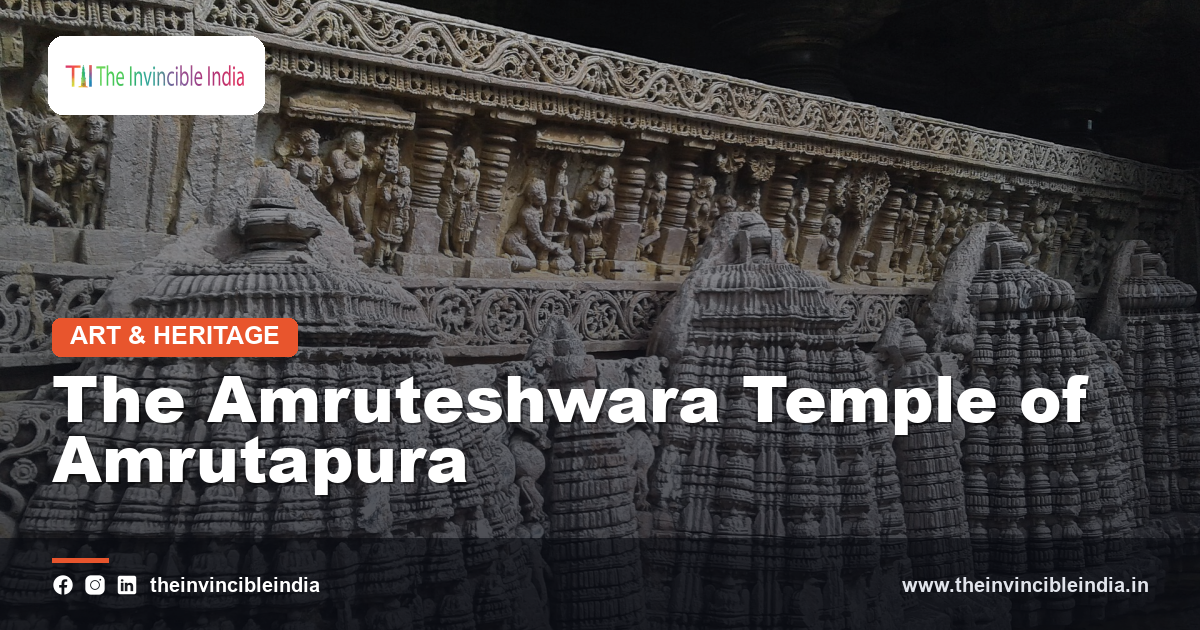
The Amruteshwara temple, also spelled the Amritesvara temple and called the Amrutapura temple after its village, is a Hoysala-period shrine to Shiva in Tarikere taluk of Chikkamagaluru district, Karnataka. It was raised in the late twelfth century, in the reign of the Hoysala king Veera Ballala II, and is celebrated for the sculpted bands that run around its outer walls and narrate scenes from the great epics. The shrine is smaller and quieter than the famous Hoysala temples of Belur and Halebidu, yet it belongs to the same brilliant artistic world and rewards close study. It forms part of the story told in the guide to Indian temple architecture. This article explains its setting, builders, design and sculpture.
Quick answer: The Amruteshwara temple is a twelfth-century Hoysala temple dedicated to Shiva at Amrutapura in Chikkamagaluru district, Karnataka, India. An inscription links its construction in 1196 with Amrita Dandanayaka, a general of King Veera Ballala II. It is known for its soapstone carving and for outer-wall friezes illustrating the Ramayana, Mahabharata and Bhagavata stories.
Key Takeaways
- The Amruteshwara temple is a Hoysala shrine to Shiva at Amrutapura, in Tarikere taluk of Chikkamagaluru district, Karnataka.
- It is dated by inscription to the late twelfth century, in the time of the Hoysala king Veera Ballala II.
- The temple is traditionally credited to Amrita Dandanayaka, a military commander and minister of the Hoysala court.
- It is built of soapstone, a fine-grained stone that allows delicate and intricate carving.
- Its outer walls carry narrative friezes from the Ramayana, Mahabharata and Bhagavata, a celebrated feature of Hoysala art.
- The sculptor Ruvari Malitamma is associated with the Hoysala workshops of the period, and his name is tied to the temple in published accounts.
The sections below describe the place, the builders, the plan, the sculpture and the experience of visiting.
Quick Facts
| Detail | Information |
|---|---|
| Location | Amrutapura, Tarikere taluk, Chikkamagaluru district, Karnataka |
| Dedicated to | Shiva (Amruteshwara) |
| Dynasty | Hoysala |
| Ruler at the time | Veera Ballala II |
| Date | Late twelfth century (1196 CE commonly cited from inscription) |
| Patron | Amrita Dandanayaka, Hoysala general and minister |
| Material | Soapstone (chloritic schist) |
| Famous for | Epic narrative friezes on the outer walls |
What Is the Amruteshwara Temple?
The Amruteshwara temple is a Shaiva temple of the Hoysala dynasty, standing in the village of Amrutapura in the Malnad-fringe country of Karnataka. It is dedicated to Shiva in the form of Amruteshwara, the lord of the nectar of immortality. The building is of modest size but is rich in sculpture, with a pillared hall, a sanctum with a tower and an outer wall that is divided into horizontal bands of figures and ornament. It is best known for its illustrations of the great epics carved in stone, which can be read like a story told in pictures. Although it is overshadowed in fame by Belur and Halebidu, many scholars regard it as a fine and instructive example of mature Hoysala work. The temple thus offers a close and quiet encounter with the artistic achievement of the Hoysala age.
Where Is Amrutapura Located?
Amrutapura is a small village in Tarikere taluk of Chikkamagaluru district in Karnataka, in the region where the Western Ghats foothills meet the open plains of the Deccan plateau. The surrounding landscape combines areca groves, rice fields, low hills and tanks, and the area lies within reach of Tarikere town and the district centre of Chikkamagaluru. The region is also near other well-known Hoysala centres, among them Belur and Halebidu in Hassan district, which makes Amrutapura a natural stop for anyone exploring the dynasty’s heritage. The village setting keeps the temple free from the crowds of major tourist sites. Roads connect it to the neighbouring towns, but the pace of life remains rural and calm. The location therefore gives the temple a peaceful frame.
What Does the Name Amruteshwara Mean?
The name Amruteshwara combines amrita, meaning the nectar of immortality, with ishvara, meaning lord, and so it can be translated as the lord of nectar, a title of Shiva. The village name Amrutapura carries the same root and means the town of nectar. Spellings vary in English, and the temple appears in writing as Amruteshwara, Amruteshvara and Amritesvara. The name also echoes the name of the builder, Amrita Dandanayaka, which is one reason scholars connect the shrine with his patronage. In Hindu thought, amrita is the divine drink that confers deathlessness, and its mention in the name of a Shiva temple hints at the hope of spiritual liberation. The name therefore carries both a religious meaning and a likely personal link to the founder.
Who Were the Hoysalas?
The Hoysalas were a medieval dynasty that ruled much of southern Karnataka from about the eleventh to the fourteenth century, with their early capital at Belur and later at Halebidu, then called Dorasamudra. They began as local chiefs in the hill country of the Western Ghats and rose to be a major power of the Deccan after the decline of the Western Chalukyas. Rulers such as Vishnuvardhana and Veera Ballala II expanded the kingdom, and the dynasty is remembered above all for its patronage of temple architecture. Hundreds of Hoysala temples survive across Karnataka, many of them built by ministers, generals and merchants as well as kings. The Hoysalas therefore left an artistic legacy out of proportion to the brevity of their rule.
Who Built the Temple and When?
The temple was built in the late twelfth century, and an inscription cited in published accounts dates it to 1196 CE, in the reign of the Hoysala king Veera Ballala II. Its builder is traditionally named as Amrita Dandanayaka, a general and minister who served under that king. Such patronage by officials was common in the Hoysala realm, where temples were founded by commanders, ministers and wealthy families as acts of devotion and as marks of status. Inscriptions at temples often record the donor, the king and the grants made for worship. The reliance on an inscription gives the date a firmer base than for many other monuments. The temple therefore stands as a documented example of Hoysala patronage at the height of the dynasty.
Who Was Amrita Dandanayaka?
Amrita Dandanayaka, also written Amritesvara Dandanayaka, was a dandanayaka, meaning a commander of the army and a high official, in the service of the Hoysala king Veera Ballala II. Records link his name with the founding of the temple at Amrutapura and with the grant of resources for its worship and upkeep. The title dandanayaka indicates that he combined military and administrative responsibilities, which was typical of senior courtiers of the age. Such men often built temples in their home regions or in the lands under their charge, and by doing so they bound their families to the memory of the shrine. The details of his life are known mainly through inscriptions, and the broader outline is more secure than any finer detail. His name survives because of the temple he founded.
Who Was the Sculptor Ruvari Malitamma?
Ruvari Malitamma, also called Malitamma, was a sculptor of the Hoysala period whose name appears in inscriptions at several temples, including Amrutapura, and who is regarded as one of the leading artists of the dynasty. Hoysala craftsmen were unusual in that many signed their work, a practice that allows us to speak of individual masters. Malitamma is credited with carving figures and panels in a number of temples, and his name is tied to the quality of sculpture at Amrutapura in published accounts. The attribution of specific panels to a particular hand is, however, a matter on which scholars apply caution. The presence of signed work shows that artists enjoyed recognition and status in the Hoysala world. Malitamma stands as a reminder that behind the temple lies a community of named craftsmen.
What Is the Plan and Layout of the Temple?
The temple follows a Hoysala plan with a main sanctum, a vestibule, a pillared hall and an entrance porch, all raised on a platform that allows pilgrims to walk around the building. The sanctum is crowned by a tower, called the vimana, and the hall is supported by a number of columns. The outer walls are broken into projections and recesses, which create a play of light and shadow characteristic of Hoysala design. The raised platform, called the jagati, lifts the temple above ground level and gives space for circumambulation, a central act of Hindu worship. Compared with the larger star-shaped temples of Belur and Halebidu, the plan at Amrutapura is simpler, though it retains the same sense of order. The layout thus presents the Hoysala temple in a compact and readable form.
Why Was Soapstone Used for the Carving?
Soapstone was used because it is soft when freshly quarried and hardens with exposure to air, which allows fine and deep carving that later becomes durable. Hoysala sculptors favoured this stone, a chloritic schist found in the region, and exploited its qualities to produce figures with delicate jewellery, crisp drapery and intricate ornament. The stone takes a smooth, almost polished finish, which gives many Hoysala sculptures their characteristic gleam. Because it can be cut in thin layers, it supports openwork screens and elaborately detailed borders. The choice of material helped shape the entire style, which prizes minute detail and rhythm of line. Soapstone is thus central to the identity of Hoysala art and to the beauty of the carvings at Amrutapura.
What Are the Epic Friezes on the Outer Walls?
The outer walls of the temple carry horizontal bands of sculpture that illustrate episodes from the Ramayana, the Mahabharata and the Bhagavata, making the temple a stone book of the epics. The panels are arranged so that a devotee walking around the temple in the clockwise direction can follow the stories in sequence. Figures of gods, heroes, sages, demons and animals are shown in lively poses, framed by borders of ornament. The epic friezes are among the most celebrated features of Amrutapura and are often mentioned in surveys of Hoysala art. Their purpose was both devotional and educational, since the stories taught moral lessons to a largely oral society. Walking along the walls, the visitor reads an entire literary heritage carved in stone.
What Do the Lower Bands of the Wall Show?
Below the epic panels the outer wall carries a series of decorative bands that are typical of Hoysala temples, including rows of elephants, horsemen, scrolling foliage and mythical sea creatures called makaras. Each band has symbolic as well as ornamental meaning: elephants suggest strength and royal power, horsemen speak of speed and conquest, and scrolling leaves signify growth and abundance. The bands are cut with remarkable regularity and precision, creating a rhythm that runs around the whole temple. Such mouldings form a stable base for the narrative panels above and give the building a layered, textured look. To understand them is to recognise that Hoysala decoration follows an ordered system and is never random. The lower bands show how ornament and meaning are woven together in the temple wall.
What Is Inside the Temple Hall?
The interior of the temple has a pillared hall whose columns are often finished with a smooth, lathe-turned look that is a hallmark of Hoysala craft. The pillars hold up ceilings that may be carved with lotus-like patterns, and the light from the entrance falls on polished stone surfaces. Beyond the hall lies the sanctum, which houses the linga, the aniconic symbol of Shiva, receiving daily worship. The interior is quieter and more subdued than the exterior, as befits a space for prayer and contemplation. Details of the ceiling and pillars repay careful observation, since they reveal the precision of the stonecutters. The interior of Amruteshwara demonstrates that Hoysala artistry extended from the outer wall all the way to the heart of the shrine.
How Is Shiva Worshipped at the Temple?
Shiva is worshipped at the temple in the form of the linga in the sanctum, and daily rituals of bathing, offering and lamp-waving are performed by temple priests. The linga is a simple, rounded stone that represents the formless presence of Shiva, and the sanctum is arranged to focus attention on it. Devotees bring flowers, leaves of the bilva tree and water, and special festivals such as Mahashivaratri draw larger gatherings. The worship follows the Shaiva traditions of the region, which have deep roots in Karnataka. The continuity of worship is important, because it means the building is a living temple and not only a monument. The prayers offered today link the village to the generation that raised the shrine.
How Does Amrutapura Compare With Belur and Halebidu?
Amrutapura is smaller and simpler than the great Hoysala temples of Belur and Halebidu, but it shares the same artistic vocabulary of soapstone carving, ornamental mouldings and narrative friezes. The Chennakeshava temple at Belur and the Hoysaleshwara temple at Halebidu are grander in scale, richer in sculpture and far more visited, and they form part of a group inscribed as a UNESCO World Heritage property. Amrutapura is not part of that group, yet it offers a more intimate experience, with fewer visitors and more time to study the carving. Comparing the three shows how the Hoysala style developed and how it appeared in works of different sizes. Together they demonstrate the range of Hoysala achievement. Amrutapura is a rewarding companion to the larger sites.
How Can Visitors Plan a Trip to Amrutapura?
Visitors usually reach Amrutapura by road from Tarikere or from Chikkamagaluru, and many combine it with a longer journey through the Hoysala heartland of Belur, Halebidu and Somanathapura. The cooler months from October to February are the most comfortable, while the monsoon brings green landscapes but wet roads. It is best to visit in daylight, as the details of the carving are easiest to appreciate in natural light. Visitors should dress modestly, remove footwear at the entrance and take care not to touch the delicate sculpture. Facilities at the village are basic, so planning meals and travel in advance is helpful. A patient visit, ideally with a guide or good reference notes, brings out the full richness of the temple.
Why Does the Amruteshwara Temple Matter for Indian Heritage?
The Amruteshwara temple matters because it preserves a well-dated and well-carved example of Hoysala architecture, showing the mature style of the dynasty in a setting free from crowds. Its epic friezes make it an important source for understanding how stories were presented visually in medieval Karnataka, and its inscription-linked patronage sheds light on the role of ministers and generals in funding temples. The signed or attributed work of master sculptors points to a society that valued individual artistic skill. For students of art history the temple offers a clear and accessible case study. For communities it remains a living place of worship. The temple stands as a testimony to the creativity and devotion of the twelfth-century Deccan.
Amruteshwara Temple Today
The Amruteshwara temple today is a protected monument and an active place of worship, quietly keeping its position in the village of Amrutapura. Conservation work by heritage authorities aims to preserve the soapstone from weathering, plant growth and the stress of age. Interest from scholars and travellers is growing as appreciation of lesser-known Hoysala sites increases, although the temple remains uncrowded. Local people continue to celebrate festivals here, and the temple is an anchor of community identity. Visitors who walk slowly around its walls can still read the epics in stone as devotees did eight centuries ago. In its calm and carved beauty the temple remains a living link to the Hoysala age.
Sources & Further Reading
- Archaeological Survey of India (asi.nic.in).
- Karnataka Tourism (karnatakatourism.org).
Frequently Asked Questions
Where is the Amruteshwara temple located?
The Amruteshwara temple is located at Amrutapura in Tarikere taluk of Chikkamagaluru district, Karnataka. It lies in the foothill region near the Western Ghats. The temple is reached by road from Tarikere and Chikkamagaluru.
Who built the Amruteshwara temple?
The Amruteshwara temple is traditionally credited to Amrita Dandanayaka, a general and minister of the Hoysala king Veera Ballala II. An inscription cited in published accounts dates its construction to 1196 CE. The temple was built as a Shiva shrine in the Hoysala style.
What is the Amruteshwara temple famous for?
The temple is famous for its soapstone carving and for the narrative friezes on its outer walls that illustrate the Ramayana, Mahabharata and Bhagavata. These panels are considered fine examples of Hoysala sculpture. The temple is also admired for its calm village setting.
Which god is worshipped at the Amruteshwara temple?
Shiva is the god worshipped at the Amruteshwara temple, in the form of the linga in the sanctum. The name Amruteshwara means the lord of nectar, a title of Shiva. The temple remains an active place of worship.
Is the Amruteshwara temple a UNESCO World Heritage Site?
No, the Amruteshwara temple is not part of the inscribed UNESCO group of Hoysala temples, which includes Belur, Halebidu and Somanathapura. It is nevertheless a significant Hoysala monument. It is regarded as a valuable lesser-known example of the style.
How is Amrutapura different from Belur and Halebidu?
Amrutapura is smaller, quieter and less visited than Belur and Halebidu, but it shares their soapstone carving and decorative style. Its epic friezes are especially admired, and it offers a more intimate experience. The larger temples are grander in scale and more elaborate in sculpture.


