

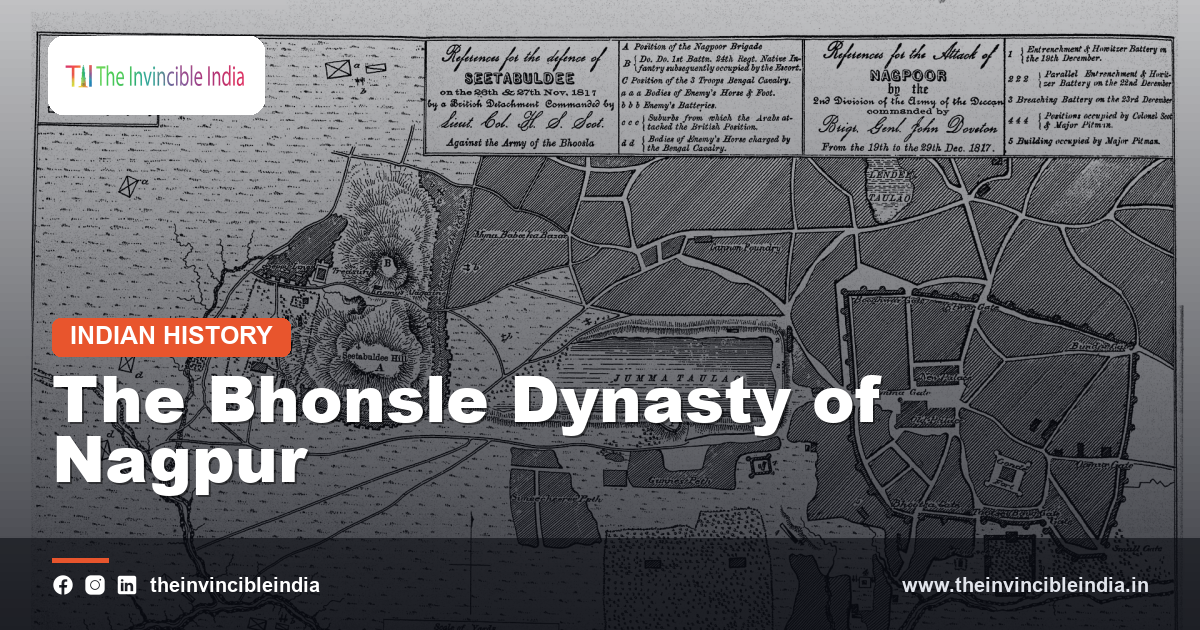
The Bhonsle dynasty of Nagpur, also written Bhosale or Bhosle, was one of the principal houses of the Maratha confederacy in the eighteenth and early nineteenth centuries. Its rulers governed a wide territory in central and eastern India from Nagpur, drawing on the old Gond kingdoms of the region, and they sent armies as far as Odisha and Bengal. Although connected by clan name to the family of Shivaji, the Nagpur Bhonsles formed a separate line that grew powerful in its own right. The dynasty is remembered for its political and military reach, its patronage of local culture and its confrontation with the British East India Company, which ended in annexation. Its story is an important chapter in the broader history of the Maratha Empire.
Quick answer: The Bhonsle dynasty of Nagpur is a Maratha ruling house that governed a large kingdom in central and eastern India from Nagpur, Maharashtra, during the eighteenth and early nineteenth centuries. Founded by Raghuji I Bhonsle as part of the Maratha confederacy, it expanded into the Gond country, Chhattisgarh and Odisha. The British East India Company annexed the kingdom in the mid-nineteenth century after the death of Raghuji III without a natural heir.
Key Takeaways
- The Bhonsles of Nagpur were one of the five major Maratha houses, alongside the Peshwas, Gaekwads, Holkars and Scindias.
- Raghuji I Bhonsle founded the dynasty in the early eighteenth century and expanded Maratha influence into the Gond country, Chhattisgarh, Odisha and Bengal.
- Nagpur, a former Gond town, became the Bhonsle capital because of its central position on routes between north, south and east.
- The Battle of Sitabuldi in 1817 was a turning point that sharply reduced Bhonsle independence.
- The kingdom was annexed by the East India Company in the mid-nineteenth century under the Doctrine of Lapse.
- Heritage sites linked to the dynasty include Sitabuldi Fort, the Mahal quarter of Nagpur and the temples at Ramtek.
Quick Facts
| Detail | Information |
|---|---|
| Dynasty | Bhonsle (Bhosale) of Nagpur |
| Capital | Nagpur, Maharashtra |
| Confederacy | Maratha confederacy |
| Founder | Raghuji I Bhonsle |
| Famous sites | Sitabuldi Fort, Mahal quarter, Ramtek temples |
| End of rule | Annexed by the British East India Company in the mid-nineteenth century |
Who were the Bhonsles of Nagpur?
The Bhonsles of Nagpur were a Maratha ruling family that governed the Nagpur kingdom, covering much of central and eastern India, during the eighteenth and early nineteenth centuries. They belonged to the wider Bhonsle clan, from which Shivaji also came, but they were a distinct line with their own territory and court. The family began as military officers serving the Chhatrapati of the Marathas and gradually became a powerful regional dynasty. Their rulers carried the title Senasaheb Subha, meaning commander of the army. The state they built stretched across present-day Maharashtra, Chhattisgarh, Madhya Pradesh and Odisha. They are important as one of the five great Maratha houses, with the Peshwas, Gaekwads, Holkars and Scindias.
How are the Nagpur Bhonsles related to Shivaji?
The Nagpur Bhonsles share a clan name with Shivaji, and family tradition links the two lines through distant common ancestry. Historians, however, caution that the exact genealogical connection is not firmly documented and that the clan name Bhonsle was widely used by many Maratha families. What is more certain is the political relationship, since Raghuji I Bhonsle rose through service to the Maratha sovereign, receiving favour and responsibility in the eastern territories. The Nagpur house therefore claimed legitimacy through loyalty to the Chhatrapati, even as it developed autonomous power. This pattern of nominal allegiance and real regional authority was typical of the Maratha confederacy during the eighteenth century.
Who was Raghuji I Bhonsle?
Raghuji I Bhonsle was the founder of the Bhonsle dynasty of Nagpur and the commander who built its territorial base in the early eighteenth century. He served the Maratha sovereign Shahu and was entrusted with expeditions in the east of the Deccan, receiving the military rank that came to define his house. Over time he expanded Maratha influence into the Gond kingdoms of the region, the territories of Chhattisgarh and the coastal districts of Odisha. He also launched campaigns into Bengal, which made his name widely known. Raghuji was an energetic administrator and strategist who turned a military command into a durable regional state. His career shows how enterprising Maratha commanders carved out kingdoms beyond the Maratha homeland.
What was the Gond kingdom of Deogarh?
The Gond kingdom of Deogarh was the indigenous state of the Nagpur region before the rise of the Bhonsles. The Gonds, an Adivasi people with a rich tradition of art and oral lore, established kingdoms in central India, including Deogarh, Chanda and Garha-Mandla, and their rulers built forts and temples. When a succession dispute weakened Deogarh, Maratha commanders including Raghuji Bhonsle became involved, and the region gradually came under Bhonsle influence. Nagpur itself, long a Gond town, grew into the capital of the new state. The Bhonsles inherited a landscape with deep Gond heritage, and many local customs, fortifications and settlements continued under the new rulers. This background is essential for understanding the regional character of Nagpur.
Why did Nagpur become the Bhonsle capital?
Nagpur became the Bhonsle capital because of its central location, its strategic position on routes between north, south and east, and its established status as a Gond town. Situated on the Deccan plateau in the Vidarbha region of Maharashtra, it was well placed for campaigns in Odisha, Bengal and Chhattisgarh, and it could draw revenue from fertile cotton-growing and agricultural land. The Bhonsles built palaces, residences and a walled city, with the Mahal quarter at the heart of the old city. Over time Nagpur developed markets, temples and tanks, and attracted merchants and artisans from many regions. Its growth under the dynasty laid the foundations for the city’s later importance in the history of central India.
What were the Maratha raids on Bengal?
The Maratha raids on Bengal were a series of incursions in the mid-eighteenth century in which horsemen from Nagpur entered Bengal and Bihar, demanding revenue and plundering territory. They are often called the Bargi raids, after the term for the mounted troopers. The Nawab of Bengal, Alivardi Khan, resisted them for several years, and the conflict caused hardship for the people of the region. It ended with a settlement in which Odisha’s revenue was assigned to the Nagpur Bhonsles and a yearly payment was agreed. The episode shows both the reach of Bhonsle power and the disruptive effects of eighteenth-century warfare. Bengali folk memory preserves the raids in lullabies and sayings, which testifies to their lasting impact.
How did the Bhonsles gain Odisha and Chhattisgarh?
The Bhonsles gained Odisha and Chhattisgarh through a combination of military campaigns, diplomacy and settlements with neighbouring powers. In Odisha they took control after the Bengal conflict, and the region, including the important temple centre of Puri, came under their administration. In Chhattisgarh they brought to an end the local Haihaya dynasty of Ratanpur and established direct governance, appointing officers to collect revenue and maintain order. These territories added to the dynasty’s income and strategic depth. Their management by the Bhonsles was often through subordinate governors, and local rulers and chiefs retained some influence. The acquisition of these regions turned Nagpur into a large inland state with access to the sea at the Bay of Bengal.
How was the Nagpur kingdom governed?
The Nagpur kingdom was governed by the Bhonsle ruler with the help of ministers, military commanders and revenue officers. Land revenue was the principal source of income, collected through village and district officials, and the Bhonsles worked with existing local structures, including Gond chiefs and zamindars. Marathi was the language of administration, while Persian was used for diplomacy with other states. The court at Nagpur followed Maratha ceremonial customs, and the ruler acknowledged the overall leadership of the Chhatrapati and the Peshwa. In practice the Bhonsle rulers were semi-independent, making their own treaties and decisions. This mixture of centralised authority and local accommodation enabled the state to administer a large and diverse territory for several generations.
How did the Bhonsles relate to the Peshwas and the confederacy?
The Bhonsles related to the Peshwas and the wider confederacy as semi-autonomous partners who sometimes cooperated and sometimes competed. In principle they accepted the leadership of the Chhatrapati and, in practice, the Peshwa at Pune. They joined confederacy campaigns, but they also pursued their own interests in the east. Disputes over territory, succession and tribute occasionally strained relations, and Bhonsle rulers at times sided with rival groups in Maratha politics. This pattern was common in the confederacy, where powerful houses such as the Scindias, Holkars and Gaekwads also acted with considerable independence. The looseness of the system gave the Marathas wide reach but also made it difficult to respond to a unified, well-organised opponent like the East India Company.
Who were the later Bhonsle rulers?
The later Bhonsle rulers included Janoji, Mudhoji, Raghuji II and Appa Sahib, who led the state through a period of growing pressure from the British. Mudhoji I and Raghuji II were prominent Bhonsle commanders, and Raghuji II took part in the Maratha war against the East India Company in the early nineteenth century that ended with treaties costing the kingdom some territory. Appa Sahib, who came to power in the following decade, tried to resist British control. Succession disputes and regency arrangements weakened the court at critical moments. The sequence of rulers shows a dynasty adapting to a rapidly changing political environment, with decreasing room to manoeuvre as the Company’s power grew.
What was the Battle of Sitabuldi?
The Battle of Sitabuldi was a clash fought in 1817 at the hills of Sitabuldi in Nagpur between the forces of Appa Sahib Bhonsle and a smaller British force. It occurred at the start of the Third Anglo-Maratha War, as the Maratha houses struggled against growing British control. The British held the hills despite a determined assault, and this victory proved decisive for the future of Nagpur. Appa Sahib was subsequently forced to accept British supervision, and later he was removed from power and left the kingdom. The Sitabuldi hills are still marked by the fort and memorials associated with the battle. The engagement is remembered as a turning point in the decline of Bhonsle independence.
How did the Bhonsle kingdom end?
The Bhonsle kingdom ended in the mid-nineteenth century, when the East India Company annexed Nagpur after the death of the last ruler, Raghuji III, without a natural heir. The annexation was carried out under the Doctrine of Lapse, a policy by which the Company refused to recognise adopted heirs in certain states. The royal family, including the widowed queens, protested and appealed against the decision, but the annexation went ahead and the state was incorporated into British India. Nagpur later became the capital of the Central Provinces. The event is often cited as an example of the annexationist policies that contributed to the discontent leading up to the great uprising of 1857.
What was the cultural and religious patronage of the Bhonsles?
The Bhonsles patronised temples, scholars, musicians and craftspeople, giving the region a lasting cultural legacy. They supported Hindu temples and pilgrimage sites, including those at Ramtek near Nagpur, which is associated in tradition with the Ramayana, and they endowed festivals and charities. The court encouraged Marathi literature, Sanskrit learning and music, and attracted artists from across the Maratha lands. Craft traditions such as weaving, metalwork and wood carving prospered. The Bhonsles also respected the existing Gond heritage and allowed local shrines and customs to continue. This pattern of patronage helped integrate the diverse communities of the kingdom and gave Nagpur a distinct cultural identity that still shapes the city today.
What heritage sites are linked to the Bhonsles?
Heritage sites linked to the Bhonsles include the Sitabuldi Fort, the old city palaces and gates, and several temples and tanks in Nagpur. The Sitabuldi hills, with their fort, preserve the site of the 1817 battle. The Mahal area of the old city retains remnants of the Bhonsle palace complex and the traditional residential quarters that grew around it. Surviving gates and fragments of the old city wall recall the walled settlement. Ramtek, a short distance away, has a hilltop temple complex that is associated with Bhonsle patronage. Though many structures have been altered over time, these places provide tangible links to the dynasty and are valuable for studying the city’s past.
What is the historical significance of the Bhonsles?
The historical significance of the Bhonsles lies in their role as builders of a major Maratha state in central and eastern India and as examples of the confederacy’s regional dynamism. They carried Maratha power beyond its western homeland, integrated Gond and other regional communities into a larger political structure and shaped the early identity of Nagpur. Their conflict with the East India Company shows the challenges faced by Indian states in the era of colonial expansion, and the manner of their fall reveals the effects of British annexation policy. Their history also offers a lens for studying relations among the Maratha houses. Understanding the Nagpur Bhonsles broadens the picture of the Maratha era beyond Pune and the Western Ghats.
Bhonsle Nagpur Today
Bhonsle Nagpur today survives in the street names, monuments and memories of the old city and the surrounding region. Nagpur is now a large city of Maharashtra, known for its oranges, its role as a regional hub and its position at the geographic centre of India. The Sitabuldi Fort, the Mahal quarter and the temples at Ramtek are among the sites that connect modern visitors to the dynasty. Local historians, archives and museums preserve records of the Bhonsle period, and descendants of the royal family remain part of the city’s social life. As a chapter in the story of the Maratha confederacy, the Bhonsle dynasty continues to attract interest from students and travellers who want to understand the diverse history of central India.
Sources & Further Reading
- Ministry of Culture, Government of India (indiaculture.gov.in).
- Archaeological Survey of India (asi.nic.in).
Frequently Asked Questions
Who were the Bhonsles of Nagpur?
The Bhonsles of Nagpur were a Maratha ruling dynasty that governed a large kingdom in central and eastern India from Nagpur in the eighteenth and early nineteenth centuries. They were one of the major houses of the Maratha confederacy.
Who founded the Bhonsle dynasty of Nagpur?
Raghuji I Bhonsle founded the Nagpur Bhonsle dynasty in the early eighteenth century. He served the Maratha sovereign Shahu and expanded Maratha power into the Gond country, Chhattisgarh, Odisha and Bengal.
Were the Nagpur Bhonsles related to Shivaji?
The Nagpur Bhonsles shared the Bhonsle clan name with Shivaji, and family tradition claims a distant link. Historians note that the exact genealogical connection is not firmly documented, and the clan name was common among Maratha families.
What was the Battle of Sitabuldi?
The Battle of Sitabuldi was fought in 1817 at Nagpur between Appa Sahib Bhonsle’s forces and a British force at the start of the Third Anglo-Maratha War. The British held the hills, and the result sharply reduced Bhonsle independence.
How did the Bhonsle kingdom of Nagpur end?
The Bhonsle kingdom ended in the mid-nineteenth century when the East India Company annexed Nagpur after Raghuji III died without a natural heir. The annexation was carried out under the Doctrine of Lapse.
What happened to Nagpur after the Bhonsles?
After the annexation, Nagpur became the capital of the Central Provinces under British rule. It later grew into a major city of Maharashtra and is known today as a regional centre of commerce and education.


