

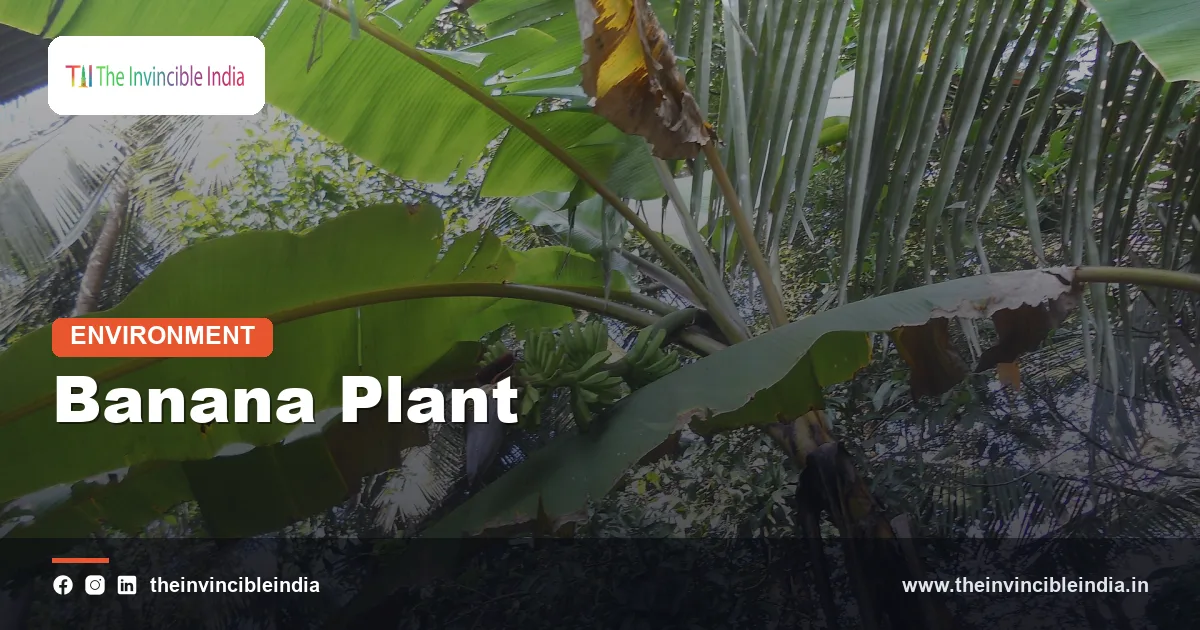
The banana plant (genus Musa) is a giant tropical herb, not a true tree, whose fruit, flower, stem and leaves are all used in India for food, ritual and daily life. India has been the world’s largest producer of bananas for many years, and the plant is grown from Kerala and Tamil Nadu in the south to Maharashtra, Gujarat, Bihar and the northeast.
The banana plant is also sacred in several Hindu traditions, where its leaves serve as plates and its young plants frame the entrances of weddings and festivals. This explainer covers what the banana plant is, why it is not a tree, how it is grown in India, which varieties are popular and what each of its parts is used for.
| Quick Facts | Banana Plant |
|---|---|
| Genus and family | Musa, family Musaceae |
| Type of plant | Giant perennial herb with a false stem (pseudostem) |
| Origin | Tropical Southeast Asia and the Indo-Malayan region |
| Parent species of most cultivated bananas | Musa acuminata and Musa balbisiana |
| Fruit type | Berry (botanically), mostly seedless in cultivated forms |
| Propagation | Suckers and tissue-cultured plantlets, not seeds |
| Crop duration | Roughly 11 to 14 months from planting to harvest |
| India’s rank | Among the largest producers in the world, with a large share of global output |
| Main research institution | ICAR-National Research Centre for Banana, Tiruchirappalli |
Key Takeaways
- The banana plant is the world’s largest herbaceous plant, and its trunk-like pseudostem is made of tightly wrapped leaf sheaths rather than wood.
- India is among the world’s largest banana-producing countries, and the fruit is one of the biggest fruit crops in India by volume.
- Cultivated banana plants are grown from suckers or tissue-culture plantlets, because most edible bananas are sterile and produce no viable seeds.
- Every part of the banana plant has a use in India, including the fruit, raw fruit, flower, stem pith, leaves and fibre.
- A single banana pseudostem flowers and fruits only once, after which the cut stem is replaced by a new sucker growing from the same underground rhizome.
- The banana plant is a symbol of prosperity and auspiciousness in Hindu rituals, and its leaves and young plants are used in pujas, weddings and festivals.
What Is the Banana Plant?
The banana plant is a large, fast-growing perennial herb of the genus Musa that produces bunches of the soft, sweet fruit known as banana. It belongs to the family Musaceae and is related to ginger, turmeric and cardamom in the larger order Zingiberales.
Wild bananas originate in tropical Southeast Asia and the islands of the Indo-Malayan region. They were domesticated thousands of years ago, and the plant spread across South Asia early. Banana references appear in ancient Indian literature, and the fruit has been a part of the Indian diet and culture for a very long time.
Most edible bananas grown today are hybrids or selections from two wild species, Musa acuminata and Musa balbisiana. The genetic mix, written as letter codes such as AAA, AAB or ABB, determines whether the fruit is sweet for eating raw or starchy for cooking.
Is the Banana Plant a Tree or a Herb?
The banana plant is a herb, not a tree, because it has no woody trunk and its upright stem is built from layers of soft leaf bases. Although it can grow taller than a person, and sometimes as tall as a small tree, it has no true wood and dies back after fruiting.
The trunk-like structure is called a pseudostem, meaning false stem. It is formed by leaf sheaths rolled tightly around each other, and it holds up the large leaves at the top. The real stem is a short underground structure called the rhizome or corm, from which roots, new shoots and the flowering stalk grow.
Because the pseudostem is mostly water and fibre, it can be cut with a knife and does not produce annual rings like a tree. The banana plant is recognised as the world’s largest herbaceous flowering plant, and a mature plant may reach roughly two to seven metres depending on the variety.
How Does the Banana Plant Grow and Fruit?
The banana plant grows by producing a series of large leaves from the centre of the pseudostem, and after about nine to twelve months a flower stalk emerges through the top and develops into a bunch of fruit. The plant then dies back, but new suckers carry on its growth.
From flower to fruit
The flower stalk carries a large purple-red bud, often called the banana blossom or heart. As the bud opens, rows of small flowers appear under its bracts. The first flowers to appear are female and each develops into a small fruit called a finger. A group of fingers forms a hand, and several hands form the bunch.
Cultivated bananas are generally parthenocarpic, meaning the fruit develops without fertilisation or seeds. This is why edible bananas have only tiny dark specks in the middle instead of hard seeds.
Suckers and ratoon crops
New shoots called suckers rise from the underground rhizome around the mother plant. Farmers keep one or two healthy suckers to replace the mother plant after it has been harvested. This second growth is called a ratoon crop, and it usually fruits faster than the first because the roots are already established.
How Is the Banana Plant Cultivated in India?
The banana plant is cultivated in India mainly as a commercial orchard crop on warm, well-drained, fertile soil with plenty of water and nutrients, and as a backyard plant in homes across the country. The crop needs a warm, humid climate and cannot tolerate frost or strong winds.
- Climate: warm tropical and subtropical conditions, with growth best at moderately high temperatures and good humidity.
- Soil: deep, loamy, well-drained soil that holds moisture without waterlogging.
- Planting material: sword suckers or tissue-cultured plantlets, which are uniform and disease-free.
- Water: regular irrigation, with drip irrigation increasingly used in dry regions.
- Nutrition: heavy feeding, especially of potassium and nitrogen, with manure and fertiliser.
- Support: bamboo or rope props to keep heavy bunches from toppling the plants.
Tissue culture became popular in India from the 1990s, and it is now a major source of planting material for commercial growers. Plants grown this way are uniform, grow vigorously and are free of many soil-borne diseases at the time of planting.
The bunch is harvested when the fingers are full and rounded but still green, and it is then ripened, often with ethylene gas in controlled chambers. Growers cut the bunch with a part of the pseudostem and handle it carefully to avoid bruising.
Which States Grow the Most Bananas in India?
Tamil Nadu, Maharashtra, Gujarat, Andhra Pradesh, Karnataka and Madhya Pradesh are among the leading banana-growing states in India, while Kerala is known for its local varieties such as the nendran. Bananas are grown in almost every state with a warm climate, in both large orchards and small household plots.
- Tamil Nadu: a major banana state, with large areas around Theni, Tiruchirappalli, Coimbatore and the Kanyakumari region.
- Maharashtra: known for its orchards in the Jalgaon area, which is a major banana hub.
- Gujarat and Andhra Pradesh: large commercial plantations of the Cavendish type.
- Karnataka: both Cavendish and local varieties, such as the small sweet elakki banana.
- Kerala: nendran, poovan and other varieties for both eating and cooking.
- Northeast and eastern India: widespread cultivation of local kinds, along with leaf and flower use.
The banana is one of the few fruit crops that is harvested throughout the year in India, which is why it is available in markets in every season. The exact ranking of states shifts from year to year with area and yield.
What Are the Main Varieties of Banana in India?
The main varieties of banana in India include Cavendish types such as Grand Naine and Robusta, the Kerala plantain nendran, the sweet poovan, the aromatic rasthali, the cooking banana monthan and the small sweet elakki. Different varieties suit different climates, tastes and uses.
| Variety | Type | Typical use and notes |
|---|---|---|
| Grand Naine | Cavendish (AAA) | Leading commercial dessert banana; tall, high-yielding, popular for export |
| Robusta and Dwarf Cavendish | Cavendish (AAA) | Widely grown for the table, with shorter plants that resist wind better |
| Nendran | Plantain (AAB) | Large, firm fruit of Kerala, used for chips, steaming and cooking |
| Poovan (Champa) | AAB | Sweet, slightly tangy table banana popular in the south |
| Rasthali (Silk) | AAB | Aromatic, sweet fruit with a delicate flavour |
| Monthan | Cooking banana (ABB) | Cooked as a vegetable when raw; also used for chips and flour |
| Elakki (Yelakki) | AB | Small, sweet and aromatic fruit grown in Karnataka |
| Red banana | AAA | Red-skinned, sweet fruit, grown on a smaller scale |
The Cavendish group dominates the commercial market in India as in the world, because it yields well and travels reasonably. Local varieties remain important for taste, cooking and tradition, and they keep valuable genetic diversity alive.
What Parts of the Banana Plant Are Used in India?
Nearly every part of the banana plant is used in India, including the ripe fruit, the raw fruit, the flower, the inner stem, the leaves and the fibre. Few other crops are used as completely, which is why the plant is described as useful from root to leaf.
Fruit
The ripe banana is eaten fresh, in milk shakes, in desserts and in sweet dishes. Raw bananas are cooked as a vegetable, fried as chips or ground into flour. Banana chips fried in coconut oil are a well-known snack of Kerala. A ripe banana provides carbohydrate and potassium, and roughly 90 kilocalories per 100 grams.
Flower
The banana flower, also called the banana blossom or heart, is eaten as a vegetable in many regions. It is known as vazhaipoo in Tamil, vazhakoombu in Malayalam and mocha in Bengali, and it is cooked in curries, fritters and stir-fries after the bitter outer layers are removed.
Stem
The soft inner core of the pseudostem is chopped and cooked as a vegetable in south and east India. It is valued as a source of fibre and is made into curries, soups and juices. In Bengal the dish is known as thor.
Leaves and fibre
Banana leaves are used as plates for serving meals, especially in south India, and as wrappers for steaming food, as in Bengali paturi and Kerala ela ada. The leaf is clean, flexible and waterproof. The fibre from the pseudostem is used for rope, mats, handloom cloth and handicrafts.
Why Is the Banana Plant Sacred in India?
The banana plant is sacred in India because it is associated with prosperity, fertility and auspiciousness, and it is used in many Hindu pujas, weddings and festivals. Its constant renewal through new suckers makes it a symbol of continuity and abundance.
- Weddings and festivals: pairs of young banana plants are tied at gateways and entrances as a sign of welcome and good fortune, particularly in the south and in Bengal.
- Satyanarayan puja: banana leaves and fruit are commonly offered, and banana plants are used to decorate the altar.
- Thursday worship: in many households the banana plant is worshipped on Thursdays and linked with Lord Vishnu and Brihaspati.
- Durga Puja: the Nabapatrika or kola bou, a bundle of nine plants led by a banana plant, is bathed and worshipped during the festival in Bengal and eastern India.
- Offerings: bananas are among the most common fruits offered in temples across the country.
The banana leaf is also considered pure for serving food, and traditional meals such as the Onam sadya in Kerala are served on it. Because the fruit and leaf are used once and then returned to the soil, they fit naturally with ideas of clean, sustainable living.
What Threatens the Banana Plant in India?
The banana plant in India is threatened mainly by soil-borne and viral diseases, pests, strong winds and water stress. Because commercial plantations rely on a few clones, a disease can spread quickly through large areas.
- Panama wilt: a fungal disease (Fusarium wilt) that blocks the plant’s water-carrying tissue and can persist in soil for many years.
- Sigatoka leaf spot: a fungal leaf disease that reduces leaf area and yield.
- Banana bunchy top virus: a virus spread by aphids and by infected planting material, which stunts the plant and prevents fruiting.
- Nematodes and rhizome weevils: pests that damage roots and the underground stem.
- Cyclones and storms: strong winds can topple whole orchards, especially when the plants are carrying heavy bunches.
Control of these threats relies on clean planting material, crop rotation, good drainage, timely removal of infected plants and the development of resistant varieties. Research institutions such as the ICAR-National Research Centre for Banana at Tiruchirappalli work on varieties, disease management and farming practices.
How Can You Grow a Banana Plant at Home?
You can grow a banana plant at home by planting a healthy sucker in a large pit or container with rich, well-drained soil, regular water and a sunny, wind-protected spot. A dwarf variety is the best choice for a small garden or terrace.
- Choose a sucker with a broad base and narrow, sword-shaped leaves from a healthy mother plant.
- Plant it in loose, compost-rich soil in a spot with at least five to six hours of sun.
- Water regularly but never allow water to stand around the roots.
- Feed with compost, manure and ash, which provide potassium.
- Remove extra suckers, keeping one or two to replace the mother plant.
- Cut the bunch when the fingers are full, and ripen it indoors.
Fruit usually appears within about a year in warm climates. Even without fruit, the plant gives shade, leaves for serving food and a lush tropical look to the garden.
Bottom Line
The banana plant is a giant herb that is central to Indian farming, food and ritual, and India ranks among the world’s largest producers. Its fruit, flower, stem, leaves and fibre are all useful, and its sacred status shows how closely it is woven into daily life.
Frequently Asked Questions
Is the banana plant a tree or a herb?
The banana plant is a herb, not a tree. Its trunk-like pseudostem is made of tightly wrapped leaf bases and contains no wood. It is the largest herbaceous plant in the world.
How long does a banana plant take to give fruit?
A banana plant usually takes about nine to twelve months to flower and roughly eleven to fourteen months from planting to harvest in India. The time varies with variety, climate and care. Ratoon crops often fruit faster than the first crop.
Why is the banana plant used in Hindu rituals?
The banana plant is used in Hindu rituals because it symbolises prosperity, fertility and continuity. It keeps producing new suckers, and its leaves and fruit are considered pure. Young plants decorate gateways at weddings and festivals, and the plant is worshipped on Thursdays in many homes.
Which parts of the banana plant can be eaten?
The ripe and raw fruit, the flower and the inner stem of the banana plant can all be eaten in India. The flower and stem are cooked as vegetables. The leaves are used to serve and wrap food but are not eaten.
Which state is the biggest banana producer in India?
Tamil Nadu, Maharashtra, Gujarat and Andhra Pradesh are among the largest banana-producing states in India. The exact ranking changes from year to year with area and yield. Kerala is famous for varieties such as the nendran.
Why do banana plants die after fruiting?
A banana pseudostem fruits only once and then dies back because it has completed its growth cycle. The underground rhizome stays alive and sends up new suckers. Farmers cut the old stem and keep a healthy sucker to produce the next crop.
{“@context”:”https://schema.org”,”@graph”:[{“@type”:”FAQPage”,”mainEntity”:[{“@type”:”Question”,”name”:”Is the banana plant a tree or a herb?”,”acceptedAnswer”:{“@type”:”Answer”,”text”:”The banana plant is a herb, not a tree. Its trunk-like pseudostem is made of tightly wrapped leaf bases and contains no wood. It is the largest herbaceous plant in the world.”}},{“@type”:”Question”,”name”:”How long does a banana plant take to give fruit?”,”acceptedAnswer”:{“@type”:”Answer”,”text”:”A banana plant usually takes about nine to twelve months to flower and roughly eleven to fourteen months from planting to harvest in India. The time varies with variety, climate and care. Ratoon crops often fruit faster than the first crop.”}},{“@type”:”Question”,”name”:”Why is the banana plant used in Hindu rituals?”,”acceptedAnswer”:{“@type”:”Answer”,”text”:”The banana plant is used in Hindu rituals because it symbolises prosperity, fertility and continuity. It keeps producing new suckers, and its leaves and fruit are considered pure. Young plants decorate gateways at weddings and festivals, and the plant is worshipped on Thursdays in many homes.”}},{“@type”:”Question”,”name”:”Which parts of the banana plant can be eaten?”,”acceptedAnswer”:{“@type”:”Answer”,”text”:”The ripe and raw fruit, the flower and the inner stem of the banana plant can all be eaten in India. The flower and stem are cooked as vegetables. The leaves are used to serve and wrap food but are not eaten.”}},{“@type”:”Question”,”name”:”Which state is the biggest banana producer in India?”,”acceptedAnswer”:{“@type”:”Answer”,”text”:”Tamil Nadu, Maharashtra, Gujarat and Andhra Pradesh are among the largest banana-producing states in India. The exact ranking changes from year to year with area and yield. Kerala is famous for varieties such as the nendran.”}},{“@type”:”Question”,”name”:”Why do banana plants die after fruiting?”,”acceptedAnswer”:{“@type”:”Answer”,”text”:”A banana pseudostem fruits only once and then dies back because it has completed its growth cycle. The underground rhizome stays alive and sends up new suckers. Farmers cut the old stem and keep a healthy sucker to produce the next crop.”}}]}]}


