

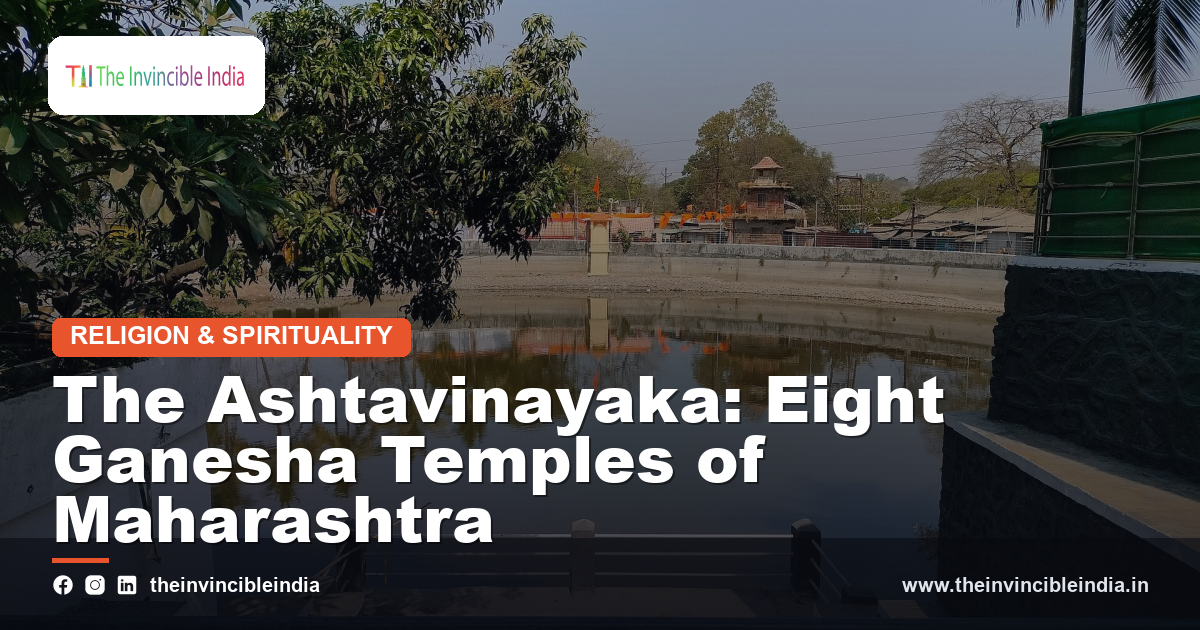
The Ashtavinayaka, meaning the eight Vinayakas, is a celebrated group of eight Ganesha temples spread across the Pune, Raigad and Ahmednagar regions of Maharashtra. Ganesha, the elephant-headed deity honored at the start of every undertaking, is worshipped here in eight distinct manifestations, each tied to its own local legend and sacred landscape. Devotees traditionally visit the shrines as a connected circuit, a pilgrimage that blends devotion, regional history and the rhythms of village life. The tradition forms an important part of the wider Hindu pantheon as it is lived in western India. This guide introduces the eight temples, their stories, the customs of the yatra, and the enduring cultural role of Ganesha worship in Maharashtra.
Quick Facts
| Detail | Information |
|---|---|
| Tradition | Eight Ganesha shrines forming one pilgrimage circuit |
| Region | Maharashtra, mainly around Pune and Raigad |
| Deity | Ganesha, remover of obstacles |
| Meaning of name | Ashta means eight; Vinayaka is a name of Ganesha |
| Traditional start | Moreshwar temple at Morgaon |
| Related festival | Ganesh Chaturthi |
What the Ashtavinayaka Means
The word Ashtavinayaka joins ashta, meaning eight, with Vinayaka, one of the many names of Ganesha. It refers to eight temples in Maharashtra, each dedicated to a particular form of the deity, that are visited together as a single devotional journey. Each shrine carries its own name, its own story of how the image came to be, and its own local community of worshippers who tend the temple across generations.
In popular belief the images at these sites are regarded as self-manifested, meaning they are understood to have appeared naturally rather than being carved by human hands. This idea gives the circuit a particular sanctity and explains why the pilgrimage holds such an honored place in Maharashtrian religious life. The Ashtavinayaka therefore stands as both a geographical grouping and a living spiritual tradition centered on Ganesha.
Ganesha in Hindu Tradition
Ganesha is among the most widely loved deities of Hinduism, recognized by his elephant head, rounded form and gentle expression. He is invoked as Vighnaharta, the remover of obstacles, and as the lord of beginnings, which is why prayers, weddings, journeys and new ventures traditionally open with his name. He is also associated with wisdom, learning and the arts, and is often shown with a modest mouse as his vehicle.
Across India his worship cuts across sectarian lines, appealing to devotees of many traditions. In western India in particular, Ganesha holds a special place in household and community life, which gives the Ashtavinayaka its deep emotional resonance. The eight temples draw on this broad affection, presenting the deity in forms closely tied to the soil and stories of Maharashtra.
Moreshwar at Morgaon
The Moreshwar temple at Morgaon, also spoken of as Mayureshwar, is regarded as the first stop on the traditional pilgrimage. The name connects to the Marathi word for peacock, and local tradition links the village and its deity with peacocks and with a story of Ganesha defeating a demon. The shrine is often described as a fortress-like complex with sturdy walls and corner towers, reflecting an architectural style common to the region.
Devotees see Morgaon as the natural beginning and end of the circuit, since the yatra is traditionally closed by returning to this temple. The place carries a special sense of welcome and completion for pilgrims. As the opening shrine of the Ashtavinayaka, Moreshwar sets the devotional tone for the journey that follows.
Siddhivinayak at Siddhatek
The Siddhivinayak temple at Siddhatek stands on the banks of the Bhima river in the Ahmednagar district. Tradition connects this hill-set shrine with the god Vishnu, who is said to have received success here in a struggle against demons after invoking Ganesha. The name Siddhi refers to attainment and fulfillment, which is why devotees come here seeking success in their endeavors.
A distinctive feature often mentioned is that the trunk of the image is turned toward the right, an unusual orientation among Ganesha images that is considered to demand strict ritual observance. Pilgrims commonly circumambulate the hill as part of their worship. Siddhatek therefore represents the Ashtavinayaka theme of obstacles overcome and aspirations fulfilled through devotion.
Ballaleshwar at Pali
The temple at Pali, in the Raigad district, is unusual because the deity is known by the name of a devotee rather than a title of Ganesha. Ballaleshwar is linked in tradition with a young boy named Ballal, whose deep devotion is said to have caused Ganesha to appear and remain at the place. The story is told as a reminder that sincere faith matters more than status or ritual display.
The shrine is set against the Sarasgad hills, and its stone structure is admired for its quiet and harmonious setting. Local accounts describe the temple as having been rebuilt in stone in later centuries to replace an earlier timber structure. The Pali temple thus highlights the Ashtavinayaka message that devotion itself can sanctify a place and shape its identity.
Varadavinayak at Mahad
The Varadavinayak temple at Mahad lies in the Raigad district, in a peaceful setting near the Konkan foothills. The name Varada means the bestower of boons, and devotees come here with prayers for blessings and the fulfillment of wishes. The tradition of this site speaks of a sage who practiced austerities here and received the grace of Ganesha.
A well-known custom associated with the temple is that of a lamp kept continuously alight, which locals regard as a sign of the unbroken devotion offered at the place. Pilgrims are traditionally permitted to approach the image closely, which gives the shrine an intimate character. Mahad reflects the generous aspect of Ganesha as the giver of boons within the Ashtavinayaka circuit.
Chintamani at Theur
The Chintamani temple at Theur is located near Pune, close to the confluence of rivers, and is among the better known shrines of the group. The name Chintamani refers to a legendary wish-fulfilling jewel, and tradition tells that Ganesha recovered this jewel from a greedy ruler and returned it to a sage, bringing peace of mind to all concerned. The word chinta means worry, so the deity is understood as the one who dispels anxiety.
The temple is closely linked with the Peshwa era of Maharashtrian history, when patrons supported the care and expansion of many such shrines, and local tradition remembers one Peshwa family as especially devoted. Theur thus shows how faith and regional history became intertwined, offering worshippers a Ganesha who calms the restless mind.
Girijatmaj at Lenyadri
The Girijatmaj temple at Lenyadri is unique among the eight because it is set within a rock-cut cave on a hillside near Junnar. The name Girijatmaj means the son of Girija, a title of the goddess Parvati, and recalls the tradition that she performed penance in these hills to be blessed with a son. Ganesha is thus honored here in his role as the beloved child of the divine mother.
The hill is also known for a series of ancient Buddhist caves, which shows how the same landscape has sheltered different religious traditions across the centuries. Reaching the shrine requires climbing a long flight of stone steps, which many pilgrims regard as part of the devotional effort. Lenyadri stands out within the Ashtavinayaka as a shrine of mountain, cave and maternal devotion.
Vighnahar at Ozar
The Vighnahar temple at Ozar is found along the Kukadi river in the Pune district, near the town of Junnar. The name Vighnahar, or the one who removes obstacles, summarizes the role Ganesha plays in the tradition. Local legend recounts that a demon named Vighnasura caused disruption to sacred rites, and that Ganesha subdued him and was thereafter worshipped at the spot as the remover of hindrances.
The temple is notable for its walled enclosure and for a spire that is traditionally described as gilded. Festivals here draw large gatherings, especially during the main Ganesha celebrations. Ozar contributes to the Ashtavinayaka the central idea of overcoming whatever blocks spiritual and worldly progress.
Mahaganapati at Ranjangaon
The Mahaganapati temple at Ranjangaon lies in the Pune district and is considered the last of the eight in the usual sequence of visits before pilgrims return to Morgaon. Ganesha is worshipped here as the Great Ganapati, and tradition links the shrine with a story in which Shiva invoked Ganesha before confronting the demon Tripurasura, thereby acknowledging the principle that no endeavor begins without his blessing.
The temple is approached through a large entrance hall and is known for a rich ritual calendar observed by the local community. As the temple of the great Ganapati, it expresses the grandeur and authority attributed to the deity. Ranjangaon rounds out the circuit by presenting Ganesha as the sovereign principle behind every successful beginning.
The Traditional Order of the Yatra
The Ashtavinayak Yatra follows a customary order of visits, beginning with Moreshwar at Morgaon and moving through the remaining shrines before returning to Morgaon to complete the circuit. Devotees believe that following this sequence completes the pilgrimage in the proper spirit, and many families plan the journey as a carefully organized undertaking spanning several days.
Pilgrims usually travel by road, since the temples are spread across villages and small towns that are some distance apart. Along the way they take part in darshan, prayer offerings and shared meals provided by local trusts. The ordered sequence gives the journey a sense of structure, so that the yatra becomes a story with a beginning, a progression and a completion rather than a random series of visits.
Legends and Textual Roots
The tradition of the eight Vinayakas draws on the wider body of devotional literature concerning Ganesha, including the Puranic texts that celebrate his many forms and exploits. Texts such as the Ganesha Purana and the Mudgala Purana are traditionally associated with the worship of the deity, and the legends told at each temple draw on this storytelling world, adapting it to local geography.
It is important to recognize that the stories of each shrine are transmitted largely through oral tradition, temple custom and regional storytelling, and different communities may narrate them with slight variations. This richness is part of the charm of the Ashtavinayaka. The legends are less a single fixed canon than a shared devotional heritage that each place expresses in its own voice.
Architecture and Temple Character
The eight temples differ in age, scale and style, yet several share features typical of the Deccan region. Many have sturdy stone walls, modest courtyards, lamp towers known as deepmals, and halls where devotees gather for prayer. Some were renovated or expanded during the Peshwa period, while others retain older foundations or are associated with much earlier sacred spots.
The most striking contrast is perhaps between the hillside cave shrine at Lenyadri and the riverside temples at places like Theur and Siddhatek. Together they show how sacred architecture adapted to terrain and community resources. Rather than a single uniform design, the Ashtavinayaka offers a varied portrait of Maharashtrian temple building, unified by a shared devotion to one beloved deity.
Rituals, Offerings and Worship
Worship at the Ashtavinayaka temples follows familiar Hindu patterns of darshan, abhisheka, aarti and offerings. Devotees commonly bring modak, the sweet dumpling regarded as Ganesha’s favorite, along with durva grass, red flowers and coconuts. Priests perform daily rites, and special observances mark auspicious days in the lunar calendar, notably Sankashti Chaturthi and the days of Ganesh Chaturthi.
Many pilgrims also practice simple vows, such as fasting or walking a circuit around the temple, as expressions of gratitude or petition. The atmosphere is typically one of quiet reverence mixed with communal warmth. Through these ordinary acts of offering, the temples keep alive a continuous line of devotional practice that links modern worshippers with earlier generations.
Ganesh Chaturthi and the Circuit
Ganesh Chaturthi, the festival celebrating the birth of Ganesha, is observed with particular energy throughout Maharashtra, and the Ashtavinayaka temples become focal points of devotion during this season. Households install clay images at home, communities set up decorated pavilions, and the festival concludes with processions and the immersion of the images in water.
The public character of the festival in western India is often linked with the late nineteenth century, when community celebration of the festival became widespread in places such as Pune. The eight temples complement this popular celebration by offering a more contemplative and place-centered form of Ganesha worship. Together, the festival and the pilgrimage show the two faces of the tradition, one joyfully public and the other quietly devotional.
Landscape and Rural Setting
One of the distinctive qualities of the Ashtavinayaka is that the temples are rooted in the countryside rather than in great urban centers. They stand on riverbanks, beneath hills or at the edge of villages, and their surroundings shape the experience of the visit. Travelers pass through farmland, small markets and quiet roads on the way from one shrine to the next.
This rural setting links the sacred to the everyday, since the temples are woven into village economies, festivals and family life. Local communities maintain the shrines, supply offerings and welcome visitors. The pilgrimage therefore offers an encounter not only with religious tradition but also with the agrarian landscape and regional character of Maharashtra.
Planning a Respectful Visit
Visitors planning the Ashtavinayaka circuit are generally advised to allow several days, since the temples lie some distance apart and each deserves unhurried attention. Modest attire, removing footwear before entering the sanctum and following the guidance of temple staff are standard courtesies. Many shrines have specific hours for darshan and ritual, so checking timings beforehand is helpful.
Festival days draw heavy crowds, and those who prefer a quieter experience often choose ordinary weekdays outside peak seasons. Local trusts frequently provide simple lodging and meals for pilgrims. Approaching the circuit with patience and respect allows visitors, whatever their own beliefs, to appreciate the warmth and dignity of this living tradition.
The Ashtavinayaka Today
Today the Ashtavinayaka remains one of the most cherished pilgrimage circuits of Maharashtra, drawing families, solo travelers and groups from across India and beyond. Improved roads and organized transport have made the journey more accessible, yet its essential character remains devotional, centered on the eight forms of a deity who is loved for his approachability and wisdom.
For many Maharashtrian families, completing the yatra is a milestone of faith, often undertaken at moments of gratitude or new beginnings. The temples continue to serve as centers of community, learning and festival life. As a whole, the Ashtavinayaka endures as a vivid expression of how place, legend and devotion combine to create a lasting sacred geography.
Sources & Further Reading
- Ministry of Culture, Government of India (indiaculture.gov.in).
- Maharashtra Tourism Development Corporation (maharashtratourism.gov.in).
Frequently Asked Questions
What is the Ashtavinayaka?
The Ashtavinayaka is a group of eight Ganesha temples in Maharashtra that are traditionally visited as one pilgrimage circuit. Each shrine honors a distinct form of the deity and has its own local legend.
Which temples make up the Ashtavinayaka?
The eight temples are Moreshwar at Morgaon, Siddhivinayak at Siddhatek, Ballaleshwar at Pali, Varadavinayak at Mahad, Chintamani at Theur, Girijatmaj at Lenyadri, Vighnahar at Ozar and Mahaganapati at Ranjangaon. They lie mainly in the Pune, Raigad and Ahmednagar regions.
Where does the traditional yatra begin and end?
The customary pilgrimage begins at the Moreshwar temple in Morgaon and, after visiting the other seven shrines, returns to Morgaon to complete the circuit. Devotees believe that following this order completes the yatra properly.
How long does the pilgrimage usually take?
Because the temples are spread across several districts, the circuit is commonly planned over a few days. The exact duration depends on the mode of travel and how much time pilgrims spend at each shrine.
Why is Ganesha worshipped at the start of undertakings?
Ganesha is regarded in Hindu tradition as the remover of obstacles and the lord of beginnings. Invoking him first is believed to ensure that a new venture proceeds smoothly.


