

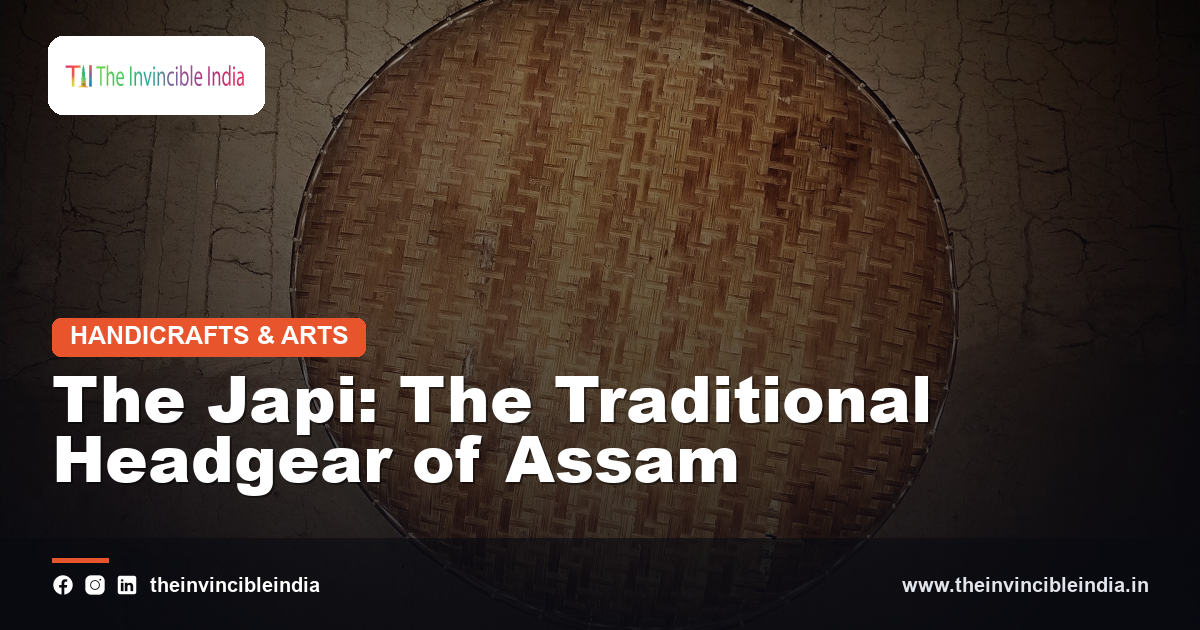
The Japi, also spelled jaapi, is the traditional conical hat of Assam, woven from bamboo and the leaves of the tokou palm or the kohua plant, and counted among the enduring emblems of Assamese culture. In its plain form it is a broad, wide-brimmed sunshade long used by farmers and field workers for protection from the sun and rain. In its decorated form, known as the phulam japi, it is brightly ornamented with coloured cloth and intricate work and is used ceremonially, offered as a mark of honour and displayed as a symbol of Assam, often seen during the Bihu festival. The Japi is a craft of woven bamboo and leaf, rooted in the daily life and identity of the region. Readers who enjoy India’s rich craft traditions may also explore the traditional handicrafts of Rajasthan. This guide describes the Japi, its materials, its forms, its making, its role in Bihu and its present-day place.
Quick answer: The Japi (also spelled jaapi) is the traditional conical hat of Assam, India, woven from bamboo and the leaves of the tokou palm or kohua plant. A plain version serves as a farmer’s broad sunshade, while a decorated version, the phulam japi, is brightly ornamented and used ceremonially as a symbol of Assamese culture, often seen during the Bihu festival. It is a craft of woven bamboo and leaf.
Key Takeaways
- The Japi, also spelled jaapi, is the traditional conical hat of Assam, India.
- It is woven from bamboo and the leaves of the tokou palm or the kohua plant.
- The plain Japi is a broad, wide-brimmed sunshade long used by farmers and field workers.
- The decorated version, the phulam japi, is brightly ornamented with coloured cloth and intricate work.
- The phulam japi is used ceremonially, offered as a mark of honour and displayed as a symbol of Assam.
- The Japi is closely associated with Assamese culture and is often seen during the Bihu festival.
The sections below explain what the Japi is, what it is made from, its plain and decorated forms, how it is woven, its role in Bihu and Assamese culture, who makes it and why it still matters.
Quick Facts
| Detail | Information |
|---|---|
| Craft type | Woven bamboo and leaf headgear |
| Region of origin | Assam, India |
| Also known as | Jaapi; the decorated form is the phulam japi |
| Materials | Bamboo and tokou palm or kohua leaves; cloth for the decorated form |
| Technique | Weaving a bamboo framework lined with dried leaves, then decorating |
| Known for | Conical sunshade hat and the ornamented phulam japi, a symbol of Assam |
| GI status | A recognised traditional craft of Assam; confirm GI details with the Registry |
| Community | Traditional Assamese bamboo and japi artisans |
What Is the Japi?
The Japi is the traditional conical hat of Assam, woven from bamboo and palm or kohua leaves and counted among the lasting emblems of Assamese culture. Also spelled jaapi, it is a broad, wide-brimmed hat shaped to a point at the top, made over a woven bamboo framework lined with dried leaves. In its plain form it is a practical sunshade and rain shield, long used by farmers and field workers. In its decorated form, the phulam japi, it is richly ornamented with coloured cloth and intricate work and used for ceremony and display. The Japi is thus both a humble working hat and a proud cultural symbol, according to its form. It is a craft of woven bamboo and leaf, rooted in the life of Assam. The Japi defines a distinctive Assamese headgear. Its conical shape is instantly recognisable.
What Is the Japi Made From?
The Japi is made from bamboo and the leaves of the tokou palm or the kohua plant, materials readily found in Assam. A framework is woven from thin strips of bamboo, which gives the hat its shape and strength, and this framework is covered or lined with dried leaves, which form the broad, protective surface of the hat. The tokou palm leaf and the kohua leaf are traditional materials for this covering, chosen for their suitability and availability. For the decorated phulam japi, coloured cloth, often in bright shades, and other ornament are added over the basic hat. The use of local bamboo and leaf ties the craft directly to the land and resources of Assam. These simple natural materials, skilfully worked, make both the plain and the decorated Japi. The materials are the foundation of the craft. Bamboo and leaf give the Japi its form and function.
What Are the Different Types of Japi?
The Japi is made in two broad types: a plain, practical sunshade used by farmers and field workers, and a decorated ceremonial form known as the phulam japi. The plain Japi, undecorated and sturdy, serves to shield the wearer from the sun and rain during work in the fields, valued for its broad brim and lightness. The phulam japi, by contrast, is brightly ornamented with coloured cloth, intricate work and decoration, and is not meant for field work but for ceremony, honour and display. While the plain Japi is a working tool, the phulam japi is a cultural and symbolic object, offered as a mark of respect and used to welcome guests and adorn occasions. Both share the same basic conical, bamboo-and-leaf construction. The two types serve very different purposes. Together they show the Japi as both utility and symbol. The form reflects its use.
Why Was the Japi Worn by Farmers?
The plain Japi was worn by farmers and field workers because its broad, conical, wide-brimmed form gives excellent protection from the strong sun and the heavy rain of Assam. Working long hours in open fields, farmers needed a light, effective shade and rain shield, and the Japi, woven from bamboo and leaf, served this purpose well. Its wide brim casts shade over the head, neck and shoulders, while the dried-leaf surface helps shed rain, and its light weight makes it comfortable to wear through the day. Being made from readily available local materials, it was practical and inexpensive to make and replace. The plain Japi was therefore a everyday tool of rural working life in Assam. Its practical design met the needs of the field. Protection from sun and rain was its first purpose. The farmer’s Japi is the root of the craft.
What Is the Phulam Japi?
The phulam japi is the decorated, ornamental form of the Japi, brightly adorned with coloured cloth and intricate work and used ceremonially as a symbol of Assamese culture. The word phulam refers to its flowered or ornamented character, and this Japi is covered and embellished with colourful cloth, patterns and decoration, making it a striking and beautiful object. Unlike the plain farmer’s Japi, the phulam japi is not for field work but for ceremony, honour and display: it is offered as a mark of respect, used to welcome and honour guests, given as a gift and displayed as an emblem of Assam. It features prominently in cultural events and celebrations, and its image has become a recognised symbol of the state. The phulam japi raises the humble hat into a work of decorative art. It carries the pride and identity of Assam. It is the Japi at its most splendid.
How Is the Japi Woven?
The Japi is woven by making a conical framework from thin strips of bamboo and covering or lining it with dried leaves to form the broad, protective hat. The artisan first prepares the bamboo, splitting it into fine strips, and weaves these into the framework that gives the Japi its characteristic conical, wide-brimmed shape and its strength. Dried tokou palm or kohua leaves are then arranged over or within this framework to create the surface that shades and sheds rain. The pieces are secured so that the hat holds its form and serves its purpose. For the phulam japi, coloured cloth and ornament are added over the finished hat to decorate it. The whole process is done by hand and relies on the artisan’s skill with bamboo and leaf. Because practices vary, the exact methods differ between makers. The weaving gives the Japi its shape and strength. The handwork is the craft.
What Role Does the Japi Play in Bihu?
The Japi, especially the decorated phulam japi, plays a prominent role in Bihu, the great festival of Assam, where it appears as a cherished symbol of Assamese culture. During Bihu celebrations, the colourful phulam japi is commonly seen, carried, displayed and used in performances of the Bihu dance and in the festivities, adding to the colour and pride of the occasion. The Japi thus features in one of the most important cultural moments of the Assamese year, reinforcing its place as an emblem of the region. Its bright decoration suits the joy and celebration of the festival. Through Bihu and other cultural events, the phulam japi is seen and honoured widely. Its role in Bihu has helped make it a recognised symbol of Assam. The festival and the Japi are closely linked. The Japi shines at Bihu. It carries Assamese pride into celebration.
What Does the Japi Symbolise in Assamese Culture?
The Japi, particularly the phulam japi, symbolises Assamese identity, honour and hospitality, and has become a recognised emblem of the state. Offered as a mark of respect, it is used to welcome and honour distinguished guests and to express regard, so that giving a phulam japi is a gesture of esteem. Displayed at cultural events, used in the Bihu festival and featured as an image of Assam, the Japi stands for the culture and pride of the region. Its roots in the everyday working life of the Assamese farmer add to its meaning as a symbol of the land and its people. The Japi thus carries both practical heritage and cultural symbolism. It is more than a hat; it is an emblem of Assam. Its symbolism is woven into the identity of the state. The Japi represents Assamese culture to the world.
What Patterns and Decorations Appear on the Phulam Japi?
The phulam japi is decorated with bright coloured cloth, patterns and intricate ornament that transform the plain hat into a striking object of beauty. Artisans cover and embellish the hat with colourful fabric, often in vivid shades, and add decorative work and patterns that give the phulam japi its flowered, ornamented character. The decoration may include geometric and floral patterns and other motifs, arranged to make the hat colourful and attractive. This ornamentation distinguishes the ceremonial phulam japi from the plain farmer’s Japi and suits its role in honour, celebration and display. The skill of the artisan shows in the richness and neatness of the decoration. Because practices vary, the exact patterns and materials differ between makers. The decoration makes the phulam japi a work of decorative art. It gives the hat its festive splendour. Ornament turns utility into symbol.
What Is the History of the Japi?
The Japi has a long history in Assam, rooted in the practical needs of rural life and growing into a cherished cultural symbol, though its precise early origins rest on tradition rather than exact record. For a very long time, the people of Assam have woven broad bamboo-and-leaf hats to shield themselves from the sun and rain while working in the fields, making the plain Japi a humble tool of everyday life. Over time, the decorated phulam japi developed as an ornamental and ceremonial form, used for honour, welcome and display, and the Japi came to be associated with Assamese identity and festivals such as Bihu. Because much of the early story rests on tradition, it is best described in general terms as part of Assam’s craft heritage. What is clear is that the Japi grew from practical need into a proud symbol. Its history runs from the field to the festival.
Who Makes the Japi?
The Japi is made by traditional Assamese bamboo and japi artisans, who weave the bamboo framework, work the leaf covering and, for the phulam japi, add the decoration. The craft requires skill in preparing and weaving bamboo, arranging the dried leaves and shaping the conical hat, as well as the decorative skill needed for the ornamented phulam japi, and this knowledge is passed down within artisan families and communities over generations. For these makers, the craft is both an inherited tradition and a source of livelihood, tied to the culture and identity of Assam. The artisans supply plain Japi for practical use and decorated phulam japi for ceremony, display and the market for Assamese craft. Like many bamboo and handicraft traditions, the Japi depends on keeping skilled artisans in the trade, on the availability of bamboo and leaf, and on fair returns. The artisans are the craft’s living heart. Their skill sustains the tradition.
Does the Japi Have a GI Tag?
The Japi is recognised as a traditional craft and cultural emblem of Assam, valued both as practical headgear and as a symbol of the state. It is promoted and supported as a distinctive craft, admired for its bamboo-and-leaf construction and its ornamented phulam japi form. Whether the Japi holds a specific Geographical Indication is best confirmed with the official Geographical Indications Registry and the relevant state authorities, since the status of individual crafts can vary and change over time, and details should be checked rather than assumed. Whatever the formal position, the Japi is clearly and strongly identified with Assam and its artisans. Recognition and cultural interest help protect the craft and sustain its makers. They also encourage the making and buying of genuine work. The bond between the Japi and Assam remains central to its identity. The Japi is a cherished emblem of the state.
How Does the Japi Compare with Other Traditional Hats?
The Japi shares with many traditional hats across Asia the conical, wide-brimmed form woven from natural materials for protection from sun and rain, but it is distinguished by its Assamese materials, its phulam japi form and its cultural symbolism. Broad conical hats of bamboo or leaf are found in several farming cultures, each adapted to local materials and needs. The Japi stands out for its construction from Assamese bamboo and tokou palm or kohua leaf, and especially for the richly decorated phulam japi, which raises the hat into a ceremonial symbol of the region. Comparing these traditions shows how similar practical needs produce distinctive local crafts. The Japi contributes a uniquely Assamese voice, both utilitarian and symbolic. Each traditional hat reflects its own culture. The Japi, with its phulam japi form, is distinctly Assamese. It holds a special place among India’s craft headgear.
How Can You Buy an Authentic Japi?
An authentic Japi can be bought from recognised Assam handicraft emporiums, cooperatives, craft fairs, bamboo-craft artisans and trusted stores that identify it as genuine Assamese work. A genuine Japi is woven by hand from bamboo and tokou palm or kohua leaf, showing the characteristic conical shape and the slight natural variation that marks it as handwork, while a true phulam japi carries neat, colourful cloth decoration and ornament. Mass-produced or imitation pieces may use synthetic materials, look perfectly uniform, or lack the proper construction and decoration. Buyers can check that the materials are natural bamboo and leaf, examine the weaving and, for the phulam japi, the quality of the decoration, and ask about the artisan and region. Buying from recognised emporiums, cooperatives or known artisans helps income reach the makers. Careful buying rewards genuine craftsmanship. It also secures a true emblem of Assamese culture.
The Japi Today
The Japi today endures as both a practical hat and a proud symbol of Assamese culture, instantly recognised as an emblem of the state. While the plain Japi still serves in rural life, it is the decorated phulam japi that is most widely seen, used to honour guests, displayed at cultural events, carried in the Bihu festival and featured as an image of Assam. Artisans continue to weave the bamboo-and-leaf hat and to adorn the phulam japi, serving both practical needs and the market for Assamese craft and cultural display. At the same time, the craft faces real challenges, including competition from other materials, fair returns for artisans and the need to pass skills to new makers. Readers can support the tradition by choosing genuine handmade Japi, buying from cooperatives and valuing the skill behind each hat. The Japi endures as a living emblem of Assam. Its conical form keeps the tradition alive.
Sources & Further Reading
- Development Commissioner (Handicrafts), Ministry of Textiles, Government of India (handicrafts.nic.in).
- Geographical Indications Registry, Government of India (ipindia.gov.in).
- Directorate of Handloom and Textiles, Government of Assam.
Frequently Asked Questions
What is the Japi?
The Japi, also spelled jaapi, is the traditional conical hat of Assam, woven from bamboo and the leaves of the tokou palm or kohua plant. A plain version is a farmer’s broad sunshade, while the decorated phulam japi is a ceremonial symbol of Assamese culture. It is a craft of woven bamboo and leaf.
What is the phulam japi?
The phulam japi is the decorated, ornamental form of the Japi, adorned with bright coloured cloth and intricate work. Unlike the plain farmer’s hat, it is used ceremonially, offered as a mark of honour and displayed as a symbol of Assam. It is often seen during the Bihu festival.
What is the Japi made from?
The Japi is made from bamboo and the dried leaves of the tokou palm or the kohua plant. A framework is woven from thin bamboo strips and covered with the leaves to form the broad, protective hat. The decorated phulam japi adds coloured cloth and ornament over this basic hat.
Why was the Japi worn by farmers?
The plain Japi was worn by farmers and field workers because its broad, conical, wide-brimmed form gives good protection from the strong sun and heavy rain of Assam. It is light, effective and made from inexpensive local materials. It was a practical everyday tool of rural working life.
What role does the Japi play in Bihu?
The Japi, especially the colourful phulam japi, is a prominent symbol during Bihu, the great festival of Assam, where it is carried, displayed and used in the Bihu dance and festivities. Its bright decoration suits the celebration. Its role in Bihu has helped make it a recognised emblem of Assam.
Does the Japi have a GI tag?
The Japi is recognised as a traditional craft and cultural emblem of Assam. Whether it holds a specific Geographical Indication is best confirmed with the official Geographical Indications Registry and the relevant state authorities, as the status of individual crafts can vary and should be checked rather than assumed.


