

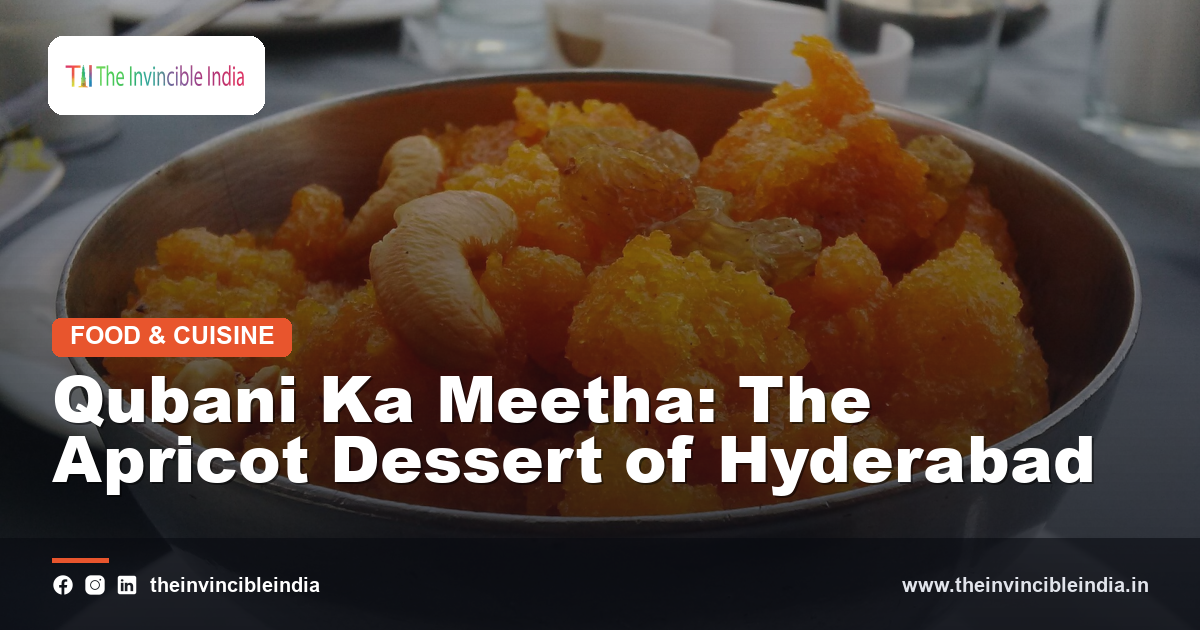
Qubani ka meetha, also spelled khubani ka meetha and sometimes called the Hyderabadi apricot pudding, is a dessert of stewed dried apricots that has become one of the signature sweets of Hyderabad. Where many dishes described in our guide to famous sweets of India rely on milk, ghee, or flour, this one draws its character from fruit that is soaked, simmered with sugar, and finished with cream. It is closely tied to the feast culture of the Deccan and to the Persian and Central Asian taste for dried fruit. This guide explains what the dessert is, how it is made, and why it holds such a place at Hyderabadi tables.
Quick answer: Qubani ka meetha is a traditional dessert of Hyderabad in Telangana, made by soaking dried apricots, simmering them with sugar until soft and syrupy, and serving them with cream, custard, or ice cream. The word qubani means apricot, and meetha means sweet. It is usually the closing course of a Hyderabadi feast, served after biryani and other festive dishes.
Key Takeaways
- Qubani ka meetha is a Hyderabadi dessert made from dried apricots stewed in sugar syrup.
- The name combines qubani, meaning apricot, with meetha, meaning a sweet dish.
- It is traditionally served as the final course of a Hyderabadi wedding or festive feast.
- The dish is usually paired with fresh cream, malai, custard, or vanilla ice cream to balance its sweet-tart flavour.
- The softened apricot kernels, blanched and added on top, give the dessert a gentle almond-like crunch.
- The dessert reflects the Persian, Central Asian, and Deccani threads that shaped Hyderabadi cuisine.
Read on for the ingredients, method, serving customs, and cultural role in detail.
Quick Facts
| Detail | Information |
|---|---|
| Dish | Qubani ka meetha (khubani ka meetha) |
| Type | Stewed fruit dessert |
| Origin | Hyderabad, Deccan region |
| State | Telangana |
| Main ingredient | Dried apricots |
| Typical accompaniment | Cream, malai, custard, or ice cream |
What is Qubani ka meetha?
Qubani ka meetha is a dessert of dried apricots stewed in sugar until they turn soft, glossy, and deep amber in colour. The name comes from qubani, a word for apricot used in Urdu and Persian-influenced speech, and meetha, meaning a sweet. In Hyderabad the dish is often described as the city’s own apricot pudding, although it has the texture of a thick compote rather than a set pudding. The apricots keep much of their shape, sitting in a syrup that carries their natural tartness. Because the base is fruit instead of milk, the dessert tastes noticeably different from many other Indian sweets, and it is usually softened with a cool, creamy topping. The dish therefore stands out as one of the clearest examples of dried-fruit cooking in Indian regional cuisine.
Where does Qubani ka meetha come from?
Qubani ka meetha comes from Hyderabad, the Deccan city whose royal kitchens blended local, Mughal, Persian, and Central Asian influences. Food historians generally link the use of dried apricots to the wider culinary tradition of the Persianate world, where dried fruit was prized for sweet and savoury dishes alike. In Hyderabad that tradition met the produce, spices, and festive customs of the Deccan, and the result became part of what is now called Hyderabadi cuisine. The exact moment when the dessert took its present form is not firmly documented, so it is best described as a product of the court and household cooking of the region over time. What is clear is that the dish is now so closely associated with Hyderabad that it is treated as a local emblem.
What are the main ingredients?
The main ingredients of Qubani ka meetha are dried apricots, sugar, and water, with a few optional flavourings. The apricots are the hard, sun-dried kind, which must be soaked before cooking so that they swell and soften. Sugar sweetens the syrup and balances the fruit’s natural sourness. Some cooks add a little cardamom, a few strands of saffron, or a squeeze of lemon, while others keep the flavour pure and simple. The kernels taken from inside the apricot stones are used as a garnish, and fresh cream or ice cream completes the plate. Because so few ingredients are involved, the quality of the dried apricots has a direct effect on the final result. The dessert shows how a short ingredient list can produce a dish of real depth.
How is Qubani ka meetha made?
Qubani ka meetha is made by soaking dried apricots, cooking them gently in sugar syrup, and cooling the mixture until it thickens. The apricots are usually soaked for several hours or overnight, which softens the flesh and loosens the stones. They are then simmered in fresh or reserved soaking water with sugar until the fruit is tender and the liquid reduces to a light syrup. Many cooks mash part of the fruit to thicken the dish, while leaving some pieces whole for texture. The stones are cracked open so the kernels can be blanched and peeled. Everything is then cooled, since the dessert is generally served chilled or at room temperature. The method is patient rather than complicated, and its success depends mainly on slow, even cooking.
Why is soaking the apricots so important?
Soaking is essential because dried apricots are firm and leathery, and they cook evenly only after they have absorbed water. A long soak, often overnight, allows the fruit to plump up, so that the later simmering softens it without scorching the sugar. The soaking water also carries the fruit’s colour and flavour, which is why many cooks reuse it as the cooking liquid instead of discarding it. Skipping or shortening this step tends to leave the apricots chewy in the centre and the syrup thin. Some households also remove the stones during soaking, since the fruit parts away from them more easily once it has swollen. The humble soak thus lays the foundation for the dessert’s smooth, spoonable texture.
What do the apricot kernels add?
The apricot kernels add a mild nutty crunch and a visual finish to Qubani ka meetha. After the softened apricots are split, the stones are cracked and the small kernels inside are taken out, then blanched so the skins slip off. The pale kernels look much like almonds and are placed on top of each serving, often alongside slivered nuts. Their taste is gentle, slightly sweet, and quietly almond-like, which suits the fruity base. In traditional kitchens this step is a sign of care, because it makes use of a part of the fruit that might otherwise be discarded. Cooks who cannot obtain the kernels sometimes use blanched almonds in their place, and the dessert remains recognisable. The kernels are therefore a small but meaningful detail of the classic presentation.
How is Qubani ka meetha served?
Qubani ka meetha is served chilled or at room temperature, usually topped with thick cream, malai, custard, or a scoop of vanilla ice cream. The cool dairy softens the sharpness of the apricots and adds richness, so each spoonful combines tart fruit, sweet syrup, and smooth cream. A scattering of blanched kernels or chopped nuts completes the bowl. At a formal feast it is brought out in small bowls or glasses after the main courses are cleared, while at home it may be eaten from a larger serving dish. Some hosts arrange the apricots in a neat layer with the cream poured around them for presentation. The serving style is flexible, but the pairing of fruit and cream is the part that defines the experience.
Why is it served after biryani?
Qubani ka meetha is served after biryani because its cool, fruity sweetness offsets the heat, spice, and richness of the main meal. A traditional Hyderabadi feast built around biryani, along with dishes such as mirchi ka salan and dalcha, is hearty and strongly seasoned. A chilled apricot dessert refreshes the palate and gives the meal a gentle ending. Over time this pairing became so customary that guests expect the dessert to follow the rice course, particularly at weddings and celebrations. The tartness of the fruit also cuts through the lingering richness of ghee and spices. The sequence of savoury feast followed by cool apricot sweetness has become one of the best-recognised rhythms in Hyderabadi dining.
What does Qubani ka meetha taste like?
Qubani ka meetha tastes sweet, tart, and fruity, with a soft, jammy texture and a creamy finish when served with dairy. The apricots bring a natural tang that keeps the dessert from feeling cloying, while the sugar syrup rounds the flavour into something closer to a spoon sweet or compote. The texture sits between whole fruit and a thick sauce, with tender pieces suspended in a syrup that clings to the spoon. When cardamom or saffron is added, a faint floral warmth appears at the edge of the taste. The kernels contribute a clean, nutty note and a small amount of bite. Altogether, the dessert is lighter on the palate than milk-based sweets and is often described as refreshing.
How does it differ from other Hyderabadi sweets?
Qubani ka meetha differs from other Hyderabadi sweets because it is fruit-based, while most of the region’s famous desserts are built on bread, milk, or semolina. Double ka meetha, for example, is a bread pudding fried and soaked in sweetened, thickened milk, and shahi tukda is a related dish of fried bread with rich milk. Both are heavy, golden, and dairy-forward. Qubani ka meetha, by contrast, is tangy and lighter, and its main colour comes from the fruit. These sweets often appear on the same dessert table, letting guests choose between a creamy bread-based option and a fruit-based one. The contrast shows how varied the dessert repertoire of Hyderabad is, extending well beyond a single style.
What role does it play at weddings and festive meals?
Qubani ka meetha plays the role of the traditional dessert at Hyderabadi weddings and festive meals, and it is closely associated with hospitality. In Hyderabadi culture the wedding feast is a major social occasion, and the order and quality of dishes carry meaning. The apricot dessert is usually one of the final items, signalling that the formal meal is complete. It also appears at celebrations such as Eid gatherings and family dinners, where a generous table is a mark of respect to guests. Caterers and restaurants across the city list it as a standard offering. Its presence at such events has helped the dish spread beyond Hyderabad, so that it is now recognised in other Indian cities with large Hyderabadi communities.
How do you choose good dried apricots?
Good dried apricots for this dessert are plump, deep orange-brown, and slightly soft to the touch, with a fragrant fruity smell. Many cooks prefer the unsulphured, naturally dried kind, which is darker and has a more concentrated flavour, over brightly coloured ones. Whole apricots with the stones intact are traditional because the kernels can be used as a garnish. Stale or overly hard fruit takes longer to soften and may taste dull or bitter. Buyers usually check that the pieces are not sticky with crystallised sugar or damp with moisture. Since the fruit is the star ingredient, selecting it carefully has more influence on the outcome than any other step. A good batch of apricots makes the dessert taste rich even with minimal added flavouring.
What are common variations of the dessert?
Common variations of Qubani ka meetha involve the thickness, the flavourings, and the toppings, while the dried apricot base remains constant. Some cooks mash the fruit into a smoother puree, while others keep the apricots whole and glossy. Cardamom, saffron, rose water, or a squeeze of lemon may be added to shape the aroma. Toppings range from plain malai and whipped cream to vanilla ice cream or chilled custard, and chopped pistachios or almonds are frequent garnishes. Restaurants sometimes present the dessert in individual glasses or layered with cream for a modern look. A few households reduce the sugar to let the fruit’s tartness stand out. These adaptations show that the dish is a flexible template rather than a rigid recipe.
How does Qubani ka meetha reflect Deccani food culture?
Qubani ka meetha reflects Deccani food culture by joining the dried-fruit traditions of the Persianate world with the ingredients and hospitality customs of Hyderabad. Hyderabadi cuisine is known for combining the richness of Mughal-style cooking with the tamarind, sesame, peanut, and chilli of the Deccan plateau. The apricot dessert shows the courtly, sweet side of that mixture, while dishes such as bagara baingan and biryani show its savoury side. Its presentation as a grand, shared finale also fits the region’s emphasis on generous, multi-course entertaining. The dish is a reminder that Indian regional cuisines were shaped by trade, migration, and court patronage over many centuries. Consequently, a single bowl of stewed apricots can illustrate a much larger story of cultural exchange.
Is Qubani ka meetha a healthy dessert?
Qubani ka meetha is a fruit-based dessert, so it is often seen as lighter than many milk and flour sweets, though it still contains added sugar. Dried apricots are generally known as a source of fibre and natural fruit sugars, and the kernels add a small amount of nuts. The sugar syrup and the cream or ice cream served with it, however, make the dessert a treat rather than a daily dish. People who watch their sugar intake often take a small portion or reduce the sugar when cooking at home. As with any traditional sweet, moderation is the usual advice. The dessert is best understood as an occasional festive pleasure that happens to rely on fruit as its core, not as a health food.
Qubani Ka Meetha Today
Qubani ka meetha today remains one of the most recognisable desserts of Hyderabad, found at weddings, restaurants, and home tables alike. Hyderabadi eateries and caterers across India and abroad list it beside biryani as part of the expected feast, and food writers regularly name it among the city’s culinary emblems. Home cooks continue to prepare it with the same simple method of soaking, simmering, and chilling, while chefs experiment with plated and layered versions. Its endurance owes much to its balance of tart fruit, sweet syrup, and cool cream, which suits both heavy feasts and light meals. The dish continues to carry the story of the Deccan, its courts, and its hospitality, and it stands as a lasting example of how fruit can anchor a celebrated Indian dessert.
Sources & Further Reading
- Ministry of Culture, Government of India (indiaculture.gov.in).
- Ministry of Tourism, Government of India (tourism.gov.in).
Frequently Asked Questions
What is Qubani ka meetha?
Qubani ka meetha is a Hyderabadi dessert made from dried apricots stewed in sugar syrup. It is usually served chilled with cream, custard, or ice cream, and garnished with the blanched kernels from the apricot stones.
What does Qubani ka meetha mean?
Qubani ka meetha means apricot sweet. Qubani is a word for apricot used in Urdu and Persian-influenced speech, and meetha means a sweet dish. The dessert is also spelled khubani ka meetha.
Is Qubani ka meetha served hot or cold?
Qubani ka meetha is usually served chilled or at room temperature. The cool serving temperature, together with a topping of cream or ice cream, balances the tart fruit and rich spices of the meal that precedes it.
What is Qubani ka meetha served with?
Qubani ka meetha is most often served with fresh cream, malai, custard, or vanilla ice cream. Blanched apricot kernels or chopped nuts are common garnishes, and the dessert traditionally follows a biryani-based feast.
Which state is Qubani ka meetha from?
Qubani ka meetha is from Hyderabad, which is the capital of Telangana. It belongs to the Deccani and Hyderabadi cuisine that grew from Persian, Mughal, and local traditions.
How is Qubani ka meetha different from double ka meetha?
Qubani ka meetha is made from stewed dried apricots, while double ka meetha is a fried bread pudding soaked in thick sweet milk. Both are Hyderabadi desserts, but the first is fruity and tart and the second is rich and creamy.


