

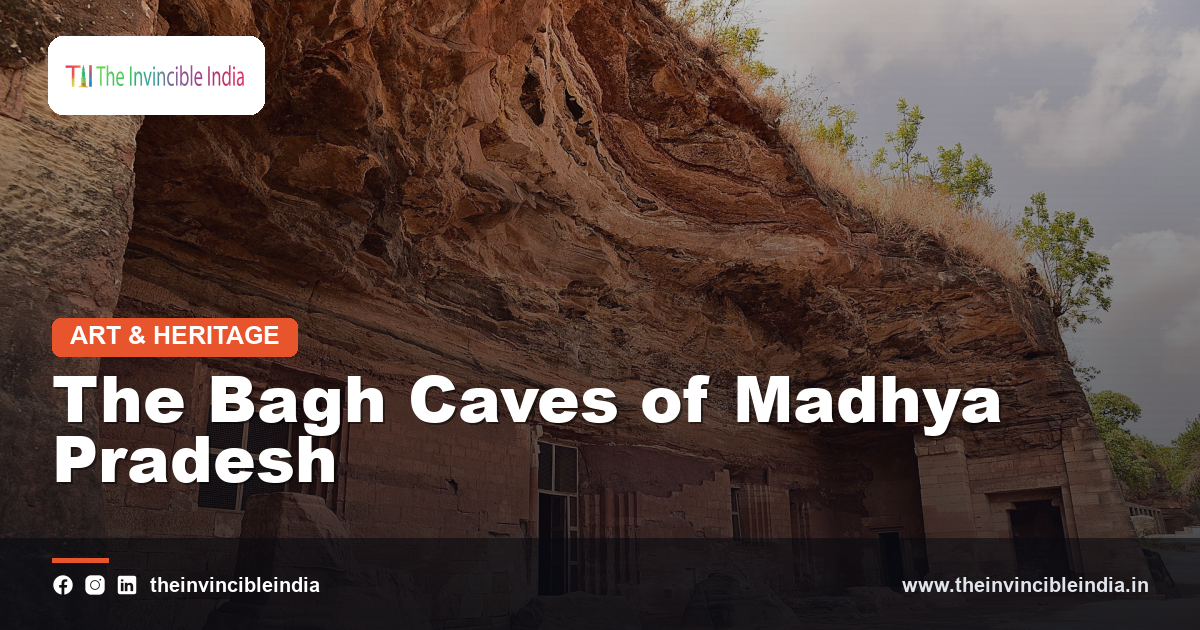
The Bagh Caves, also called the Bagh Group of Caves or the Bagh cave temples, are a series of rock-cut Buddhist monasteries cut into a sandstone hillside above the Baghini river in Dhar district of western Madhya Pradesh. Created in the early centuries of the first millennium CE, they once held some of the most accomplished wall paintings in India, and they are often discussed alongside Ajanta as part of the wider story of Buddhist cave art, a story that also touches the traditions of Indian sculpture. This guide explains what the caves are, where they stand, how they were made and why they still matter.
Quick answer: The Bagh Caves are a group of rock-cut Buddhist monasteries in Dhar district, Madhya Pradesh, India, cut into a hillside above the Baghini river. They were excavated in the early centuries of the first millennium CE and are famous for the fragments of mural painting that survive in their halls. Scholars link their painting style to Ajanta, which makes Bagh important for the history of Indian art.
Key Takeaways
- The Bagh Caves are a group of rock-cut Buddhist monasteries in Dhar district, Madhya Pradesh, standing above the Baghini river.
- The complex is traditionally described as nine caves, of which only some are well preserved today.
- The caves were carved as viharas, or monastic dwellings, for Buddhist monks, and they date broadly to the Gupta-age centuries.
- Their wall paintings are closely related in style to the murals of Ajanta, and the fame of the site rests mainly on them.
- The caves are protected monuments under the Archaeological Survey of India, and copies of the paintings were made in the twentieth century to record their appearance.
- The village of Bagh is also known for a separate craft, the hand block printing called Bagh print, which shares the river but not the history of the caves.
The sections below describe the location of the caves, their layout, their paintings and the ways in which they are protected and visited.
Quick Facts
| Detail | Information |
|---|---|
| Location | Near Bagh town, Dhar district, western Madhya Pradesh |
| River | Baghini river, a tributary of the Narmada |
| Type | Rock-cut Buddhist monastic caves (viharas) |
| Number of caves | Traditionally nine, with a few well preserved |
| Approximate era | Gupta-age centuries, roughly fifth to sixth century CE (scholarly estimates vary) |
| Famous for | Ancient mural paintings related in style to Ajanta |
| Best-known caves | Cave 2 (Pandava Cave) and Cave 4 (Rang Mahal) |
| Protection | Protected monument of the Archaeological Survey of India |
What Are the Bagh Caves?
The Bagh Caves are a group of rock-cut Buddhist monasteries excavated into a soft sandstone cliff in the Malwa region of Madhya Pradesh. They were cut as viharas, which means residential halls for monks arranged around a central pillared space with small cells opening from its sides. Some caves also contain a shrine chamber with a stupa or an image at the rear. The complex belongs to the long Indian tradition of excavating sacred architecture directly out of living rock, a tradition that produced Ajanta, Ellora, Karla and many other sites. What sets Bagh apart is the painted decoration that once covered the walls, columns and ceilings of its halls. Although much has been lost, enough survives to show a refined artistic culture. The Bagh Caves therefore stand as a valuable witness to Buddhist monastic life and painting in central India.
Where Are the Bagh Caves Located?
The Bagh Caves are located near the town of Bagh in Dhar district, in the southwestern part of Madhya Pradesh, close to the border with Gujarat and Maharashtra. The caves are cut into a hillside above the Baghini river, which flows down to join the Narmada. This region, known as Malwa and its neighbouring tribal belt, lay along old trade and pilgrimage routes that linked the Gangetic plain with the western coast. Such routes often supported Buddhist monasteries, because monks, merchants and patrons moved along them. The landscape around Bagh is one of rolling hills, scrub forest and river valleys, and the caves are reached by a short approach from the road. The setting explains why a monastic community chose the spot, since a quiet cliff beside a river offered both seclusion and water.
Who Made the Caves and When Were They Cut?
The caves were made by Buddhist monastic communities supported by local rulers, merchants and lay donors, and they are generally dated to the Gupta-age centuries of roughly the fifth and sixth centuries CE. Inscriptions found at or near the site record donations and refer to local ruling families of the region, though the exact chronology is debated among scholars. Different caves were probably excavated over a span of time rather than all at once, as was usual at rock-cut sites. For that reason a single precise date for the whole complex would be misleading. What can be said with confidence is that Bagh flourished when Buddhist art in central and western India was at a high point. The caves were therefore the product of patient communal effort, supported by a wide circle of donors.
How Many Caves Are There at Bagh?
The Bagh complex is traditionally described as a group of nine caves arranged in a long line along the hillside, numbered from one to nine in the sequence used by archaeologists. Over the centuries the soft sandstone has weathered and portions of the cliff have collapsed, so several caves are badly damaged or partly filled, and a few have lost their front walls entirely. Cave 2 and Cave 4 are the most completely preserved, and they receive most of the attention of visitors and scholars. Others retain only traces of their plans, such as the outline of a hall or the base of a pillar. The numbering is a modern convenience for study and not an ancient designation. The surviving caves, however few, are enough to reveal the planning of a major monastery.
What Is the Pandava Cave (Cave 2)?
The Pandava Cave, numbered Cave 2, is one of the best preserved caves at Bagh and takes its popular name from the Pandava brothers of the Mahabharata. The name is a later folk association, since the cave was made for Buddhist monks and has no connection to the epic. It is a vihara with a spacious pillared hall, a series of cells for monks and a shrine chamber at the rear. Traces of old plaster and colour can still be seen in places. The cave shows how the monks organised daily life around a shared hall, where they would gather for teaching and ritual, and private cells, where they would rest and meditate. Cave 2 is a good starting point for understanding the layout of the whole complex.
What Is the Rang Mahal (Cave 4)?
The Rang Mahal, numbered Cave 4, is the most famous cave at Bagh, and its name means the painted palace or the palace of colour. The name reflects the fact that this cave preserved some of the finest paintings at the site. It is a large vihara with a pillared hall, a verandah, cells and a stupa shrine, and its walls and ceilings were once plastered and painted over much of their surface. Only portions of the painting survive today, and these are fragile. The cave is therefore both an architectural monument and a delicate artistic record. Visitors who see the Rang Mahal today are looking at the remains of a great decorative programme, and they must use imagination to restore the original richness of colour that once filled the hall.
What Do the Bagh Paintings Show?
The Bagh paintings show figures and scenes that combine Buddhist themes with scenes of courtly and everyday life. Surviving fragments include groups of men and women in procession, musicians, riders and attendants, as well as decorative bands of foliage and pattern. The figures are drawn with strong outlines and modelled with soft shading, and their faces, jewellery and garments are rendered with care. The scenes reflect the taste of a prosperous society in which monks, lay donors and artists shared a common visual language. Because many panels have been lost, the full subjects of some compositions can no longer be read with certainty. What remains still gives a vivid impression of movement, grace and human feeling. The Bagh paintings thus present a lively picture of life and devotion in early medieval India.
How Were the Murals Painted?
The murals were painted on a prepared surface of plaster laid over the rock, using a technique often described as tempera, in which mineral and earth pigments are mixed with a binding medium. First the wall was smoothed and coated with layers of clay and lime plaster, then the design was outlined and the colours were applied in stages, with highlights and dark contours added last. Pigments came from locally available minerals and earths, including reds, yellows, whites and blacks, along with other colours made from stone or plant sources. Because the rock was porous, damp could damage the surface over time. This process explains why many murals have flaked, faded or fallen away. The method nonetheless produced brilliant results that impressed scholars when the caves were studied in modern times.
How Do the Bagh Caves Relate to Ajanta?
The Bagh Caves are closely related to Ajanta in the style of their painting, though they are a separate site in a different region. Scholars have noted similarities in the treatment of faces, bodies, drapery and ornament, which suggests that artists and workshops moved between centres or shared a common tradition. Ajanta lies in Maharashtra, while Bagh lies in Madhya Pradesh, but both belonged to the wide cultural world of central and western India during the age of Buddhist patronage. Because Bagh is less well preserved, it is often studied to extend the evidence from Ajanta and to show that mural painting was not confined to one valley. Comparing the two sites helps historians understand how artistic ideas travelled. Bagh therefore forms an important companion to Ajanta in the history of Indian painting.
Who Rediscovered and Documented the Caves?
The caves were brought to the notice of European officers and scholars in the early nineteenth century, long after the monastery had been abandoned and the forest had returned to the hillside. A British officer visited the site and reported on its condition, and later archaeologists documented the architecture and the surviving paintings. In the early twentieth century the princely administration of the region and the Archaeological Survey took interest in the site, and artists of the Bengal school of painting, including Nandalal Bose, were invited to make copies of the murals. These copies are valuable because they record details that have since faded. The study of Bagh is thus an example of how scholars, artists and officials worked together to document a vulnerable heritage site.
Why Were the Murals Damaged?
The murals were damaged mainly by natural causes, since the sandstone is soft and the climate brings heavy monsoon rains that seep into the rock. Water carries salts that weaken the plaster and cause the paint layer to peel, while the collapse of the front walls of some caves exposed the interiors to wind, rain and sunlight. Neglect during the long centuries after the monks left also played a role, as did the effects of people and animals sheltering in the caves. The loss of so much painting is a sad but common fate for ancient murals around the world. Conservation work today aims to slow further decay rather than restore what has gone. The state of Bagh reminds visitors how fragile ancient art can be.
How Are the Caves Protected Today?
The Bagh Caves are protected as a monument under the Archaeological Survey of India, which is responsible for their care and conservation. The work involves stabilising the rock, controlling water seepage, cleaning and consolidating surviving plaster, and regulating access so that visitors do not touch the painted surfaces. Documentation by photography and drawing also forms part of modern protection, since a precise record helps conservators and scholars. The caves are not a heavily commercialised destination, and the site retains a quiet, rural character. Protection also depends on local communities, who value the site as a part of their regional heritage. In this way the legal protection of the caves is supported by public awareness, and both are necessary for the long survival of the monument.
What Is the Difference Between Bagh Caves and Bagh Print?
The Bagh Caves and Bagh print are two different cultural treasures that happen to share a place name. Bagh print is a traditional hand block printing craft practised in the Bagh area, known for its geometric and floral patterns in deep red and black on cotton, made with natural dyes and carved wooden blocks. The craft is associated with artisan families who work beside the river, and the quality of the river water is traditionally said to help the colours. The caves, by contrast, are an ancient Buddhist monastic site from many centuries earlier. Visitors who come to see the caves may also see printers at work, and the two together show the continuity of artistic skill in the region. Both reveal how art in this area has long been bound up with craft and community.
How Can Visitors Experience the Caves?
Visitors can experience the caves by walking along the hillside from one excavation to the next, entering the better preserved halls and observing the architecture and the traces of colour. Morning and late afternoon give softer light for viewing and photographing the interiors, and the cooler months are more comfortable than the hot summer or the wet monsoon. As a protected site, the caves require respectful behaviour, which means no touching of the walls, no flash photography near the murals unless permitted, and no littering. It is helpful to read about the site beforehand, since the surviving paintings are subtle and easy to overlook without context. Local guides and the museum collections that hold copies of the paintings add understanding. A visit to Bagh rewards patience and careful looking.
Why Do the Bagh Caves Matter for Indian Heritage?
The Bagh Caves matter because they preserve rare evidence of early Indian mural painting outside the well-known sites of Maharashtra. Most ancient Indian paintings have vanished, since wall painting is much more perishable than stone sculpture, and each surviving fragment therefore carries unusual value. Bagh shows that the tradition of painted Buddhist monasteries extended across central India and was supported by many levels of society. The site also demonstrates the skill of monastic architects and the generosity of donors. Beyond their historical significance, the caves inspire modern artists and scholars who study the line, colour and composition of the old masters. Bagh therefore matters as a source of knowledge, a work of art and a reminder of the shared artistic past of the subcontinent.
Bagh Caves Today
The Bagh Caves today stand as a quiet but significant monument in Dhar district, cared for by the Archaeological Survey of India and valued by historians, artists and travellers. Their paintings survive only in fragments, yet those fragments continue to inform the study of Indian mural art and Buddhist monastic life. Copies made in the early twentieth century and modern photographic records help preserve what the walls themselves can no longer hold. The site is an invitation to look closely, to think about the artists who worked by lamplight in the rock, and to appreciate the delicate balance between art and nature. The Bagh Caves remain a living part of India’s cultural memory, linking the patrons, monks and painters of the past with students and visitors of the present.
Sources & Further Reading
- Archaeological Survey of India (asi.nic.in).
- Ministry of Culture, Government of India (indiaculture.gov.in).
Frequently Asked Questions
What are the Bagh Caves?
The Bagh Caves are a group of rock-cut Buddhist monasteries in Dhar district, Madhya Pradesh, cut into a hillside above the Baghini river. They were excavated in the early centuries of the first millennium CE and are famous for their surviving wall paintings. The site is a protected monument.
Where are the Bagh Caves located?
The Bagh Caves are located near the town of Bagh in Dhar district in the southwestern part of Madhya Pradesh. They lie above the Baghini river, a tributary of the Narmada. The site is in the Malwa region, close to the borders with Gujarat and Maharashtra.
How old are the Bagh Caves?
The Bagh Caves are generally dated to the Gupta-age centuries, roughly the fifth and sixth centuries CE, although scholars debate the exact chronology. The caves were probably excavated over a span of time rather than all at once. Their murals are usually assigned to the same broad period.
What is the Rang Mahal at Bagh?
The Rang Mahal is Cave 4 at Bagh and is the most famous cave of the complex. Its name means the painted palace, and it preserved some of the best murals at the site. It is a large vihara with a pillared hall, cells and a stupa shrine.
Are the Bagh Caves related to Ajanta?
Yes, the paintings of Bagh are closely related in style to those of Ajanta, which is in Maharashtra. Both sites belong to the same broad Buddhist artistic tradition of central and western India. Comparing them helps historians understand how painting workshops and ideas travelled.
Are the Bagh Caves the same as Bagh print?
No, the Bagh Caves and Bagh print are different things. The caves are an ancient Buddhist monastic site, while Bagh print is a traditional hand block printing craft practised in the same area. Only the place name and river setting connect them.


