

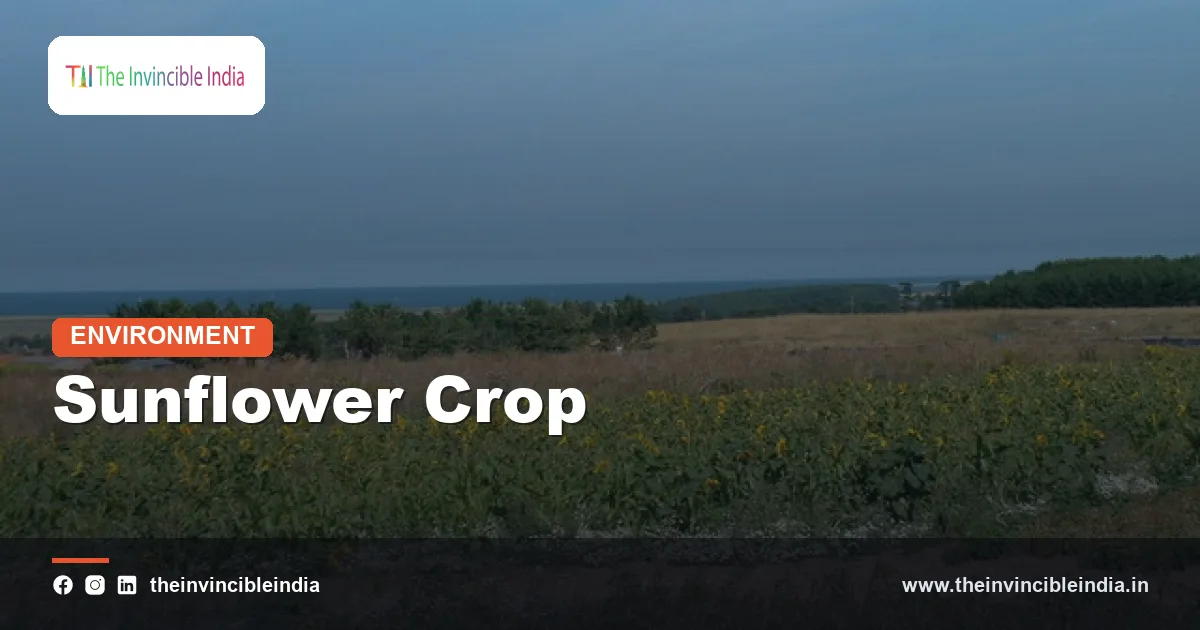
The sunflower is a tall, fast-growing annual plant of the daisy family (Helianthus annuus) whose large, bright yellow flower head produces oil-rich seeds, and in India it is an important oilseed crop grown for edible oil, especially in Karnataka, Andhra Pradesh, Telangana and Maharashtra. Native to North America, the sunflower was introduced to India in the twentieth century and became a commercial field crop from the 1970s.
What looks like a single giant flower is actually a cluster of hundreds of tiny flowers packed onto one disc, and each one can become a seed. This article explains what the sunflower crop is, how it is grown, where it flourishes in India, why its seeds yield a popular cooking oil and how it fits into the country’s edible oil supply.
Quick Facts
| Common names | Sunflower; surajmukhi (meaning “facing the sun”) in Hindi |
|---|---|
| Scientific name | Helianthus annuus |
| Family | Asteraceae (the daisy or sunflower family) |
| Native region | North America; domesticated by Indigenous peoples thousands of years ago |
| Where grown in India | Karnataka, Andhra Pradesh, Telangana, Maharashtra, Tamil Nadu, Odisha, and spring crops in Punjab and Haryana |
| Season | Can be sown in kharif, rabi or spring; the crop matures in roughly 90 to 110 days |
| Part used | Seed (achene) for oil and snack kernels; meal and stalks as by-products |
| Main uses | Edible oil, oilcake for cattle feed, roasted seeds, bird feed, ornamental flowers |
| Importance | One of India’s major oilseeds and a short-duration crop that fits many rotations |
Key Takeaways
- The sunflower (Helianthus annuus) is an annual oilseed crop of the daisy family whose seeds contain a large share of edible oil.
- Sunflower is largely insensitive to day length, so it can be sown in different seasons in India, including kharif, rabi and spring.
- Karnataka is traditionally the leading sunflower-growing state in India, followed by other peninsular states such as Andhra Pradesh, Telangana and Maharashtra.
- The sunflower head is made of hundreds of small florets, and young plants track the sun, a movement called heliotropism, which stops once the head matures.
- Sunflower oil is rich in unsaturated fats, particularly linoleic acid, and the leftover seed meal is a protein-rich cattle feed.
- India produces only part of the edible oil it consumes, so oilseeds such as sunflower are central to the country’s self-sufficiency goals.
What is the sunflower crop?
The sunflower crop is the cultivated form of Helianthus annuus grown in fields mainly for its seeds, which are crushed to produce edible oil and sold as a snack. Unlike the ornamental sunflower in a garden, the crop varieties and hybrids are selected for high seed yield, high oil content and uniform maturity.
The plant has a single thick, hairy stem that can reach one to three metres, with large heart-shaped rough leaves. At the top it carries a head, called a capitulum, with an outer ring of yellow ray florets that look like petals and a central disc of small tubular florets. Each fertilised disc floret grows into a one-seeded fruit called an achene, which is what people call the sunflower seed.
Seeds from oil varieties are usually small and dark, with a thin shell and a kernel that contains a large share of oil, roughly forty per cent or more by weight in good varieties. Confectionery types, which are larger and striped, are grown for roasting and eating rather than for oil.
Where did sunflower come from and how did it reach India?
The sunflower came from North America, where Indigenous peoples domesticated it more than four thousand years ago, and it reached India as an ornamental and later as a field oilseed crop in the twentieth century. European explorers took the plant to Spain and then across Europe, where Russian and Ukrainian breeders developed high-oil varieties in the nineteenth and twentieth centuries.
These Eastern European varieties, such as Peredovik, were brought to India in the 1970s as the country looked for new oilseeds to bridge the gap between demand and domestic production. Early research and trials were carried out by agricultural universities and the Indian Council of Agricultural Research (ICAR), and hybrids were released by public and private institutions in the following decades.
The Hindi name surajmukhi, meaning “face of the sun”, refers to the flower’s famous habit of turning toward sunlight, an observation that is reflected in the plant’s name in many languages.
Why do sunflowers follow the sun?
Young sunflower plants follow the sun because growth on the shaded side of the stem is faster than on the sunlit side, which bends the stem and head toward the light in a process called heliotropism. Overnight the head swings back toward the east, ready for the next sunrise, guided by the plant’s internal clock.
This movement is common in the bud stage and while the plant is still growing. Once the flower head matures and the stem stiffens, the head settles in a fixed position, usually facing east. An east-facing head warms up quickly in the morning, which research suggests attracts more pollinating insects and may help the seeds develop, and it also reduces sunburn on the heavy head in the hot afternoon.
The behaviour has no direct effect on farm practice, but it is a favourite classroom example of how plants respond to their environment without muscles or nerves.
Where is sunflower grown in India?
Sunflower is grown in India mainly in Karnataka, Andhra Pradesh, Telangana and Maharashtra, with smaller areas in Tamil Nadu, Odisha, Bihar, Punjab and Haryana. Karnataka has long been the single largest sunflower state, though the area under the crop has moved up and down from year to year because farmers shift between sunflower and competing crops.
- Karnataka: grown in the northern and southern interior districts in both the rainy and winter seasons.
- Andhra Pradesh and Telangana: a major area, often as a rabi or post-rainy crop on black soils.
- Maharashtra: grown in the Marathwada and western regions.
- Tamil Nadu: sown in different seasons depending on rainfall and irrigation.
- Punjab and Haryana: a spring-season crop sown after potato or wheat in some areas.
The crop’s popularity in the peninsular states reflects its tolerance of moderate drought and its short duration, which allows it to be sown after another crop is harvested or when the monsoon is late.
How is sunflower cultivated?
Sunflower is cultivated by sowing seed on a well-prepared field in rows, keeping weeds under control, supplying a few well-timed irrigations and harvesting when the back of the head turns yellow-brown. The crop prefers well-drained loamy or black cotton soils and does not grow well in waterlogged or highly acidic land.
Season and sowing
Sunflower is largely photoperiod-insensitive, meaning day length does not strongly control flowering. This allows sowing in three seasons: kharif (June to July), rabi (October to November) and spring or summer (January to February). Hybrid seed is generally preferred and is bought fresh each year, since seed saved from hybrids does not produce a uniform crop.
Spacing and nutrition
The crop is sown in rows with sufficient spacing to allow large heads to develop. It responds well to nitrogen, phosphorus and potassium, and also to boron, since boron deficiency causes poor seed set and hollow stems. Farmers also apply gypsum in some areas for better oil content.
Water and weeds
Sunflower needs adequate moisture at the bud, flowering and seed-filling stages. Water stress during flowering is particularly damaging. Weeding in the first month matters because young plants grow slowly at first before rapidly gaining height.
Harvest
Harvesting takes place roughly 90 to 110 days after sowing, when the back of the head turns lemon-yellow to brown, the leaves dry and the seeds are firm. The heads are cut, dried in the sun and threshed, either by hand or by machine, and the seed is dried further to a safe moisture level before storage.
How does the sunflower flower get pollinated?
The sunflower is pollinated mainly by bees, which move pollen between the many florets on each head as they collect nectar and pollen. Most sunflower varieties are largely self-incompatible, so cross-pollination by insects strongly influences seed set and yield.
Because the disc florets open in rings from the outside inward over several days, the flower head offers a steady supply of nectar for about a week. Farmers sometimes keep honeybee colonies near sunflower fields, which raises seed set and gives beekeepers a flow of light-coloured honey. In hybrid seed production, rows of male and female parent lines are planted in set ratios and pollination is carefully managed.
Poorly filled heads with empty seeds near the centre are a common sign of inadequate pollination or heat stress during flowering.
What are sunflower seeds and oil used for?
Sunflower seeds are crushed to extract edible oil, roasted and eaten as a snack, or used as bird feed, while the pressed cake is fed to livestock. Sunflower oil is one of the most commonly used cooking oils in the world and is popular in Indian households as a light, neutral-tasting oil.
| Product | What it is | Typical use |
|---|---|---|
| Sunflower oil | Pale yellow oil pressed or solvent-extracted from the seed | Frying, sauteing, salad dressings, packaged foods |
| Oilcake or meal | Protein-rich residue after oil extraction | Cattle, poultry and fish feed |
| Kernels and seeds | Shelled or whole roasted seeds | Snacks, bakery, trail mixes |
| Hulls | Seed shells | Fuel, litter and fibre applications |
| Stalks | Dry woody stems | Fuel, compost and mulch |
Sunflower oil is rich in unsaturated fatty acids and is valued for its light taste and high smoke point when refined. Standard varieties are high in linoleic acid, while high-oleic types contain more oleic acid and are more stable during frying.
How important is sunflower to India’s edible oil supply?
Sunflower is a useful but modest part of India’s edible oil supply, because the country consumes far more edible oil than it produces and imports a large share of its requirement, including a significant amount of sunflower oil. The main domestic oilseeds are groundnut, mustard, soybean, sesame, safflower and sunflower, with oil palm being developed as well.
Imports of sunflower oil have historically come largely from the Black Sea region and Argentina, so world events in these areas affect Indian prices. Promoting domestic oilseed production has therefore been a repeated policy theme, and sunflower is attractive because it is a short-duration crop that grows in several seasons.
Farmers’ decisions on sunflower depend on the minimum support price (MSP), market prices, availability of quality hybrid seed and competition from maize, cotton, pulses and other crops. Growers sometimes switch away when prices are weak, which explains why the area under the crop varies.
What problems affect the sunflower crop?
The main problems of sunflower cultivation are bird damage, downy mildew, Alternaria leaf spot, head rot, sucking pests and poor seed filling caused by heat or inadequate pollination. Good farm management can reduce most of these risks.
- Birds: parrots, sparrows and other birds feed on maturing seeds, so growers use scaring methods or cover heads.
- Downy mildew: a fungal-like disease that stunts plants; it is managed with resistant hybrids and treated seed.
- Alternaria leaf spot: causes brown spots on leaves and reduces yield in humid weather.
- Necrosis disease: a viral disease spread by thrips that can kill young plants in some regions.
- Head-boring caterpillars and sucking insects: damage developing heads and stems.
- Poor seed set: caused by heat during flowering, boron deficiency or too few pollinators.
Rotating sunflower with cereals or pulses, using certified seed and sowing at recommended times helps break pest and disease cycles.
Is sunflower good for the soil and environment?
Sunflower fits well into crop rotations, offers nectar for bees and has a deep taproot that can draw moisture from lower soil layers, but it removes a considerable amount of nutrients from the soil and must be fertilised. It is therefore a useful rotation crop rather than a soil-building crop in itself.
The taproot can help break compacted layers, and the crop’s dry stalks add organic matter when returned to the field. At the same time, repeated sunflower sowing on the same land can build up disease, so rotation with cereals such as sorghum, millet or wheat is advised. In regions with deficient rainfall, the crop’s moderate water need makes it more attractive than some alternatives, although it still benefits from irrigation at critical stages.
Sunflower fields in bloom are also an agricultural landscape of great beauty, and in parts of Karnataka and Andhra Pradesh the golden fields have become a seasonal attraction for photographers and visitors.
Bottom Line
The sunflower is a short-duration annual oilseed whose bright heads hide hundreds of tiny florets and a seed rich in edible oil. In India, grown chiefly in Karnataka and other peninsular states, it plays a valuable supporting role in a country that still depends heavily on imported edible oil.
Frequently Asked Questions
What is sunflower called in Hindi?
Sunflower is called surajmukhi in Hindi, which means “facing the sun”. The name refers to the way young sunflower heads turn toward sunlight. Regional languages have their own names for the crop.
Which state grows the most sunflower in India?
Karnataka has traditionally been the largest sunflower-growing state in India. Andhra Pradesh, Telangana and Maharashtra are other important states. Area and production change from year to year with rainfall and prices.
How long does sunflower take to grow?
Sunflower takes about 90 to 110 days from sowing to harvest in most Indian conditions. The exact duration depends on the hybrid, season and temperature. Short duration is one reason farmers use it in rotations.
Do sunflowers really follow the sun?
Young sunflowers do follow the sun by bending toward the light, a response called heliotropism. Mature flower heads stop moving and usually face east. The movement results from uneven growth on the two sides of the stem.
How much oil does a sunflower seed contain?
Oil varieties of sunflower seed typically contain about 40 per cent oil or more by weight, though the figure varies by hybrid and growing conditions. Confectionery types have lower oil content. After extraction, the remaining meal is used as protein-rich animal feed.
Is sunflower oil healthy?
Sunflower oil is rich in unsaturated fats and vitamin E, and it is low in saturated fat. Like all cooking oils, it is high in calories and is best used in moderation. Repeatedly reheating any oil to high temperatures reduces its quality.
{“@context”:”https://schema.org”,”@graph”:[{“@type”:”FAQPage”,”mainEntity”:[{“@type”:”Question”,”name”:”What is sunflower called in Hindi?”,”acceptedAnswer”:{“@type”:”Answer”,”text”:”Sunflower is called surajmukhi in Hindi, which means “facing the sun”. The name refers to the way young sunflower heads turn toward sunlight. Regional languages have their own names for the crop.”}},{“@type”:”Question”,”name”:”Which state grows the most sunflower in India?”,”acceptedAnswer”:{“@type”:”Answer”,”text”:”Karnataka has traditionally been the largest sunflower-growing state in India. Andhra Pradesh, Telangana and Maharashtra are other important states. Area and production change from year to year with rainfall and prices.”}},{“@type”:”Question”,”name”:”How long does sunflower take to grow?”,”acceptedAnswer”:{“@type”:”Answer”,”text”:”Sunflower takes about 90 to 110 days from sowing to harvest in most Indian conditions. The exact duration depends on the hybrid, season and temperature. Short duration is one reason farmers use it in rotations.”}},{“@type”:”Question”,”name”:”Do sunflowers really follow the sun?”,”acceptedAnswer”:{“@type”:”Answer”,”text”:”Young sunflowers do follow the sun by bending toward the light, a response called heliotropism. Mature flower heads stop moving and usually face east. The movement results from uneven growth on the two sides of the stem.”}},{“@type”:”Question”,”name”:”How much oil does a sunflower seed contain?”,”acceptedAnswer”:{“@type”:”Answer”,”text”:”Oil varieties of sunflower seed typically contain about 40 per cent oil or more by weight, though the figure varies by hybrid and growing conditions. Confectionery types have lower oil content. After extraction, the remaining meal is used as protein-rich animal feed.”}},{“@type”:”Question”,”name”:”Is sunflower oil healthy?”,”acceptedAnswer”:{“@type”:”Answer”,”text”:”Sunflower oil is rich in unsaturated fats and vitamin E, and it is low in saturated fat. Like all cooking oils, it is high in calories and is best used in moderation. Repeatedly reheating any oil to high temperatures reduces its quality.”}}]}]}


