

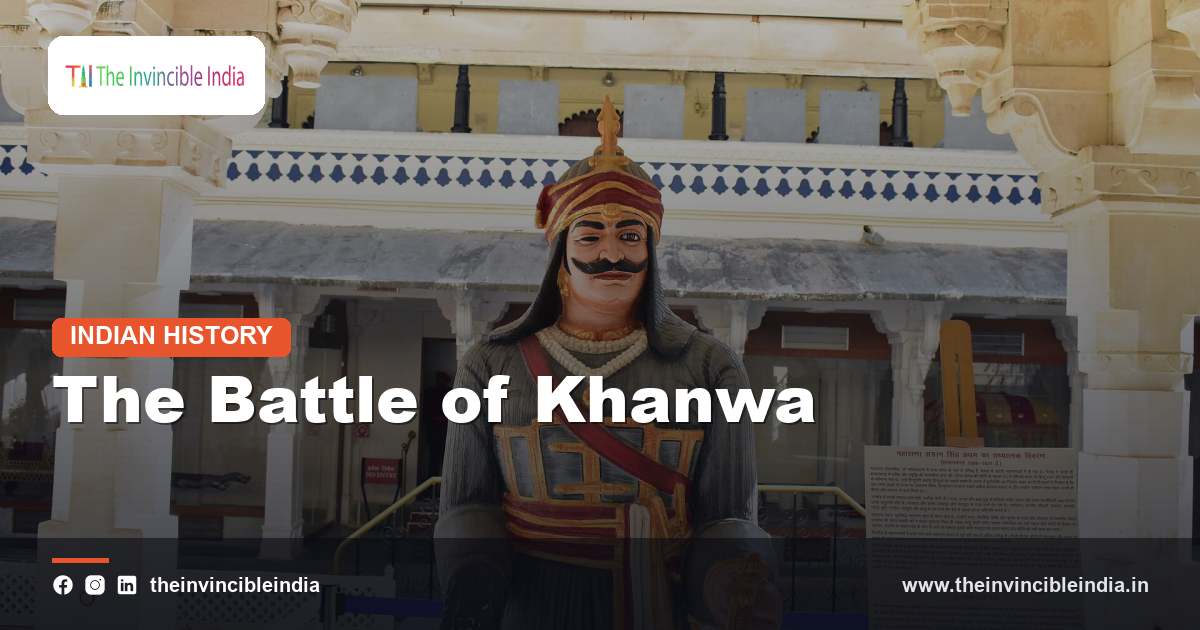
The Battle of Khanwa, fought in the early sixteenth century near the village of Khanwa west of Agra, brought together two of the most formidable leaders of their age: Babur, the Timurid prince who had recently established himself in northern India, and Rana Sanga, the celebrated ruler of Mewar who led a broad confederacy of Rajput and allied forces. The encounter is widely regarded as one of the decisive contests in Indian history, because its outcome secured the foundations of the Mughal state. Its background lies in the rise of Rajput power described in our guide to the Rajputs and in the new technology of warfare that Babur brought with him from Central Asia.
Quick Facts
| Detail | Information |
|---|---|
| Battle | Battle of Khanwa |
| Period | Early sixteenth century |
| Location | Khanwa, near Bharatpur in present-day Rajasthan, west of Agra |
| Commanders | Babur versus Rana Sanga of Mewar |
| Outcome | Decisive Mughal victory |
| Significance | Secured Mughal power in northern India |
Northern India Before Khanwa
In the early sixteenth century, northern India was divided among several competing powers. The Delhi Sultanate, then under the Lodi dynasty, was weakened by internal quarrels among its nobles, while regional kingdoms in Malwa, Gujarat, Bengal and Rajasthan pursued their own ambitions. Among these, the Rajput kingdom of Mewar had grown into one of the strongest and most respected states. This fragmented landscape invited intervention from outside, and it was in these conditions that a new conqueror from the northwest appeared. The political situation before Khanwa was thus one of instability, in which no single power commanded the whole of the plains, and in which the balance could shift dramatically with the arrival of a determined and well equipped army.
Babur's Arrival and Panipat
Babur, a descendant of both Timur and Genghis Khan, had been driven from his ancestral lands in Central Asia and established himself at Kabul before turning his attention to India. At the First Battle of Panipat he defeated the army of Ibrahim Lodi, the last Sultan of Delhi, and took control of Delhi and Agra. This victory was achieved through disciplined tactics and the use of firearms, and it opened the way for a new dynasty. Yet Panipat did not make Babur master of India. He still had to contend with powerful rivals, the foremost of whom was Rana Sanga of Mewar. The aftermath of Panipat therefore set the stage for a second and even more consequential confrontation.
Rana Sanga of Mewar
Rana Sanga, also known as Maharana Sangram Singh, was the Sisodia ruler of Mewar and one of the most celebrated Rajput leaders of his time. Under his leadership, Mewar expanded its influence over a wide area of Rajasthan, Malwa and neighboring regions, and its prestige stood high among the Rajput houses. Tradition remembers him as a warrior who bore many scars from earlier campaigns and who commanded the respect of his peers. His record of success against neighboring sultanates made him a natural leader for a coalition of princes. Sanga thus stood as the greatest obstacle to the consolidation of Babur’s rule, and the story of his house continues to form a central strand in the history of Rajput Rajasthan.
Why the Clash Became Inevitable
Several factors made a confrontation between Babur and Rana Sanga difficult to avoid. Both leaders sought dominance over the same region, and the territories of Mewar lay uncomfortably close to the new Mughal holdings around Agra. Sanga, according to tradition, had hoped that Babur would withdraw from India after defeating the Lodis, as earlier invaders had done. When it became clear that the newcomer intended to stay, the Rana moved to challenge him. Mutual suspicion and the skirmishes that followed hardened positions on both sides. The result was a contest not merely between two armies but between two visions of who would govern northern India, a question that only a decisive battle could settle.
The Rajput Confederacy
Rana Sanga assembled a large coalition that drew on the military resources of many Rajput houses and other allied rulers. Contingents from across Rajasthan and neighboring regions joined his banner, as did some Afghan chiefs who had lost their positions after the fall of the Lodis. Prominent among the allies were the ruler of Mewat, Hasan Khan, and a member of the Lodi family who was regarded as a claimant to the Delhi throne. The assembly of such a diverse force demonstrates the prestige of Sanga and the widespread concern about Babur’s advance. The confederacy represented the last great attempt of the old order of northern India to prevent the establishment of a new empire.
Babur's Army and Military Methods
Babur’s army was smaller than that of his opponents but had important advantages in organization, discipline and technology. His forces included skilled horse archers in the Central Asian tradition, together with matchlock gunners and cannon that were still unusual in Indian warfare. Babur had learned from the Ottoman style of battle, which combined artillery with carts and fortifications, and he made use of experienced commanders who understood these techniques. His men were veterans accustomed to fighting in difficult conditions far from home. This combination of mobility and firepower gave the Mughal army a character quite different from the traditional armies of northern India. The contrast in military methods would prove one of the decisive factors at Khanwa.
Rajput Strengths in War
The Rajput forces brought formidable strengths of their own. Rajput warriors were famed for their courage, their skill with sword and spear, and their devotion to honor, which made them dangerous in close combat. Cavalry charges by Rajput horsemen had long been feared across northern India, and the army of Sanga included elephants and large numbers of foot soldiers. The coalition also had the advantage of numbers and the confidence born of earlier victories. These qualities made the army a serious threat, even to a force equipped with the newest weapons. The battle would test whether traditional valor and shock tactics could overcome a more modern and carefully disciplined opponent, a question with large consequences for the future.
The Mood Before the Battle
As the two armies approached one another, the Mughal camp experienced a period of anxiety. Reports of the size and reputation of the Rajput force, along with earlier setbacks in minor engagements, weakened morale among some of Babur’s soldiers, who were far from their homeland. In his own memoirs, Babur describes efforts to restore confidence, including a solemn renunciation of wine and a call to his men to fight with resolve. He framed the coming battle in religious terms and appealed to the loyalty and pride of his soldiers. The episode shows the importance of leadership and morale in medieval warfare. The decision to rally his army in this way helped transform the mood of the camp before the engagement began.
The Battlefield at Khanwa
The battle took place at Khanwa, a village in present-day Rajasthan situated a short distance west of Agra, on open ground suitable for the movement of large armies. Babur chose and prepared his position with care, in the manner he had learned from earlier campaigns. He arranged carts linked together with chains to form a barrier, behind which gunners and archers could operate safely, and he dug defensive features to protect his flanks. These preparations turned a stretch of plain into a fortified line. The choice of ground and the careful planning reflect Babur’s skill as a commander and illustrate how engineering and preparation could shape the outcome of a battle long before the first charge.
The Course of the Fighting
When the armies engaged, the Rajput cavalry and infantry pressed forward with great determination, striking at the Mughal line with repeated charges. The fighting was fierce, and for a time the outcome seemed uncertain as the weight of the attack tested the Mughal position. Babur’s artillery and matchlocks, however, inflicted heavy losses on the advancing ranks, and the barrier of carts held the attackers at a distance. At the critical moment Babur employed the tulughma, a flanking maneuver in which mounted detachments swung around the sides and rear of the enemy. Surrounded and under fire, the confederate army lost cohesion. The sequence of events at Khanwa shows how disciplined tactics could overcome a powerful frontal assault.
The Turning Point
Historians generally identify the combination of gunfire and flanking maneuvers as the turning point of the battle. Once the Rajput lines were caught between the Mughal center and the encircling cavalry, the superior numbers of the coalition became a disadvantage, as crowded ranks were unable to maneuver. Some allies were reported to have wavered, and the army broke up under pressure. The commanders on the field struggled to restore order, but the momentum had passed to Babur. The battle illustrates the importance of coordination and firepower in the new age of warfare. What began as a magnificent charge ended in a rout, and the course of northern Indian history was changed in a single day.
Fate of Rana Sanga
According to tradition, Rana Sanga was gravely wounded during the battle and was carried from the field by loyal followers. He is said to have wished to continue the struggle against Babur, but he died not long afterward, and his death deprived the Rajput cause of its most capable leader. The loss was felt acutely in Mewar, where the succession passed to other members of the family. Sanga remained in popular memory as a heroic figure, admired even by opponents for his courage and his resolve. His end illustrates the human cost of the battle and the way the fortunes of an entire kingdom could depend on the fate of a single commander.
Immediate Consequences
The victory at Khanwa greatly strengthened Babur’s position in India. With the most powerful opponent gone, the new ruler could consolidate his hold on Delhi and Agra and extend his authority eastward and southward. Babur followed the victory with further campaigns against other strongholds in the region, including Chanderi, and against Afghan chiefs in the east. The Rajput coalition dissolved, and the military initiative passed to the Mughals. At the same time, Babur adopted the title of Ghazi in recognition of his triumph. The immediate consequences of Khanwa were therefore political and military, since the battle ended the prospect of a united Rajput challenge and confirmed the foundations of Mughal power in the heart of northern India.
Impact on Mewar and the Rajputs
For Mewar and the broader Rajput world, Khanwa marked a major setback but not the end of their history. The Rajput houses retained their territories and their martial traditions, and they continued to play important roles in the politics of northern India. In later decades, rulers such as Maharana Pratap would resist Mughal expansion, while other Rajput houses entered into alliances with the Mughal court and served as nobles and generals. The memory of Khanwa shaped Rajput identity and became part of the heroic narrative preserved in bardic poetry and local tradition. The battle thus influenced not only military affairs but also the long term relationship between the Rajputs and the emerging Mughal state.
The Place of Khanwa in Mughal History
In the broader story of the Mughal empire, Khanwa is often paired with Panipat as one of the two battles that established Babur’s rule. Panipat removed the Lodi dynasty, but Khanwa removed the greatest remaining rival and made the Mughal presence permanent. Babur did not live long enough to build an elaborate administration, yet the military foundations he laid supported his successors, including his son Humayun and, later, Akbar. Our guide to the Mughal empire follows this story through the following centuries. Khanwa therefore stands at the beginning of one of the most influential dynasties in the history of the subcontinent and of its cultural life.
The Battle of Khanwa Today
Today the Battle of Khanwa is remembered as a turning point that is studied in schools, universities and military histories. The memory of Rana Sanga is honored in Rajasthan, where the bravery of the Rajputs continues to be celebrated in monuments, folk songs and stories. Scholars use Babur’s own memoirs, together with later chronicles, to understand the battle, while acknowledging that accounts differ in detail. The site itself, near Fatehpur Sikri and Bharatpur, is quiet farmland that draws occasional visitors. Khanwa teaches that history is shaped by the meeting of courage, technology and leadership, and it reminds readers of the lasting consequences of decisions made on a single battlefield centuries ago.
Sources & Further Reading
- Ministry of Culture, Government of India (indiaculture.gov.in).
- Archaeological Survey of India (asi.nic.in).
Frequently Asked Questions
Who fought in the Battle of Khanwa?
The battle was fought between Babur, the founder of the Mughal empire, and Rana Sanga of Mewar, who led a confederacy of Rajput and allied forces. Babur’s army won a decisive victory. The outcome secured Mughal power in northern India.
Where did the Battle of Khanwa take place?
It took place at Khanwa, a village in present-day Rajasthan a short distance west of Agra, near Bharatpur and Fatehpur Sikri. The open plain suited the movement of large armies. Babur fortified his position with carts and defensive works.
Why did Babur win at Khanwa?
Babur’s victory is attributed to disciplined organization, the use of artillery and matchlocks, and a well prepared defensive position. He also used the tulughma flanking maneuver to surround the enemy. Together these methods overcame the larger Rajput coalition.
What happened to Rana Sanga after the battle?
According to tradition, Rana Sanga was wounded and carried from the field by his followers. He died not long afterward, which removed the Rajput confederacy’s most capable leader. His memory remains honored in Rajasthan.
Why is the Battle of Khanwa important?
The battle ended the main Rajput challenge to Babur and confirmed the foundations of Mughal rule in northern India. It is often paired with the First Battle of Panipat as one of the two key victories of his career. Its consequences shaped the history of the subcontinent for centuries.


