

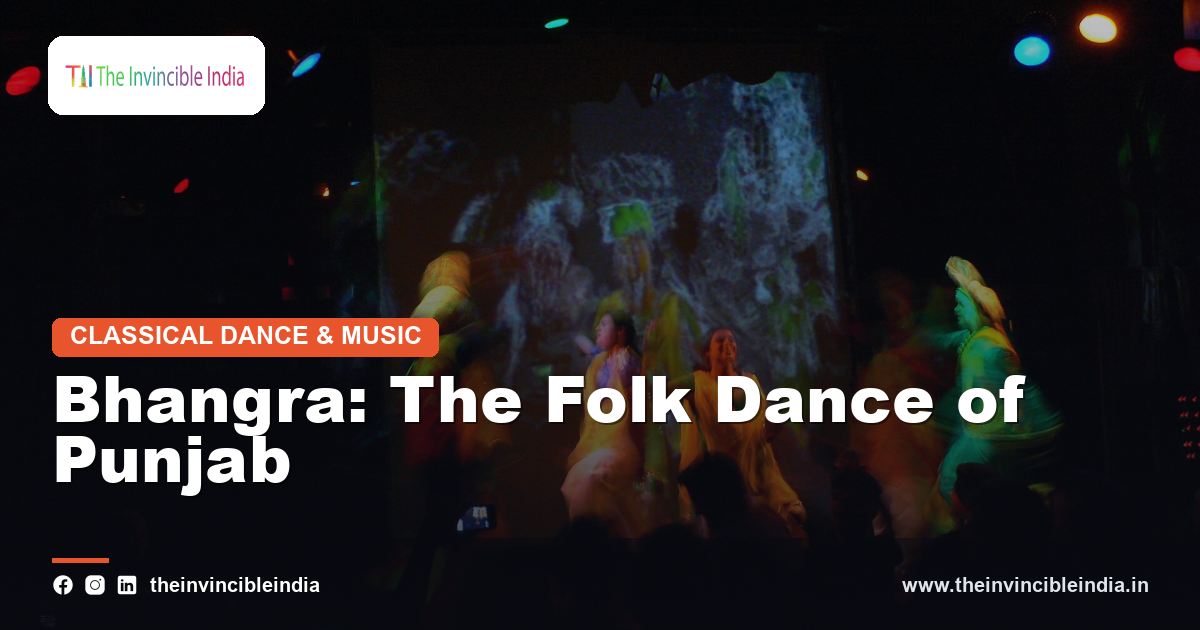
When the dhol begins to thunder, few people can resist the urge to move. Bhangra, the exuberant folk dance of Punjab, grew out of the joy of the harvest and the lively spirit of farming communities, and it has since become one of the most recognisable of all folk dances of India. With its raised arms, bounding steps, bright costumes and booming drum rhythms, it conveys celebration in its purest form. From village fields and fairs in Punjab it travelled to wedding halls, university stages and international festivals, carried by communities across the world. This guide explores the origins, music, costume, steps and enduring cultural meaning of Bhangra.
Quick Facts
| Detail | Information |
|---|---|
| Type | An energetic folk dance of celebration |
| Region | Punjab, in northern India and Pakistan |
| Occasions | Harvest festivals, Baisakhi, weddings and fairs |
| Lead instrument | The dhol drum |
| Costume | Kurta, lungi or tehmat, waistcoat and turban |
| Women's counterpart | Giddha |
What Is Bhangra
Bhangra is a vigorous folk dance of the Punjab region, traditionally performed by men to express joy, strength and festivity. Dancers move to the commanding beat of the dhol, leaping, spinning and thrusting their arms skyward in bold, rhythmic patterns that mirror the labour and exuberance of agricultural life. The dance is accompanied by lively songs, often in the form of short verses that tell of love, work, humour and village life. Bhangra is above all a communal art, danced in groups and shared with an audience that often joins in. Its energy, simplicity and warmth have made it one of the most popular and recognisable dances not only in India but around the world.
Roots in the Harvest
The dance is rooted in the farming culture of Punjab, a region famed for its fertile plains and wheat harvest. Farmers traditionally celebrated the ripening of the crops and the end of hard seasonal work with song and dance, and Bhangra grew from this celebration. The movements are often said to echo agricultural actions such as sowing, reaping and tilling, giving the dance a link to the soil and the rhythm of the fields. Its early forms were informal, performed in village gatherings and at fairs without elaborate staging. The agrarian origin explains much about the character of Bhangra: its open, robust energy, its communal spirit and its association with gratitude for the bounty of the land.
Baisakhi and Seasonal Festivals
Bhangra is most strongly associated with Baisakhi, the spring festival that marks the harvest season in Punjab and holds great importance in the region’s religious and agricultural calendar. On this occasion villages and towns fill with fairs, processions and dancing, and Bhangra becomes the chief expression of collective happiness. The dance also appears at other festivals and family celebrations, including Lohri, weddings and the birth of children. Its sound and sight signal that an occasion is joyous and communal. Through these seasonal and life-cycle events the dance has remained woven into the fabric of Punjabi social life, serving as a shared language of celebration that unites people across villages, generations and backgrounds.
The Dhol: Heart of the Dance
The dhol is the beating heart of Bhangra. This large, double-headed barrel drum is slung from the shoulder and played with a curved stick on one side and a thinner stick or the hand on the other, producing a deep, resonant bass alongside sharp, crisp tones. The dhol player is central to the performance, setting the tempo, signalling changes of step and driving the energy of the dancers. Distinct rhythmic patterns are associated with different phases of the dance, and the interplay between drummer and dancers creates much of its excitement. The sound of the dhol is so closely tied to Bhangra that the two are almost inseparable, and a skilled dhol player is held in high esteem within the tradition.
Other Instruments and Props
Alongside the dhol, Bhangra uses a range of other instruments that give it a distinctive sonic texture. The chimta, a pair of iron tongs with small jingling discs, adds a metallic shimmer; the tumbi, a single-stringed plucked instrument, provides a high, twanging melody; and the algoza, a double flute, offers a more pastoral tone. Dancers may also carry props such as the rumal, or handkerchief, and sometimes sticks or small ornamental items that add visual interest. These instruments and props reflect the rural origin of the dance and its delight in simple, portable and expressive means. Together they give the music of Bhangra a rich and unmistakable character that is recognised instantly by listeners.
Costume and Dress
Bhangra costume is bright, bold and suited to vigorous movement. Male dancers traditionally wear a loose kurta, a lungi or tehmat wrapped at the waist, and a decorative waistcoat or jacket, often in vivid colours, together with a turban known as a pagri that is tied with care and sometimes adorned. A scarf or handkerchief may be carried in the hand, and ornaments such as necklaces add flair. The colours and layers catch the light and exaggerate the movements of the arms and torso, adding visual drama to the dance. In modern performances, costumes are often more elaborate and coordinated across a troupe, but they continue to draw on the traditional village dress of Punjab.
Steps and Movements
The movements of Bhangra are vigorous and expressive. Dancers lift their arms high, roll their shoulders, bend and spring from the knees, and move in lively footwork patterns that follow the beat of the dhol. Characteristic gestures include raising both arms overhead, one hand to the ear in a listening pose, and sweeping motions that recall agricultural work. Dancers may clap, shout and respond to one another, creating a sense of playful competition and shared delight. The steps are relatively simple to learn but demanding to perform with stamina and flair, which allows beginners to take part while skilled dancers display remarkable athleticism. This blend of accessibility and virtuosity is a major reason for the dance’s wide appeal.
Songs and the Boliyan
Song is an essential part of Bhangra. Singers deliver short, rhythmic verses known as boliyan, which comment on love, village life, humour, courage and the changing seasons. These verses are often sung in call-and-response form, with the dancers and audience joining the refrain. The language is Punjabi, rich in earthy imagery and witty turns of phrase, and the songs reflect the outlook and humour of rural communities. Some verses are traditional and passed down by memory, while others are improvised on the spot. The union of poetry, rhythm and movement makes Bhangra a total performance art in which words and dance reinforce one another and carry the voice of the people.
Bhangra and Giddha
Giddha is the folk dance of Punjabi women and is often seen as the counterpart to Bhangra. Where Bhangra is energetic and athletic, Giddha is playful and expressive, built around clapping, rhythmic movement and songs that comment on family life, relationships and humour. Both dances share the same festive spirit and are often performed side by side at weddings and celebrations. Together they represent the two complementary halves of the dance heritage of Punjab, each with its own style, music and costume. Modern troupes frequently present both, and women now also perform Bhangra, reflecting the dance’s openness and the evolving roles of performers in contemporary society.
Regional Styles and Variations
Punjab has several related folk dances, and Bhangra itself developed local variations in different districts. Some styles emphasise rapid footwork, others stress the swaying of the upper body, and certain older forms use props or specific formations. Related dances such as Jhumar, Luddi and Sammi come from the same cultural world and have their own distinct rhythms and moods. Over time, Bhangra became a kind of umbrella label for many of these energetic male dances, particularly as the form was adopted for stage performance. Understanding these variations shows that Bhangra is not a single fixed dance but a living family of traditions that continues to grow and change with the communities that practise it.
From Village Fields to the Stage
In the twentieth century Bhangra moved from village fairs and harvest fields to formal stages, colleges and cultural competitions. Teachers and performers organised troupes, standardised some steps and created group choreographies suited to public display. University competitions in particular encouraged skilled, polished performances, and the dance became a symbol of regional pride. This transition brought new audiences and greater visibility but also changed the character of the dance, making it more choreographed and spectacle-oriented. Despite these changes, the essential elements of the dhol, the energy and the celebratory mood were retained. The movement from field to stage shows how a folk tradition can adapt and flourish in a changed society.
Bhangra Across the World
Bhangra has travelled far beyond Punjab with the Punjabi diaspora. Communities settled in countries such as the United Kingdom, Canada and the United States carried the dance with them, using it to celebrate their heritage and to bring people together. In these places Bhangra developed its own scenes, with competitions, clubs and new musical fusions that blended the dhol and Punjabi vocals with other popular styles. It has featured in international festivals, sporting events and popular music, becoming an emblem of South Asian culture abroad. The global spread of Bhangra shows the power of dance to carry identity across borders and to build cultural bridges between communities and generations.
Bhangra Music and Popular Culture
The music of Bhangra has developed into an important popular genre in its own right. Beginning with the traditional dhol and folk songs, the form was gradually mixed with modern instruments and studio production, giving rise to dance music that found large audiences in South Asia and the diaspora. Bhangra rhythms have appeared in film songs, concerts and collaborations with artists from other musical traditions. While this popular style differs from the village folk music of the past, it keeps the driving rhythm and festive spirit of the original. Its success has given new prominence to Punjabi language and music and has introduced Bhangra to listeners who may never have seen a harvest festival.
Fitness, Competitions and Education
Bhangra has also found a place in education and fitness. Schools and universities teach it as part of cultural programmes, and competitions bring together teams who train for months to perfect their routines. Its fast tempo and continuous movement make it an energetic workout, and classes in Bhangra for fitness have become popular in many countries. These developments have widened the circle of people who practise the dance and encouraged new interest in its history and technique. At the same time, teachers often stress the cultural background of the dance, so that students learn not only the steps but also the songs, instruments and traditions that give Bhangra its meaning.
Preserving Tradition in a Changing Form
The success of modern Bhangra has raised questions about how to preserve its older forms. Village folk versions, with their local songs, rhythms and customs, can be overshadowed by polished stage and commercial styles, and elderly practitioners may not always find students for the older ways. Cultural bodies, folk artists and enthusiasts work to record and teach the traditional repertoire, encouraging respect for the dance’s rural roots. Many modern performers also take care to learn the older material, understanding that creativity grows best from a firm foundation. Balancing innovation with continuity remains the central task, and the vitality of the present suggests that Bhangra is well placed to meet it.
Bhangra Today
Today Bhangra stands as one of the most joyous and widely loved dances of India. It is performed at harvest festivals and weddings in Punjab, on university stages and in international competitions, and in countless community gatherings around the world. The sound of the dhol and the sight of dancers with arms raised in celebration continue to symbolise warmth, energy and the pride of Punjabi culture. While styles and settings have changed, the heart of the dance, its gratitude for the harvest and its spirit of togetherness, remains intact. Bhangra shows how a folk art can grow from the soil of one region into a shared global language of celebration.
Sources & Further Reading
- Sangeet Natak Akademi, Government of India (sangeetnatak.gov.in).
- Ministry of Culture, Government of India (indiaculture.gov.in).
Frequently Asked Questions
What is Bhangra?
Bhangra is an energetic folk dance of Punjab, traditionally performed by men to celebrate the harvest and other festive occasions. It is danced to the beat of the dhol drum and accompanied by lively songs.
Which instrument is most important in Bhangra?
The dhol, a large double-headed barrel drum, is the central instrument. Its commanding rhythms set the tempo and drive the movements of the dancers.
What is the connection between Bhangra and Baisakhi?
Bhangra is closely associated with Baisakhi, the spring harvest festival of Punjab. The dance is a principal expression of joy and thanksgiving during the celebrations.
What is Giddha?
Giddha is the folk dance of Punjabi women, often seen as the counterpart to Bhangra. It is playful and expressive, built around clapping, rhythmic movement and humorous songs.
How did Bhangra become popular worldwide?
The Punjabi diaspora carried the dance to countries such as the United Kingdom, Canada and the United States, where it grew through community events and competitions. Fusions with popular music and its appearance in film and festivals further widened its reach.


