

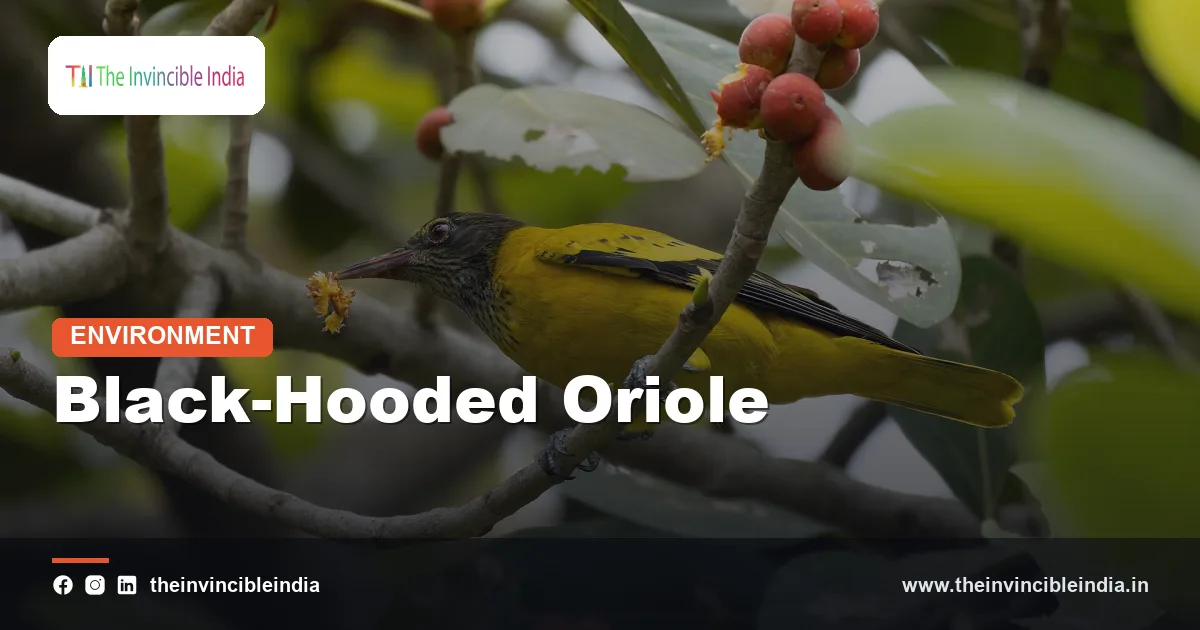
The black-hooded oriole (Oriolus xanthornus) is a brilliant golden-yellow songbird with a complete black hood, a pink bill and dark wings, found in groves, orchards, gardens and light woodland across much of India. The black-hooded oriole spends most of its life high in leafy canopies, where it feeds on fruit and insects, and it is far more often heard, in the form of a rich fluty whistle, than seen.
Because the black-hooded oriole is a resident species that stays in the same region through the year, it is one of the easiest orioles to learn in India. This explainer covers how to recognise the black-hooded oriole, where it lives, what it eats, how it nests, how it differs from other Indian orioles and what its status is, as of the most recent assessments.
Quick Facts
| Attribute | Detail |
|---|---|
| Common name | Black-hooded oriole |
| Scientific name | Oriolus xanthornus (described by Linnaeus in 1758) |
| Family | Oriolidae (the Old World orioles) |
| Body length | About 25 cm, roughly the size of a myna |
| Key field marks | Golden-yellow body, full black hood, pink-red bill, dark red eye |
| Habitat in India | Groves, mango and other orchards, gardens, open and moist deciduous woodland, mangroves |
| Movement | Largely resident, with some local movements |
| IUCN status | Least Concern |
| Legal protection in India | Wild birds are protected under the Wild Life (Protection) Act, 1972 |
Key Takeaways
- The black-hooded oriole is a golden-yellow songbird whose head, throat and upper breast are covered by a solid black hood, which separates it from most other Indian orioles.
- The black-hooded oriole is largely a resident bird of India, so it can be seen in the same groves and gardens in every season.
- Fruit, especially figs and berries, together with insects and some nectar, makes up the diet of the black-hooded oriole.
- The black-hooded oriole weaves a neat, cup-shaped hammock nest slung between the fork of a thin branch, usually high in a tree.
- The female black-hooded oriole is duller and greener on the back than the male, and young birds show streaked underparts and an incomplete hood.
- The black-hooded oriole is classed as Least Concern by the IUCN, though loss of old trees and orchards can reduce local nesting sites.
What is the black-hooded oriole?
The black-hooded oriole is a medium-sized arboreal songbird of the family Oriolidae, a small group of colourful, fruit-and-insect eating birds found in the Old World tropics. The scientific name of the black-hooded oriole is Oriolus xanthornus, and the species was formally described by Carl Linnaeus in the 18th century. The genus name Oriolus comes from a Latin word associated with the golden colour of these birds, and the species name xanthornus refers to the yellow plumage.
The black-hooded oriole belongs to a genus that includes several similar-looking species across Asia, Africa and Australasia. Within India, the black-hooded oriole is the oriole that most people notice first in gardens, because it occupies the plains and low hills and tolerates human-modified habitats. It is a shy bird that keeps high in dense foliage, so its yellow colour often flashes briefly between leaves before the bird disappears again.
In Hindi and several other Indian languages, orioles are generally known by names such as peelak, and some regional names refer to the golden colour or to the whistling call. Local names vary widely from one language and district to another, so naturalists usually rely on the scientific name to avoid confusion between the different oriole species.
What does the black-hooded oriole look like?
The adult male black-hooded oriole is bright golden-yellow over most of the body, with a solid black hood covering the head, throat, nape and upper breast. The hood is the defining feature of the species and gives the bird its name. The wings are mostly black with a yellow patch on the coverts and yellow edges to some flight feathers, while the tail is black in the centre with yellow outer feathers and a yellow tip, which becomes visible when the bird flies.
The bill of the black-hooded oriole is stout, slightly curved and pink to reddish, which stands out strongly against the black hood. The eye is dark reddish and is hard to see against the black head. A bird about 25 cm long, it looks compact and strong-flying, with a rather rapid, undulating flight over open gaps between trees.
Differences between male, female and juvenile
- Adult male: Bright yellow body, full black hood, pink bill, black and yellow wings and tail.
- Adult female: Similar pattern, but the yellow is less vivid and the back often has an olive or greenish wash. The black hood is usually present but may look slightly less glossy.
- Juvenile: Duller, with a head that is not fully black and underparts that show dark streaks. The bill is darker and takes time to turn pink.
Younger birds can cause confusion because their streaked underparts and pale throat resemble other oriole species. Observers should therefore look for the developing black head, the pinkish bill and the overall yellow-and-black wing pattern before settling on an identification.
How can the black-hooded oriole be told apart from similar orioles?
The black-hooded oriole can be told apart from other Indian orioles mainly by its full black hood, which extends over the whole head and throat, while related species show only a thin black stripe through the eye. Observers in India may meet several oriole species, and the differences below are the ones most useful in the field.
| Species | Head pattern | Typical status in India | Bill colour |
|---|---|---|---|
| Black-hooded oriole | Full black hood over head, throat and upper breast | Widespread resident | Pink to reddish |
| Indian golden oriole (Oriolus kundoo) | Black stripe through the eye only; yellow head | Resident and migrant across much of the country | Pink to reddish |
| Eurasian golden oriole (Oriolus oriolus) | Black eye stripe that stops at the eye | Passage migrant and winter visitor in some regions | Pink to reddish |
| Black-naped oriole (Oriolus chinensis) | Black band that passes through the eye and joins behind the nape | Winter visitor in some eastern and island areas | Pink |
| Maroon oriole (Oriolus traillii) | Dark maroon plumage with a black head | Hills of the Himalaya and the north-east | Yellowish |
The simplest rule is that a golden oriole with a clearly black head in the plains is almost certainly a black-hooded oriole, while a yellow head with a dark eye stripe points to a golden oriole. The maroon oriole, by contrast, looks more reddish than yellow and is found mostly in hill forests.
Where is the black-hooded oriole found in India?
The black-hooded oriole is found across most of peninsular and northern India, from the foothills of the Himalaya through the Gangetic plains and central India to the Western Ghats and the east coast. The black-hooded oriole is more patchy in the dry north-west, where there are fewer large trees, and generally avoids higher mountain elevations.
Beyond India, the black-hooded oriole occurs across the Indian subcontinent and parts of South-East Asia, including Sri Lanka, Bangladesh, Nepal, Myanmar and Thailand. Ornithologists recognise a few regional forms, and populations differ slightly in the extent and gloss of the black hood. Details of the subspecies and their precise ranges vary between checklists, so the exact boundaries should be treated with caution.
Habitats the black-hooded oriole prefers
- Mango and other fruit orchards, where large leafy trees offer both food and nest sites.
- Village groves, temple gardens and tree-lined avenues in towns and cities.
- Open deciduous and semi-evergreen woodland in the plains and foothills.
- Mangrove edges and riverine woodland in coastal and delta regions.
- Large well-treed urban gardens and campuses with old trees.
The black-hooded oriole is typically a lowland and foothill bird. It uses the middle and upper canopy and often follows a regular route between fruiting trees through the day.
What does the black-hooded oriole eat?
The black-hooded oriole eats a mix of fruit, insects and nectar, taking whichever food is most abundant in the season. Soft fruits such as figs (from banyan, peepal and other Ficus species), berries and wild fruits make up a large part of the diet, and the oriole often visits fruiting trees in the company of barbets, bulbuls and mynas.
Insects are important too, especially during the breeding season when growing chicks need protein. The black-hooded oriole picks caterpillars, beetles and other insects from leaves and branches. Orioles also visit flowers of trees such as silk cotton (Bombax) and coral tree (Erythrina) in the dry season to drink nectar, and in doing so they can carry pollen from one blossom to another.
Feeding behaviour
The black-hooded oriole forages mostly alone, in pairs or in small family groups, moving steadily through foliage. It rarely descends to the ground. It may hang upside down to reach a fruit and will sometimes snatch an insect in a short flight. In orchards, the bird is occasionally accused of damaging ripe fruit, but its insect-eating habit balances this to some extent, and the damage is usually modest.
What does the black-hooded oriole sound like?
The black-hooded oriole has a loud, rich, fluty whistle, usually rendered as a liquid phrase of a few notes, which carries well through a grove even when the bird itself is hidden. The black-hooded oriole also gives harsh, nasal calls, often compared to the mewing of a cat, particularly when alarmed or when two birds are interacting.
Because the oriole is difficult to see, the voice is usually the first clue that one is nearby. Males sing most actively in the pre-breeding and breeding season, which in much of India runs from roughly the late winter through the summer, with local variation. Learning the whistle makes it far easier to locate the bird and then pick out the yellow shape in the canopy with binoculars.
How does the black-hooded oriole breed and build its nest?
The black-hooded oriole builds a deep, cup-shaped nest that hangs like a hammock from a fork of thin outer branches, normally well above the ground. The nest is woven from fine grass, plant fibres, strips of bark and bits of leaf, and spider silk and similar material is used to bind it and to attach it to the supporting twigs. The finished structure is neat and sturdy, and it is well suited to withstand wind and rain.
The female lays a small clutch, typically two to three eggs, which are whitish or pinkish with reddish-brown or dark spots. Both parents are generally involved in guarding the nest, and the birds are known to chase away crows and other intruders. Chicks are fed on insects and fruit and leave the nest after a few weeks. The exact breeding months differ with region and monsoon timing, so observers should consider local patterns rather than a single national calendar.
Stages of the breeding cycle
- Courtship: The male sings from the canopy and chases the female through the tree tops.
- Nest building: The pair weaves the hanging cup, usually within a few days to a couple of weeks.
- Incubation: The eggs are kept warm for roughly two weeks, with the female doing most of the work.
- Fledging: Young birds leave the nest after about two to three weeks and remain with the parents for some time.
What is the conservation status of the black-hooded oriole?
The black-hooded oriole is assessed as Least Concern on the IUCN Red List, which means the species is not considered at immediate risk of extinction. The black-hooded oriole has a wide range across South and South-East Asia, and its use of orchards, gardens and village trees helps it remain common in many parts of India.
Even so, its dependence on large, mature trees means that the removal of old groves, the felling of avenue trees and heavy pruning can reduce nest sites locally. Pesticide use in orchards may also reduce the insect food needed by chicks. In India, wild birds including orioles are protected under the Wild Life (Protection) Act, 1972, which restricts capture, killing and trade, though enforcement varies. Population estimates for the species are approximate and should be treated as indicative rather than exact.
Why does the black-hooded oriole matter ecologically?
The black-hooded oriole matters ecologically because it spreads seeds, helps pollinate some trees and controls insect populations. By eating fruits and passing the seeds away from the parent tree, the black-hooded oriole contributes to the regeneration of figs and other trees, especially in fragmented landscapes where wide-ranging fruit-eating birds are valuable.
The oriole is also a useful bio-indicator of green cover. A garden or campus with regular black-hooded oriole visits usually has a healthy mix of native fruiting trees, adequate insect life and structural diversity. Planting native fig, jamun, mulberry and similar trees is therefore an inexpensive way to encourage orioles in an urban neighbourhood.
How can you watch and photograph the black-hooded oriole?
The best way to watch the black-hooded oriole is to learn its whistle, find a fruiting fig or a flowering silk cotton tree, and wait quietly in good morning light. The black-hooded oriole tends to be most active early in the day and again in the late afternoon, when it comes to feed and to bathe.
- Use binoculars and look into the upper canopy, where yellow flashes between leaves.
- Listen first, then scan; the whistle usually gives away the direction.
- Visit fruiting fig trees in the morning, when many birds gather.
- Keep a respectful distance from nests and avoid playback of recorded calls near breeding birds.
- Note whether the bird has a complete black hood to separate it from golden orioles.
Birdwatchers often record sightings on community platforms so that scientists can track how widespread species are over time. Such records, collected over many years, are valuable for understanding changes in local bird populations.
Bottom Line
The black-hooded oriole is a golden-yellow, black-hooded songbird of Indian groves, gardens and open woodland, recognised by its pink bill and fluty whistle. It is a widespread resident that eats fruit and insects, weaves a hanging cup nest and is currently of Least Concern, though it relies on mature trees to thrive.
Frequently Asked Questions
What is a black-hooded oriole?
A black-hooded oriole is a golden-yellow songbird with a solid black hood and a pink bill, found in groves and gardens across India. Its scientific name is Oriolus xanthornus. It belongs to the oriole family Oriolidae and feeds mainly on fruit and insects.
Is the black-hooded oriole found in India all year?
Yes, the black-hooded oriole is largely a resident bird of India and can be seen in the same areas through the year. Some local movements occur in response to fruiting trees and weather. It is most visible in the breeding season, when males call loudly.
How is the black-hooded oriole different from the Indian golden oriole?
The black-hooded oriole has a full black hood over the head, throat and upper breast, while the Indian golden oriole has a yellow head with only a black stripe through the eye. Both have pink bills and yellow bodies, so the head pattern is the quickest clue. The two species may sometimes share the same trees.
What does the black-hooded oriole eat?
The black-hooded oriole eats fruits such as figs and berries, insects such as caterpillars and beetles, and sometimes flower nectar. Fruit dominates the diet outside the breeding season. Insects become more important when the birds are feeding chicks.
What does the nest of a black-hooded oriole look like?
The nest of a black-hooded oriole is a neat, deep cup woven from grass, fibres and bark, slung like a hammock in a fork of thin branches. Spider silk and similar material hold it together. It usually holds two to three spotted eggs.
Is the black-hooded oriole endangered?
No, the black-hooded oriole is not endangered and is listed as Least Concern by the IUCN. It has a wide range and adapts to gardens and orchards. Loss of old trees can still reduce nest sites locally, and wild birds are protected under the Wild Life (Protection) Act, 1972.
{“@context”:”https://schema.org”,”@graph”:[{“@type”:”FAQPage”,”mainEntity”:[{“@type”:”Question”,”name”:”What is a black-hooded oriole?”,”acceptedAnswer”:{“@type”:”Answer”,”text”:”A black-hooded oriole is a golden-yellow songbird with a solid black hood and a pink bill, found in groves and gardens across India. Its scientific name is Oriolus xanthornus. It belongs to the oriole family Oriolidae and feeds mainly on fruit and insects.”}},{“@type”:”Question”,”name”:”Is the black-hooded oriole found in India all year?”,”acceptedAnswer”:{“@type”:”Answer”,”text”:”Yes, the black-hooded oriole is largely a resident bird of India and can be seen in the same areas through the year. Some local movements occur in response to fruiting trees and weather. It is most visible in the breeding season, when males call loudly.”}},{“@type”:”Question”,”name”:”How is the black-hooded oriole different from the Indian golden oriole?”,”acceptedAnswer”:{“@type”:”Answer”,”text”:”The black-hooded oriole has a full black hood over the head, throat and upper breast, while the Indian golden oriole has a yellow head with only a black stripe through the eye. Both have pink bills and yellow bodies, so the head pattern is the quickest clue. The two species may sometimes share the same trees.”}},{“@type”:”Question”,”name”:”What does the black-hooded oriole eat?”,”acceptedAnswer”:{“@type”:”Answer”,”text”:”The black-hooded oriole eats fruits such as figs and berries, insects such as caterpillars and beetles, and sometimes flower nectar. Fruit dominates the diet outside the breeding season. Insects become more important when the birds are feeding chicks.”}},{“@type”:”Question”,”name”:”What does the nest of a black-hooded oriole look like?”,”acceptedAnswer”:{“@type”:”Answer”,”text”:”The nest of a black-hooded oriole is a neat, deep cup woven from grass, fibres and bark, slung like a hammock in a fork of thin branches. Spider silk and similar material hold it together. It usually holds two to three spotted eggs.”}},{“@type”:”Question”,”name”:”Is the black-hooded oriole endangered?”,”acceptedAnswer”:{“@type”:”Answer”,”text”:”No, the black-hooded oriole is not endangered and is listed as Least Concern by the IUCN. It has a wide range and adapts to gardens and orchards. Loss of old trees can still reduce nest sites locally, and wild birds are protected under the Wild Life (Protection) Act, 1972.”}}]}]}


