

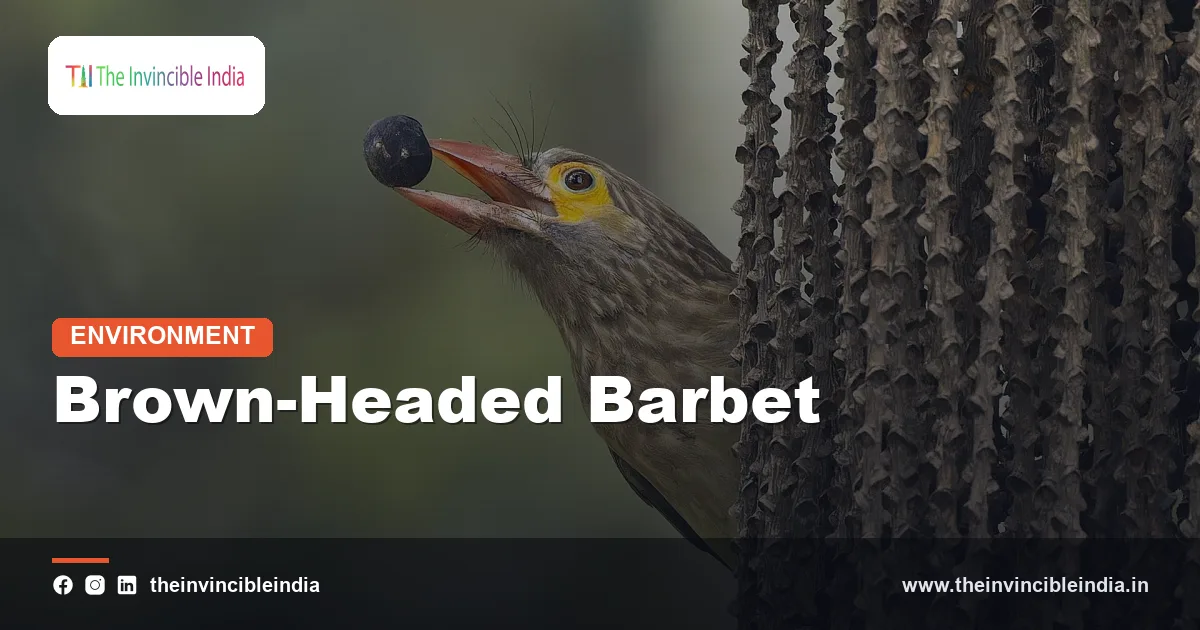
The brown-headed barbet (Psilopogon zeylanicus), also known as the large green barbet, is a chunky green bird with a streaked brown head and breast and a patch of bare orange skin around each eye, whose loud, monotonous “kutroo, kutroo” call rings out from fruiting trees across India. It is a fruit-eating bird of gardens, groves and open forests, and it is more often heard than seen.
The brown-headed barbet belongs to the Asian barbet family and is widespread in the Indian subcontinent, including Sri Lanka. It is a valuable seed disperser for fig and other fruiting trees, and it nests in holes that it excavates in dead wood, which makes it an important contributor to the cavity-nesting community of Indian woodlands.
| Quick Fact | Detail |
|---|---|
| Common names | Brown-headed barbet, large green barbet |
| Scientific name | Psilopogon zeylanicus (formerly Megalaima zeylanica) |
| Family | Megalaimidae (Asian barbets) |
| Size | About 27 cm long; heavy bill and stocky body |
| Key field marks | Green body, brown streaked head and breast, orange bare skin around the eye, heavy pale bill |
| Habitat | Gardens, groves, orchards, tree-lined avenues and open deciduous or moist forest |
| Diet | Mainly fruits, especially figs; also flower nectar and some insects |
| Nest | Hole excavated in a dead branch or tree trunk; usually about two to four white eggs |
| Conservation status | Least Concern on the IUCN Red List |
Key Takeaways
- The brown-headed barbet is a stocky green barbet, about 27 cm long, with a streaked brown head, a heavy bill and a patch of bare orange skin around each eye.
- The brown-headed barbet is famous for its loud, repeated “kutroo, kutroo, kutroo” call, which it gives from high perches, especially in the hot months before the monsoon.
- The brown-headed barbet feeds mostly on fruit, with figs from banyan and peepal trees being a favourite, and it spreads the seeds of many trees.
- The brown-headed barbet excavates its own nest hole in dead wood, and the abandoned holes are later used by other cavity-nesting birds and small animals.
- The brown-headed barbet is widespread in India and Sri Lanka, thrives in gardens and groves, and is classed as Least Concern.
- The brown-headed barbet is larger than the coppersmith barbet, which has a metallic “tuk-tuk” call, a red forehead and a streaked yellow-and-green underside.
What does a brown-headed barbet look like?
A brown-headed barbet looks like a plump, mainly green bird with a brown head and breast streaked with white, a bare orange-yellow patch of skin around each eye, and a thick, pale-tipped bill. The back, wings and tail are leaf-green, which makes the bird surprisingly hard to find among foliage.
The bill is stout and slightly curved, with bristles at its base that give the family its name, since barbs means beards. The belly is paler and streaked, and the legs are dull grey to yellowish. Males and females look alike, and juveniles are similar but duller with less distinct streaking.
Because the plumage matches the leaves so well, the barbet is often detected by its voice first. When the bird sits still in a tree crown, the orange eye-patch and brown head are the best identification clues.
What does the brown-headed barbet’s call sound like?
The brown-headed barbet’s call is a loud, rolling, repeated “kutroo, kutroo, kutroo” or “kot-roo”, delivered in a long, monotonous series from a high perch. The call is far-carrying and may continue for long periods, often through the heat of the day in summer.
The calling bird usually sits upright in a tree, sometimes swinging its head from side to side as it sounds the notes. A barbet calling in a garden can often be pinpointed by listening for the direction of the sound and then scanning the top branches of a leafy tree. Other calls include harsher, chattering notes given when birds squabble over fruit.
Calling is most intense in the breeding season, which is generally in the hotter months in many regions, when males advertise their territory and attract mates.
Where is the brown-headed barbet found in India?
The brown-headed barbet is found across most of peninsular and central India, in the western and eastern ghats, and in parts of the northern plains and foothills, and it also occurs in Sri Lanka as a distinct population. It is common in gardens and groves, but is generally absent from very dry deserts and the highest mountains.
The species is highly adaptable. It occupies a range of habitats provided there are enough large trees for fruit and nesting:
- Urban gardens, parks and tree-lined avenues.
- Orchards and mango, banyan and peepal groves.
- Village trees and temple compounds.
- Open deciduous and semi-evergreen forests.
- Plantation shade trees and forest edges.
It is a resident species, so it does not undertake long-distance migrations, though birds may move short distances to follow fruiting trees.
What does the brown-headed barbet eat?
The brown-headed barbet eats mainly fruit, with wild figs from banyan, peepal and other Ficus trees being a favourite food. It also takes berries, papaya, banana, mulberries and other soft fruit, and occasionally feeds on flower nectar and insects.
The strong bill allows the bird to crush and swallow fruit whole or in large pieces. Seeds pass through the digestive system and are dropped away from the parent tree, which makes the barbet an effective seed disperser. Insects, including large beetles, caterpillars and termites, are mostly taken in the breeding season, when the chicks need protein.
Fruiting fig trees may attract many birds at once, including barbets, bulbuls, mynas, parakeets and hornbills, and the brown-headed barbet often joins these feeding gatherings.
How does the brown-headed barbet help forests and gardens?
The brown-headed barbet helps forests and gardens mainly as a seed disperser, because it swallows fruit and drops viable seeds at some distance from the parent plant. This movement helps trees colonise new ground and maintains genetic mixing between tree populations.
The bird has a second ecological role as a hole-maker. By digging its own nest hole in dead wood, the barbet creates cavities that are later used by other species. Old barbet holes are commonly taken over by small owls, mynas, parakeets, flying squirrels, bees and other animals.
- Seed dispersal: fig and many other fruits are spread across wide areas.
- Cavity creation: nest holes become homes for other species.
- Insect control: insects are eaten, mostly in the breeding season.
- Food-web link: eggs and young may be eaten by snakes, squirrels and birds of prey.
How does the brown-headed barbet nest?
The brown-headed barbet nests by excavating a hole in a dead or decaying branch or tree trunk, which it digs with its strong bill, and the pair usually lays about two to four white eggs inside. The entrance is a neat round hole, and the chamber is unlined or has only a few chips of wood at the bottom.
Both parents take part in digging, incubating the eggs and feeding the chicks, which are fed on fruit and insects. Nest holes may be placed at a height of several metres, often on the underside of a sloping branch. Breeding time varies by region, but it often takes place in the warmer months, before or during the early part of the rains.
Nests are easily damaged by tree felling and branch pruning, so keeping dead wood in safe places in large gardens helps these birds breed.
How is the brown-headed barbet different from the coppersmith barbet?
The brown-headed barbet differs from the coppersmith barbet in size, colour and voice: it is much larger, has a brown streaked head and orange eye-patch, and gives a rolling “kutroo” call, while the coppersmith barbet is small, has a red forehead and breast patch, and gives a metallic “tuk-tuk-tuk” call. Both are common in Indian gardens and often occur in the same trees.
| Feature | Brown-headed barbet | Coppersmith barbet |
|---|---|---|
| Scientific name | Psilopogon zeylanicus | Psilopogon haemacephalus |
| Length | About 27 cm | About 16 to 17 cm |
| Head | Brown, streaked, with orange eye-patch | Red forehead, yellow face and throat |
| Call | Loud, rolling “kutroo” | Metallic “tuk-tuk-tuk” like a hammer on metal |
| Diet | Large fruits, figs, some insects | Figs and small fruits, some insects |
| Build | Heavy, stocky | Small and compact |
The name coppersmith comes from the repeated, hammer-like call, which resembles a metalworker tapping on copper. The call of the brown-headed barbet is a deeper, longer-phrased sound.
Is the brown-headed barbet threatened?
The brown-headed barbet is not threatened and is listed as Least Concern by the IUCN, because it has a wide range and adapts well to gardens and plantations. It may even benefit from tree planting in towns, where fruiting trees such as figs provide a reliable food supply.
The main local threats are the removal of large old trees and dead wood, which reduces nesting sites, and the loss of fruiting trees through clearing and urban development. Like other native birds, the species is protected under India’s Wildlife (Protection) Act, 1972. Collision with glass and vehicles, and harm from heavy pesticide use, are minor additional risks.
How can you attract and see brown-headed barbets?
You can attract brown-headed barbets by growing native fruiting trees such as fig, mulberry and papaya, and by retaining large old trees and some dead wood for nesting. In summer, listen for the call at dawn and look at the tops of leafy trees with binoculars.
- Plant native fig, mulberry, jamun and other fruiting trees.
- Leave safe standing dead branches for nest holes where possible.
- Avoid cutting trees during the nesting season.
- Provide clean water in a shaded bird bath.
- Listen first, then scan the canopy slowly for the orange eye-patch.
What other barbets live in India?
Several other barbets live in India, including the coppersmith barbet, the white-cheeked barbet, the blue-throated barbet and the Malabar barbet, and each occupies a somewhat different region or habitat. Together they form the Asian barbet family, which is best known for loud, repetitive calls and fruit-heavy diets.
The brown-headed barbet is among the most widespread of these in the plains, while others are more regional. The white-cheeked barbet is a bird of the Western Ghats, the blue-throated barbet is found in the Himalayan foothills and the north-east, and the Malabar barbet is a bird of the southern hills. Learning the calls is the quickest route to telling them apart, since all are green and difficult to see among leaves.
- Coppersmith barbet: small, with a metallic, hammer-like “tuk-tuk” call.
- White-cheeked barbet: a bird of the Western Ghats, with a streaked head and pale cheek.
- Blue-throated barbet: found in forests of the northern hills and north-east.
- Brown-headed barbet: the large, widespread species with the rolling “kutroo” call.
When fruit is plentiful, several barbet species may feed in the same fig tree at the same time, each announcing its presence with its own call.
Bottom Line
The brown-headed barbet is a loud, fruit-eating green bird that is easier to hear than to see. By dispersing seeds and excavating nest holes that others reuse, the brown-headed barbet quietly supports the health of India’s gardens, groves and woodlands.
Frequently Asked Questions
What is a brown-headed barbet?
A brown-headed barbet is a large green barbet, Psilopogon zeylanicus, with a streaked brown head and an orange patch of bare skin around the eye. It lives in gardens, groves and open forests across India and Sri Lanka. It eats mostly fruit and nests in holes it digs in dead wood.
Why is the brown-headed barbet also called the large green barbet?
The brown-headed barbet is also called the large green barbet because it is the biggest of the green-bodied barbets in India and its body is mostly green. The two names refer to the same species. The brown-headed name highlights the head colour, while the large green name stresses its size and body colour.
What does the brown-headed barbet’s call sound like?
The call of the brown-headed barbet is a loud, monotonous “kutroo, kutroo, kutroo” repeated many times from a high perch. It carries over a long distance and is most often heard in the hot months. It is quite different from the metallic “tuk-tuk” of the smaller coppersmith barbet.
What does the brown-headed barbet eat?
The brown-headed barbet eats mainly fruit, especially figs, along with berries, papaya and banana. It also takes some flower nectar and insects, particularly when feeding chicks. Its habit of swallowing fruit makes it a useful seed disperser.
Where does the brown-headed barbet nest?
The brown-headed barbet nests in a hole that it excavates in a dead or rotting branch or trunk. The pair typically lays two to four white eggs and both parents feed the chicks. After the birds leave, other cavity-nesting species may use the hole.
Is the brown-headed barbet found in cities?
Yes, the brown-headed barbet is found in many Indian cities and towns wherever large trees and fruiting plants are present. Parks, campuses, temple grounds and tree-lined streets all provide suitable habitat. Its loud call is often the first sign that a barbet is in the neighbourhood.
{“@context”:”https://schema.org”,”@graph”:[{“@type”:”FAQPage”,”mainEntity”:[{“@type”:”Question”,”name”:”What is a brown-headed barbet?”,”acceptedAnswer”:{“@type”:”Answer”,”text”:”A brown-headed barbet is a large green barbet, Psilopogon zeylanicus, with a streaked brown head and an orange patch of bare skin around the eye. It lives in gardens, groves and open forests across India and Sri Lanka. It eats mostly fruit and nests in holes it digs in dead wood.”}},{“@type”:”Question”,”name”:”Why is the brown-headed barbet also called the large green barbet?”,”acceptedAnswer”:{“@type”:”Answer”,”text”:”The brown-headed barbet is also called the large green barbet because it is the biggest of the green-bodied barbets in India and its body is mostly green. The two names refer to the same species. The brown-headed name highlights the head colour, while the large green name stresses its size and body colour.”}},{“@type”:”Question”,”name”:”What does the brown-headed barbet’s call sound like?”,”acceptedAnswer”:{“@type”:”Answer”,”text”:”The call of the brown-headed barbet is a loud, monotonous “kutroo, kutroo, kutroo” repeated many times from a high perch. It carries over a long distance and is most often heard in the hot months. It is quite different from the metallic “tuk-tuk” of the smaller coppersmith barbet.”}},{“@type”:”Question”,”name”:”What does the brown-headed barbet eat?”,”acceptedAnswer”:{“@type”:”Answer”,”text”:”The brown-headed barbet eats mainly fruit, especially figs, along with berries, papaya and banana. It also takes some flower nectar and insects, particularly when feeding chicks. Its habit of swallowing fruit makes it a useful seed disperser.”}},{“@type”:”Question”,”name”:”Where does the brown-headed barbet nest?”,”acceptedAnswer”:{“@type”:”Answer”,”text”:”The brown-headed barbet nests in a hole that it excavates in a dead or rotting branch or trunk. The pair typically lays two to four white eggs and both parents feed the chicks. After the birds leave, other cavity-nesting species may use the hole.”}},{“@type”:”Question”,”name”:”Is the brown-headed barbet found in cities?”,”acceptedAnswer”:{“@type”:”Answer”,”text”:”Yes, the brown-headed barbet is found in many Indian cities and towns wherever large trees and fruiting plants are present. Parks, campuses, temple grounds and tree-lined streets all provide suitable habitat. Its loud call is often the first sign that a barbet is in the neighbourhood.”}}]}]}


