

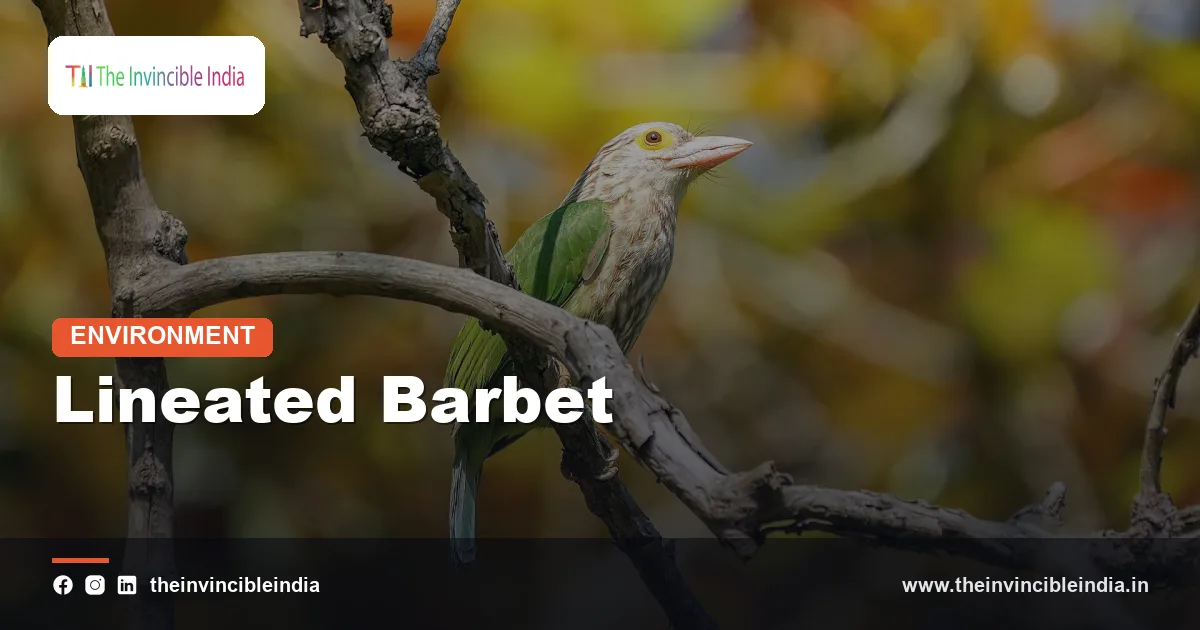
The lineated barbet (Psilopogon lineatus) is a large, green, fruit-eating barbet of northern and northeast Indian groves, easily recognised by its brown head and breast marked with pale streaks and by its loud, monotonous, repeated call. It lives in mango orchards, banyan and peepal trees, town gardens and forest edges, and it nests in holes that it excavates in dead branches.
Although it is bulky, bright green and very vocal, the lineated barbet is often hard to spot because its colour matches the leaves it sits among. This explainer covers how to identify the bird, where it lives in India, what it eats, how it calls and breeds, and why it matters as a seed-spreading species of village and urban trees.
Quick Facts
| Common name | Lineated barbet |
|---|---|
| Scientific name | Psilopogon lineatus (placed in the genus Megalaima in older books) |
| Family and order | Megalaimidae (Asian barbets); order Piciformes |
| Size | About 28 cm long |
| Range in India | Himalayan foothills, the northern and eastern plains and the northeast |
| Habitat | Groves, orchards, gardens, tree-lined roads, open woodland and forest edges |
| Diet | Mainly figs and other fruits; also flowers, nectar and insects |
| Breeding | Excavates a nest hole in a dead branch or trunk; usually 2 to 4 white eggs in spring and early summer |
| Conservation status | Least Concern on the IUCN Red List; protected under Indian wildlife law |
Key Takeaways
- The lineated barbet is a heavy-bodied, green barbet about 28 cm long, with a brown head and breast streaked in pale buff or white.
- The lineated barbet belongs to the Asian barbet family, Megalaimidae, and takes its name from the stiff bristles around the base of its bill.
- Fruit is the main food of the lineated barbet, and figs from banyan and peepal trees are among its favourites.
- The lineated barbet calls loudly and monotonously, repeating a two-note “kotur”-like call for long stretches, especially in the heat of the day.
- The lineated barbet nests in a hole that it excavates itself in a dead branch or trunk, and the hole is later used by other cavity-nesting birds.
- The lineated barbet is assessed as Least Concern, and it helps to spread tree seeds through its droppings.
What is the lineated barbet?
The lineated barbet is a large Asian barbet in the family Megalaimidae, found across northern and northeast India and parts of Southeast Asia. Its scientific name is Psilopogon lineatus, and in older bird books it is listed as Megalaima lineata. The change of genus reflects revisions made after genetic studies of Asian barbets.
Barbets are stout-bodied, short-necked birds with thick bills and bristles at the base of the beak. The word “barbet” comes from the French for beard, a reference to those bristles. Barbets are related to woodpeckers and belong to the same order, Piciformes, but they feed mainly on fruit rather than on insects found in wood.
The common name “lineated” refers to the pale lines or streaks that mark the bird’s head, neck and breast. The bird is a resident species in India, which means it stays in the same region throughout the year and does not undertake long migrations.
It is often described as a bird of the garden and the grove rather than of deep forest, and it is among the barbets most commonly seen in towns and villages of its range.
How can you identify a lineated barbet?
A lineated barbet can be identified by its bright green body, a brown head, neck and breast heavily streaked with pale lines, a bare yellow or orange patch around the eye, and a thick pale yellowish bill. The bird is about the size of a myna or somewhat larger and sits upright on a branch with a stocky, round-headed look.
Plumage in detail
- Head, neck and breast: brown with pale buff or whitish streaks, giving the bird its name.
- Back, wings and tail: leaf green, which makes the bird blend into foliage.
- Eye: a patch of bare yellow to orange skin around the eye is a useful field mark.
- Bill: thick, strong and pale yellowish, with a slightly darker tip and bristles at the base.
- Underparts: green to greenish-yellow below the streaked breast.
Males and females
Male and female lineated barbets look alike, and the two sexes cannot be separated easily in the field. Young birds are duller and have less well-defined streaking than adults.
Lineated barbet and similar birds
Several barbets share Indian gardens and woodland, so careful observation is needed. The table below gives the main differences.
| Species | Key difference from the lineated barbet |
|---|---|
| Brown-headed barbet | Has a plainer brown head and streaking that is less crisp; more widespread in central and peninsular India. |
| Coppersmith barbet | Much smaller, with a red forehead and a patch of red on the breast; gives a metallic “tuk-tuk” call. |
| Blue-throated barbet | Has a bright blue throat and a red patch on the head; found in forest and foothills. |
| Great barbet | Bigger, with a massive yellow bill and a dark blue-black head; lives in higher Himalayan forests. |
Where does the lineated barbet live in India?
The lineated barbet lives in the Himalayan foothills, the northern and eastern plains, and the northeast of India. It is also found in neighbouring countries such as Nepal, Bangladesh and Myanmar and extends into parts of Southeast Asia.
The bird is closely associated with trees that bear fruit. Its typical habitats include:
- Mango groves and other orchards.
- Large fig trees, such as banyan and peepal, in villages and towns.
- City parks, university campuses and tree-lined avenues.
- Open deciduous woodland and forest edges.
- Riverside trees and wooded farmland.
The lineated barbet is usually found at low to moderate elevations. It avoids dense, high-altitude forest and treeless land, and it relies on a supply of large trees for both food and nesting.
Because the species tolerates people and noise, it has adapted to many towns and cities. In such places it often lives alongside mynas, parakeets and other fruit-eating birds.
What does the lineated barbet eat?
The lineated barbet eats mainly fruit, especially figs, and it also takes flowers, nectar and some insects. Fruit makes up the bulk of the diet and is swallowed whole or in large pieces, with the seeds passing through the gut or being dropped later.
Typical foods
- Figs from banyan, peepal and other wild fig trees.
- Cultivated fruits such as papaya, mango and banana, when available.
- Berries and other small fleshy fruits.
- Flowers and nectar, taken from flowering trees.
- Insects such as beetles, termites and caterpillars, especially during breeding.
The lineated barbet often joins other birds at a fruiting tree. It tends to be bold and sits for long periods while feeding, but it will move away when approached closely. Insects are especially important for feeding chicks, which need protein for growth.
Because the bird eats a lot of fruit, farmers occasionally regard it as a minor pest in orchards. In practice, it takes a modest share of the crop and in return plays a useful part in spreading seeds.
How does the lineated barbet call?
The lineated barbet calls with a loud, monotonous, repeated two-note sound, often written as “kotur” or “kutur”, which it may repeat for minutes at a stretch. The call carries well and is one of the typical sounds of Indian groves and gardens in the warmer months.
The bird often calls from a high, bare perch or from within the foliage, and it may call at midday, when most other birds fall silent. Because the barbet is hard to see among leaves, the call is the best way to find it. Birdwatchers often follow the sound to locate the bird in the treetop.
Why the bird calls
- To advertise its territory to other barbets.
- To attract a mate during the breeding season.
- To keep contact with a partner nearby.
- To warn rivals away from a fruiting tree.
Calling is most frequent in spring and early summer, which are the main breeding months. During this period, the repeated call can become almost constant, and some people find it monotonous.
How does the lineated barbet breed?
The lineated barbet breeds by excavating a nest hole in a dead branch or tree trunk, where the female lays a small clutch of white eggs. Both birds of the pair help to dig the cavity, using their strong bills to chisel into soft or rotten wood.
Nest site
The nest is normally in a dead or partly dead limb that is soft enough to excavate. The entrance is a neat round hole, and the chamber widens below. The floor has no lining apart from wood chips. A pair may use a branch within a village grove or a large tree in a garden.
Eggs and chicks
- A typical clutch has 2 to 4 white eggs.
- Both parents incubate the eggs and feed the chicks.
- The adults bring fruit and insects to the nest.
- The young leave after several weeks and remain with their parents for a time.
Breeding in northern India generally takes place in spring and early summer, although the timing varies with region and weather. The pair often reuses a suitable site, or they may dig a new one nearby. Once abandoned, the holes are valuable to other birds and small animals.
Why does the lineated barbet matter for trees and seeds?
The lineated barbet matters because it spreads the seeds of fig and other fruiting trees, and because its nest holes provide shelter for other animals. Seeds swallowed with the fruit pass through the bird’s gut or are dropped away from the parent tree, giving them a chance to grow elsewhere.
Fig trees, including banyan and peepal, are known as keystone resources in many Indian habitats because they bear fruit when little else is available. The barbet is one of many birds and mammals that depend on such trees, and in return the bird helps these trees to reproduce and spread.
The hole nests are also useful. After the barbets have left, other cavity-nesting birds such as mynas, parakeets and owlets may use the same chamber. In this way, one species adds to the shelter available for several others.
The lineated barbet is also an easy bird for beginners to learn. Its loud call and its habit of sitting on conspicuous perches make it a good introduction to birdwatching for people living in towns.
Is the lineated barbet threatened?
The lineated barbet is not currently regarded as threatened, and the International Union for Conservation of Nature (IUCN) lists it as Least Concern. It has a large range and adapts well to gardens, orchards and towns, which helps to keep its numbers stable.
Some local pressures nevertheless exist:
- Felling of large old trees, which removes both food and nest sites.
- Pruning or removal of dead branches in gardens and avenues.
- Loss of village groves and orchards to development.
- Heavy pesticide use that affects insect food for chicks.
In India, wild birds are protected by law, and capturing or harming them is an offence. Simple measures such as keeping large fruiting trees and leaving safe dead limbs in place can help the bird in towns and villages.
How does the lineated barbet differ from the brown-headed barbet?
The lineated barbet differs from the brown-headed barbet mainly in its more strongly streaked head and breast, its range and its slightly different build. The two are similar green barbets and are often confused, but careful attention to the head pattern and location helps to separate them.
The lineated barbet has crisp pale streaks on a brown head and chest, and its range centres on northern and northeast India. The brown-headed barbet has a plainer brown head, a less distinct streak pattern and a wider distribution in central and peninsular India. In areas where both occur, birdwatchers rely on the head pattern and the call to be sure of the identification.
Understanding these differences is a good exercise in field observation. Habitat, range, voice and plumage should all be considered together rather than relying on a single feature.
How and where can you watch a lineated barbet?
You can watch a lineated barbet by visiting a mango grove, a garden with old fig trees or a park with tall trees, listening for its repeated call and scanning the upper branches. The bird usually perches openly for a time, so a patient search with binoculars often succeeds.
Practical tips
- Visit in the morning or late afternoon, when the bird is active.
- Learn the repeated two-note call and follow it to the tree.
- Check fruiting fig trees, which attract many birds.
- Look for the green body and the streaked brown head against the sky.
- Avoid disturbing nest holes, since this can cause the pair to abandon the site.
Many city parks, university campuses and sanctuaries across north and northeast India have records of the species, and it is a regular on local birdwatching checklists.
Bottom Line
The lineated barbet is a loud, green, fruit-eating bird of Indian groves and gardens that spreads seeds and creates nest holes used by others. Keeping large fruiting trees and safe dead limbs is the simplest way to keep it common.
Frequently Asked Questions
What is a lineated barbet?
The lineated barbet is a large green barbet (Psilopogon lineatus) of northern and northeast India. It has a brown head and breast streaked with pale lines and a thick pale bill. It feeds mainly on fruit and calls loudly and repeatedly.
How can you identify a lineated barbet?
You can identify a lineated barbet by its green body, streaked brown head and breast, and a bare yellow or orange patch around the eye. Its bill is thick and pale yellowish. The loud, repeated two-note call is another useful clue.
What does a lineated barbet eat?
The lineated barbet eats mainly fruit, especially figs from banyan and peepal trees. It also takes flowers, nectar and insects. Insects are especially important for feeding the chicks.
What does the lineated barbet’s call sound like?
The lineated barbet gives a loud, monotonous, repeated two-note call, often written as “kotur” or “kutur”. It can repeat the call for minutes at a time, even at midday. The call is most frequent in the breeding season.
Where does the lineated barbet nest?
The lineated barbet nests in a hole that the pair excavates in a dead branch or tree trunk. The female lays about 2 to 4 white eggs, and both parents feed the chicks. The hole may later be used by other cavity-nesting birds.
Is the lineated barbet endangered?
No, the lineated barbet is classified as Least Concern by the IUCN, so it is not currently threatened. It adapts well to groves, gardens and towns. Loss of large old trees can still reduce local numbers.
{“@context”:”https://schema.org”,”@graph”:[{“@type”:”FAQPage”,”mainEntity”:[{“@type”:”Question”,”name”:”What is a lineated barbet?”,”acceptedAnswer”:{“@type”:”Answer”,”text”:”The lineated barbet is a large green barbet (Psilopogon lineatus) of northern and northeast India. It has a brown head and breast streaked with pale lines and a thick pale bill. It feeds mainly on fruit and calls loudly and repeatedly.”}},{“@type”:”Question”,”name”:”How can you identify a lineated barbet?”,”acceptedAnswer”:{“@type”:”Answer”,”text”:”You can identify a lineated barbet by its green body, streaked brown head and breast, and a bare yellow or orange patch around the eye. Its bill is thick and pale yellowish. The loud, repeated two-note call is another useful clue.”}},{“@type”:”Question”,”name”:”What does a lineated barbet eat?”,”acceptedAnswer”:{“@type”:”Answer”,”text”:”The lineated barbet eats mainly fruit, especially figs from banyan and peepal trees. It also takes flowers, nectar and insects. Insects are especially important for feeding the chicks.”}},{“@type”:”Question”,”name”:”What does the lineated barbet’s call sound like?”,”acceptedAnswer”:{“@type”:”Answer”,”text”:”The lineated barbet gives a loud, monotonous, repeated two-note call, often written as “kotur” or “kutur”. It can repeat the call for minutes at a time, even at midday. The call is most frequent in the breeding season.”}},{“@type”:”Question”,”name”:”Where does the lineated barbet nest?”,”acceptedAnswer”:{“@type”:”Answer”,”text”:”The lineated barbet nests in a hole that the pair excavates in a dead branch or tree trunk. The female lays about 2 to 4 white eggs, and both parents feed the chicks. The hole may later be used by other cavity-nesting birds.”}},{“@type”:”Question”,”name”:”Is the lineated barbet endangered?”,”acceptedAnswer”:{“@type”:”Answer”,”text”:”No, the lineated barbet is classified as Least Concern by the IUCN, so it is not currently threatened. It adapts well to groves, gardens and towns. Loss of large old trees can still reduce local numbers.”}}]}]}


