

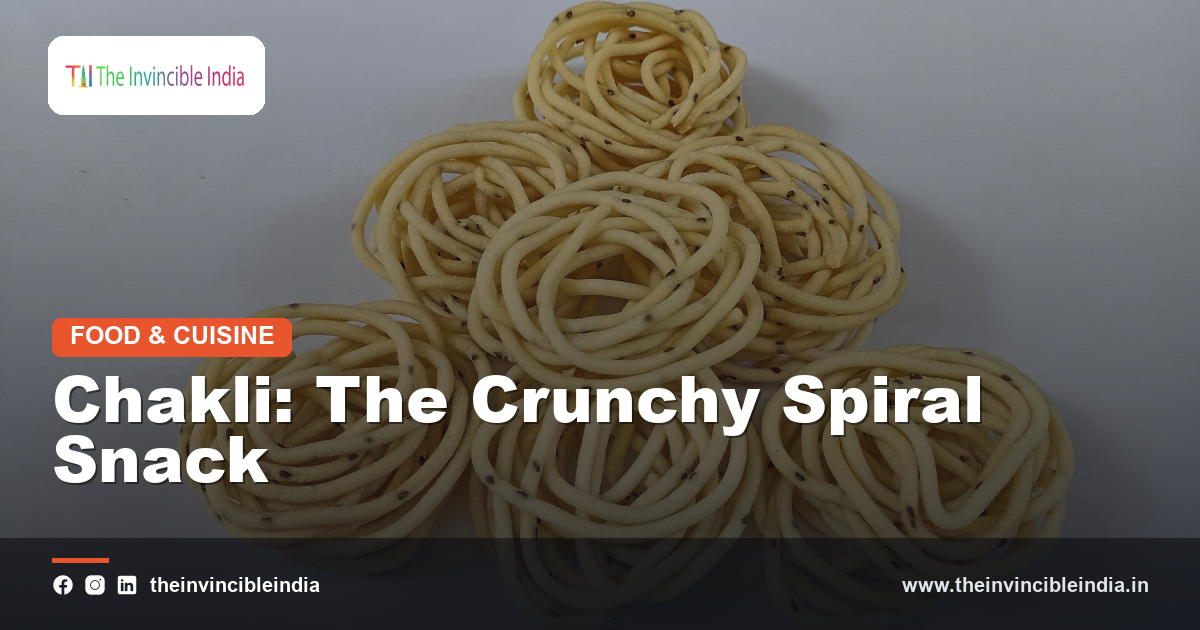
Chakli is a much-loved crunchy snack of western India, formed by pressing a spiced flour dough through a star-shaped mould into tight, coiled spirals and frying them until golden and brittle. Aromatic with cumin, sesame and chilli, it is a fixture of tea-time and festival tables, and no Diwali platter in a Maharashtrian home feels complete without it. Easy to store and delightful to share, it represents the savoury side of festive cooking, standing proudly beside the sweets that usually receive more attention. It belongs to the varied world of Indian namkeen snacks. This guide explores chakli, its ingredients, its method, its cultural role and its continuing popularity.
Quick Facts
| Detail | Information |
|---|---|
| Type | Deep-fried savoury spiral snack |
| Region | Maharashtra and Gujarat, western India |
| Main ingredients | Rice flour, lentil flour, spices, sesame |
| Flavour | Crisp, savoury and lightly spiced |
| Served with | Tea, chutney or enjoyed on its own |
| Cultural link | Diwali faral and festive snack platters |
What Is Chakli
Chakli is a crisp, spiral-shaped snack made from a dough of flour and spices that is pressed into coils and deep fried. The name comes from a word meaning a wheel or circle, which describes its round, coiled form. Each piece is made of fine ridged strands wound into a compact spiral, giving it a distinctive texture that shatters pleasantly when bitten. Its flavour is savoury and gently spiced, with the warmth of chilli and the fragrance of cumin and sesame. Enjoyed on its own or with a cup of tea, it is a familiar companion of everyday snacking and festive celebration. As a simple yet satisfying creation, chakli remains one of the best-known fried snacks of western India.
A Snack of Festive Tables
Chakli is most closely associated with the festival of Diwali, when Maharashtrian households prepare an assortment of sweet and savoury treats collectively called faral. The preparation of chakli often begins days before the festival, with family members gathering to make large batches that will be shared with guests and neighbours. Its long shelf life makes it ideal for this purpose, since it can be stored and offered over many days. Beyond Diwali, it appears at other celebrations and as a regular tea-time treat. Its presence on a festive platter signals hospitality and abundance, and the shared effort of making it brings families closer. In this way chakli serves as both a snack and a symbol of festive togetherness.
The Flours Behind the Crunch
The distinctive crispness of chakli comes from its carefully chosen flours. A traditional Maharashtrian recipe uses a roasted multigrain flour called bhajani, made by roasting and grinding rice, lentils, millets and other grains together. Other households prefer a simpler mixture of rice flour with a smaller amount of roasted chickpea or urad dal flour. The grains are usually dry roasted before grinding, which deepens their flavour and improves the texture of the finished snack. Each flour contributes something different, with rice giving lightness, lentils adding flavour and protein, and millets lending a nutty depth. The balance of these flours is the quiet foundation of a good chakli, and every family treasures its own preferred combination.
Spices and Seasoning
The seasoning of chakli is bold but balanced. Red chilli powder provides heat, turmeric gives a warm golden colour, and cumin and sesame seeds lend aroma and a faint nuttiness. Carom seeds, known as ajwain, are often added for their sharp, digestive character, and a pinch of asafoetida contributes a distinctive savoury depth. Salt is mixed through the dough evenly, since seasoning cannot be adjusted after frying. Some cooks add a little coriander powder or crushed coriander seed for extra fragrance. The skill lies in achieving a mixture that tastes lively and complete without being overpowering. These humble spices turn plain flour into a snack of memorable character, and they are the reason a good chakli is so difficult to stop eating.
Making the Dough
Preparation of the dough is a careful process that determines how crisp the snack will be. In many recipes the flour is first steamed or roasted to remove excess moisture, then mixed with spices, sesame seeds and a little hot oil or butter, which gives the snack its tender crunch. Warm water is added gradually while kneading until the dough becomes smooth, soft and pliable but not sticky. It is then covered and rested briefly so that the flour absorbs the moisture evenly. A dough that is too dry will crack when pressed, while one that is too wet will absorb too much oil. Patience in kneading and resting is therefore essential, and it rewards the cook with evenly shaped, perfectly crisp spirals.
The Chakli Press
The special tool used to shape chakli is a hand-operated press, traditionally made of brass, steel or wood. It consists of a cylinder that holds the dough and a perforated disc with a star-shaped opening, through which the dough is squeezed as the handle is turned. The ridged strands that emerge give chakli its characteristic fluted surface, which crisps beautifully in hot oil. Different discs can be fitted to the same press to make other snacks, such as thin sev or ribbon-like strips. Many families treasure their presses as long-used kitchen companions. This simple device is what turns shapeless dough into elegant spirals, and its design has changed little because it already performs its task perfectly.
Forming the Spiral
Shaping chakli is a skill that improves with practice. The dough is loaded into the press, and the cook squeezes out a continuous strand onto a greased plate, a piece of cloth or directly onto a spoon, coiling it into a tight circle with an even thickness. The ends are pressed together gently to seal the spiral so that it does not unravel during frying. Experienced hands produce rows of neat, identical coils at remarkable speed, while beginners often find their first attempts uneven. The even thickness of the strand is what ensures uniform cooking. This graceful, rhythmic process is one of the most satisfying parts of festive cooking, and the neat pattern of the finished spirals is a mark of the maker’s skill.
Frying to Golden Perfection
Once shaped, the chakli are carefully lowered into hot oil and fried until they turn a deep golden colour and stop sizzling noisily, a sign that the moisture has cooked out. The temperature of the oil is crucial, since oil that is too hot will brown the surface while leaving the inside raw, and oil that is too cool will make the snack greasy. Chakli are turned gently during frying so that they cook evenly, then lifted out and drained on absorbent paper. They are allowed to cool completely before being stored, because crispness develops fully as they cool. Careful frying produces a snack that is light, crunchy and clean in flavour, and it is the final step that rewards all the earlier preparation.
Chakli Across Western India
Chakli is made in both Maharashtra and Gujarat, with subtle differences in style. In Maharashtra the multigrain bhajani flour is the classic choice, producing a darker, more robust snack with a nutty flavour. In Gujarat the dough is often made with rice flour and lentil flours and may be spiced with green chilli paste, giving a lighter colour and fresher taste. Gujarati cooks commonly call the snack chakri. Despite these differences, the basic principle of a pressed, coiled and fried spiral remains the same. The local variations show how a common idea can be shaped by regional taste and available grains, and they enrich the shared tradition of savoury snacking that connects the western states of India.
Murukku and Other Cousins
Pressed and fried spiral snacks are found in many parts of India, and chakli has several close relatives. In Tamil Nadu and neighbouring regions the equivalent is called murukku, traditionally made from rice flour and urad dal flour and seasoned with cumin, sesame or butter. In Karnataka a ring-shaped relative called kodubale is popular, often spicier and chunkier in character. Kerala and Andhra Pradesh have their own versions, each shaped by local flavours. Although the names, flours and spices differ, the family resemblance is unmistakable, reflecting a shared approach to making crisp snacks from grains and pulses. Chakli takes its place within this wider family while keeping its own recognisable western Indian character.
Serving and Pairing Chakli
Chakli is traditionally served as a tea-time snack, its crispness and spice pairing perfectly with a hot cup of tea or coffee. It is also offered to guests on festive platters alongside sweets, sev, savoury mixtures and other treats. Some people enjoy it with a dab of chutney or yoghurt, while others prefer it plain. Children often love the playful spiral shape and the satisfying crunch. Because it keeps well in an airtight container, it is also a popular gift and a familiar item in travel food bundles. The versatility of the snack makes it welcome at almost any hour, and its crisp, savoury charm is one of the most reliable pleasures of Indian snack culture.
Storage and Shelf Life
One of the great practical advantages of chakli is that it keeps well for a long time when stored correctly. After cooling completely, the spirals should be placed in an airtight container, away from moisture, which is the enemy of crispness. Under such conditions the snack remains fresh for a considerable period, which is why it is traditionally made in large batches before festivals. If chakli become soft with humidity, a brief warming restores much of their crunch. This long keeping quality made the snack ideal in times before modern packaging, as it could be prepared in advance and enjoyed over many days. Its durability remains one of its quiet virtues in busy modern households.
Tips for Making Chakli at Home
Those who wish to make chakli at home can benefit from a few straightforward guidelines. Roasting or steaming the flour before use gives a lighter and crisper result, and adding a little hot oil to the flour mixture improves tenderness. The dough should be soft and smooth, neither crumbly nor sticky. A well-oiled press and plate make shaping easier, and the oil for frying should be moderately hot throughout. Frying in small batches keeps the temperature steady, and allowing the snack to cool completely before storing preserves its crunch. With a little practice and attention to these details, even first-time cooks can produce golden, fragrant spirals worthy of the festive table.
Nutrition and Moderation
As a deep-fried snack, chakli is best enjoyed in moderation as part of a balanced diet. The grains and lentils in the flour provide carbohydrate, protein and fibre, and the sesame seeds contribute healthy fats and minerals. Because the multigrain versions use a variety of roasted grains, they offer somewhat more nutritional variety than snacks made from refined flour alone. Some modern cooks bake or air-fry chakli to reduce the oil content, though the result differs in texture from the traditional version. Traditionally the snack is eaten in small quantities and mainly at festive times, which fits naturally with a sensible approach to indulgence. Understanding chakli as a festive treat helps place it in healthy perspective.
Chakli Today
Today, chakli remains a beloved snack in Indian households and is widely available in sweet shops, snack stores and packaged form across the country and overseas. During the Diwali season, homemade batches are still prepared with enthusiasm, and many families insist that nothing matches the version made in their own kitchen. Modern variations include baked chakli and versions made with millets, reflecting current interest in wholesome grains. Even so, the traditional spiral shape and spiced crunch remain unchanged. As a snack that combines craft, flavour and festive spirit, chakli stands as a cherished part of the savoury heritage of western India and a delicious emblem of Indian celebration.
Sources & Further Reading
- Ministry of Culture, Government of India (indiaculture.gov.in).
- Maharashtra Tourism, Government of Maharashtra (maharashtratourism.gov.in).
Frequently Asked Questions
What is chakli?
Chakli is a crisp, spiral-shaped fried snack made from spiced flour dough pressed through a star-shaped mould. It is popular in Maharashtra and Gujarat, especially during Diwali.
What flour is used to make chakli?
Maharashtrian chakli traditionally uses bhajani, a roasted multigrain flour, while other versions combine rice flour with roasted lentil flours. The flours are often roasted or steamed before use for extra crispness.
What is the difference between chakli and murukku?
Both are pressed and fried spiral snacks, but murukku is the South Indian version, typically made with rice and urad dal flour. Chakli is the western Indian version and often uses multigrain flour and bolder spices.
Why does chakli become soft?
Chakli loses its crunch when exposed to moisture, so it should be cooled completely and kept in an airtight container. A brief warming usually restores crispness.
When is chakli traditionally made?
It is a classic part of Diwali faral in Maharashtra, though it is also enjoyed all year as a tea-time snack. Its long shelf life makes it ideal for festive preparation.


