

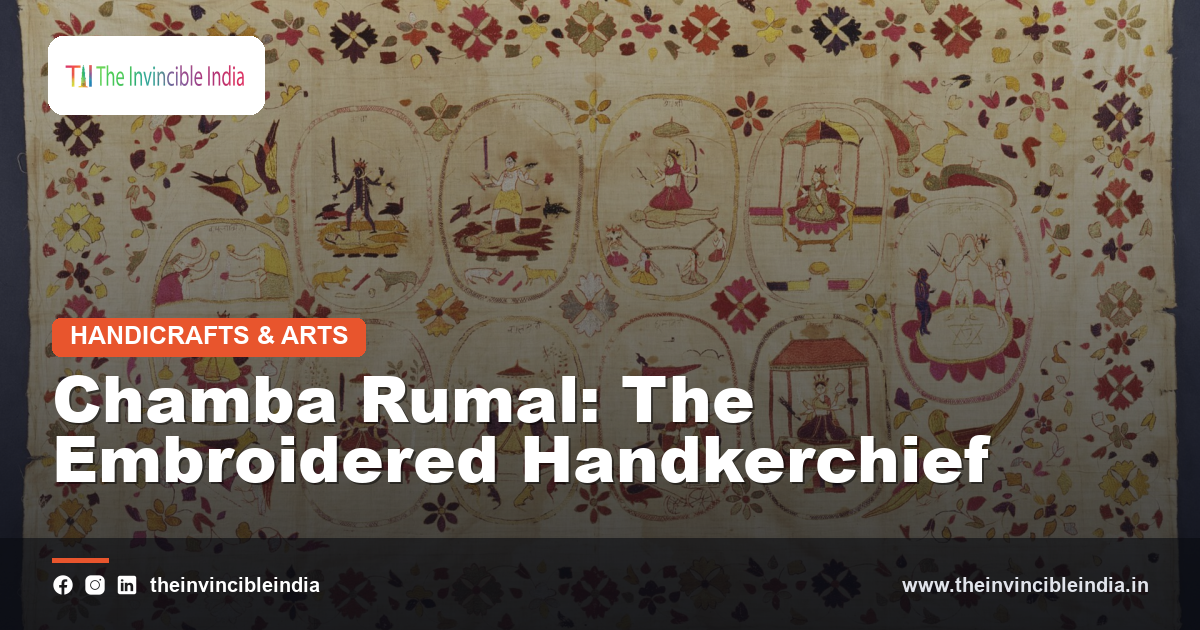
The Chamba Rumal is a distinctive form of pictorial embroidery from the town of Chamba in Himachal Pradesh, in which fine untwisted silk thread is used to render entire scenes on cloth with the delicacy of a painted miniature. Worked almost entirely in a reversible double satin stitch that leaves no visible knots on either side of the fabric, the craft occupies a unique place among India’s needle arts, standing apart from raised or knotted embroidery traditions such as Phulkari embroidery from Punjab. Traditionally worked by women of the hill state using designs closely linked to the Pahari school of miniature painting, the Chamba Rumal was historically used to cover ceremonial gifts and offerings, giving it a role that extends well beyond simple decoration into the everyday ritual life of the region.
Quick Facts
| Detail | Information |
|---|---|
| Also Known As | Do-rukha embroidery, needle painting of Chamba |
| Primary Region | Chamba, Himachal Pradesh |
| Core Technique | Reversible double satin stitch |
| Typical Thread | Untwisted silk floss |
| Common Motifs | Krishna Raas Leela, hunting and courtly scenes |
| Recognition | Geographical Indication (GI) tag |
Origins in the Chamba Hills
The Chamba Rumal takes its name from the town of Chamba, nestled in the hill country of what is now Himachal Pradesh, where the craft developed under the patronage of local hill courts over several centuries. Its emergence is closely tied to the artistic environment of the region, where painting, court culture, and domestic needlework existed in close conversation with one another.
Women within noble and artisan households in Chamba practised this embroidery as part of everyday domestic life, often producing pieces intended for family use rather than for open sale. This origin within household and courtly settings gave the craft an intimate, personal character that has remained closely associated with the identity of the region ever since.
Meaning of Rumal and Do-Rukha
The word rumal simply means handkerchief or square cloth, referring to the basic form on which this embroidery is traditionally worked, typically a square or rectangular piece of cotton or silk fabric. The finished object was never intended purely as a functional handkerchief but rather as a decorative and ceremonial textile of considerable artistic ambition.
The technique itself is often described using the term do-rukha, meaning two-faced or double-sided, a reference to the reversible satin stitch that produces an identical image on both the front and back of the cloth. This reversible quality is considered a hallmark of technical mastery, since it requires exceptional control of thread tension and stitch placement throughout the embroidery process.
Court Patronage and Early Development
The rulers of Chamba state and other hill principalities in the region are widely understood to have supported and encouraged this embroidery tradition, providing an environment in which skilled needlework could develop alongside court painting and other decorative arts. Royal households often commissioned rumals for ceremonial and diplomatic purposes.
This patronage helped elevate the craft beyond purely domestic production, encouraging greater ambition in composition and detail as embroiderers sought to match the visual richness associated with courtly taste. The link between court culture and household embroidery remains a defining feature of how the Chamba Rumal tradition is understood today.
Link with Pahari Miniature Painting
The Chamba Rumal is closely associated with the Pahari school of miniature painting, which flourished across the hill states of northern India and is known for its refined figures, flowing lines, and depictions of courtly and devotional life. Many rumal designs drew directly on the visual vocabulary established by local painters.
This relationship meant that embroiderers often worked from sketches or outlines that echoed the compositional style of miniature paintings, translating painted scenes into thread with careful attention to posture, gesture, and narrative detail. The result is a craft frequently described as needle painting, reflecting its close visual kinship with the painted tradition it draws upon.
Materials: Fabric and Thread
Traditional Chamba Rumal work is typically embroidered on a fine, closely woven cotton or silk base cloth, chosen for its ability to hold delicate stitch work without distorting under the pull of the thread. The choice of ground fabric directly affects the final texture and drape of the finished piece.
The embroidery itself uses untwisted silk floss, prized for the smooth, lustrous surface it creates when laid flat across the fabric in the satin stitch technique. This combination of a stable ground cloth and soft, untwisted thread is essential to achieving the craft’s characteristic even, painting-like finish.
The Double Satin Stitch Technique
The defining technical feature of the Chamba Rumal is its use of a double satin stitch worked so precisely that the design appears identically on both sides of the cloth, with no stray threads or knots visible on the reverse. Achieving this effect requires careful planning of thread paths before any stitching begins.
Embroiderers must control thread tension consistently across long stretches of stitching to prevent puckering or unevenness, a skill that typically develops only after extended practice under experienced guidance. This reversible technique remains one of the most technically demanding aspects of traditional Indian embroidery and a key marker of authentic Chamba work.
Sketching the Design Before Embroidery
Before embroidery begins, the intended design is typically sketched or traced onto the fabric, often with the involvement of a local artist familiar with the compositional conventions of Pahari painting. This preparatory stage establishes the overall narrative layout that the embroiderer will later render in thread.
Careful planning at this stage helps ensure that figures, architectural elements, and decorative borders are proportioned correctly across the available cloth, since corrections after stitching begins are difficult given the reversible nature of the technique. This close relationship between drawing and embroidery reflects the craft’s origins at the intersection of painting and needlework.
Popular Mythological Themes
Many Chamba Rumals depict scenes from Hindu mythology, with episodes from the life of Krishna, particularly the Raas Leela circular dance with the gopis, forming one of the most frequently recurring themes across surviving examples. These mythological scenes allowed embroiderers to explore complex, multi-figure compositions.
Other devotional and epic themes have also been depicted, drawing on a shared repertoire of stories familiar to embroiderers and viewers alike within the region’s cultural context. This grounding in well-known narratives gave the embroidery an immediate legibility, allowing viewers to recognise the depicted scene even from the intricate arrangement of stitched figures.
Hunting and Courtly Scenes
Alongside mythological subjects, Chamba Rumals frequently depict hunting expeditions, courtly processions, and scenes of daily life within a royal household, reflecting the broader visual interests of the Pahari painting tradition from which the craft draws inspiration. These scenes often include finely detailed figures, animals, and landscape elements.
Such compositions allowed embroiderers to display technical range beyond devotional imagery, working with a wider variety of poses, groupings, and decorative borders. The presence of these secular themes alongside mythological ones illustrates the breadth of subject matter that the double satin stitch technique was capable of rendering.
Colour Palette and Silk Threads
Chamba Rumal embroidery traditionally makes use of a vivid but carefully balanced palette of coloured silk threads, chosen to distinguish figures, costumes, and background elements clearly within often densely populated compositions. Reds, yellows, greens, and blues frequently appear alongside more muted tones for shading and detail.
The careful selection and placement of these colours allows embroiderers to suggest depth, movement, and narrative emphasis without relying on any painted or printed elements, since the entire visual effect must be achieved through thread alone. This disciplined use of colour remains central to the craft’s distinctive, painting-like appearance.
Ceremonial and Ritual Uses
Beyond their artistic value, Chamba Rumals traditionally served practical ceremonial functions, most notably as covers placed over gifts, trays of offerings, or ceremonial items presented on auspicious occasions. This use gave the embroidered cloth a role within ritual etiquette as well as decorative display.
The act of covering an offering with a finely embroidered rumal was understood as a mark of respect and care toward the recipient, whether a deity, a guest, or a family member. This ritual dimension helped ensure that the craft remained embedded in the social and religious life of the region rather than existing purely as decorative art.
Role in Weddings and Gift-Giving
Chamba Rumals held particular significance in wedding customs, where they were often prepared by the bride’s family and presented as part of the ceremonial exchange of gifts between households. A well-made rumal was seen as a reflection of the skill and care invested by the embroiderer.
This association with marriage rituals meant that many rumals were created specifically for a single important occasion, imbuing individual pieces with strong personal and familial significance beyond their broader cultural value. Such use also helped transmit embroidery skills across generations, as younger women learned the craft in preparation for these important life events.
Decline and Revival Efforts
Like many hand embroidery traditions, the Chamba Rumal experienced a decline through the twentieth century as changing lifestyles, reduced court patronage, and competition from machine-made textiles reduced demand for such labour-intensive handwork. Fewer artisans continued to practise the craft at its traditional level of skill.
In more recent decades, government bodies, craft organisations, and individual practitioners have worked to revive the tradition through training programmes, documentation of historical pieces, and efforts to connect contemporary embroiderers with new markets. These revival initiatives have helped ensure that the specialised knowledge required for authentic double satin stitch work is not entirely lost.
Geographical Indication and Recognition
The Chamba Rumal has received formal Geographical Indication recognition, a status that identifies the craft specifically with the Chamba region and helps distinguish authentic hand-embroidered pieces from imitations produced elsewhere or by mechanised means. This recognition supports both cultural preservation and the livelihoods of genuine practitioners.
Museums and cultural institutions have also played a role in preserving historical examples of the craft, documenting its designs and techniques for future study and reference. Together, formal recognition and institutional documentation have helped secure the Chamba Rumal’s status as a distinct and valued strand of Indian embroidery heritage.
Chamba Rumal Today
The Chamba Rumal today continues to be practised by a smaller but dedicated community of embroiderers in and around Chamba, supported by craft development programmes aimed at sustaining traditional skills alongside new design applications. Contemporary pieces range from faithful reproductions of historical themes to smaller, more accessible items for modern buyers.
As long as artisans continue to train new embroiderers in the demanding double satin stitch technique and maintain the craft’s close relationship with Pahari pictorial tradition, the Chamba Rumal is likely to remain a distinctive and celebrated part of Himachal Pradesh’s cultural heritage.
Sources & Further Reading
- Ministry of Textiles, Government of India (texmin.nic.in).
- Ministry of Culture, Government of India (indiaculture.gov.in).
Frequently Asked Questions
What makes the Chamba Rumal technically unusual?
The Chamba Rumal is worked in a reversible double satin stitch that produces an identical image on both sides of the cloth with no visible knots, a technically demanding effect that few other embroidery traditions attempt.
Where does the design inspiration for Chamba Rumals come from?
Chamba Rumal designs draw heavily on the Pahari school of miniature painting, with many pieces echoing the compositional style, figures, and themes found in painted works from the same hill region.
What themes are commonly depicted on a Chamba Rumal?
Common themes include mythological scenes such as Krishna’s Raas Leela, as well as hunting expeditions, courtly processions, and depictions of everyday royal life drawn from the broader Pahari artistic repertoire.
How was the Chamba Rumal traditionally used?
Beyond decoration, Chamba Rumals were traditionally used as ceremonial covers for gifts and offerings and held particular significance in wedding customs as part of gift exchanges between families.
Has the Chamba Rumal received any formal recognition?
Yes, the Chamba Rumal has been granted Geographical Indication status, which identifies it specifically with the Chamba region and helps protect the authenticity of genuine hand-embroidered work.


