

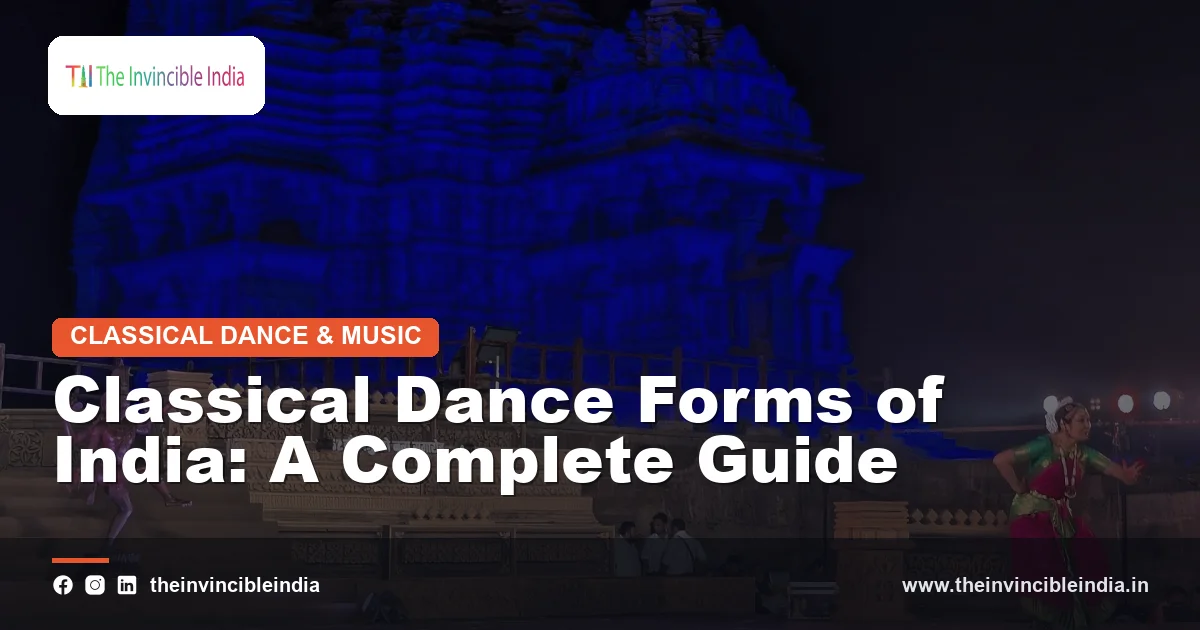
India’s classical dance traditions are among the oldest, richest and most expressive in the world. Rooted in the ancient Sanskrit treatise the Natya Shastra — attributed to the sage Bharata and composed more than 2,000 years ago — these dance forms blend rhythm (nritta), expression (abhinaya) and pure storytelling to convey mythology, devotion and the whole range of human emotion. Far more than entertainment, they are living spiritual and cultural traditions passed down through generations of gurus and disciples. The Sangeet Natak Akademi, India’s national academy for performing arts, officially recognises eight classical dance forms. This complete guide explores each of them in depth, along with the philosophy, music and elements that unite them.
The Foundations: Natya Shastra and the Elements of Dance
The Natya Shastra laid down the theory of natya (drama), nritta (pure, decorative dance) and nritya (expressive dance that conveys meaning), along with the profound concepts of rasa (aesthetic emotion or “flavour”) and bhava (mood). Indian classical dance uses a precise vocabulary of hastas or mudras (symbolic hand gestures), footwork, facial expressions, eye movements and body postures to communicate stories and feelings. Most forms are performed to classical music — Carnatic in the south and Hindustani in the north — and are accompanied by rhythmic syllables called bols or sollukattu. Traditionally, the themes are devotional, drawing on the Ramayana, Mahabharata, Puranas and the poetry of saints.
Quick Facts
| Number of classical forms | Eight (Sangeet Natak Akademi) |
| Ancient text | Natya Shastra by Bharata |
| Oldest form | Bharatanatyam (Tamil Nadu) |
| Newest recognised | Sattriya (Assam, 2000) |
| Core concepts | Nritta, nritya, natya, rasa, bhava, mudra |
Bharatanatyam (Tamil Nadu)
One of the oldest classical dances, Bharatanatyam originated in the temples of Tamil Nadu, where it was performed by devadasis as an offering to the deities. It is known for its fixed upper torso, deeply bent legs (araimandi), intricate and precise footwork, sculpturesque poses, expressive hand gestures and powerful facial abhinaya. A traditional solo recital, or margam, follows a structured sequence — alarippu, jatiswaram, shabdam, varnam, padam and the concluding tillana. The form was revived and brought from the temple to the concert stage in the early 20th century by pioneers such as Rukmini Devi Arundale and E. Krishna Iyer, and is today perhaps the most widely learnt Indian classical dance.
Kathak (North India)
Kathak takes its name from “katha” (story) and the kathakars, travelling bards who narrated epics through movement, song and gesture. Flourishing in both temples and Mughal courts, it developed a distinctive blend of Hindu devotional and Persian courtly influences. Kathak is famous for its rapid, dizzying spins (chakkars), intricate rhythmic footwork accentuated by rows of ankle bells (ghungroos that can number in the hundreds), subtle expressional pieces and playful interplay with the tabla. Its major gharanas (stylistic schools) — Lucknow, Jaipur and Banaras — each emphasise different aspects, from grace and expression to rhythm and technique.
Odissi (Odisha)
One of the oldest surviving dance forms, with roots traceable to the temples of Odisha and evidence in ancient carvings, Odissi is characterised by the fluid, sensuous “tribhangi” (three-bend) posture and the square “chauka” stance representing Lord Jagannath. Its lyrical, sculptural movements mirror the temple carvings of Konark and Puri. Odissi is deeply devotional, often depicting the love of Radha and Krishna through the exquisite Sanskrit poetry of Jayadeva’s Gita Govinda. It was revived in the mid-20th century by gurus such as Kelucharan Mohapatra.
Kuchipudi (Andhra Pradesh)
Originating in the village of Kuchipudi in Andhra Pradesh, this graceful dance-drama tradition combines swift rhythms with expressive storytelling and, in its traditional form, spoken dialogue and song by the dancers themselves. Historically performed by troupes of male Brahmins enacting entire plays, it is famous for spectacular technical feats such as the tarangam, in which the dancer performs intricate steps balanced on the rim of a brass plate, sometimes while holding a lit lamp or balancing a pot of water on the head.
Kathakali (Kerala)
Instantly recognisable by its elaborate costumes, towering headgear and vividly painted faces (with colours signifying character types), Kathakali is a dramatic dance-theatre form from Kerala. It enacts stories from the Ramayana, Mahabharata and Puranas entirely through stylised gestures, elaborate eye and facial movements and codified hand mudras, with no spoken words by the dancers themselves; singers and percussionists narrate and drive the drama. Performers undergo years of rigorous training, including special exercises for the eyes and body, and a traditional performance can last through the night.
Mohiniyattam (Kerala)
The “dance of the enchantress” (Mohini, the female avatar of Vishnu), Mohiniyattam is a graceful solo form performed traditionally by women. It is marked by gentle, swaying, circular movements, subtle and tender expressions, and elegant off-white-and-gold costumes, evoking the swaying of palm trees and the gentle waves of Kerala’s backwaters. It emphasises lasya — the graceful, lyrical and feminine aspect of dance — and is performed to soft Carnatic music in the Manipravalam language.
Manipuri (Manipur)
From the northeastern state of Manipur, this devotional and lyrical form is known for its gentle, rounded, flowing movements and its themes centred on the love of Radha and Krishna, especially the Raas Leela. Unlike the sharp footwork of some other forms, Manipuri is soft and graceful, with the feet never striking the ground harshly. Female dancers wear the distinctive, richly decorated cylindrical skirt (kumil) and a translucent veil, creating an ethereal, dreamlike effect.
Sattriya (Assam)
Originating in the 15th-century Vaishnavite monasteries (satras) of Assam founded by the saint-reformer Srimanta Sankardev, Sattriya was traditionally performed by celibate monks (bhokots) as part of daily devotional practice and religious drama. Combining drama, devotion and rhythmic grace, and accompanied by distinctive Assamese music and the khol drum, it was formally recognised as a classical dance form by the Sangeet Natak Akademi in 2000, making it the most recent addition to the classical canon and bringing it from the monasteries to the wider stage.
A Comparison of the Eight Forms
| Dance | Origin |
| Bharatanatyam | Tamil Nadu |
| Kathak | North India |
| Odissi | Odisha |
| Kuchipudi | Andhra Pradesh |
| Kathakali & Mohiniyattam | Kerala |
| Manipuri | Manipur |
| Sattriya | Assam |
A Living Heritage
These eight dance forms are far more than museum pieces — they are vibrant, evolving traditions taught in gurukuls, universities and academies across India and performed on stages around the world. They continue to inspire cinema, contemporary and fusion dance, and grand cultural festivals such as those held at Konark, Khajuraho, Mamallapuram and Chidambaram. By preserving and celebrating them, India keeps alive an ancient art of storytelling through movement that connects the human and the divine.
Music and Instruments
Indian classical dance is inseparable from classical music. Southern forms like Bharatanatyam, Kuchipudi and Mohiniyattam are performed to Carnatic music, while Kathak is set to Hindustani music. Common accompanying instruments include the mridangam, tabla, violin, flute, veena, cymbals (nattuvangam) and the harmonium, along with vocal music and rhythmic recitation. The interplay between the dancer’s footwork and the percussionist is a highlight of many performances, especially in Kathak.
Costumes and Make-up
Each dance form has its own distinctive costume and make-up, which are integral to its identity. Bharatanatyam and Kuchipudi dancers wear brightly coloured, pleated silk costumes with temple jewellery and flowers in the hair. Odissi features silver jewellery and a distinctive headdress. Kathakali is famous for its towering headgear and elaborate painted faces, which can take hours to apply, using colours that signify the nature of each character. These visual elements help audiences instantly recognise the form and the roles being portrayed.
Dance Festivals of India
India celebrates its classical dances through spectacular festivals, often set against the backdrop of ancient temples. The Konark Dance Festival in Odisha, the Khajuraho Dance Festival in Madhya Pradesh, the Mamallapuram (Mahabalipuram) Dance Festival in Tamil Nadu, the Nishagandhi Festival in Kerala and the Chidambaram Natyanjali Festival draw leading artists and audiences from around the world, keeping these traditions vibrant and visible.
Learning and Legendary Exponents
Indian classical dance is traditionally taught through the guru-shishya (teacher-disciple) tradition, with years of dedicated practice. Legendary exponents have shaped and popularised these forms — from Rukmini Devi Arundale in Bharatanatyam and Birju Maharaj in Kathak, to Kelucharan Mohapatra in Odissi. Today, dance is taught in schools, universities and academies, and many students learn it as part of their cultural education, ensuring these art forms are passed on to new generations.
Nritta, Nritya and Natya Explained
Indian classical dance is traditionally understood through three aspects. Nritta is pure, decorative dance — rhythmic movement and footwork with no specific meaning, showcasing technique and grace. Nritya is expressive dance that conveys meaning, emotion and story through gestures and facial expression. Natya is the dramatic element, essentially dance-theatre that enacts a narrative. A complete classical performance weaves these three together, moving from pure rhythm to storytelling and drama, allowing the dancer to display both technical mastery and emotional depth.
The Nine Rasas
Central to Indian performing arts is the concept of rasa, the aesthetic “flavour” or emotion evoked in the audience. The Natya Shastra describes nine rasas (navarasa): shringara (love), hasya (laughter), karuna (compassion), raudra (anger), veera (heroism), bhayanaka (fear), bibhatsa (disgust), adbhuta (wonder) and shanta (peace). Through subtle changes in expression, gesture and posture, a skilled dancer can convey each of these emotions, drawing the audience into the story and creating a shared aesthetic experience.
Folk Dances Versus Classical Dances
India also has a vast wealth of folk and tribal dances — such as Bhangra of Punjab, Garba of Gujarat, Ghoomar of Rajasthan, Bihu of Assam and Lavani of Maharashtra. Unlike the codified classical forms with their ancient texts and strict grammar, folk dances are community-based, often tied to harvests, festivals and rituals, and passed down informally. Both traditions are vital to India’s cultural landscape, with the classical forms representing refined, temple- and court-based art and the folk forms expressing the joy and rhythms of everyday village life.
Classical Dance Today
Indian classical dance thrives in the modern era. It is performed on global stages, taught in universities and cultural centres worldwide, and has profoundly influenced Indian cinema, where classical elements appear in countless songs and choreographies. Contemporary and fusion choreographers blend classical vocabulary with modern themes, while institutions and festivals work to preserve the traditional repertoire. For millions of young Indians, learning a classical dance remains a cherished part of cultural education and identity.
Frequently Asked Questions
How many classical dance forms are there in India?
The Sangeet Natak Akademi recognises eight classical dance forms of India.
Which is the oldest classical dance of India?
Bharatanatyam from Tamil Nadu is widely regarded as one of the oldest classical dance forms.
What is the Natya Shastra?
The Natya Shastra is an ancient Sanskrit treatise on the performing arts, attributed to Bharata, that forms the theoretical foundation of Indian classical dance.
Which is the newest classical dance form?
Sattriya from Assam was the most recently recognised classical dance form, added in 2000.
What are mudras in Indian dance?
Mudras are symbolic hand gestures used to convey meaning, objects, deities and emotions in Indian classical dance.
Which two classical dances come from Kerala?
Kathakali and Mohiniyattam both originate from the state of Kerala.


