

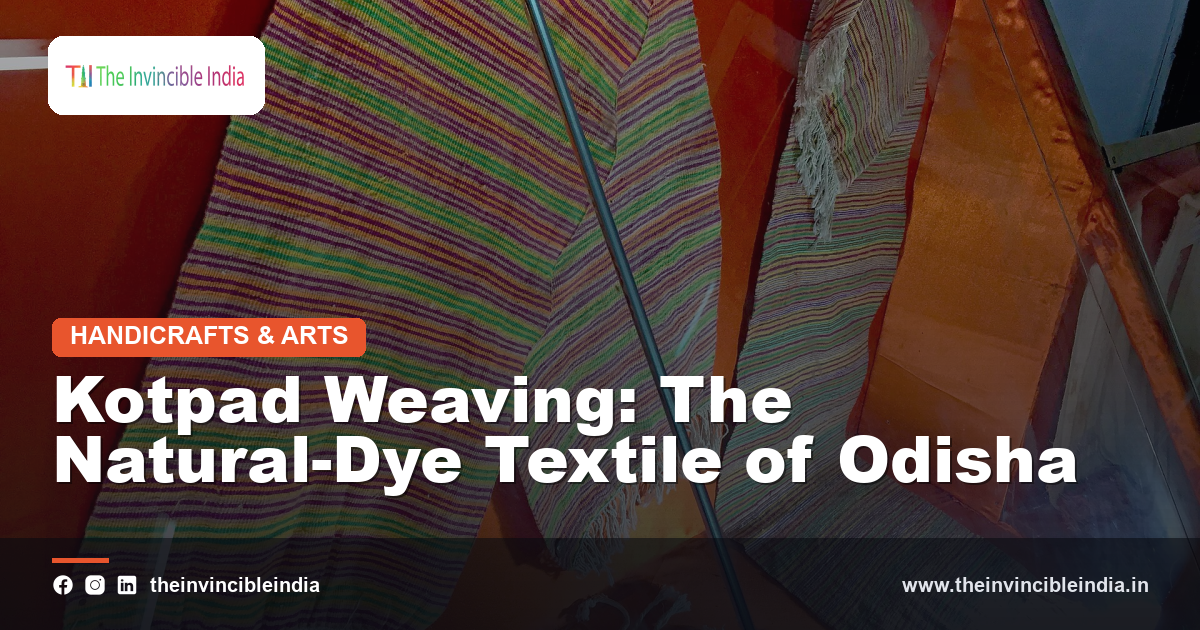
Kotpad weaving is the handloom tradition of the Kotpad area in the Koraput region of southern Odisha, where tribal weavers make cotton cloth dyed with natural colour from the roots of the aal tree. It is also called Kotpad handloom, Kotpad fabric or the Kotpad dyed cloth, and it is recognised for its earthy red, brown and black tones and its simple, powerful motifs. The textile belongs to the wider heritage of Odisha weaving, a state that also gave India the ritual wall art of Saura painting and the temple silks of the coast. Kotpad cloth is distinctive because it combines tribal design, hand weaving and plant dyeing in one unbroken process.
Quick answer: Kotpad weaving is a tribal handloom craft of the Koraput region of Odisha in which cotton cloth is woven by hand and dyed with natural colour extracted from the root of the aal tree. It produces deep red, brown and black fabric marked with bold geometric and tribal motifs, and the cloth has been recognised with a Geographical Indication tag. It is valued as an eco-friendly textile used for sarees, stoles, dupattas and furnishings.
Key Takeaways
- Kotpad weaving is a handloom craft from the Kotpad area of Koraput district in southern Odisha.
- It is also called Kotpad handloom, Kotpad fabric or Kotpad dyed cloth.
- The cloth is dyed with natural colour from the root of the aal tree, which gives red, brown and dark tones.
- Weavers belong largely to tribal and local communities of the Koraput and neighbouring regions.
- Kotpad handloom fabric has been granted Geographical Indication protection.
- The textile is used for sarees, stoles, shawls, dupattas, bags and home furnishings.
The sections below explain the origin, dye, weaving process, motifs and revival of this unusual craft.
Quick Facts
| Detail | Information |
|---|---|
| Type | Natural-dye handloom textile |
| Place of origin | Kotpad, Koraput region, Odisha |
| Fibre | Handspun and mill cotton |
| Dye | Root of the aal tree |
| Typical colours | Red, brown, black |
| Recognition | Geographical Indication tag |
What Is Kotpad Weaving?
Kotpad weaving is a handloom craft in which cotton cloth is woven by hand and then dyed with natural colour to produce a rich, earthy fabric. It comes from Kotpad and the surrounding villages in the Koraput region of Odisha, an area of hills, forests and tribal settlements. The cloth is easy to recognise by its deep reds, browns and blacks, which come from the root of a tree rather than from synthetic chemicals. Patterns are woven in simple bands, lines and geometric forms that echo tribal tattoo and wall art. Kotpad is therefore more than a textile, since it carries the tastes and identity of the communities who make and wear it. The craft is celebrated today as a sustainable, handmade fabric that has found admirers far beyond its home region.
Where Is Kotpad and Why Does It Matter?
Kotpad is a town and block in Koraput district in southern Odisha, set in a hilly region close to the border with Chhattisgarh. The wider area is home to many tribal communities with distinct languages, customs and art forms, and it has long been a meeting place of forest life, agriculture and craft. Kotpad matters because it is the centre from which this particular dyed-cotton tradition takes its name and reputation. The surrounding countryside supplies the aal trees whose roots give the cloth its colour, linking the textile directly to the local landscape. Weaving villages in the area keep the craft alive in family and community settings. In this sense, the place and the cloth are bound together, and the name of the town has become shorthand for a whole way of making textiles.
Who Are the Kotpad Weavers?
Kotpad weavers belong mainly to tribal and local communities of the Koraput region, among them groups such as the Bhumia, Gadaba and Paraja peoples as well as weaving castes of the area. Weaving is often a family activity, with different members taking on tasks such as spinning, dyeing, setting up the loom and finishing the cloth. In earlier times the cloth was woven largely for community use, to be worn as a wrapped garment, shawl or ceremonial piece. Knowledge of the craft passes through observation and practice from elders to younger members. Many weavers combine their craft with farming and forest work, so the loom fits into a wider rural livelihood. Because the tradition lives in households rather than factories, each piece reflects a personal hand, and recognising the weavers is central to understanding the cloth itself.
How Did Kotpad Weaving Begin?
The beginnings of Kotpad weaving lie in the long tradition of tribal cloth-making in the hill country of southern Odisha, and no exact founding date is recorded. The craft grew from the local habit of weaving cotton and colouring it with materials found in the forest, and it is generally understood to be centuries old. Historically the cloth served as everyday and ceremonial dress for tribal communities, with its colour and pattern suggesting identity and belonging. Over time, as markets and craft promotion reached the region, the fabric attracted wider attention for its natural dye and striking simplicity. The tradition has survived periods of declining demand, thanks to the endurance of weaving families and later to support from craft organisations. Its history is best told as that of a living practice, handed on quietly, rather than as a story with a single moment of origin.
What Is the Aal Dye Used in Kotpad Cloth?
The aal dye is a natural colour extracted from the roots of the aal tree, a plant of the genus Morinda that grows in the forests and fields of the region. The root bark is dried and pounded into powder, which is then used to dye cotton yarn or cloth in a long, patient process. The dye is valued because it produces a warm range of colours, from bright reds and rusts to deeper browns and, with further treatment, near black. The colour is known for being durable once fixed, and it deepens attractively with age. Using aal ties the craft to the forest, since the tree is part of the local ecology and its roots are gathered with care. This plant-based colour is what makes Kotpad fabric both visually unique and widely admired as an eco-friendly, natural-dye textile.
How Is Kotpad Cloth Dyed?
Kotpad cloth is dyed through a slow, multi-step process that depends on patience, experience and repeated treatment. Cotton is first prepared and treated so that it can absorb colour, and it is then soaked in a bath containing the powdered aal root along with other natural additives. The cloth is steeped, dried in the open air, and dipped again several times so that the colour builds up gradually and evenly. Different treatments and mordants help determine whether the final shade leans toward red, brown or black. Dyeing is often carried out by whole families and may take many days from start to finish. Because the process uses plant materials and simple tools, it has a low environmental footprint compared with synthetic dyeing. The result is a fabric whose colours are rich, soft and lasting, reflecting the slow rhythm of the craft.
How Is Kotpad Cloth Woven?
Kotpad cloth is woven on traditional handlooms, usually pit looms or simple frame looms, by weavers who set up the warp and pass the weft by hand. Cotton yarn, whether handspun or mill-spun, is prepared and arranged on the loom, and patterned bands are introduced through the weaving. Many of the characteristic designs are created by adding extra weft threads in contrasting tones so that lines and shapes stand out on the surface of the cloth. The fabric is often woven in its natural state and dyed afterwards, which lets the weaver concentrate on structure before colour is applied. Weaving requires steady rhythm, careful tension and a good eye for symmetry, since the motifs are formed thread by thread. The combination of simple technology and skilled hands gives the cloth its firm, honest texture.
What Motifs Appear on Kotpad Textiles?
Kotpad motifs are bold, geometric and symbolic, drawing on the visual language of tribal art. Common designs include rows of bands, zigzags, diamonds, triangles and stylised forms that resemble tattoo patterns, rope and animal shapes. Some motifs recall elements of nature such as fish, birds, trees or the sun, rendered in a flat, abstract manner. Borders usually frame the body of the cloth with repeated bands, while the field may be left plain so that the colour itself becomes the main feature. The simplicity of the design is part of its strength, since a few well-chosen lines can create a strong visual effect. The motifs link Kotpad cloth to other tribal arts of Odisha, such as the ritual wall painting described in Saura painting, which also relies on bold geometry and symbolic forms.
What Colours Define Kotpad Fabric?
Kotpad fabric is defined by a palette of deep, earthy colours, chiefly red, maroon, brown and black. These shades arise from the aal root and its processing and give the cloth its warm, grounded character. A single piece may show subtle variations, because natural dyes are never perfectly uniform and each batch can differ slightly in tone. Contrast is often created by patterns in lighter or darker yarn against the dyed ground, which makes motifs easy to see without any need for bright artificial colours. The restrained palette gives the cloth a timeless and dignified look that suits both traditional and contemporary dress. Designers and craft lovers increasingly value these natural tones as an alternative to bright synthetic fabrics. In short, the colours of Kotpad are not decoration added to the cloth but an expression of the forest from which they come.
How Is Kotpad Cloth Used?
Kotpad cloth was traditionally used as a wrapped garment, shawl or ceremonial textile among tribal communities, and it still serves these purposes in some places. Today the fabric is also made into sarees, stoles, scarves, dupattas, bags, cushion covers and other home furnishings. Its sturdy texture suits garments that need to be both comfortable and durable, and its natural colours work well with modern wardrobes. Designers sometimes combine Kotpad with other handloom fabrics or add simple tailoring to create contemporary clothing. Because the cloth is made by hand, each piece is slightly different from the next, which appeals to buyers who value individuality. The wider range of uses has opened new markets for weavers, and it shows how a traditional textile can adapt without losing its character. Kotpad thus bridges village life and urban fashion.
Why Does Kotpad Hold a Geographical Indication Tag?
Kotpad handloom fabric has received a Geographical Indication tag, which formally recognises the cloth as a product connected with a specific place and a specific tradition. A GI tag helps protect the name from misuse by imitators and gives weavers a stronger claim over their craft in the market. It also encourages standards, so that buyers can trust that a piece sold as Kotpad has come from the traditional region and process. For artisans, the recognition can support better prices, wider visibility and a sense of pride in their heritage. GI status is one of several tools used in India to safeguard handloom and handicraft traditions, alongside training programmes and craft fairs. While a tag alone cannot guarantee a livelihood, it strengthens the identity of the craft. For Kotpad, it acknowledges what weavers have long known, that the cloth belongs to its place.
How Does Kotpad Compare With Other Odisha Textiles?
Kotpad differs from other Odisha textiles mainly in its tribal character, plant dye and simple, earthy appearance. The temple silks and ikat sarees of coastal Odisha are known for fine silk, intricate tie-dyed patterns and ceremonial use, as seen in the Khandua saree. Kotpad, by contrast, is a cotton cloth of the hill country, coloured with forest roots and patterned with bold geometry. Both traditions reflect the deep textile culture of the state, but they speak in different registers, one refined and devotional, the other elemental and tribal. Comparing them shows the range of Odisha weaving, from the delicate to the rugged. Each is valued in its own right, and both continue to be supported by craft institutions. Seeing the two side by side helps explain why Odisha is regarded as one of the richest textile states of India.
What Challenges Do Kotpad Weavers Face?
Kotpad weavers face challenges that are common to many handloom communities, including competition from cheaper power-loom imitations and uncertain market access. The dyeing process is long and labour-intensive, which makes it hard to match the speed and low cost of synthetic production. Younger members of weaving families sometimes seek other work, raising the risk that skills will not pass to the next generation. Access to quality yarn, fair prices and stable demand also affects earnings. Changes in forest access and the availability of aal roots can influence the supply of natural dye. Craft organisations, cooperatives and government agencies have tried to respond through training, design support and marketing assistance. Meeting these challenges requires a steady commitment to fair trade and appreciation of the labour behind each piece, so that the craft can remain a viable way of life.
How Can Kotpad Cloth Be Cared For?
Kotpad cloth should be cared for gently so that its natural colours remain rich and its fibres stay strong. New pieces may release a little colour in the first wash, so they are best washed separately in cool water with a mild detergent. Harsh soaps, bleach and prolonged soaking should be avoided, since they can fade or alter natural dyes. The fabric should be dried in the shade rather than in strong sunlight, which can dull the tones over time. Pressing on the reverse side with moderate heat helps preserve the surface. Because natural dyes age gracefully, the cloth often grows softer and more beautiful with use. Careful treatment respects the long hours of dyeing and weaving that go into each length, and it ensures that a Kotpad piece can be worn and enjoyed for many years.
Kotpad Weaving Today
Kotpad weaving today is a revived and respected craft, supported by weavers, designers, cooperatives and institutions that value natural dyes and tribal design. The fabric has appeared in craft exhibitions and fashion collections, and its eco-friendly image has widened its appeal among conscious consumers. Weaving families continue to work in Kotpad and nearby villages, balancing tradition with new products and markets. Sustaining the craft depends on fair pay, steady demand and the protection of the dye plants and skills that make the cloth what it is. For readers of India’s craft heritage, Kotpad stands beside other celebrated tribal arts such as Gond art as proof that community creativity can carry a place’s identity across generations. As long as the loom and the dye pot remain in use, the story of Kotpad will continue.
Sources & Further Reading
- Ministry of Textiles, Government of India (texmin.nic.in).
- Ministry of Culture, Government of India (indiaculture.gov.in).
Frequently Asked Questions
What is Kotpad weaving?
Kotpad weaving is a handloom craft of the Koraput region of Odisha in which cotton cloth is woven by hand and dyed with natural colour from the root of the aal tree. It is known for its deep red, brown and black tones and bold tribal motifs.
Where is Kotpad fabric made?
Kotpad fabric is made in the Kotpad area of Koraput district in southern Odisha and in nearby weaving villages. The region is home to many tribal communities who preserve the craft.
What dye is used in Kotpad cloth?
Kotpad cloth is dyed with a natural colour obtained from the roots of the aal tree. The root bark is dried, powdered and used in repeated dye baths to build up red, brown and dark shades.
Does Kotpad handloom have a GI tag?
Yes, Kotpad handloom fabric has been granted a Geographical Indication tag. The recognition protects the name and links the cloth officially to its place of origin.
Who weaves Kotpad cloth?
Kotpad cloth is woven mainly by tribal and local weaving communities of the Koraput region, including groups such as the Bhumia, Gadaba and Paraja peoples. Weaving is usually a family activity carried on in village homes.
How should Kotpad fabric be washed?
Kotpad fabric should be washed gently by hand in cool water with a mild detergent and dried in the shade. New pieces may release some colour at first, so they should be washed separately.


