

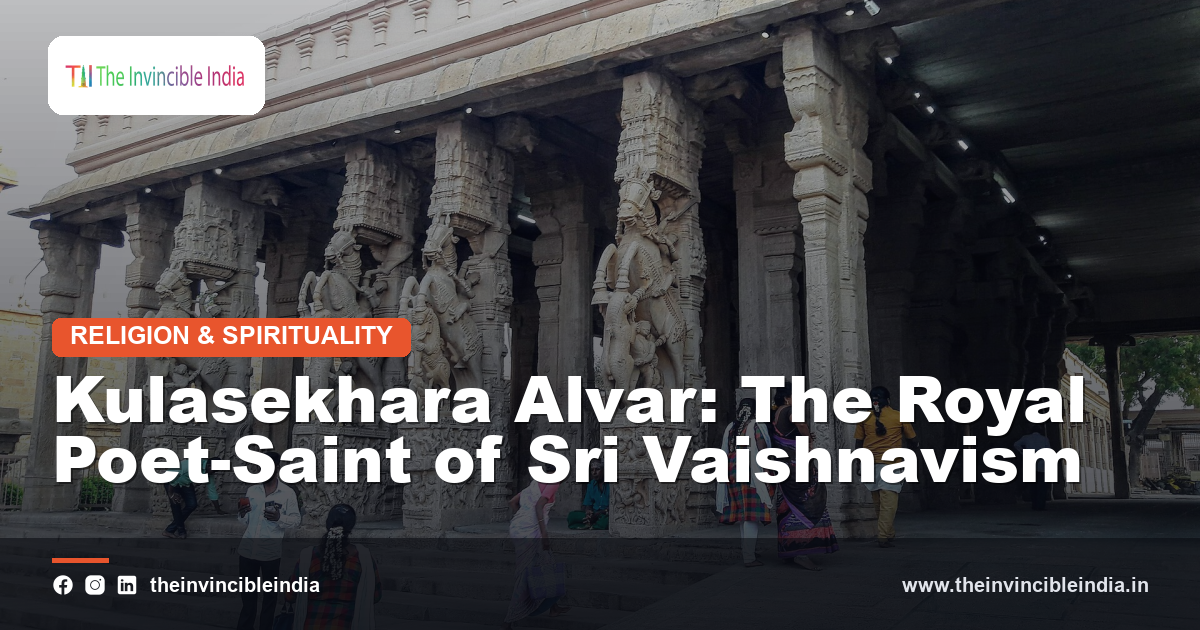
Kulasekhara Alvar, also written Kulashekhara Alwar, Kulasekhara Perumal or Cheraman Perumal in popular memory, is one of the twelve Alvars, the Tamil poet-saints of Vaishnava devotion. Tradition remembers him as a king from the Chera country of present-day Kerala who gave up the comforts of royal life for the love of Vishnu, and who composed the Perumal Tirumozhi in Tamil and the Mukundamala in Sanskrit. His story belongs to the larger tradition of Vaishnavism, in which the Alvars sang the praise of Vishnu in the language of the people and shaped the worship of the great temples of the south.
Quick answer: Kulasekhara Alvar is one of the twelve Alvars, the Tamil poet-saints of Sri Vaishnavism, and is traditionally remembered as a Chera king of Kerala who became a devotee of Vishnu. His Tamil hymns, the Perumal Tirumozhi, are included in the Nalayira Divya Prabandham, and the Sanskrit Mukundamala is attributed to him in tradition. He is especially honoured for verses on Rama, Krishna and the deity of Tirumala.
Key Takeaways
- Kulasekhara Alvar is one of the twelve Alvars, the Tamil poet-saints whose hymns form the Nalayira Divya Prabandham.
- Tradition describes him as a Chera king of Kerala who set aside royal duties for devotion to Vishnu.
- His Tamil work, the Perumal Tirumozhi, is a collection of devotional decads included in the Divya Prabandham.
- The Sanskrit Mukundamala, a prayer to Vishnu, is attributed to him by tradition.
- His verses give special place to Rama, the child Krishna, Srirangam and the Venkata hills of Tirumala.
- Sri Vaishnava tradition celebrates his deep respect for devotees of the Lord, known as bhagavatas.
The sections below explain the life, works, teachings and continuing legacy in more detail.
Quick Facts
| Detail | Information |
|---|---|
| Also known as | Kulashekhara Alwar, Kulasekhara Perumal, Cheraman Perumal |
| Tradition | Sri Vaishnavism (Alvars) |
| Origin (traditional) | Chera country, present-day Kerala |
| Principal work in Tamil | Perumal Tirumozhi |
| Work attributed in Sanskrit | Mukundamala |
| Collection | Nalayira Divya Prabandham |
| Chief deities praised | Vishnu as Ranganatha, Rama, Krishna and Venkatesa |
| Era | Early medieval period (exact dates debated) |
Who Was Kulasekhara Alvar?
Kulasekhara Alvar was a poet-saint of the Tamil Vaishnava tradition and one of the twelve Alvars, the devotees who sang of Vishnu in the centuries before the great Vaishnava teachers. Tradition honours him as a king who found his highest joy in devotion and who gave his poetry to the service of the Lord. He is among the few Alvars described as a ruler.
The details of his life come mostly from the later hagiographies of the Sri Vaishnava community, which blend memory with devotional narrative. Dates, family and political history are not firmly established, and scholars debate how far the saint can be matched with historical rulers. What remains secure in the tradition is the picture of a royal devotee who chose humility and song.
What Is the Meaning of the Word Alvar?
The word Alvar, from Tamil, means one who is immersed in the divine, and it names the twelve poet-saints of Vaishnava devotion in South India. Their hymns, composed in Tamil, praise Vishnu in his many forms and the temples where he is worshipped. They are counted among the foundations of the Sri Vaishnava tradition.
The Alvars came from many backgrounds, including kings, scholars, a woman poet named Andal and wandering devotees. Their combined songs were later gathered into the Nalayira Divya Prabandham, whose name means the four thousand divine compositions. Kulasekhara Alvar is one of this group, and his verses form an important portion of the collection that Vaishnavas still recite in temples and homes.
Where Did Kulasekhara Alvar Live?
Tradition places Kulasekhara Alvar in the Chera country, a region that corresponds to present-day Kerala, with a link to the old capital often named as Tiruvanjikkulam, near Kodungallur. The Chera kingdom was one of the three great Tamil kingdoms of early South India, alongside the Chola and the Pandya. The saint is remembered as a ruler of this land who later travelled to holy places.
His pilgrimages, as the verses and the traditional accounts suggest, took him to the great Vaishnava shrines of the south, including Srirangam and the hills of Venkatam. Because his home region used Malayalam in later centuries, his Tamil verses remind readers of the shared literary world of early South India. The exact geography of his life remains partly traditional.
Was Kulasekhara Alvar Really a King?
Tradition holds that Kulasekhara Alvar was a king of the Chera line, and the name Kulasekhara itself is also a royal name known in the history of Kerala. Some scholars have discussed whether the saint can be identified with a ruler of the later Chera dynasty of Mahodayapuram, but the question is debated and not settled. The devotional tradition does not depend on the answer.
What the tradition does preserve is the memory of a ruler who stood apart from pride of rank. Accounts describe how he turned his attention from kingship to the company of devotees and to the worship of Vishnu. Readers are therefore best advised to take the royal identity as part of the sacred biography while remembering that the historical identification remains open.
What Is the Perumal Tirumozhi?
The Perumal Tirumozhi is the Tamil work of Kulasekhara Alvar, a collection of devotional hymns arranged in groups of ten verses called decads. The title means the sacred words of the Lord, with perumal as a common Tamil name for Vishnu. The work is included in the Nalayira Divya Prabandham and is recited in Sri Vaishnava worship.
The hymns move between several moods, including longing, self-surrender and praise, and they address shrines in different parts of the south. They also retell episodes from the Ramayana and the life of Krishna with unusual tenderness. In this way the Perumal Tirumozhi serves both as a prayer book and as a gallery of devotional portraits of Vishnu in his incarnations.
What Is the Mukundamala?
The Mukundamala is a Sanskrit devotional poem in praise of Vishnu, called Mukunda, which tradition attributes to Kulasekhara Alvar. The word mala means garland, and the work is understood as a garland of verses offered to the Lord. It is widely recited by Vaishnavas and is admired for its simple language and moving prayers for devotion.
Some scholars discuss questions of authorship for Sanskrit works linked to early saints, and the attribution here rests on tradition. Whatever the final judgement, the Mukundamala is honoured as a classic of Sanskrit stotra literature. Its verses ask for steady remembrance of the Lord and for the company of devotees, and they have inspired readers across many Vaishnava traditions.
How Does Kulasekhara Alvar Portray Rama?
Kulasekhara Alvar portrays Rama with deep love and compassion, and a notable portion of the Perumal Tirumozhi retells scenes of the Ramayana. The hymns linger on moments such as the birth of Rama, the sorrow of his parents and the tenderness of the epic’s household. The retelling is through the eyes of those who love him.
This focus on Rama has led the saint to be remembered as especially devoted to the hero of Ayodhya, whom Vaishnavas honour as an avatar of Vishnu. The verses show how the Alvars moved easily between the stories of epic and the personal experience of devotion. Through them, Rama is no distant king but an object of intimate affection, and this warmth remains one of the charms of the work.
What Do His Verses Say About Krishna?
The Perumal Tirumozhi also turns to Krishna and includes verses that dwell on the child Krishna, in keeping with a long devotional tradition of the Alvars. One decad is remembered for giving voice to a mother’s feelings, expressing the longing of Devaki, who was parted from her son. Such passages show the Alvar’s skill in speaking through other voices.
The tradition values these verses because they bring the stories of the Bhagavata and related texts into the world of Tamil devotion. They stand beside the work of other Alvars, such as Periyalvar and Andal, who also sang of Krishna. The shared theme joins the Alvars into one community of song, in which Kulasekhara contributes a note of tenderness and reflection.
What Is the Connection with Srirangam?
Kulasekhara Alvar is closely associated with Srirangam, the great island temple of Ranganatha on the river Kaveri near Tiruchirappalli in Tamil Nadu. Srirangam is counted as the foremost of the 108 Divya Desams, the shrines praised in the hymns of the Alvars. Tradition says the saint sang of Ranganatha with great longing.
The temple is also regarded as the chief seat of Sri Vaishnavism and was later the centre of the teacher Ramanuja’s work. Through his hymns, Kulasekhara Alvar forms part of the long devotional memory of the place. Pilgrims who visit Srirangam recall the Alvars as the earliest singers of its praise, and the saint holds an honoured place among them.
What Is the Kulasekhara Padi at Tirumala?
The Kulasekhara padi is the name given in Tirumala to the sacred threshold step before the sanctum of Lord Venkateswara, which tradition links with the saint. In his hymns on the Venkata hills, the Alvar expresses the wish to be anything at all, even a humble step, in the shrine of the Lord. This humility lies behind the naming of the threshold.
The step, honoured with a tradition of reverence, has led devotees to recall the saint whenever they approach the inner shrine at the Tirumala temple in Andhra Pradesh. The story captures the spirit of his poetry, which prefers service to status. It also shows how the memory of the Alvar has been written into the physical structure of one of the most visited temples in India.
Why Did He Honour Devotees So Highly?
Kulasekhara Alvar honoured devotees highly because the tradition teaches that the company of those who love the Lord is itself a form of worship. His hymns express the wish to be among them and to serve them. This theme runs strongly through the Perumal Tirumozhi and the Mukundamala.
The stress on bhagavatas, or devotees, has made him a model for Sri Vaishnava humility. In stories told in the community, the king is shown to value the assembly of devotees above wealth or power. The emphasis offers a gentle correction to pride and affirms that spiritual standing is measured by love rather than rank, a message that fits the wider social teaching of the Alvars.
How Does the Tradition Describe His Renunciation?
Sri Vaishnava tradition describes Kulasekhara Alvar as a king who gradually turned away from the duties of court and handed over his rule so that he could live for devotion. The accounts present this as a joyful choice and not as a flight from responsibility. His heart, they say, was fixed on the Lord.
As with other hagiographical accounts, the details are part of sacred tradition and vary between sources. The core message is that true greatness lies in surrender and that a ruler can also be a servant. The story is retold in the community because it joins two ideals, the dignity of kingship and the humility of the devotee, in one life.
What Is the Place of the Alvars in Sri Vaishnavism?
The Alvars hold the foundational place in Sri Vaishnavism as the inspired singers whose hymns are treated as the Tamil Veda of the community. Their songs are recited in temple worship and household prayer, and they are honoured through festivals and daily ritual. They are followed by the acharyas, such as Nathamuni and Ramanuja, who organised and taught their message.
The Divya Prabandham joins Tamil literary excellence with religious devotion. Kulasekhara Alvar is one of the twelve whose verses are woven into this fabric. His contribution of royal humility, love of Rama and devotion to the Lord of Tirumala gives the corpus some of its most affectionate and memorable passages.
How Is Kulasekhara Alvar Remembered in Temples?
Kulasekhara Alvar is remembered in temples through shrines, festival days and the recitation of his hymns. In many Vaishnava temples of South India, the Alvars are installed as bronze images in separate sanctums and are brought out in procession during festivals. The saint appears among them with a form that is often shown with folded hands.
His birth star is celebrated in the Tamil month traditionally associated with him, and in Kerala his memory is linked with devotional sites in the Chera land. The ritual remembrance keeps the verses alive in a form that is heard rather than only read. Through such observances the Alvar continues to take part in living worship.
What Can Readers Learn from the Perumal Tirumozhi?
Readers can learn from the Perumal Tirumozhi that devotion is compatible with high responsibility and that humility is the sign of true greatness. The poems invite the reader to see the divine in the stories of Rama and Krishna and in the quiet company of fellow devotees. They also show how poetry can serve as prayer.
The work offers modern readers a gentle, unforced model of faith. It has no argument against other traditions and does not rely on ritual display. It speaks in the plain language of longing, offering and thankfulness. Its appeal rests on this sincerity, which has carried it across many centuries of Tamil devotional life.
Kulasekhara Alvar Today
Kulasekhara Alvar today is honoured by Sri Vaishnavas around the world as a royal saint whose verses continue to be recited in temples and homes. The Perumal Tirumozhi and the Mukundamala are studied, sung and taught, and his name is attached to the sacred step at Tirumala that pilgrims remember. His story is regularly retold at festivals.
For students of Indian religion, he illustrates the range of backgrounds from which the Alvars came and the poetic depth of early Tamil devotion. The accounts of his life are traditional, and respectful readers treat them as sacred narrative that carries real devotional truth. His legacy lives on in the hymns that welcome the devotee to the feet of the Lord.
Sources & Further Reading
- Ministry of Culture, Government of India (indiaculture.gov.in).
- Archaeological Survey of India (asi.nic.in).
Frequently Asked Questions
Who was Kulasekhara Alvar?
Kulasekhara Alvar was one of the twelve Alvars, the Tamil poet-saints of Sri Vaishnavism. Tradition remembers him as a Chera king of Kerala who became a devotee of Vishnu.
What is the Perumal Tirumozhi?
The Perumal Tirumozhi is the collection of Tamil devotional hymns composed by Kulasekhara Alvar. It is included in the Nalayira Divya Prabandham and contains verses on Rama, Krishna and several Vishnu shrines.
What is the Mukundamala?
The Mukundamala is a Sanskrit devotional poem in praise of Vishnu, attributed by tradition to Kulasekhara Alvar. The name means garland of Mukunda, and it is widely recited by Vaishnavas.
What is the Kulasekhara padi at Tirumala?
The Kulasekhara padi is the sacred threshold step at the sanctum of the Tirumala Venkateswara temple, which tradition links with the saint. It recalls his hymn expressing the wish to serve the Lord even as a humble step.
Was Kulasekhara Alvar a real king?
Tradition says Kulasekhara Alvar was a Chera king, but scholars debate whether he can be matched with a historical ruler. The devotional tradition preserves his royal identity as part of his sacred biography.
What is the Nalayira Divya Prabandham?
The Nalayira Divya Prabandham is the collection of about four thousand Tamil hymns of the twelve Alvars, honoured as the Tamil scripture of Sri Vaishnavism. It is recited in temple worship across South India.


