

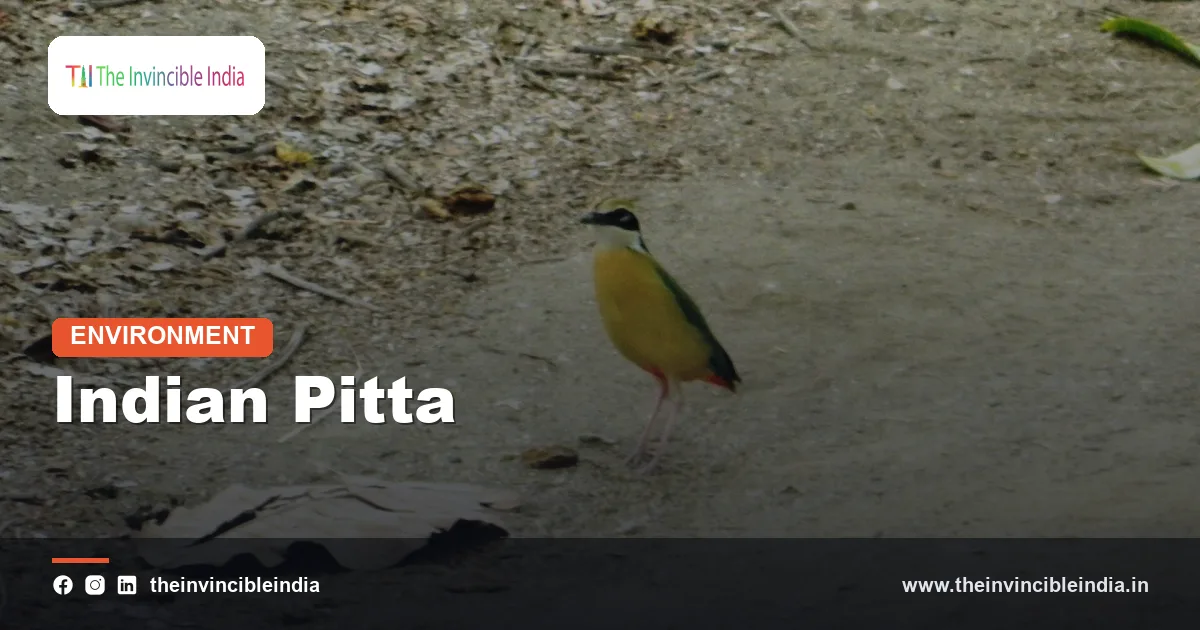
The Indian pitta (Pitta brachyura) is a small, plump, short-tailed ground bird of the Indian subcontinent that is famous for its jewel-like plumage, which has earned it the Hindi name “navrang”, meaning “nine colours”. The Indian pitta spends most of its time hopping through leaf litter in shaded scrub and forest, and it is far more often heard than seen, especially at dawn and dusk when its two-note whistle carries across the woodland.
The Indian pitta is a breeding migrant across much of India: it arrives around the onset of the monsoon, nests close to the ground in a domed structure, and then moves to its wintering areas in the south of the peninsula. This explainer covers the bird’s identification, calls, diet, nesting, movements, habitat, conservation status and the best ways to look for it responsibly.
Quick Facts About the Indian Pitta
| Attribute | Detail |
|---|---|
| Common name | Indian pitta (“navrang” in Hindi; a species distinct from the blue-winged pitta, Pitta moluccensis) |
| Scientific name | Pitta brachyura |
| Family | Pittidae (the pittas) |
| Size | About 16 to 19 cm long, roughly the size of a bulbul but stockier |
| Key features | Very short tail, long legs, black eye-stripe, buff underparts, green back, blue wing patch, red vent |
| Call | A clear two-note whistle, often rendered “wheet-tew”, the source of the nickname “six-o’clock bird” |
| Habitat | Shaded scrub, moist deciduous forest, bamboo thickets and wooded ravines |
| Movement | Partial migrant; breeds across much of India and winters mainly in the south and in Sri Lanka |
| Conservation | Assessed as Least Concern globally by the IUCN, with local pressure from trapping and habitat loss |
Key Takeaways
- The Indian pitta (Pitta brachyura) is a short-tailed, long-legged ground bird of the family Pittidae found across the Indian subcontinent.
- The Hindi name “navrang” refers to the Indian pitta’s combination of green, blue, black, white, buff, red and other colours in a single small bird.
- The Indian pitta is called the “six-o’clock bird” because its two-note whistle is typically heard around dawn and dusk.
- The Indian pitta forages in leaf litter for insects, earthworms and snails, and it can crack snail shells against stones.
- The Indian pitta builds a domed nest of twigs and leaves on or near the ground, usually timed with the monsoon.
- The Indian pitta is a partial migrant, and many individuals move between breeding areas and wintering areas in the south each year.
What Is the Indian Pitta?
The Indian pitta is a passerine bird in the pitta family, Pittidae, whose scientific name is Pitta brachyura. The genus name “Pitta” is generally traced to a Telugu word for a small bird, and the species name “brachyura” means “short-tailed” in Greek-derived scientific Latin.
The pittas are a group of about forty species spread across Africa, Asia and Australasia, and most of them are secretive forest birds that live on the ground. The Indian pitta is one of the few that occurs widely in India and is among the most colourful birds a visitor to Indian woodland is likely to encounter, although encountering one still takes patience.
The family is an old and distinctive one. Pittas are not closely related to the thrushes or babblers they sometimes resemble at a glance. Their long legs, compact bodies and short tails are adaptations to a life spent hopping and bounding across the forest floor, rather than flying through the canopy.
What Does the Indian Pitta Look Like?
The Indian pitta is a stocky bird with a short tail, long pinkish legs, a stout dark bill and a bold head pattern, and it is typically described as having nine colours. The top of the head is buff-brown with a thick black stripe through the eye, while a pale supercilium (eyebrow) runs above it. The throat is white, the underparts are buff to pale cinnamon, and the undertail and belly centre show a patch of bright crimson-red.
The back and wing coverts are a rich green, the rump and a shoulder patch are bright turquoise or cobalt blue, and the wings have white patches that flash conspicuously when the bird flies. The tail is tiny, tipped with blue and green, and is held cocked during hopping.
Why is it called “navrang”?
The name “navrang” is a popular description rather than a strict count. Different observers list the colours slightly differently, but the general idea is that green, blue, black, white, buff, yellow-brown, crimson and related shades all appear on one compact body. The name is also used in other contexts in India, so the bird is sometimes specified as the “navrang” pitta in field guides and local conversations.
Do males and females look different?
Male and female Indian pittas look very similar, which is typical of pittas. The female tends to be slightly duller, and juveniles are paler with less vivid blue and red. Telling the sexes apart in the field is difficult and usually unnecessary for identification.
Why Is the Indian Pitta Called the “Six-O’Clock Bird”?
The Indian pitta is called the “six-o’clock bird” because it often whistles at dawn and again at dusk, close to the hours of six in the morning and six in the evening. The call is a clear, liquid, two-note phrase that is sometimes written “wheet-tew” or “pu-lip”, with the second note slightly lower or sharper depending on the listener’s ear.
Pittas call most readily from a low branch or the ground at the edge of cover, and they often sing in response to one another across a ravine. In the breeding season, calling increases and can continue during the day, especially when clouds gather and the first rains arrive. Because the species is shy, birders frequently locate it by sound before they see it.
Some local names in different Indian languages reflect this habit of calling at set times of day, and in several regions the bird’s arrival is associated with the coming of the monsoon. Such traditions vary from place to place and are better treated as folk observation than strict rules.
What Does the Indian Pitta Eat?
The Indian pitta eats mainly small invertebrates, including insects, ants, beetle larvae, earthworms, centipedes and small land snails, which it picks from leaf litter and moist soil. The bird forages by hopping a few steps, pausing, and then flicking aside dry leaves with its bill to uncover prey.
Pittas have a well-known habit of dealing with snails by carrying them to a hard surface and hammering the shell against a stone or root until it cracks. This “anvil” behaviour is seen in several pitta species. After the monsoon begins, the damp forest floor becomes rich with worms and insects, which supports both feeding and breeding.
- Insects and larvae, especially beetles, ants and termites
- Earthworms drawn up by wet soil
- Small snails, broken open on stones
- Other small invertebrates found in leaf litter
Where Does the Indian Pitta Live in India?
The Indian pitta lives in shaded scrub, bamboo and moist deciduous forest across a broad swathe of India, including the Himalayan foothills, central India, the Eastern and Western Ghats and parts of the peninsula. It prefers places with thick leaf litter, patches of shade and nearby water or damp soil.
The species is often seen in forest edges, hill scrub, ravines, orchards with undergrowth and well-wooded gardens, particularly during migration. It generally avoids open grassland and very dry, bare terrain. In winter, many birds are found in the southern peninsula, and some reach Sri Lanka.
Because the bird is so dependent on leaf litter, healthy undergrowth matters more than the tallest trees. Forests cleared of understorey, or kept too tidy, offer little to a pitta even when the canopy remains.
Does the Indian Pitta Migrate?
Yes, the Indian pitta is a partial migrant, meaning that many individuals move seasonally while others stay in the same area. Birds breeding in northern and central India are generally thought to move south after the breeding season, wintering in peninsular India and Sri Lanka. They return north and west around the onset of the monsoon.
Pittas typically migrate at night, which makes the movement hard to observe. Birders sometimes find exhausted individuals in unusual places, such as lawns, city parks or even beneath lit buildings, during migration periods. The exact routes, timing and numbers are not fully documented, and patterns can differ between regions and years.
When can you see it?
The best time to look for an Indian pitta is usually the pre-monsoon and early monsoon period, when the birds arrive on breeding grounds and call frequently. In the south, wintering birds may be found during the cooler months, although they are quieter. Dates vary across regions, so local knowledge is useful.
How Does the Indian Pitta Breed and Nest?
The Indian pitta builds a loose, domed nest of twigs, grass, leaves and roots, usually on the ground or in a low bush or tree, with a side entrance. The nest is often placed in shady vegetation such as thorny scrub, bamboo clumps or the base of a tree, and it may be lined with finer material.
A typical clutch has four to five eggs, which are white or cream with reddish or purplish speckling, though clutch size can vary. Both parents are involved in raising the young, which are fed on insects and worms. Because the nest is on or near the ground, eggs and chicks are vulnerable to snakes, mongooses, dogs and cats, as well as disturbance from people.
| Stage | Typical pattern |
|---|---|
| Arrival at breeding areas | Around the pre-monsoon and early monsoon period |
| Nest type | Domed, with a side entrance, on or near the ground |
| Clutch | Commonly around four to five eggs |
| Parental care | Both parents feed the chicks |
| Departure | After breeding, birds move toward wintering areas |
How Does the Indian Pitta Differ From Other Pittas in India?
The Indian pitta differs from other Indian pittas mainly in its range, its buff underparts and its particular colour pattern. India has a small number of pitta species, and the commonly cited ones include the Indian pitta, the hooded pitta, the blue pitta and the blue-naped pitta, some of which are restricted to the north-east or other regions.
The hooded pitta, for example, has a black head and a more contrasting appearance, and it occurs mostly in the north-east and parts of the east. The Indian pitta, in contrast, has a striped head and buff underside. Identification in the field is helped by remembering the habitat, the range and the call, in addition to the colours.
- Indian pitta: striped head, buff underparts, widespread across the peninsula and central India
- Hooded pitta: dark hood, found mainly in the north-east and eastern regions
- Other pittas: restricted to forests of the north-east and the Andamans, with differing patterns
Is the Indian Pitta Threatened?
The Indian pitta is assessed as Least Concern by the International Union for Conservation of Nature (IUCN) because it has a wide range, but local populations are believed to face pressure and the overall trend is considered uncertain. The main threats are loss of forest understorey, scrub clearance, collisions with buildings during night migration, predation by free-ranging dogs and cats, and capture for the cage-bird trade.
Wild birds in India are protected under the Wildlife (Protection) Act, 1972, which restricts hunting, capture and trade in native species. Even so, illegal trapping of colourful birds continues in some regions, and the Indian pitta’s bright plumage makes it a target. Population estimates are difficult for a secretive migratory species, so any figure should be treated with caution.
How can people help?
People can help by leaving leaf litter and scrub in gardens and forest patches, keeping cats indoors during migration season, reducing night lighting on tall buildings, and reporting any trapping or sale of wild birds to the forest department. Citizen-science platforms that record bird sightings also help researchers understand migration timing.
How Can You Spot an Indian Pitta Responsibly?
The best way to spot an Indian pitta is to arrive early or stay late in suitable woodland, stand quietly near leaf-littered ground and listen for the two-note whistle. Patience and silence matter more than equipment, although binoculars are a great help in dim light.
- Visit during the pre-monsoon and early monsoon when birds are calling.
- Move slowly and stay on paths, since trampling undergrowth can damage nests.
- Avoid playing recorded calls, which can stress birds during breeding.
- Never approach or photograph a nest closely; give it a wide berth.
- Share sightings on a citizen-science platform without disclosing exact nest locations.
Responsible behaviour is especially important with nesting birds, because pittas will abandon a nest if they are repeatedly disturbed. A good photograph is never worth the loss of a clutch.
Bottom Line
The Indian pitta is one of India’s most striking small birds: a short-tailed, nine-coloured forager of leaf litter whose dawn and dusk whistle gives it the name “six-o’clock bird”. It breeds with the monsoon, migrates at night and relies on healthy forest understorey, which makes protecting scrub and woodland the surest way to protect the species.
Frequently Asked Questions
What is an Indian pitta?
The Indian pitta is a small, colourful ground-dwelling bird, Pitta brachyura, found across the Indian subcontinent. It has a short tail, long legs, a black eye-stripe, a green back, blue wing patches and a red vent. It belongs to the pitta family, Pittidae.
Why is the Indian pitta called navrang?
The Indian pitta is called “navrang”, meaning “nine colours”, because its small body combines many bright shades, including green, blue, black, white, buff and crimson. The number nine is a popular description rather than an exact count. The name highlights how unusually vivid the bird is among Indian woodland species.
Why is it called the six-o’clock bird?
The Indian pitta is called the six-o’clock bird because it tends to whistle at dawn and dusk, around six o’clock in the morning and evening. Its call is a clear two-note phrase often written “wheet-tew”. Calling increases in the breeding season, especially around the arrival of the monsoon.
Is the Indian pitta a migratory bird?
Yes, the Indian pitta is a partial migrant in India. Many birds that breed in northern and central regions move south in the cooler months and return around the start of the monsoon. Exact routes and numbers are not fully documented, and movements vary by region and year.
What does the Indian pitta eat?
The Indian pitta eats mostly insects, ants, larvae, earthworms and small snails found in leaf litter. It flicks aside dry leaves to uncover prey and may crack snail shells against stones. Its diet depends on a moist, undisturbed forest floor.
Is the Indian pitta endangered?
No, the Indian pitta is currently assessed as Least Concern by the IUCN, because it has a wide range. However, local pressures such as loss of understorey, night-time collisions with buildings and illegal trapping can affect it. Native birds in India are legally protected under the Wildlife (Protection) Act, 1972.
{“@context”:”https://schema.org”,”@graph”:[{“@type”:”FAQPage”,”mainEntity”:[{“@type”:”Question”,”name”:”What is an Indian pitta?”,”acceptedAnswer”:{“@type”:”Answer”,”text”:”The Indian pitta is a small, colourful ground-dwelling bird, Pitta brachyura, found across the Indian subcontinent. It has a short tail, long legs, a black eye-stripe, a green back, blue wing patches and a red vent. It belongs to the pitta family, Pittidae.”}},{“@type”:”Question”,”name”:”Why is the Indian pitta called navrang?”,”acceptedAnswer”:{“@type”:”Answer”,”text”:”The Indian pitta is called “navrang”, meaning “nine colours”, because its small body combines many bright shades, including green, blue, black, white, buff and crimson. The number nine is a popular description rather than an exact count. The name highlights how unusually vivid the bird is among Indian woodland species.”}},{“@type”:”Question”,”name”:”Why is it called the six-o’clock bird?”,”acceptedAnswer”:{“@type”:”Answer”,”text”:”The Indian pitta is called the six-o’clock bird because it tends to whistle at dawn and dusk, around six o’clock in the morning and evening. Its call is a clear two-note phrase often written “wheet-tew”. Calling increases in the breeding season, especially around the arrival of the monsoon.”}},{“@type”:”Question”,”name”:”Is the Indian pitta a migratory bird?”,”acceptedAnswer”:{“@type”:”Answer”,”text”:”Yes, the Indian pitta is a partial migrant in India. Many birds that breed in northern and central regions move south in the cooler months and return around the start of the monsoon. Exact routes and numbers are not fully documented, and movements vary by region and year.”}},{“@type”:”Question”,”name”:”What does the Indian pitta eat?”,”acceptedAnswer”:{“@type”:”Answer”,”text”:”The Indian pitta eats mostly insects, ants, larvae, earthworms and small snails found in leaf litter. It flicks aside dry leaves to uncover prey and may crack snail shells against stones. Its diet depends on a moist, undisturbed forest floor.”}},{“@type”:”Question”,”name”:”Is the Indian pitta endangered?”,”acceptedAnswer”:{“@type”:”Answer”,”text”:”No, the Indian pitta is currently assessed as Least Concern by the IUCN, because it has a wide range. However, local pressures such as loss of understorey, night-time collisions with buildings and illegal trapping can affect it. Native birds in India are legally protected under the Wildlife (Protection) Act, 1972.”}}]}]}


