

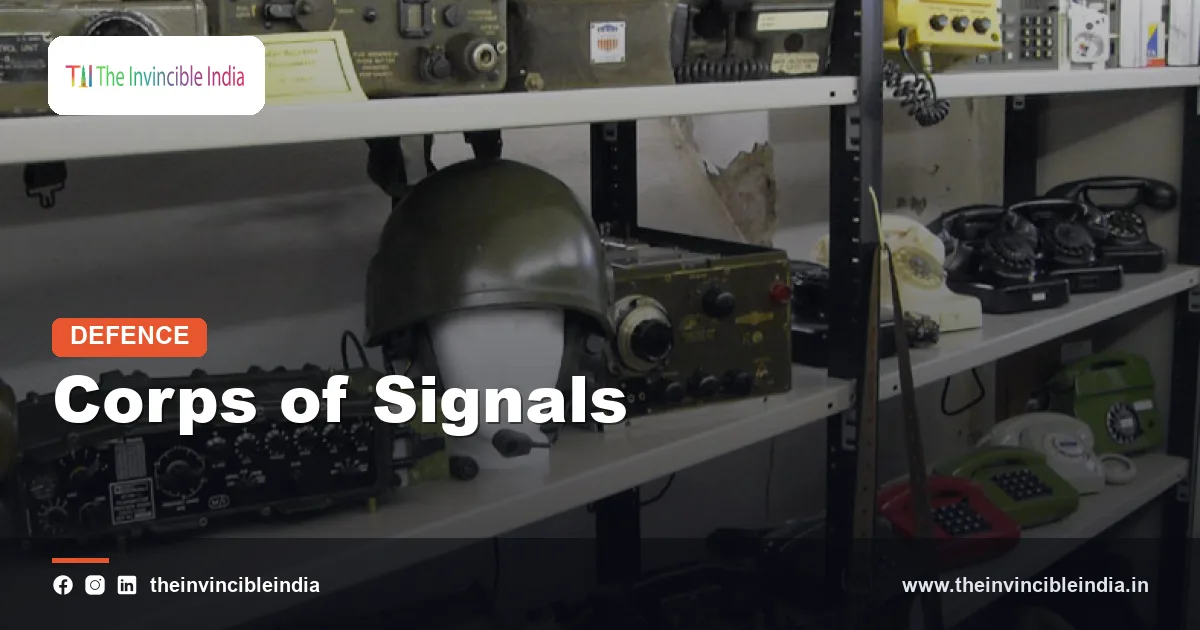
The Corps of Signals is the arm of the Indian Army responsible for providing communications and information systems to commanders at every level, from the infantry battalion in the mountains to the Army Headquarters in New Delhi. Tracing its origins to 1911 and bearing the motto “Teevra Chaukas”, meaning swift and alert, the Corps ensures that orders, intelligence and situational pictures travel securely across the battlefield and beyond.
Modern warfare depends on the ability to see, decide and act faster than an adversary, and all three depend on communications. This explainer describes the history of the Corps of Signals, its structure, its training institutions, the technologies it manages, and its expanding responsibilities in electronic warfare, cyber security and network-centric operations. It uses only well-established public information.
Quick Facts
| Item | Detail |
|---|---|
| Arm of the Army | Combat support arm (communications and information systems) |
| Origins | 1911, with the formation of signal units for the Indian Army |
| Motto | “Teevra Chaukas” (Swift and Alert) |
| Head of the Corps | Signal Officer-in-Chief at Army Headquarters |
| Key training institution | Military College of Telecommunication Engineering, Mhow |
| Corps training centre | Signal Training Centre, Jabalpur |
| Core tasks | Command and control communications, secure networks, electronic warfare and cyber support |
| Well-known display team | The Corps of Signals motorcycle team, the “Daredevils” |
Origins and Early History of the Corps of Signals
Military signalling is as old as armies, from drums and flags to heliograph mirrors and runners. In the British Indian Army, signalling was originally the responsibility of engineers, and signal sections were part of the Sappers and Miners. As telegraph, telephone and wireless matured in the early twentieth century, specialised units were needed, and in 1911 the first dedicated signal units were formed for the Indian Army.
From signal companies to a Corps
During the First World War, Indian signal units served in Mesopotamia, France, Egypt and other theatres, running telephone lines, wireless sets and visual signalling in demanding conditions. After the war, the signal units were consolidated into a separate corps. In the interwar years it became the Royal Indian Corps of Signals, a name it kept until Independence, when the prefix was dropped and it became the Corps of Signals of the Indian Army.
The Second World War
The Second World War brought rapid growth. Indian signallers supported the campaigns in North Africa, Italy, Burma and the Middle East, and the Corps expanded greatly in strength and technical depth. Experience with wireless sets, cipher systems and signal intelligence set the foundation for the post-war Corps.
Role in the Army’s Command and Control
Command and control is the process by which commanders gather information, take decisions and issue orders. The Corps of Signals builds and operates the communication systems that make this possible. Without reliable links, the best plans cannot be executed, and without secure links, they can be compromised.
Layers of communication
- Strategic communications: Long-distance backbone networks linking Army Headquarters, Commands and Corps, often over optical fibre, microwave and satellite links.
- Operational communications: Links between Corps, Divisions and Brigades, providing voice, data and video services.
- Tactical communications: Combat net radios and field networks supporting battalions, companies and sub-units on the move.
- Static communications: Secure fixed networks serving cantonments, installations and headquarters.
Signal units in the field
Every formation of the Army, from the brigade upwards, has a signal element attached to it. Signal regiments and companies establish command posts, run radio relays on mountain peaks and lay cables across deserts and jungles. The signaller is therefore present wherever the Army operates, and often among the first to arrive and the last to leave.
Organisation and Insignia
The Corps is headed by the Signal Officer-in-Chief, a senior officer at Army Headquarters who is responsible for the policy, planning and development of signal communications for the whole Army. Signal units and sub-units are spread across commands, corps and divisions, in addition to specialised signal regiments for particular roles.
Types of units
- Corps, division and brigade signal regiments and companies: The workhorses providing communications to formations.
- Radio and line units: Teams responsible for wireless sets, antenna systems and cable networks.
- Signal intelligence and electronic warfare units: Specialist units to intercept, analyse and jam electronic signals.
- Satellite and microwave units: Teams that operate satellite terminals and long-haul links.
- Cipher and security units: Teams that safeguard cryptographic material and secure communications.
Badge and motto
The Corps’ cap badge features the figure of Mercury, the winged messenger of the gods in Roman mythology, a fitting symbol for an arm devoted to carrying messages. The motto “Teevra Chaukas” captures the two qualities demanded of every signaller: speed and alertness. Corps colours are traditionally associated with the arms’ technical character and are seen on parades and formal occasions.
Training Institutions
The Corps of Signals invests heavily in training because communications technology changes rapidly. Its institutions train soldiers and officers not only for the Army but for other services and friendly foreign countries as well.
Military College of Telecommunication Engineering
The Military College of Telecommunication Engineering at Mhow in Madhya Pradesh is the premier technical institution of the Corps. It trains officers in telecommunication, electronics, information technology and cyber security, awarding engineering degrees through affiliated universities, and offers courses for officers of the three services and allied nations. The college has been closely associated with the introduction of information technology in the Army.
Signal Training Centre
The Signal Training Centre at Jabalpur trains recruits and non-commissioned ranks, providing the basic military and technical instruction that every signaller needs. The Signal Records office, also located at Jabalpur, manages the personnel records of the Corps and its regimental traditions.
Other schools
Specialised courses are also run at other establishments for subjects such as satellite communications, radar interfaces, cipher systems and network management. Officers of the Corps also attend general staff colleges, serving in command and staff appointments with the rest of the Army.
Technology: From Field Telephone to Network-Centric Systems
The equipment of the Corps has changed enormously. A century ago, soldiers carried field telephones, heliographs and signal flags. Today they manage digital radios, satellite terminals and software-defined networks.
| Era | Typical means |
|---|---|
| Early twentieth century | Flags, heliographs, field telephones, telegraph lines |
| Mid-century | HF and VHF radio sets, teleprinters, line communications |
| Late twentieth century | Microwave links, tropospheric scatter, automatic switched networks |
| Early twenty-first century | Optical fibre backbones, satellite links, digital combat net radios, secure data networks |
| Present and emerging | Software-defined radios, secure cloud and mobile networks, cyber defence, space-based and AI-assisted systems |
Army networks
The Army operates dedicated networks that allow secure voice, data and video communication across the country. Static switched communications networks link cantonments and installations, while the Army Wide Area Network and related systems carry data. The Corps also manages the radio and satellite links that connect remote forward posts to the national grid.
Electronic Warfare and Signal Intelligence
Electronic warfare is the contest for control of the electromagnetic spectrum. The Corps of Signals has long been involved in signal intelligence, the interception and analysis of enemy communications, and in electronic countermeasures such as jamming and deception. These roles allow commanders to understand an adversary’s intentions while denying the same advantage to the other side.
Three parts of electronic warfare
- Electronic support: Detecting, locating and identifying enemy emissions.
- Electronic attack: Jamming or deceiving enemy radars and communications.
- Electronic protection: Shielding own systems from such attacks, using frequency hopping, encryption and spectrum management.
Spectrum management
A less visible task is managing the frequencies used by the Army in cooperation with national authorities, so that thousands of radios operating in close proximity do not interfere with one another. In a modern force, spectrum is a vital resource that must be planned and defended.
Cyber Security and Information Warfare
As the Army digitised, cyber security became a vital task. The Corps of Signals is responsible for the integrity of Army networks, defending them from hacking, malware and espionage. Its officers are trained in network security, cryptography, digital forensics and incident response.
Why cyber matters to the Army
Modern armies rely on connected sensors, logistics systems, drones and command software, and any of these may be targeted through the network. Cyber defence therefore forms part of the broader notion of information warfare, which includes electronic warfare, psychological operations and the protection of information. India has established tri-service structures, such as the Defence Cyber Agency, to coordinate cyber capabilities across the armed forces, and the Corps works within this larger architecture.
Secure communications and cryptography
Encryption of voice and data remains central. The Corps manages the distribution of cryptographic equipment and keys, trains personnel in secure practices and monitors networks for violations. Indigenous development of secure radios and encryption devices with the Defence Research and Development Organisation and public and private industry is a continuing priority.
Network-Centric Operations and Modernisation
Network-centric warfare means linking sensors, decision makers and shooters in a shared network so that information flows quickly and accurately. The Corps of Signals is at the heart of this transformation in the Army.
Key elements
- Tactical command, control, communications and information systems: Digital networks designed for formations in forward areas.
- Battlefield surveillance integration: Combining inputs from radars, unmanned aerial vehicles and ground sensors.
- Satellite communications: Using military and civil satellites, including dedicated defence communication satellites, to reach remote areas.
- Software-defined radios: Flexible radios able to change frequencies and waveforms through software.
- Interoperability: Linking Army systems with those of the Air Force and Navy to support joint operations.
Indigenisation
Self-reliance has become an important goal. Over the years, the Army has encouraged Indian firms, start-ups and defence laboratories to develop communication equipment. This lowers dependence on imports, allows customisation and improves supply security in time of conflict.
Operations, Disaster Relief and Peacekeeping
The Corps has served in every major operation of the Indian Army since Independence, from Jammu and Kashmir in 1947-48 to the wars of 1962, 1965, 1971 and 1999. Its signallers work in high-altitude regions such as Siachen and Ladakh, in deserts of Rajasthan and in the dense forests of the north-east, laying communication lines where no civil infrastructure exists.
Peacetime responsibilities
In peacetime, Signals units support exercises, help establish communications during natural disasters such as floods, earthquakes and cyclones, and restore links when civil networks are knocked out. The Corps has also contributed personnel to United Nations peacekeeping missions, where signal units provide communications for mission headquarters and contingents.
Gallantry and sports
Men and women of the Corps have earned gallantry and distinguished service awards over the years. The Corps is also known for adventure and sporting activities, including the celebrated motorcycle display team, the Daredevils, whose acrobatic performances at Republic Day and other events have long been admired by the public.
Careers, Women in the Corps and Future Challenges
Officers of the Corps are commissioned through the National Defence Academy, the Indian Military Academy and the Officers Training Academy, among other entries, and many of them receive advanced technical education. Other ranks join through the recruitment process of the Army and are trained as operators, technicians and cryptographers. Women officers are commissioned in the Corps and serve in technical and staff appointments.
Challenges ahead
- Protecting networks from sophisticated cyber attacks and electronic interference.
- Ensuring communications in contested environments where satellites or links may be denied.
- Integrating artificial intelligence, drones and sensors into Army networks.
- Recruiting and retaining highly skilled technical personnel.
- Maintaining resilient communications across extremely varied terrain and climate.
The nature of the Corps’ work means that it must anticipate technological change rather than follow it.
Conclusion
The Corps of Signals is the nervous system of the Indian Army. From simple signal flags in 1911 to secure, network-centric digital systems today, it has evolved with each technological wave while keeping to its motto of swiftness and alertness. As electronic warfare, cyber operations and joint integration become ever more important, the role of this arm in India’s defence is likely to grow further.
Frequently Asked Questions
When was the Corps of Signals raised?
The Corps of Signals traces its origins to 1911, when dedicated signal units were formed in the Indian Army. It became a separate corps after the First World War and was known as the Royal Indian Corps of Signals until Independence.
What is the motto of the Corps of Signals?
The motto is “Teevra Chaukas”, which means swift and alert. It reflects the need for signallers to pass messages quickly and remain vigilant at all times.
What does the Corps of Signals do?
It provides communications and information systems to the Army at every level. This includes command and control networks, secure voice and data links, satellite communications, electronic warfare and signal intelligence, and cyber defence of Army networks.
Where are Signals personnel trained?
Officers and technicians are trained at the Military College of Telecommunication Engineering in Mhow, while recruits and non-commissioned ranks are trained at the Signal Training Centre in Jabalpur. The Corps also uses other specialist schools.
Who heads the Corps of Signals?
The Signal Officer-in-Chief at Army Headquarters heads the Corps and is responsible for the policy and development of Army communications. Day-to-day work is carried out by signal units attached to commands, corps, divisions and brigades.
What is the Daredevils team?
The Daredevils is the motorcycle display team of the Corps of Signals. It is known for acrobatic stunts performed on motorcycles at events such as Republic Day celebrations.
{“@context”:”https://schema.org”,”@graph”:[{“@type”:”FAQPage”,”mainEntity”:[{“@type”:”Question”,”name”:”When was the Corps of Signals raised?”,”acceptedAnswer”:{“@type”:”Answer”,”text”:”The Corps of Signals traces its origins to 1911, when dedicated signal units were formed in the Indian Army. It became a separate corps after the First World War and was known as the Royal Indian Corps of Signals until Independence.”}},{“@type”:”Question”,”name”:”What is the motto of the Corps of Signals?”,”acceptedAnswer”:{“@type”:”Answer”,”text”:”The motto is “Teevra Chaukas”, which means swift and alert. It reflects the need for signallers to pass messages quickly and remain vigilant at all times.”}},{“@type”:”Question”,”name”:”What does the Corps of Signals do?”,”acceptedAnswer”:{“@type”:”Answer”,”text”:”It provides communications and information systems to the Army at every level. This includes command and control networks, secure voice and data links, satellite communications, electronic warfare and signal intelligence, and cyber defence of Army networks.”}},{“@type”:”Question”,”name”:”Where are Signals personnel trained?”,”acceptedAnswer”:{“@type”:”Answer”,”text”:”Officers and technicians are trained at the Military College of Telecommunication Engineering in Mhow, while recruits and non-commissioned ranks are trained at the Signal Training Centre in Jabalpur. The Corps also uses other specialist schools.”}},{“@type”:”Question”,”name”:”Who heads the Corps of Signals?”,”acceptedAnswer”:{“@type”:”Answer”,”text”:”The Signal Officer-in-Chief at Army Headquarters heads the Corps and is responsible for the policy and development of Army communications. Day-to-day work is carried out by signal units attached to commands, corps, divisions and brigades.”}},{“@type”:”Question”,”name”:”What is the Daredevils team?”,”acceptedAnswer”:{“@type”:”Answer”,”text”:”The Daredevils is the motorcycle display team of the Corps of Signals. It is known for acrobatic stunts performed on motorcycles at events such as Republic Day celebrations.”}}]}]}


