

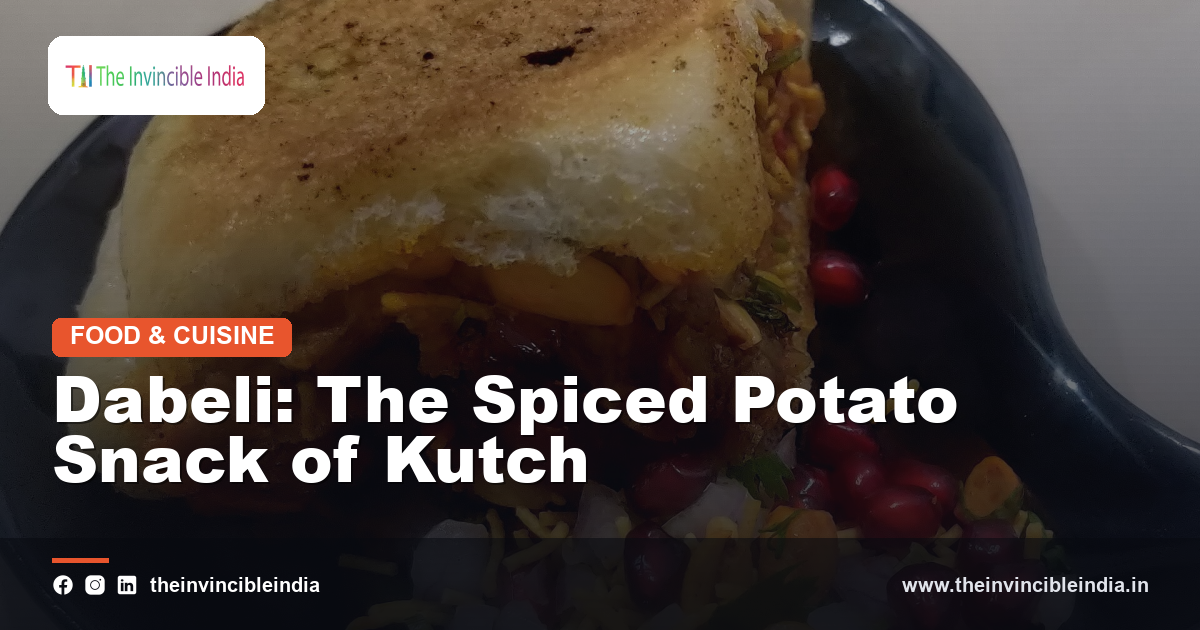
Dabeli is one of the most popular street snacks of western India, a soft bun filled with a sweet, tangy and mildly spicy potato mixture, finished with chutneys, roasted peanuts and fine sev, and lightly toasted in butter. Traditionally associated with Kutch in Gujarat, it is often called Kutchi dabeli and is widely regarded as the Gujarati answer to the burger, though its flavours are entirely its own. The word dabeli is commonly understood to refer to the pressing of the filling into the bun. Among the many treats described in the guide to Indian namkeen and snacks, it stands out for its balance of sweetness, spice and crunch.
Quick Facts
| Detail | Information |
|---|---|
| Type | Stuffed bun street snack |
| Region | Kutch, Gujarat |
| Filling | Spiced mashed potato with dabeli masala |
| Bread | Soft pav, toasted in butter |
| Toppings | Peanuts, sev, pomegranate and coriander |
| Flavour | Sweet, tangy and mildly spicy |
What Dabeli Is
Dabeli is a street snack made by filling a small, soft bun with a seasoned mixture of mashed potato, then dressing it with sweet and spicy chutneys and a generous coating of roasted peanuts, sev and pomegranate seeds. The bun is typically toasted on a griddle with butter, which gives it a golden, slightly crisp surface while keeping the inside soft. Each bite delivers a combination of sweet, sour, salty, spicy and crunchy sensations, which is the secret of its wide appeal. The snack is compact and easy to eat by hand, making it ideal for quick refreshment. Dabeli is therefore a model of the Indian street-food principle, in which a simple filling and a few clever toppings create a complex and memorable taste.
Kutch and Its Culinary Setting
Kutch is a large and distinctive district in western Gujarat, known for its salt desert, its vivid crafts and its long history as a crossroads of trade and migration. Its food reflects this heritage, combining Gujarati vegetarian traditions with influences from neighbouring Sindh, Rajasthan and the coast. The region’s dry climate encouraged the use of preserved and dried ingredients, and a fondness for sweet and spicy flavours existing side by side. The town of Mandvi, on the Kutch coast, is traditionally named as the home of dabeli. The snack grew out of a cultural environment accustomed to mixing flavours boldly and creatively. Kutch is thus the natural birthplace of a snack whose charm lies in its blend of contrasting tastes.
The Origins of Dabeli
Dabeli is traditionally traced to the town of Mandvi in Kutch, where a local street vendor is credited in popular accounts with devising the snack in the middle of the twentieth century. The details of the story vary in the telling, and it should be regarded as a locally cherished account rather than a formally documented history. What is generally agreed is that the snack began as a modest local specialty sold from a cart and was gradually taken up by other vendors in Kutch before spreading across Gujarat and beyond. Its rapid rise suggests that it met a real appetite for an inexpensive, flavourful and filling snack. The origin of dabeli is therefore a story of local creativity that grew into a regional institution.
The Meaning of the Name
The word dabeli is commonly explained as coming from a term meaning pressed or pressed together, a reference to the way the filling is pressed into the bun before it is toasted. Some also link the name to the idea of a pressed or compressed snack that is quickly assembled and quickly eaten. As with many food names, the precise derivation is more a matter of tradition than of firm scholarship. The name, however it arose, suits a snack in which the stuffing is firmly pressed between the halves of the bread to produce a compact and satisfying bite. In Kutch the snack is also known as kachchhi dabeli, tying it explicitly to its home region. The name thus echoes both the method and the place.
The Potato Filling
At the centre of every dabeli is a filling of boiled and mashed potato, cooked in a little oil or butter with a special spice blend, a touch of sweetness and often a hint of tamarind or dates. The mixture is cooked briefly so that the flavours blend and the texture becomes soft but not entirely smooth, retaining some body. It is typically seasoned with salt and finished with chopped coriander. The potato provides a neutral and comforting base that carries the bold seasoning, much as in other beloved Indian snacks. A carefully made filling is moist, aromatic and balanced between sweet and spicy. The potato is therefore the humble foundation upon which the whole snack is built.
Dabeli Masala
The signature flavour of the snack comes from dabeli masala, a ready-ground spice blend that is made in the region and prepared by each cook according to a closely guarded recipe. It commonly includes coriander, cumin, fennel, red chilli, cloves, cinnamon and other warm spices, sometimes with dried coconut, and has a sweet, aromatic and mildly hot character that distinguishes it from other Indian spice mixes. Dabeli masala is sold in packets across Gujarat and elsewhere, making it possible to prepare the snack at home. The blend is largely responsible for the distinctive taste that is immediately recognisable to those who know the snack. It also shows how a single masala can define a dish, a theme explored in the guide to Indian spices.
Sweet and Tangy Chutneys
Two chutneys are typically spread inside the bun, the first a sweet and tangy preparation of tamarind and dates, and the second a fiery red chutney made from garlic and dried red chilli. The sweet chutney tempers the heat of the filling and adds a fruity depth, while the garlic chutney introduces a sharp, spicy edge. Together they create the interplay of sweet and hot that is characteristic of the snack. The proportion of each can be adjusted to suit the eater, allowing a gentler or a spicier result. The skilful use of chutney is one of the marks of an excellent dabeli. These sauces demonstrate how contrast and balance lie at the heart of the dish.
Peanuts, Sev and Pomegranate
The toppings of dabeli provide the texture and freshness that lift the snack above a simple stuffed bun. Roasted, salted peanuts bring crunch and a nutty flavour, fine sev, made from gram flour, adds a crisp, savoury layer, and pomegranate seeds give bursts of juicy sweetness and a jewel-like colour. Chopped coriander contributes freshness, and some cooks add grated coconut or finely chopped onion. The bun is rolled in these toppings so that they cling to its buttery edges. The result is a snack that pleases the eye as much as the palate. The toppings complete the dabeli by supplying the contrasts in texture that the soft filling and bun otherwise lack.
The Pav and the Toasting
The bread used for dabeli is a small, soft bun of the kind known as pav, a product of the Portuguese-influenced baking tradition of western India that has become integral to the region’s street food. The bun is slit open, filled and pressed, then toasted on a hot griddle with butter until its surfaces become golden and slightly crisp. This final toasting is crucial, as it adds warmth, a pleasant aroma of butter and a contrast between the crisp crust and the soft interior. A dabeli served without toasting would lack much of its appeal. The pav, finished on the griddle, thus brings the whole creation together into a neat, hot and fragrant package.
Assembling a Dabeli
The assembly of dabeli is quick and almost choreographed in the hands of an experienced vendor. A bun is split, spread with the two chutneys, filled with a generous spoonful of the potato mixture and topped with peanuts, pomegranate and sev, and the halves are pressed together. The filled bun is then toasted briefly on a buttered griddle, turned once, and finally rolled in sev or peanuts before being handed over, usually on a paper plate or in a piece of paper. The whole process takes only a few minutes, which is part of the snack’s charm as fast food. Watching a skilled vendor assemble dabeli is a small performance. The assembly is as much a part of the experience as the eating.
Dabeli as Street Food
Dabeli is above all a street snack, sold from carts, stalls and small shops in the evenings and at festivals in towns across Gujarat. Its low price, portability and satisfying taste make it a favourite of students, workers and families alike, and many cities have well-known dabeli stalls that draw loyal crowds. It is often eaten alongside other Gujarati street treats such as fafda, khaman and the many varieties of chaat. The snack fits easily into the Indian habit of casual eating on the move, and its popularity shows how street food fulfils a social as well as a nutritional role. Dabeli is thus a symbol of the lively street culture of western India.
The Gujarati Palate
Dabeli reflects the Gujarati palate, which is famous for its fondness for a balance of sweet and savoury flavours, evident in dishes ranging from sweetened dal to jaggery-laced vegetables. The snack’s blend of sugar-laced chutney and fiery spice mirrors this inclination, delivering contrast without extremes. It also reflects the strong vegetarian orientation of Gujarat, since the snack contains no meat or egg and relies on potatoes, nuts and chutneys for its substance. This agreement with local taste helps to explain why dabeli has become so firmly established in the region. Through its flavours, the dabeli expresses Gujarati culinary character in a compact and accessible form.
Variations and Modern Twists
While the traditional dabeli follows a fixed pattern, vendors and home cooks have devised numerous variations, among them cheese dabeli, with grated cheese melted into the filling, as well as versions with added vegetables, paneer or sweet corn. Some cooks serve it as a platter, with the filling presented alongside toasted pav, or turn it into miniature bites for parties. Fusion adaptations, such as dabeli pizzas and rolls, have also appeared in restaurants. Opinions differ on whether such inventions improve the original, yet they confirm the snack’s popularity and flexibility. The willingness to experiment shows that dabeli has become part of the shared culinary vocabulary of modern India, adaptable to many tastes.
Making Dabeli at Home
Dabeli is a popular snack to make at home, especially because ready-made dabeli masala is easy to find and the other components are simple to prepare. Cooks boil and mash potatoes, mix them with the masala and a sweet chutney, prepare the garlic chutney and toast the buns with butter. The preparation can be done in stages, and the filling and chutneys keep well, so that the snack can be assembled quickly when guests arrive. Home versions allow cooks to adjust sweetness and heat and to experiment with healthier ingredients. The ease of preparation has helped dabeli enter family kitchens throughout India. At home, the snack becomes a friendly way to bring the flavours of Kutch to any table.
Dabeli Today
Today dabeli is enjoyed throughout India and in Indian communities around the world, served in street stalls, snack chains and restaurants, and prepared at home on festive and relaxed occasions. It has become one of the most recognisable street foods of Gujarat and a proud symbol of Kutch, with the town of Mandvi still associated with its beginnings. The snack’s combination of sweetness, spice and crunch continues to delight new generations, while the ready availability of dabeli masala has carried its flavours to distant kitchens. Dabeli today demonstrates how a modest local snack, born of simple ingredients and creative flair, can capture the imagination of an entire country.
Sources & Further Reading
- Ministry of Tourism, Government of India, on the cuisines of India (tourism.gov.in).
- Ministry of Culture, Government of India (indiaculture.gov.in).
Frequently Asked Questions
What is dabeli?
Dabeli is a street snack from Kutch in Gujarat made of a soft bun filled with a spiced mashed-potato mixture, sweet and spicy chutneys, roasted peanuts and sev. It is toasted in butter before serving.
What does the word dabeli mean?
The name is commonly explained as referring to something pressed, describing how the filling is pressed into the bun before toasting. The exact derivation is a matter of tradition.
What is dabeli masala?
Dabeli masala is a sweet and aromatic spice blend that commonly includes coriander, cumin, fennel, red chilli, cloves and cinnamon. It gives the potato filling its distinctive flavour.
Where did dabeli originate?
Dabeli is traditionally traced to the town of Mandvi in Kutch, Gujarat, where a local street vendor is credited in popular accounts with creating it. Details of the story vary and are part of local lore.
Is dabeli vegetarian?
Yes, traditional dabeli is entirely vegetarian, made from potatoes, chutneys, peanuts, sev and pomegranate. It reflects the strongly vegetarian food culture of Gujarat.


