

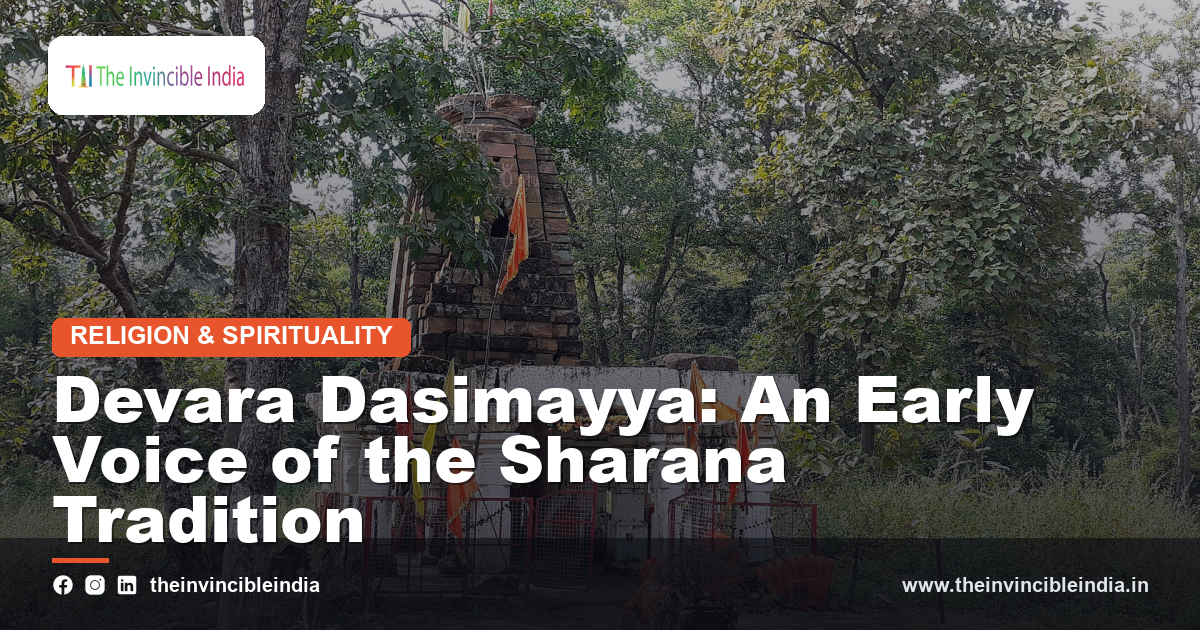
Devara Dasimayya, also called Jedara Dasimayya, Dasimayya of Mudanur or Dasayya, is a Kannada poet-saint honoured as one of the earliest voices of the vachana tradition and of the wider Sharana movement of Shiva devotion in Karnataka. He is remembered for short prose-poems, called vachanas, which carry the signature name Ramanatha, and tradition places him before the better-known Basavanna of the twelfth century. His dates are not firmly established, and many stories about him are tradition. His thought belongs to the broader stream of Shiva worship described in the guide to Shaivism.
Quick answer: Devara Dasimayya is a Kannada poet-saint of the Sharana tradition, traditionally regarded as one of the earliest writers of vachanas, which are short devotional prose-poems in Kannada. He is called Jedara Dasimayya because tradition describes him as a weaver, and his verses carry the signature name Ramanatha. He is usually placed before Basavanna, though exact dates are not firmly documented.
Key Takeaways
- Devara Dasimayya, also called Jedara Dasimayya, is a Kannada poet-saint of the Sharana tradition of Shiva devotion.
- He is traditionally regarded as one of the earliest writers of vachanas, the short prose-poems of Kannada devotional literature.
- The word Jedara means weaver, and tradition describes him as following the weaver’s craft.
- His vachanas end with the signature name Ramanatha, which he used to address the Lord.
- He is generally placed before Basavanna and the great Sharana gathering of the twelfth century, but exact dates are not firmly documented.
- Many details of his life are tradition and legend, and the relation of the Sharana tradition to wider Hinduism is understood differently by different communities.
The sections below explain the life, works, teachings and continuing legacy in more detail.
Quick Facts
| Detail | Information |
|---|---|
| Also known as | Jedara Dasimayya, Dasimayya of Mudanur, Dasayya |
| Tradition | Sharana tradition of Shiva devotion in Karnataka |
| Language | Kannada |
| Form | Vachana, short devotional prose-poem |
| Signature name | Ramanatha |
| Traditional occupation | Weaver, as the name Jedara suggests |
| Region | Karnataka, with Mudanur linked by tradition |
| Era | Early period before Basavanna, exact dates not firmly documented |
Who Was Devara Dasimayya?
Devara Dasimayya was a Kannada poet and devotee of Shiva who is regarded as one of the earliest writers of vachanas and as a forerunner of the great Sharana movement of the twelfth century. His name is spoken with respect among the followers of the Sharana tradition and among students of Kannada literature, where he is remembered as a pioneer of a new kind of devotional writing.
Little is known of his life from documents, and the surviving picture comes from tradition and from the vachanas attributed to him. For this reason respectful readers describe him as a poet-saint of tradition. His importance rests on the verses and on the place he holds as an early voice in a movement that shaped Kannada culture.
What Do the Names Devara and Jedara Mean?
The word Devara means of God or belonging to God, and it is used as an honorific before the name Dasimayya, while Jedara means weaver in Kannada and refers to the occupation traditionally ascribed to him. The name Dasimayya is a respectful form in which the ending ayya is an affectionate title for an elder.
Together the names tell something of how the poet is remembered, as a devotee of the Lord and as a person of humble craft. The alternate form Dasayya also appears in some sources. These variations help readers recognise one figure across books and traditions, and they reflect the respect given to a saint who lived by honest labour.
What Is the Sharana Tradition?
The Sharana tradition is a movement of Shiva devotion in Karnataka whose followers are called Sharanas, meaning those who have taken refuge in God, and it is best known through the vachana poetry of the twelfth century. It stresses sincere devotion, honest work, equality among devotees and a personal bond with Shiva rather than reliance on outward ritual.
The movement is closely linked with the Lingayat or Veerashaiva community. Communities and scholars understand the relationship between this tradition and wider Hinduism in different ways, and this guide describes the tradition respectfully without taking sides. What all agree on is the importance of the Sharanas in the history of Kannada religion, literature and social thought.
What Are Vachanas?
Vachanas are short, direct poems in Kannada prose-like rhythm that express devotion, reflection and teaching in the plain speech of the people. The word vachana means saying or utterance, and each vachana usually ends with the signature name of the Lord, which acts as the poet’s mark.
The form does not follow the strict metres of classical poetry, and this freedom allows the poets to speak with great directness. Vachanas were composed by men and women from many walks of life and became a major part of Kannada literature. They are valued for their honesty, their imagery and their closeness to daily life, and they are still read, sung and studied.
Why Is Dasimayya Called an Early Vachanakara?
Dasimayya is called an early vachanakara, meaning a writer of vachanas, because tradition and many scholars place him before Basavanna and regard him as one of the first known authors in this form. Some writers describe him as the first, while others prefer to speak of him as among the earliest, since early history is hard to confirm.
This careful wording matters because exact dates and the order of the earliest poets are debated. What is clear is that his vachanas are counted among the oldest in the tradition and that they helped prepare the ground for the movement of the twelfth century. His place as a pioneer is widely accepted, even where the details are uncertain.
When and Where Did Dasimayya Live?
Dasimayya is generally placed in the period before Basavanna, often described as the late tenth or the eleventh century, though no precise date is accepted by everyone. Tradition links him with Mudanur, a place in the northern part of Karnataka.
The exact location and years remain matters of tradition and scholarly discussion. Careful writers therefore describe him simply as an early figure who lived in the Kannada country. The uncertainty does not reduce the value of the verses, which stand on their own. The setting of villages, temples and workshops forms the natural background for the imagery of his poems.
What Does the Name Ramanatha Signify?
Ramanatha is the signature name that closes the vachanas of Dasimayya, and it is the name by which he addresses the Lord, whom he understands as Shiva. The ending serves as a personal mark and as a form of address, much as other Sharana poets used different names of the divine in their own verses.
The name is understood as a name of Shiva, and it shows the way the Sharanas used distinct personal names for the one Lord they worshipped. Readers who recognise the signature can identify a vachana of Dasimayya at once. The practice is part of the shared style of the vachana tradition, in which each poet has his or her own sign.
What Are the Main Themes of His Vachanas?
The main themes of Dasimayya’s vachanas are sincere devotion, the primacy of conduct over show, the dignity of honest work and the nearness of God to the faithful. His verses ask whether outward signs mean anything without inner truth and encourage a life in which faith and action are joined.
Like other vachana poets he uses images from daily life to teach spiritual lessons, and his language is plain. The themes echo through the later Sharana movement, which developed them in greater detail. His voice is one of the earliest in this chorus. Readers meet in it a clear invitation to live honestly and to keep the heart turned toward the divine.
What Do Traditional Stories Say About His Life?
Traditional stories say that Dasimayya was a weaver by trade who devoted himself to Shiva, and that his sincerity was tested through trials of faith and generosity. Tradition names his wife as Duggale and tells of the couple as models of devotion and hospitality, though the details differ in each telling.
These accounts belong to tradition and legend, and they carry moral lessons about giving, sincerity and trust. They should be read as sacred narrative and not as proved history. Many readers value them for the picture of a household that lived simply and gave freely. The stories give a human face to a poet whose recorded biography is very thin.
How Is He Linked with the Weaver's Craft?
Dasimayya is linked with the weaver’s craft through the name Jedara and through the tradition that he made his living at the loom, which reflects the Sharana ideal that honest labour is a form of worship. The image of the weaver, with thread and cloth, appears as a natural source of comparison in the poetry of the tradition.
The connection also shows that the early Sharana poets came from many occupations and not only from learned classes. This breadth of background became a hallmark of the movement. The honour given to a weaver-saint carries a message about the worth of ordinary work, and it explains part of the lasting appeal of the tradition among working communities.
How Did Dasimayya Influence Basavanna and Later Sharanas?
Dasimayya is regarded as a forerunner whose vachanas prepared the ground for Basavanna, Allama Prabhu, Akka Mahadevi and the other Sharanas who developed the form to its full strength in the twelfth century. Later poets often speak of the earlier saints with respect, and Dasimayya is counted among those whose example was remembered.
The precise lines of influence are not documented in detail, and scholars describe the connection in general terms. The form he used, the signature name, the plain language and the focus on sincerity all reappear in the later movement. He is therefore seen as one of the roots of a tradition that came to bloom in the great gathering at Kalyana.
What Is the Anubhava Mantapa?
The Anubhava Mantapa is the name given in tradition to the hall of spiritual experience associated with Basavanna at Kalyana in northern Karnataka, where Sharanas from many backgrounds are said to have gathered to discuss devotion and life. It is remembered as an early example of open and equal discussion among people of different social ranks.
Although Dasimayya is traditionally placed before this gathering, the hall is an important part of the setting in which his legacy is understood. The story of the Mantapa shows the world that the vachana tradition created, and it remains an inspiring symbol in Karnataka. The details are described by tradition, and scholars discuss how far they can be confirmed.
How Is Devara Dasimayya Remembered Today?
Devara Dasimayya is remembered today through the reading and singing of his vachanas, through the observance of a jayanti, or birth commemoration, in Karnataka, and through the study of early Kannada literature. Cultural institutions, schools and religious bodies recall him as a pioneer of vachana poetry.
His memory is honoured by the Sharana community and by many Kannada readers who see him as an early voice of sincere and socially aware devotion. Public commemoration and publications keep his name before new generations. The way he is remembered shows how a poet with a sparse biography can still hold a significant place in the cultural memory of a people.
What Lessons Does Dasimayya Offer?
Dasimayya offers the lesson that devotion is shown through honest living and generous action, and that humble work can be a path to the divine. His vachanas encourage readers to look past outward display and to ask what is true in the heart.
The tradition around him also teaches that spiritual wisdom is not limited to the learned and that a craftsman may be a poet and a saint. These ideas appeal to readers who value sincerity and equality. The message is simple and enduring, and it is expressed in the plain language that the Sharana poets preferred. His example remains a gentle reminder to join faith with daily work.
Devara Dasimayya Today
Devara Dasimayya today is honoured as one of the earliest voices of the vachana tradition, and his verses are read, sung and studied in Karnataka and beyond. Teachers, scholars and devotees recall him as a pioneer of sincere devotion in the Kannada language.
For students of Indian spirituality he is a valuable starting point for understanding the Sharana movement and its emphasis on honest work, equality and personal devotion. The stories told about his life are best understood as tradition, with respect for the faith they express. His vachanas remain a living part of Kannada heritage, speaking in plain words to each new reader.
Sources & Further Reading
- Ministry of Culture, Government of India (indiaculture.gov.in).
- Sahitya Akademi, India’s National Academy of Letters (sahitya-akademi.gov.in).
Frequently Asked Questions
Who was Devara Dasimayya?
Devara Dasimayya was a Kannada poet-saint of the Sharana tradition, regarded as one of the earliest writers of vachanas. His exact dates are not firmly documented, and he is generally placed before Basavanna.
Why is he called Jedara Dasimayya?
He is called Jedara Dasimayya because Jedara means weaver in Kannada and tradition describes him as following the weaver’s craft. The name links the poet with the honour of humble, honest work.
What are vachanas?
Vachanas are short devotional prose-poems in Kannada that express devotion and reflection in plain speech. Each usually ends with the signature name of the Lord used by the poet.
What is Dasimayya's signature name?
His signature name is Ramanatha, which closes his vachanas and serves as the name by which he addresses the Lord. Each Sharana poet used a personal name of this kind.
Was Dasimayya the first vachana poet?
He is regarded as one of the earliest vachana poets, and some writers call him the first, but early history is hard to confirm. Careful sources prefer to say that he is among the earliest known.
How is the Sharana tradition related to Hinduism?
Communities and scholars understand the relationship in different ways, and some regard the Sharana tradition as part of Shaivism while others see it as distinct. This guide describes the tradition respectfully without taking sides.


