

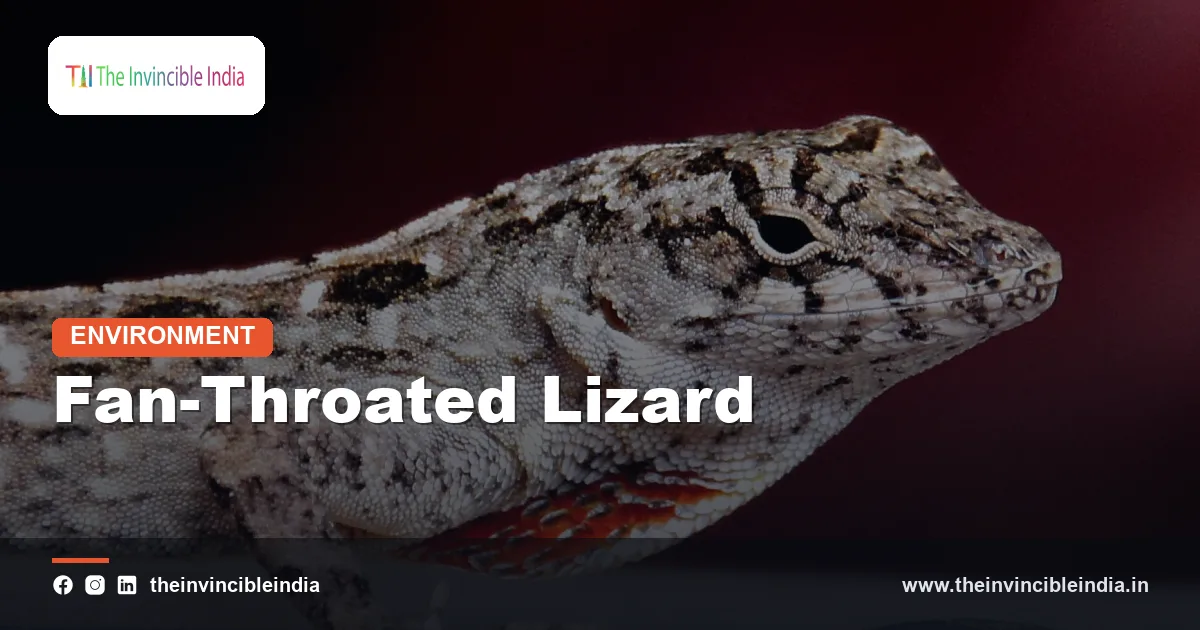
A fan-throated lizard is a small, fast-running ground lizard of the genera Sitana and Sarada in which breeding males flick open a bright blue, orange and black throat flap, called a dewlap, to signal to rivals and females. These agamid lizards live in dry, open country across the Indian subcontinent, including scrub, sandy plains and grassland.
The fan-throated lizard is a common sight but a poorly understood animal. Over the past two decades scientists have shown that what was once treated as one widespread species is really a group of several, and new ones are still being described. This explainer covers how the animal looks, why it displays, where it lives and why its open habitats matter.
| Quick Facts | Details |
|---|---|
| Common name | Fan-throated lizard (also called fan-throated or fan-throat lizards) |
| Genera in India | Sitana and Sarada |
| Family | Agamidae (agamid lizards) |
| Best-known species | Sitana ponticeriana, the Pondicherry fan-throated lizard, described in 1844 |
| Defining feature | Male throat fan (dewlap) coloured in blue, orange and black |
| Size | Small; a body of a few centimetres with a long, thin tail |
| Habitat | Dry open land: sandy plains, scrub, grassland and rocky plateaus |
| Diet | Ants, termites and other small insects |
| Conservation outlook | Several species have not been fully assessed; loss of open habitat is the main concern |
Key Takeaways
- The fan-throated lizard is a small agamid lizard of the genera Sitana and Sarada, found in dry, open habitats across India.
- Only breeding male fan-throated lizards carry the large, brightly coloured throat fan, and it is spread open during territorial and courtship displays.
- The fan-throated lizard’s dewlap is supported by a stiff, rod-like structure of the hyoid apparatus, which swings forward to open the throat flap.
- Scientists now recognise many species of fan-throated lizard, where earlier works named only a few, and further species continue to be described.
- Fan-throated lizards feed mainly on ants, termites and other small insects found on open ground.
- The main threat to the fan-throated lizard is the conversion of open grasslands and scrub, which are often wrongly labelled as wasteland.
What is a fan-throated lizard?
A fan-throated lizard is a ground-dwelling agamid lizard whose males can expand a vividly coloured throat fan, and the name is used mainly for lizards in the genera Sitana and Sarada. Agamids are a large family of Old World lizards that also includes the garden lizard, the rock agama and the flying dragons.
These lizards are slender, long-legged and quick. They spend most of the day on bare ground in sunshine, darting between patches of grass and stone. Because they live in the open, and because males display from low perches such as small stones and tufts, they are among the easiest lizards to watch in dry country.
Wherever you see one standing on a small rock, bobbing its head and flaring a coloured flap under its chin, you are almost certainly looking at a male fan-throated lizard.
Which lizards are called fan-throated lizards in India?
In India, the lizards called fan-throated lizards belong to two genera, Sitana and Sarada, which together include a growing list of species spread from the northern plains to the peninsula. For a long time most Indian records were assigned to a single species, Sitana ponticeriana, but later studies showed that it was a complex of several look-alike species.
The key points of this history are:
- The Pondicherry fan-throated lizard, Sitana ponticeriana, was described in the nineteenth century and long served as a catch-all name.
- Researchers who compared body measurements, dewlap patterns and DNA began separating regional species in the early twenty-first century.
- In 2016 a group of large, mainly peninsular species was moved into a separate genus, Sarada, on the basis of both genetics and body form.
- Different species often have different dewlap colours, which is one of the easiest ways to tell them apart.
Because the classification is still developing, readers should treat species counts as provisional and check current checklists.
What does a fan-throated lizard look like?
A fan-throated lizard looks like a slim, brownish or sandy lizard with long hind legs, a pointed snout and a very long tail, and it blends closely with dry soil and leaf litter. The males are usually larger than the females and carry the throat fan.
The most useful features are:
- Body colour: shades of brown, grey or sand, often with a pale stripe along the back or along each side.
- Limbs: long, strong hind limbs adapted for fast sprints and quick turns.
- Tail: long and tapering, often about twice the length of the body.
- Dewlap: in breeding males, a large throat flap, folded flat when the animal rests.
Females and young lizards lack the large fan and look plain, which keeps them hard to spot against the ground. Males can also change tone a little with temperature and mood.
What is the throat fan of a fan-throated lizard?
The throat fan of a fan-throated lizard is a flap of loose skin under the chin, called a dewlap, that opens like a hand fan when the male wants to signal. In the Pondicherry fan-throated lizard and several relatives it is marked with patches of blue, orange or red, and black, and in some species it reaches back past the forelegs onto the belly.
The fan is not just loose skin. It is held out by a long, slender rod that forms part of the hyoid apparatus, the set of small bones and cartilage that supports the tongue and throat. Muscles pull this rod forward, which spreads the skin into a broad, flat sail. When the muscles relax, the fan folds back and almost disappears under the chin.
Colour and pattern differ among species, so a careful look at the dewlap is the quickest field clue to identification, along with the place where the lizard was seen.
Why does a male fan-throated lizard open its fan?
A male fan-throated lizard opens its fan mainly to defend a territory against other males and to attract females during the breeding season. The display is a visual signal, and it works best in open ground where the colour can be seen from a distance.
A typical display runs in a sequence:
- The male climbs onto a small perch, such as a stone, a mound or a clump of grass.
- He raises his body on stretched forelegs in a series of push-ups.
- He bobs his head and flares the dewlap, sometimes several times in quick succession.
- If a rival responds, the two may circle each other, display side by side and, rarely, chase or fight.
Female lizards watch these displays and approach males that hold good ground. Many lizards can also see ultraviolet light, so the signals may carry details that human eyes miss.
Where does the fan-throated lizard live?
The fan-throated lizard lives in dry, open habitats such as sandy plains, thorny scrub, short grassland, rocky plateaus and the edges of dry deciduous forest across much of the Indian subcontinent. Different species occupy different regions, from the northern plains and foothills to the Deccan and the peninsula.
Several features of the habitat matter to the lizard:
- Open, sunny ground for warming up and for display.
- Loose or sandy soil for digging nests and shelters.
- Low scrub and grass clumps for escape from predators.
- An abundant supply of ants and termites.
Fan-throated lizards are not forest animals, so they are often missing from dense woodland. Many are found in landscapes, such as scrub and grassland, that are sometimes classed as wasteland in official records.
What does the fan-throated lizard eat?
The fan-throated lizard eats mainly small insects, especially ants and termites, which it picks up from the ground as it forages in short runs. Small beetles, grasshoppers, flies and spiders make up the rest of the diet.
The lizard hunts by sight. It watches from a patch of open ground, dashes forward to seize prey and then returns to a safe spot. Its sandy body colour and quick pace help it avoid the birds, snakes and larger lizards that prey on it.
By eating many small insects, the fan-throated lizard plays a modest part in keeping insect numbers in balance and serves as food for the animals above it in the food chain, such as shrikes, kestrels, snakes and monitor lizards.
How do fan-throated lizards breed?
Fan-throated lizards breed by laying small clutches of eggs in shallow nests dug into soil, and the season generally coincides with the rains. A female typically lays a few eggs at a time and may produce more than one clutch over the season.
After mating, the female finds loose or damp ground, scrapes a small hole, deposits the eggs and covers them. The eggs are left to develop on their own, warmed by the soil. Hatchlings emerge as small, fully formed lizards that feed and escape from danger without parental help.
Exact breeding times and clutch sizes differ among species and regions, and many details have been studied for only a few populations. The pattern described here is the general one reported for the group.
Why are new species of fan-throated lizard still being found?
New species of fan-throated lizard are still being found because the animals look very similar, so careful measurements and genetic tests are needed to separate them. Earlier naturalists grouped them by general appearance, and modern researchers have shown that many hidden species were mixed together under one name.
This work has several practical consequences:
- A species once thought to be widespread may turn out to be several species, each with a smaller range.
- Small ranges raise conservation questions, because a restricted species can be more easily harmed by habitat change.
- Field naturalists can help by recording the place, date and dewlap colours of the lizards they see.
The story of the fan-throated lizard is a good example of how much remains to be learned even about common animals in Indian grasslands.
How does the fan-throated lizard compare with other common lizards?
The fan-throated lizard differs from other common Indian lizards in its small size, ground habit and male throat fan. The table below compares it with two familiar lizards.
| Feature | Fan-throated lizard | Garden lizard | House gecko |
|---|---|---|---|
| Family | Agamidae | Agamidae | Gekkonidae |
| Main habitat | Open dry ground | Gardens, shrubs, trees | Walls and ceilings |
| Active | By day | By day | By night |
| Display feature | Large throat fan in males | Red or crimson throat and head in breeding males | Soft chirps, no display |
| Typical build | Slim, long-legged, long tail | Larger, crested | Flat, pale, sticky toes |
Is the fan-throated lizard endangered?
The fan-throated lizard is not generally regarded as endangered, but several of the newly described species are poorly known, and open habitats across India are under increasing pressure. Many species have not been fully assessed by the International Union for Conservation of Nature (IUCN), so conservation status varies from species to species.
The threats are mostly indirect:
- Conversion of grassland and scrub to farms, plantations, housing and industrial sites.
- Large solar farms and quarries on open land that was previously regarded as unproductive.
- Roads, fencing and the use of pesticides that reduce ant and termite numbers.
Protecting open natural ecosystems, and not planting trees on natural grasslands, helps fan-throated lizards and many other specialised animals such as larks, wolves and bustards.
Bottom Line
The fan-throated lizard is a small but striking reptile of India’s dry open lands, known for the males’ blue, orange and black throat fan. Its story shows how open grasslands shelter hidden biodiversity, and why species counts and conservation status should be treated as developing knowledge.
Frequently Asked Questions
What is a fan-throated lizard?
A fan-throated lizard is a small, ground-dwelling agamid lizard whose males open a coloured throat fan, called a dewlap. The name mainly covers lizards in the genera Sitana and Sarada. They live in dry, open habitats across the Indian subcontinent.
Why does the fan-throated lizard open its throat fan?
The fan-throated lizard opens its throat fan to defend a territory against rival males and to attract females. The male usually performs push-ups and head-bobs from a low perch as he flares the fan. The bright colours stand out clearly against the dry ground.
Is the fan-throated lizard poisonous?
No, the fan-throated lizard is not poisonous or venomous, and it is harmless to people. It is a timid animal that runs away when approached. It feeds only on small insects.
Where can I see a fan-throated lizard in India?
You can see a fan-throated lizard in dry, open habitats such as sandy plains, scrub, grassland and rocky plateaus across much of India. The best time is a warm, sunny morning in the breeding season, when males sit on small perches and display. Local naturalists can point out good spots, and species differ from region to region.
What does the fan-throated lizard eat?
The fan-throated lizard eats mainly ants, termites and other small insects. It also takes small beetles, flies and spiders from the ground. It hunts by sight in short, quick dashes.
Why are new species of fan-throated lizard being discovered?
New species of fan-throated lizard are being discovered because many look alike and were earlier grouped under one name. Studies of body measurements, dewlap patterns and DNA have separated them into several species. More are likely to be described as researchers survey India’s open habitats.
{“@context”:”https://schema.org”,”@graph”:[{“@type”:”FAQPage”,”mainEntity”:[{“@type”:”Question”,”name”:”What is a fan-throated lizard?”,”acceptedAnswer”:{“@type”:”Answer”,”text”:”A fan-throated lizard is a small, ground-dwelling agamid lizard whose males open a coloured throat fan, called a dewlap. The name mainly covers lizards in the genera Sitana and Sarada. They live in dry, open habitats across the Indian subcontinent.”}},{“@type”:”Question”,”name”:”Why does the fan-throated lizard open its throat fan?”,”acceptedAnswer”:{“@type”:”Answer”,”text”:”The fan-throated lizard opens its throat fan to defend a territory against rival males and to attract females. The male usually performs push-ups and head-bobs from a low perch as he flares the fan. The bright colours stand out clearly against the dry ground.”}},{“@type”:”Question”,”name”:”Is the fan-throated lizard poisonous?”,”acceptedAnswer”:{“@type”:”Answer”,”text”:”No, the fan-throated lizard is not poisonous or venomous, and it is harmless to people. It is a timid animal that runs away when approached. It feeds only on small insects.”}},{“@type”:”Question”,”name”:”Where can I see a fan-throated lizard in India?”,”acceptedAnswer”:{“@type”:”Answer”,”text”:”You can see a fan-throated lizard in dry, open habitats such as sandy plains, scrub, grassland and rocky plateaus across much of India. The best time is a warm, sunny morning in the breeding season, when males sit on small perches and display. Local naturalists can point out good spots, and species differ from region to region.”}},{“@type”:”Question”,”name”:”What does the fan-throated lizard eat?”,”acceptedAnswer”:{“@type”:”Answer”,”text”:”The fan-throated lizard eats mainly ants, termites and other small insects. It also takes small beetles, flies and spiders from the ground. It hunts by sight in short, quick dashes.”}},{“@type”:”Question”,”name”:”Why are new species of fan-throated lizard being discovered?”,”acceptedAnswer”:{“@type”:”Answer”,”text”:”New species of fan-throated lizard are being discovered because many look alike and were earlier grouped under one name. Studies of body measurements, dewlap patterns and DNA have separated them into several species. More are likely to be described as researchers survey India’s open habitats.”}}]}]}


