

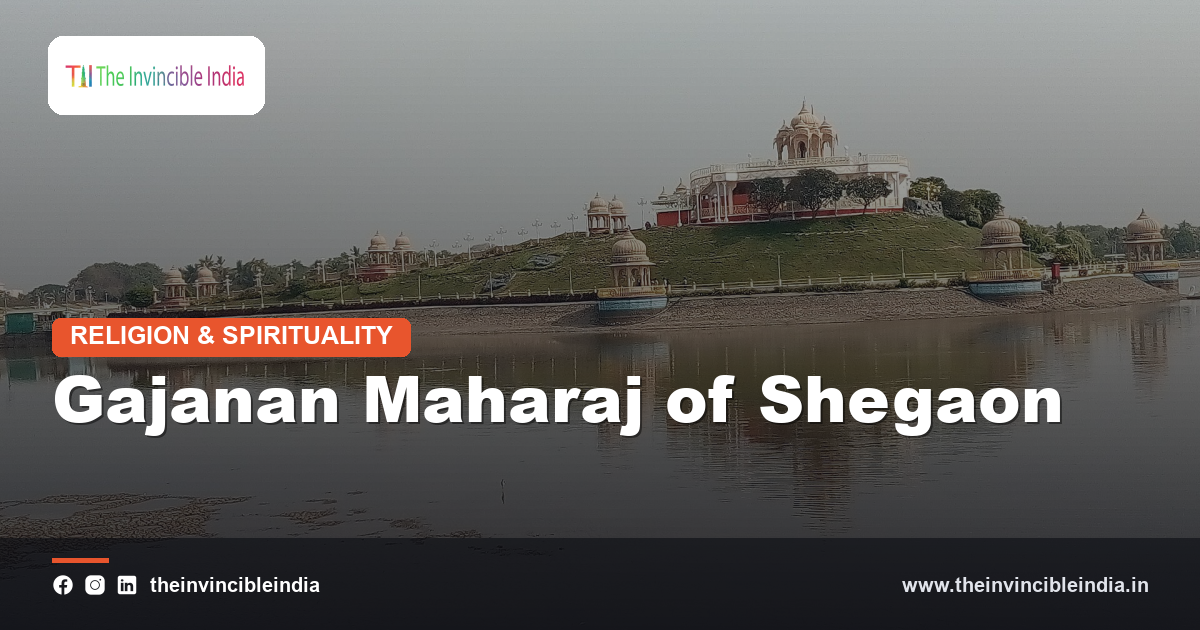
Gajanan Maharaj of Shegaon was a revered saint of Maharashtra, honoured in the Datta tradition as an avadhuta, a liberated sage beyond the cares of the world, whose presence at Shegaon in Buldhana district became the heart of a great devotion. By widely accepted accounts he first appeared at Shegaon in the year 1878 and took samadhi, his final conscious departure from the body, in 1910, though his origins before his appearance are unknown and are honoured as a mystery. His life gathered a host of devotees drawn by his wisdom, his renunciation and the many accounts of his grace, which are preserved in the Gajanan Vijay Granth, the cherished devotional text of his tradition. The great temple at Shegaon is one of the most visited shrines of Maharashtra, drawing pilgrims from across the region. His life and devotion belong to the wider world of the Dattatreya tradition, and he is honoured as a beloved saint whose grace is remembered to this day.
Quick answer: Gajanan Maharaj of Shegaon is a revered saint of Maharashtra, honoured in the Datta tradition as an avadhuta, whose presence at Shegaon in Buldhana district became the heart of a great devotion. By widely accepted accounts he first appeared at Shegaon in 1878 and took samadhi in 1910. His life is preserved in the Gajanan Vijay Granth, and the temple at Shegaon is among the most visited shrines of Maharashtra.
Key Takeaways
- Gajanan Maharaj of Shegaon is a revered Maharashtrian saint honoured in the Datta tradition as an avadhuta.
- By widely accepted accounts he first appeared at Shegaon in Buldhana district in 1878.
- He took samadhi, his final conscious departure from the body, in 1910.
- His origins before his appearance at Shegaon are unknown and are honoured as a mystery.
- His life and grace are preserved in the devotional text known as the Gajanan Vijay Granth.
- The temple at Shegaon is one of the most visited shrines of Maharashtra.
The sections below explain his life as told by tradition, his appearance at Shegaon, the Datta tradition, the meaning of an avadhuta, the many accounts of his grace, the Gajanan Vijay Granth, the Shegaon temple, his samadhi and his continuing place in devotion.
Quick Facts
| Detail | Information |
|---|---|
| Tradition | Datta tradition; honoured as an avadhuta saint |
| Era | Appeared at Shegaon 1878; samadhi 1910 (widely accepted) |
| Region | Shegaon, Buldhana district, Maharashtra |
| Language of works | Marathi (the Gajanan Vijay Granth) |
| Principal works | Gajanan Vijay Granth (devotional text of the tradition) |
| Deity | Dattatreya; the saint himself revered as a form of the divine |
| Known for | Renunciation, wisdom and accounts of grace and miracles |
| Principal shrine | The Gajanan Maharaj temple at Shegaon |
Who Was Gajanan Maharaj of Shegaon?
Gajanan Maharaj of Shegaon was a revered saint of Maharashtra, honoured in the Datta tradition as an avadhuta, a liberated sage beyond the cares of the world, whose presence at Shegaon in Buldhana district became the heart of a great devotion. He is remembered as a saint of deep renunciation and wisdom whose grace drew a host of devotees.
By widely accepted accounts he first appeared at Shegaon in the year 1878 and took samadhi in 1910, though the story of his life before his appearance is unknown and is honoured as a mystery. His devotees cherish many accounts of his wisdom, his renunciation and his grace, which are preserved in the Gajanan Vijay Granth. The great temple at Shegaon keeps his memory and draws pilgrims from across Maharashtra. His standing as a beloved avadhuta saint of the Datta tradition is firmly and lovingly held in the devotion of the region.
How Did He Appear at Shegaon?
By widely accepted accounts, Gajanan Maharaj first appeared at Shegaon in Buldhana district in the year 1878, coming into view as a young avadhuta already absorbed in a state beyond worldly concern, and the story of his life before this appearance is unknown and honoured as a mystery. His coming to Shegaon marks the beginning of his cherished presence there.
Tradition recalls that he appeared at Shegaon as a renunciate indifferent to the body and the world, a sage whose bearing revealed a soul absorbed in the divine. Devotees who encountered him came to recognise in him a saint of great spiritual attainment, and a devotion gathered around his presence. Because his origins before Shegaon are not known, they are received with reverence as a mystery befitting an avadhuta. Understanding his appearance at Shegaon helps a reader see how the devotion to Gajanan Maharaj began and why the town became the heart of his memory.
What Is the Datta Tradition?
The Datta tradition is the stream of devotion centred on Dattatreya, revered as a sage and a form of the divine who unites the natures of the great gods, and honoured as the lord of yogis and the fountainhead of a lineage of saints. Gajanan Maharaj is counted among the saints of this tradition.
The devotion to Dattatreya is cherished across Maharashtra and neighbouring regions, honouring a succession of revered saints held to embody the grace of Datta in the world. These saints are remembered as avadhutas and gurus whose lives and teaching carry the devotion of the tradition. Gajanan Maharaj of Shegaon is honoured within this stream as an avadhuta saint in whom devotees saw the grace of the divine. Understanding the Datta tradition helps a reader see the devotional world to which Gajanan Maharaj belongs and the lineage of saints among whom his memory is cherished in the devotion of Maharashtra.
What Does It Mean to Be an Avadhuta?
An avadhuta is a liberated sage who has cast off all worldly attachment and the ordinary rules of conduct, living in a state of absorption in the divine beyond the concerns of the body and the world, and Gajanan Maharaj is revered as such a saint. This state is honoured as the mark of the highest renunciation.
In the traditions of Indian spirituality, the avadhuta is a sage who has shed the bonds of desire, fear and convention, dwelling in freedom and in constant awareness of the divine. Such a sage may appear indifferent to the comforts and customs of the world, for the mind is absorbed in a higher reality. Gajanan Maharaj is remembered as an avadhuta whose bearing revealed this liberation and whose grace flowed from it. Understanding the meaning of an avadhuta helps a reader appreciate the spiritual state in which Gajanan Maharaj is honoured and the depth of renunciation that his devotees cherish in his memory.
What Accounts of His Grace Are Cherished?
The devotees of Gajanan Maharaj cherish many accounts of his grace, in which the saint is said to have relieved suffering, guided the faithful and shown his care for those who turned to him, and these accounts are honoured as devotional tradition rather than documented fact. They express the love and faith of his followers.
Tradition preserves numerous episodes in which Gajanan Maharaj is said to have blessed his devotees, eased their troubles and revealed his spiritual power, stories cherished as signs of his grace and compassion. Such accounts of wonders are woven through the devotion to the saint and are gathered in the Gajanan Vijay Granth. Careful writers present these miraculous episodes explicitly as devotional tradition, honouring their meaning for the faithful while not treating them as historical record. The accounts of his grace are cherished above all as expressions of the love between the saint and his devotees and of the faith that gathers around his memory.
What Is the Gajanan Vijay Granth?
The Gajanan Vijay Granth is the cherished devotional text of the tradition of Gajanan Maharaj, a work in Marathi that recounts his life, his grace and the accounts of his devotees, read and honoured by the faithful. It is the chief source of the devotion to the saint.
The Gajanan Vijay Granth gathers the episodes of the saint’s life and the stories of his grace into a devotional narrative revered by his followers, who read it with faith and devotion. The text keeps alive the memory of Gajanan Maharaj and the many accounts cherished by his devotees. Because the work belongs to the living tradition and recounts episodes received as devotional belief, careful accounts describe it in general terms and present its miraculous episodes as tradition. Understanding the Gajanan Vijay Granth helps a reader appreciate how the memory and the grace of the saint have been preserved and how the devotion to him is nourished among the faithful.
Where Is the Temple at Shegaon?
The great temple of Gajanan Maharaj stands at Shegaon in Buldhana district in the Vidarbha region of Maharashtra, where the saint lived and took samadhi, and it is one of the most visited shrines of the state. Shegaon is the chief centre of his veneration.
The temple at Shegaon is cherished as the holy place where the memory of Gajanan Maharaj is honoured and where his samadhi is revered, drawing pilgrims from across Maharashtra and beyond who come to pay their respects to the saint. The shrine and the institutions connected with it are known for their care of pilgrims and for the devotion that fills the town. Shegaon is thus bound in the devotional geography of Maharashtra to the memory of the saint. Understanding where the temple lies helps a reader place the life and the continuing devotion of Gajanan Maharaj within the Vidarbha region and the town that cherishes him.
What Was His Samadhi?
By widely accepted accounts, Gajanan Maharaj took samadhi, his final conscious departure from the body, in the year 1910 at Shegaon, and the place of his samadhi is revered as the heart of the temple there. His samadhi is honoured as the culmination of the life of a liberated sage.
In the traditions of Indian spirituality, a great saint is held to leave the body consciously and willingly, and the samadhi of Gajanan Maharaj in 1910 is remembered in this way, as the departure of an avadhuta into the divine. The place of his samadhi at Shegaon became the focus of devotion, honoured as a holy shrine where his presence is felt by the faithful. Devotees cherish his samadhi not as an ending but as the continuing presence of the saint. Understanding his samadhi helps a reader appreciate the reverence in which the shrine at Shegaon is held and the faith of the devotees in the abiding grace of Gajanan Maharaj.
How Do Devotees Experience His Presence?
The devotees of Gajanan Maharaj experience his presence as an abiding reality, believing that the grace of the saint continues to guide and protect those who turn to him with faith, even after his samadhi. This sense of his living presence is at the heart of the devotion to him.
For his followers, Gajanan Maharaj is not a figure of the past alone but a living presence whose grace is felt in their lives, and they turn to him in their needs and their devotions with trust in his care. The shrine at Shegaon is cherished as a place where this presence is especially felt, and the reading of the Gajanan Vijay Granth is held to bring his grace near. Such experiences are received as the devotional faith of his followers. Understanding how devotees experience his presence helps a reader appreciate the living bond of love and trust between the saint and those who cherish his memory.
What Values Does His Life Teach?
The life of Gajanan Maharaj teaches the values of renunciation, detachment from the cares of the world, compassion for the suffering and absorption in the divine, in keeping with his standing as an avadhuta saint. These values are cherished by his devotees as the heart of his example.
As a liberated sage indifferent to comfort and convention, Gajanan Maharaj is remembered as a model of detachment and inner freedom, while the accounts of his grace reveal his compassion for those who turned to him. His life is honoured as a witness to the truth that the highest good lies in devotion to the divine rather than in the possessions and honours of the world. His devotees seek to draw from his example a spirit of faith, humility and surrender. Understanding the values his life teaches helps a reader appreciate why Gajanan Maharaj is cherished not only as a worker of grace but as a guide toward the spiritual life.
When and Where Did He Live?
Gajanan Maharaj lived at Shegaon in Buldhana district, Maharashtra, and by widely accepted accounts he appeared there in 1878 and took samadhi in 1910, while the story of his life before his appearance is unknown and honoured as a mystery. His memory is bound to Shegaon and to the Vidarbha region.
His life unfolded in the Vidarbha region of Maharashtra in the late nineteenth and early twentieth centuries, a time that saw a great flowering of devotion to saints across the land. The dates of his appearance and his samadhi are widely accepted, while his origins remain veiled and are received with reverence. His devotion gathered around Shegaon, which became the heart of his memory. Understanding when and where he lived helps a reader place Gajanan Maharaj within the devotional life of Maharashtra and the town that cherishes him as its beloved saint to this day.
How Is He Linked to the Saints of Maharashtra?
Gajanan Maharaj is linked to the great company of saints of Maharashtra, the land cherished for its tradition of revered sants and gurus, and he is honoured among the saints of the Datta tradition in particular. These links set his life within a rich and beloved spiritual heritage.
Maharashtra is honoured for a long tradition of saints whose devotion and teaching shaped the religious life of the region, from the saint-poets of the Varkari fellowship to the avadhutas of the Datta tradition. Gajanan Maharaj belongs to this heritage, revered as an avadhuta saint whose grace drew a great devotion. His memory is cherished alongside that of other saints of the region, and his shrine at Shegaon is counted among the great places of pilgrimage. Understanding his link to the saints of Maharashtra helps a reader see Gajanan Maharaj within the broad and cherished spiritual tradition of the land that honours him.
Why Does Gajanan Maharaj Still Matter Today?
Gajanan Maharaj still matters today because his memory as a liberated avadhuta saint and his cherished grace continue to draw a great devotion, and because the temple at Shegaon remains one of the most visited shrines of Maharashtra. His presence is felt as a living reality by his followers.
For his devotees he is a beloved saint whose grace guides and protects them, and whose life of renunciation is a model of the spiritual path. The reading of the Gajanan Vijay Granth and the pilgrimage to Shegaon keep his memory and his grace near. The accounts of his wonders are received as devotional tradition, cherished for their meaning for the faithful. His enduring importance lies in the living devotion that gathers around his memory and in the faith of countless followers who turn to Gajanan Maharaj as their beloved saint and the source of grace in their lives.
Gajanan Maharaj Today
Gajanan Maharaj today is revered as a liberated avadhuta saint of the Datta tradition, whose appearance at Shegaon in 1878 and samadhi in 1910 are widely accepted, and whose grace is cherished by a great host of devotees. His memory endures as a living presence in the devotion of Maharashtra.
Through his life of renunciation, the many accounts of his grace preserved in the Gajanan Vijay Granth and the great temple at Shegaon, he became an enduring figure of the spiritual heritage of the region. The miraculous episodes of his life are received as devotional tradition, honoured for their meaning rather than treated as documented chronicle, and his origins before Shegaon are honoured as a mystery. His legacy endures as a reminder of the grace of a liberated sage and of the devotion that still gathers, with faith and love, around the memory of Gajanan Maharaj at Shegaon.
Sources & Further Reading
- Ministry of Culture, Government of India (indiaculture.gov.in).
- Maharashtra State Gazetteers, general references on the saints of Maharashtra.
Frequently Asked Questions
Who was Gajanan Maharaj of Shegaon?
Gajanan Maharaj of Shegaon was a revered saint of Maharashtra, honoured in the Datta tradition as an avadhuta, a liberated sage. By widely accepted accounts he appeared at Shegaon in Buldhana district in 1878 and took samadhi in 1910, and his life and grace are preserved in the Gajanan Vijay Granth.
When did Gajanan Maharaj appear and take samadhi?
By widely accepted accounts, Gajanan Maharaj first appeared at Shegaon in 1878 and took samadhi, his final conscious departure from the body, in 1910. The story of his life before his appearance at Shegaon is unknown and is honoured by devotees as a mystery.
What is the Gajanan Vijay Granth?
The Gajanan Vijay Granth is the cherished devotional text of the tradition of Gajanan Maharaj, a work in Marathi that recounts his life, his grace and the accounts of his devotees. It is read and honoured by the faithful, and its miraculous episodes are received as devotional tradition.
Where is the temple of Gajanan Maharaj?
The great temple of Gajanan Maharaj stands at Shegaon in Buldhana district in the Vidarbha region of Maharashtra, where the saint lived and took samadhi. It is one of the most visited shrines of the state and draws pilgrims from across the region and beyond.
What does it mean that he is an avadhuta?
An avadhuta is a liberated sage who has cast off all worldly attachment and the ordinary rules of conduct, dwelling in absorption in the divine. Gajanan Maharaj is revered as such a saint, whose bearing revealed this liberation and whose grace is cherished by his devotees.
Are the miracles of Gajanan Maharaj documented history?
The many accounts of the grace and miracles of Gajanan Maharaj are cherished as devotional tradition rather than documented history. They are preserved in the Gajanan Vijay Granth and are honoured for their meaning for the faithful, expressing the love and faith of his devotees.


