

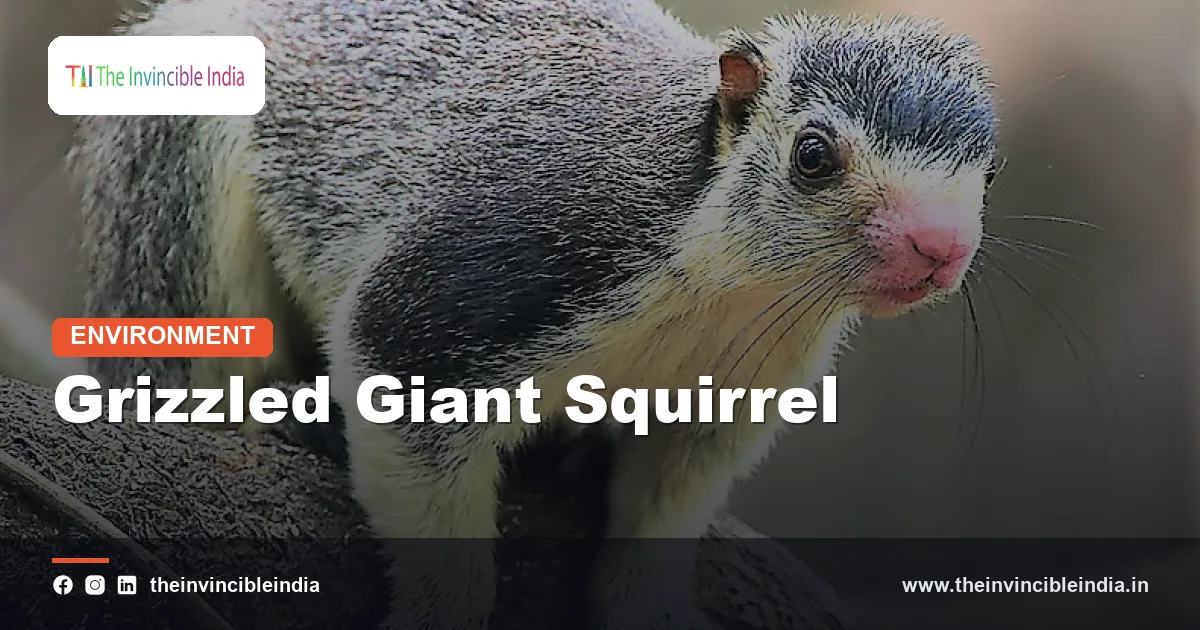
The grizzled giant squirrel (Ratufa macroura) is a large, grey-speckled tree squirrel that lives in the riverine forests of southern India and Sri Lanka, and in India it is a Near Threatened species found mainly in a few pockets of Tamil Nadu and Kerala. It spends nearly its whole life high in the canopy, leaping between trees and building big ball-shaped nests of twigs and leaves.
The species is far less well known than the colourful Indian giant squirrel of the Western Ghats, yet its small, scattered Indian population makes it one of the more vulnerable squirrels of the subcontinent. Understanding where the grizzled giant squirrel lives, what it eats and why it depends on streamside trees explains why a few protected forests matter so much for its survival.
| Attribute | Detail |
|---|---|
| Common name | Grizzled giant squirrel, also called the grizzled Indian giant squirrel |
| Scientific name | Ratufa macroura |
| Family and genus | Sciuridae (squirrels), genus Ratufa (giant squirrels) |
| Size | Head and body roughly 25 to 40 cm, with a tail as long as or longer than the body; weight about 1.5 to 2 kg |
| Colour | Grey to grey-brown above, speckled or “grizzled”, with a cream or whitish underside |
| Indian range | Dry and moist forests of the southern Western Ghats and adjoining hills in Tamil Nadu and Kerala |
| Habitat | Riverine and tall dry deciduous forest with tall, continuous trees |
| IUCN status | Near Threatened |
| Legal protection in India | Listed under the Wildlife (Protection) Act, 1972 |
Key Takeaways
- The grizzled giant squirrel (Ratufa macroura) is a large tree squirrel of southern India and Sri Lanka that is assessed as Near Threatened on the IUCN Red List.
- In India, the grizzled giant squirrel is concentrated in a few forest pockets of the southern Western Ghats, notably in Tamil Nadu around Srivilliputhur and in Kerala around Chinnar.
- The grizzled giant squirrel lives almost entirely in the treetops, travelling from branch to branch by leaping across gaps and rarely coming down to the ground.
- Grizzled giant squirrels depend on tall, continuous riverine forest, so tree felling along streams, fragmentation and dams threaten the species more than direct hunting does.
- The grizzled giant squirrel eats fruits, nuts, seeds, flowers and bark, and by moving seeds around it helps regenerate the forests it lives in.
- The grizzled giant squirrel is protected under India’s Wildlife (Protection) Act, 1972, and sanctuaries such as the Srivilliputhur Grizzled Squirrel Wildlife Sanctuary in Tamil Nadu were set up partly to conserve it.
What is the grizzled giant squirrel?
The grizzled giant squirrel is a species of giant squirrel in the genus Ratufa, and it is distinguished by its grey, speckled coat, pale belly and bushy tail. Giant squirrels are the largest tree squirrels in Asia, and the grizzled giant squirrel is the one found in the drier, more open southern forests rather than in the wet evergreen forests of the Western Ghats.
The English word “grizzled” simply means flecked with grey, and the animal’s dark back hairs are tipped with paler shades, giving it a frosted or salt-and-pepper appearance. Two groups of populations are recognised: one in peninsular India, often treated as a distinct subspecies, and another in Sri Lanka, where the animal is known as the dusky or Ceylon giant squirrel and has a darker, more brownish coat.
The species is a close relative of the common striped palm squirrels seen in Indian gardens, but it is many times heavier and behaves quite differently. It is shy, forest-bound and almost never seen in cities.
What does the grizzled giant squirrel look like?
The grizzled giant squirrel looks like a very large, grey-brown squirrel with creamy underparts, a long bushy tail and rounded ears without tufts. Adult animals can weigh around 1.5 to 2 kilograms, which is much more than a typical garden squirrel, and the tail is often as long as the body or longer.
The coat is a mix of buff, grey and dark brown shades. The upper body appears finely speckled, while the underparts, chest and throat are pale cream to white. Unlike the Indian giant squirrel, the grizzled species has no bold patches of maroon, orange or black, and its tail is not strongly banded.
How is it different from the other giant squirrels of India?
The easiest rule is to look at the colour. If the animal is a dull grey with a pale belly, it is a grizzled giant squirrel. If it is richly coloured with maroon, orange, buff and black, it is an Indian giant squirrel. If it is blackish with a pale underside and lives in the north-east, it is a Malayan giant squirrel.
| Species | Scientific name | Colour | Where in India |
|---|---|---|---|
| Grizzled giant squirrel | Ratufa macroura | Grey, speckled, pale belly | Southern Western Ghats pockets in Tamil Nadu and Kerala |
| Indian giant squirrel (Malabar giant squirrel) | Ratufa indica | Maroon, orange, buff and black | Western Ghats, Eastern Ghats pockets and central India |
| Malayan giant squirrel | Ratufa bicolor | Dark upper body, pale to buff underside | North-eastern India and the Himalayan foothills |
Where does the grizzled giant squirrel live in India?
The grizzled giant squirrel lives in a few scattered patches of the southern Western Ghats and the neighbouring hills, mostly in Tamil Nadu and Kerala, and it is much more restricted in India than the Indian giant squirrel. The two best-known strongholds are the forests around Srivilliputhur in Tamil Nadu and Chinnar in Kerala.
The Srivilliputhur Grizzled Squirrel Wildlife Sanctuary in Tamil Nadu’s Virudhunagar district was set up specifically with this animal in mind and is among the few protected areas named after a squirrel. It lies in the rain-shadow side of the Western Ghats and has dry deciduous forest with streams, and it now forms part of the larger Srivilliputhur-Megamalai tiger landscape. Chinnar Wildlife Sanctuary in Idukki district, Kerala, sits in a rain-shadow region of the Anamalai range and is another renowned site, where visitors sometimes watch the squirrel along dry riverbeds.
Smaller populations are reported from neighbouring hill areas and forest belts in the southern peninsula. Outside India, the species occurs in Sri Lanka’s dry zone.
What habitat does the grizzled giant squirrel need?
The grizzled giant squirrel needs tall, continuous forest, especially riverine or streamside vegetation, because its way of life depends on moving through connected branches without descending to the ground. It prefers dry deciduous and thorn-edged forests with big trees along watercourses.
Streamside forests provide large, spreading trees with strong forks that hold bulky nests, a steady supply of fruit and a continuous canopy corridor. When roads, plantations or farms break this canopy, the squirrels may be forced to cross open ground, which exposes them to predators and vehicles.
Its habitat needs can be summarised as:
- Tall native trees whose crowns touch or lie close together.
- Large nesting trees with strong horizontal branches.
- Fruit, flower and seed-bearing trees that produce food in different seasons.
- Access to streams or seasonal water in or near the forest.
- Low human disturbance and little tree felling.
How does the grizzled giant squirrel move and live in the canopy?
The grizzled giant squirrel moves by running along branches and by making long leaps between tree crowns, and it can cross gaps of several metres with the help of its long balancing tail. Because it travels along an elevated “highway” of branches, it seldom touches the ground.
The animal is mostly active in the early morning and late afternoon, resting in the shade during the hottest part of the day. It is usually seen alone or in pairs, and it announces itself with a loud, rattling or chuckling call that carries through the forest. When alarmed, it freezes against a branch, flattens itself, or retreats around the trunk, which makes it surprisingly hard to spot for such a big animal.
What are its nests like?
The grizzled giant squirrel builds large, rounded nests called dreys from twigs, leaves and bark, usually placed in the fork of a tall tree high above the ground. A single animal may maintain several nests, using different ones for resting, sleeping and raising young.
These nests are quite conspicuous when leaves are sparse, and conservationists often count nests as an indirect way to estimate squirrel numbers. Because nests are bulky and built in specific trees, the felling of a few large trees can remove important nesting sites.
What does the grizzled giant squirrel eat?
The grizzled giant squirrel eats mostly fruits, nuts, seeds, flowers, tender leaves and bark, and it will occasionally take insects and bird eggs. Its diet shifts through the year as different trees fruit and flower.
Foods commonly eaten by giant squirrels include wild figs, pods, wild forest fruits, seeds of large trees, and tree flowers. By biting into fruit and dropping seed fragments, or by carrying seeds away and burying them, the squirrel acts as a seed disperser and helps new trees grow. In dry forests where rain is seasonal, this role is particularly useful, since few other animals move seeds through the canopy.
The squirrel sometimes gnaws bark to reach sap or to wear down its continuously growing incisors, a behaviour typical of rodents.
How does the grizzled giant squirrel breed?
The grizzled giant squirrel breeds in its tree nests, and a female typically raises a small number of young at a time, often one or two. The young are born blind and hairless and stay in the nest until they have grown fur and developed enough strength to climb.
Breeding can occur through much of the year in suitable conditions, but it is influenced by food supply and rainfall. The female builds or chooses a secure nest in a tall tree and cares for the young, and the young then learn to leap and forage by following her. Because litter sizes are small and survival depends on safe nests, the species recovers slowly from population declines.
Is the grizzled giant squirrel endangered?
The grizzled giant squirrel is not classified as endangered, but the IUCN lists it as Near Threatened because its habitat is shrinking and its Indian range is very limited. Its numbers in India are small and concentrated in a few forest blocks, which makes the species sensitive to local habitat loss.
The main threats are summarised below.
- Loss of riverine forest: Streamside trees are cleared for agriculture, settlements, firewood and development.
- Fragmentation: Roads, power lines, plantations and fields split the canopy and isolate small populations.
- Dams and water projects: Reservoirs and canal works can submerge or alter riparian forest.
- Hunting and capture: Illegal hunting for meat or the pet trade has occurred in some areas, even though it is prohibited.
- Climate and fire: Drought, forest fires and changes in rainfall can reduce fruiting and degrade dry forests.
Under the Wildlife (Protection) Act, 1972, hunting or trading the species is prohibited, and sanctuaries and tiger reserve landscapes in the Western Ghats provide protected habitat.
Why does the grizzled giant squirrel matter?
The grizzled giant squirrel matters because it is a seed disperser, a prey species for forest predators and an indicator of healthy, tall riverine forest. Where grizzled giant squirrels thrive, the forest canopy is usually continuous and rich in fruiting trees.
The squirrel also has cultural and tourism value. Sanctuaries such as the one near Srivilliputhur attract naturalists and bird-watchers, and local communities can benefit from guided visits. Protecting the animal means protecting tall streamside trees, which also help hold soil, regulate water flow and shelter many other species including birds, bats and other mammals.
Because the species is easy to recognise and relatively visible when nests are counted, it can serve as a flagship species for dry-forest conservation in southern India.
How can you spot a grizzled giant squirrel?
You can spot a grizzled giant squirrel by visiting its protected habitats early in the morning, scanning tall trees along streams for large nests and listening for its loud calls. Patience matters, because the animal is shy and often stays still or moves behind branches.
- Visit sanctuaries such as the Srivilliputhur Grizzled Squirrel Wildlife Sanctuary in Tamil Nadu or Chinnar Wildlife Sanctuary in Kerala, following forest department rules and guide requirements.
- Go in the early morning or late afternoon, when the squirrel is most active.
- Look for large rounded nests in the forks of tall trees along dry riverbeds.
- Use binoculars rather than approaching, and keep noise low.
- Do not feed wild squirrels or leave litter, since both can change their behaviour.
Bottom Line
The grizzled giant squirrel is a shy canopy specialist whose Indian population is small and tied to tall streamside forests in Tamil Nadu and Kerala. Safeguarding these forests, keeping the tree canopy connected and enforcing wildlife laws are the best ways to keep this Near Threatened species leaping through the treetops.
Frequently Asked Questions
Where is the grizzled giant squirrel found in India?
The grizzled giant squirrel is found in a few forest pockets of the southern Western Ghats and neighbouring hills, mainly in Tamil Nadu and Kerala. Well-known sites include the Srivilliputhur Grizzled Squirrel Wildlife Sanctuary and Chinnar Wildlife Sanctuary.
Is the grizzled giant squirrel endangered?
The grizzled giant squirrel is listed as Near Threatened by the IUCN, not Endangered. Its Indian population is small and scattered, and it is threatened by the loss of riverine forest and habitat fragmentation.
How big is a grizzled giant squirrel?
A grizzled giant squirrel has a head and body length of roughly 25 to 40 centimetres, a tail as long as or longer than its body, and a weight of around 1.5 to 2 kilograms. This makes it many times heavier than the common striped palm squirrel.
What is the difference between the grizzled and Indian giant squirrel?
The grizzled giant squirrel is a dull grey, speckled animal with a pale belly, while the Indian giant squirrel (Ratufa indica) is brightly coloured in maroon, orange, buff and black. The grizzled species lives in drier southern forests, whereas the Indian giant squirrel is more widespread in the Western Ghats.
What does the grizzled giant squirrel eat?
The grizzled giant squirrel eats mainly fruits, nuts, seeds, flowers and bark, and sometimes insects and eggs. By carrying and dropping seeds, it helps regenerate forest trees.
Does the grizzled giant squirrel come down to the ground?
The grizzled giant squirrel rarely comes down to the ground and spends nearly all its life in the tree canopy. It travels between trees by running along branches and leaping across gaps, using its long tail for balance.
{“@context”:”https://schema.org”,”@graph”:[{“@type”:”FAQPage”,”mainEntity”:[{“@type”:”Question”,”name”:”Where is the grizzled giant squirrel found in India?”,”acceptedAnswer”:{“@type”:”Answer”,”text”:”The grizzled giant squirrel is found in a few forest pockets of the southern Western Ghats and neighbouring hills, mainly in Tamil Nadu and Kerala. Well-known sites include the Srivilliputhur Grizzled Squirrel Wildlife Sanctuary and Chinnar Wildlife Sanctuary.”}},{“@type”:”Question”,”name”:”Is the grizzled giant squirrel endangered?”,”acceptedAnswer”:{“@type”:”Answer”,”text”:”The grizzled giant squirrel is listed as Near Threatened by the IUCN, not Endangered. Its Indian population is small and scattered, and it is threatened by the loss of riverine forest and habitat fragmentation.”}},{“@type”:”Question”,”name”:”How big is a grizzled giant squirrel?”,”acceptedAnswer”:{“@type”:”Answer”,”text”:”A grizzled giant squirrel has a head and body length of roughly 25 to 40 centimetres, a tail as long as or longer than its body, and a weight of around 1.5 to 2 kilograms. This makes it many times heavier than the common striped palm squirrel.”}},{“@type”:”Question”,”name”:”What is the difference between the grizzled and Indian giant squirrel?”,”acceptedAnswer”:{“@type”:”Answer”,”text”:”The grizzled giant squirrel is a dull grey, speckled animal with a pale belly, while the Indian giant squirrel (Ratufa indica) is brightly coloured in maroon, orange, buff and black. The grizzled species lives in drier southern forests, whereas the Indian giant squirrel is more widespread in the Western Ghats.”}},{“@type”:”Question”,”name”:”What does the grizzled giant squirrel eat?”,”acceptedAnswer”:{“@type”:”Answer”,”text”:”The grizzled giant squirrel eats mainly fruits, nuts, seeds, flowers and bark, and sometimes insects and eggs. By carrying and dropping seeds, it helps regenerate forest trees.”}},{“@type”:”Question”,”name”:”Does the grizzled giant squirrel come down to the ground?”,”acceptedAnswer”:{“@type”:”Answer”,”text”:”The grizzled giant squirrel rarely comes down to the ground and spends nearly all its life in the tree canopy. It travels between trees by running along branches and leaping across gaps, using its long tail for balance.”}}]}]}


