

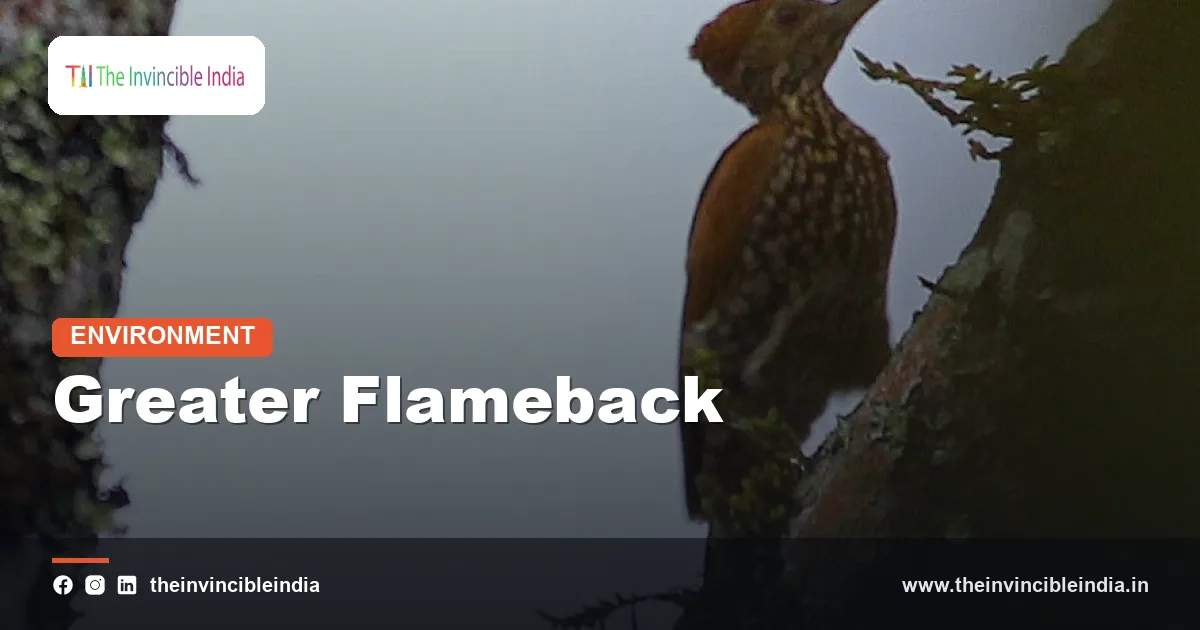
The greater flameback (Chrysocolaptes guttacristatus) is a large, golden-backed woodpecker of Indian forests, known for its long dagger-like bill, bright red crest in the male, and loud rattling call. It lives in the Himalayan foothills, the northeast and the Western Ghats, and it feeds mainly on wood-boring beetle larvae, ants and termites taken from trunks and branches.
The greater flameback is one of the largest and most striking woodpeckers in the Indian region, and it is often noticed first by its call and the loud tapping of its bill. This explainer covers how to identify the bird, where it lives, what it eats, how it drums and breeds, and why its work matters for forests and for other wildlife.
Quick Facts
| Common name | Greater flameback |
|---|---|
| Scientific name | Chrysocolaptes guttacristatus (listed as Chrysocolaptes lucidus in older books) |
| Family and order | Picidae (woodpeckers); order Piciformes |
| Size | About 33 cm long, with a long, strong bill |
| Range in India | Himalayan foothills, northeast India, Western Ghats and some forest tracts of the peninsula |
| Habitat | Moist deciduous and evergreen forest, forest edges, plantations and large old trees |
| Diet | Wood-boring beetle larvae, ants, termites and other insects; sometimes nectar and fruit |
| Breeding | Nests in a hole excavated in a tree trunk; usually lays 2 to 3 white eggs |
| Conservation status | Least Concern on the IUCN Red List; protected under Indian wildlife law |
Key Takeaways
- The greater flameback is a large woodpecker about 33 cm long, with a golden-yellow back, red rump and a long, pointed bill.
- The greater flameback is named for its flame-coloured upperparts, which glow gold and orange in sunlight when the bird clings to a tree trunk.
- Male greater flamebacks have a bright red crest, while females have a crest that is black with fine white spotting.
- Wood-boring beetle larvae, ants and termites are the main foods of the greater flameback, and the bird locates them by tapping and probing bark and dead wood.
- The greater flameback gives a loud, rattling or laughing call and often drums on dead branches to announce its territory.
- The greater flameback is assessed as Least Concern, but it depends on large old trees for feeding and nesting, so felling of mature forest affects it.
What is the greater flameback?
The greater flameback is a large woodpecker in the family Picidae, found across the Indian subcontinent and parts of Southeast Asia. Its scientific name is Chrysocolaptes guttacristatus, and the genus name refers to its golden colour. In older bird books the same bird often appears under the name Chrysocolaptes lucidus, because taxonomists have since divided what was once a single widespread species into several.
The word “flameback” refers to the bird’s upperparts, which are a rich golden-yellow with an orange-red tint in good light. The bird is a member of a group of woodpeckers called flamebacks, which includes smaller species such as the black-rumped flameback of the plains.
The greater flameback is considered a resident species in India. It tends to live in pairs and keeps to the same stretch of forest for years, provided that large trees remain.
It is a bird of the middle and upper parts of tall trees, and it often forages high in the canopy. Because of this habit, many people hear the bird before they see it.
How can you identify a greater flameback?
A greater flameback can be identified by its golden-yellow back, red rump, long pointed bill, and a black-and-white patterned face and neck. At roughly 33 cm, it is clearly larger than the common plains flameback and has a more elongated, slender look because of its long bill and neck.
Plumage in detail
- Back and wings: golden-yellow to orange-yellow, with a bright, glossy look in sunlight.
- Rump: red, which is easy to see when the bird flies.
- Underparts: whitish with dark scale-like or streaked markings.
- Head and neck: a pale face crossed by dark lines, with a long black neck stripe.
- Bill: long, strong and sharply pointed, dark in colour.
Males and females
The male greater flameback has a vivid red crest that stands out against the black-and-white head, while the female has a black crest dotted with white spots. This difference makes it easy to separate the sexes when a bird is seen clearly from the side or below.
Greater flameback and similar birds
The greater flameback is most often compared with the black-rumped flameback, a smaller flameback of open country and plains. The table below lists the main differences.
| Feature | Greater flameback | Black-rumped flameback |
|---|---|---|
| Size | Larger, about 33 cm | Smaller, about 28 cm |
| Rump | Red | Black |
| Bill | Longer and more slender | Shorter and thicker |
| Habitat | Forest and wooded foothills | Open woodland, groves and towns |
Where does the greater flameback live in India?
The greater flameback lives in forested parts of India, including the Himalayan foothills, the northeast and the Western Ghats, along with some forest tracts of the peninsula. Elsewhere it occurs in Nepal, Bangladesh, Myanmar and across much of Southeast Asia, where related forms replace it in some islands.
It prefers habitats with large trees:
- Moist deciduous forest with tall canopy trees.
- Evergreen and semi-evergreen forest, especially near edges and clearings.
- Old plantations and shaded estates that retain large trees.
- Wooded river valleys and foothill forests.
- Mangrove forests and coastal woodland in parts of its wider range.
The bird generally avoids open scrub and heavily cleared land. In regions where the forest has been broken into small patches, the greater flameback may disappear from the smallest fragments while surviving in the larger ones.
In hill regions it is usually found at low to middle elevations rather than in cold, high-altitude forest.
What does the greater flameback eat?
The greater flameback eats mainly the larvae of wood-boring beetles, along with ants, termites and other insects that live in or on bark. It also sometimes takes nectar from flowers and small amounts of fruit, especially when insects are scarce.
The bird uses its long bill to hammer through the outer layer of dead or decaying wood and to probe into narrow tunnels. After making an opening, it extends its tongue, which is long, barbed and sticky, to pull out larvae. It climbs spirally up trunks and large branches, stopping now and then to tap and listen.
Typical food items
- Beetle larvae found inside dead wood and tree bark.
- Ants and their eggs and larvae along bark and branches.
- Termites and their galleries in decaying timber.
- Small caterpillars and spiders picked from the surface.
- Nectar from flowering trees, and occasionally fruit.
By removing wood-boring insects, the greater flameback may help limit damage to weakened trees, although its main influence on the forest is through the holes and foraging scars it leaves behind.
How does the greater flameback find food inside wood?
The greater flameback finds food inside wood by tapping the surface and listening or feeling for the hollow sound and vibrations that reveal tunnels made by insects. It then drills into the wood at that spot and reaches in with its tongue. This method is common to many woodpeckers but is especially refined in the larger species.
Body design for the job
- Feet: woodpeckers have a zygodactyl arrangement, with two toes forward and two back, which grips bark firmly.
- Tail: the stiff tail feathers press against the trunk and act as a prop.
- Skull and bill: a strong skull and a chisel-tipped bill take the repeated impact of pecking.
- Tongue: a long, flexible tongue wraps around the back of the skull and extends well beyond the bill tip.
- Neck muscles: strong muscles drive the head forward with force and speed.
A woodpecker’s pecking looks violent, but the bird is protected by the design of its skull and the way it strikes along a straight line. This allows the greater flameback to work all day without injury.
Why does the greater flameback drum and call?
The greater flameback drums and calls to mark its territory and to communicate with a mate. Drumming is a rapid burst of tapping on a resonant dead branch, and it carries a long distance through the forest. It is different from the slower taps made while feeding.
The bird’s call is a loud, harsh and rattling series of notes, often described as a laughing or ringing cry. It is usually given in flight or when the bird is perched high on a tree, and it carries well across valleys. A pair often calls back and forth as they move through their territory, and the sound can reveal a flameback in forest where the bird itself is hidden.
Both sexes may drum, especially in the breeding season. Drumming also helps a pair to stay in contact and to defend a feeding area against rivals.
Observers who want to find a greater flameback should therefore listen for the rattling call and for sharp bursts of drumming, rather than relying on sight alone.
How does the greater flameback breed?
The greater flameback breeds by excavating a nest hole in a tree trunk, usually high above the ground, where the female lays a small clutch of white eggs. Both partners share the digging, and the entrance hole is typically round and neatly made.
Nest and eggs
- The nest is usually in a dead or partly dead tree, often at a good height.
- The chamber widens below the entrance and is lined only with wood chips.
- The female usually lays 2 to 3 white eggs.
- Both parents incubate the eggs and feed the chicks.
Raising the young
The chicks hatch blind and naked and are fed on insects brought by both parents. They leave the nest after several weeks and are fed by their parents for a time after fledging. Breeding generally takes place in the drier months of the year, although the exact timing varies by region.
The nest tree is usually reused only rarely, since the woodpecker excavates a new hole each season. Old holes become available to other animals, which is one of the chief ecological benefits of the species.
Is the greater flameback threatened?
The greater flameback is not currently regarded as threatened, and the International Union for Conservation of Nature (IUCN) lists it as Least Concern. The bird has a wide range across South and Southeast Asia and is recorded from many protected areas.
However, its dependence on large old trees makes it vulnerable to certain pressures:
- Loss and fragmentation of mature forest.
- Removal of dead and dying trees that provide feeding and nest sites.
- Conversion of forest to monoculture plantations with few old trees.
- Heavy pesticide use that reduces insect food.
The bird is protected under Indian wildlife law, which prohibits hunting and capture of wild birds. The most useful steps for conservation are protecting large forest tracts and leaving some standing dead wood.
Why does the greater flameback matter for forests and other wildlife?
The greater flameback matters because the holes it excavates become homes for many other species, and because it helps to control insects that live in wood. Ecologists describe this role as that of an “ecosystem engineer”, a species whose activities create habitat for others.
After a pair has used a nest hole, it often passes to secondary cavity nesters such as barbets, mynas, parakeets, owlets, flycatchers and tits, as well as small mammals such as squirrels and bats. A large woodpecker’s hole is bigger than the holes made by small woodpeckers, so it can accommodate larger tenants.
The bird is also a good indicator of forest health. A forest that supports flamebacks usually has tall trees, dead wood and a rich insect community. For people who enjoy nature, a flameback calling from a tall tree is a sign that the forest is functioning as it should.
How and where can you watch a greater flameback?
You can watch a greater flameback by visiting a mature forest in the early morning, listening for its rattling call and scanning tall trunks for a golden bird climbing in a spiral. Binoculars are important because the bird often feeds high above the ground.
Practical tips
- Visit early or in the late afternoon, when the bird is most active.
- Learn the loud rattling call, which often reveals the bird first.
- Look for large dead or partly dead trees with signs of fresh wood chips.
- Check forest edges, clearings and river valleys.
- Keep well away from nest holes to avoid disturbing the pair.
National parks and sanctuaries in the Western Ghats, the Himalayan foothills and the northeast offer good chances of sightings.
Bottom Line
The greater flameback is a large, golden-backed woodpecker that depends on tall forest trees for food and nesting, and it creates holes that many other animals later use. Protecting mature forest and standing dead wood is the best way to keep the species common.
Frequently Asked Questions
What is a greater flameback?
The greater flameback is a large woodpecker (Chrysocolaptes guttacristatus) of Indian and Southeast Asian forests. It has a golden-yellow back, a red rump and a long pointed bill. It is about 33 cm long and feeds on wood-boring insects, ants and termites.
How can you tell a male greater flameback from a female?
The male greater flameback has a bright red crest, whereas the female has a black crest spotted with white. The rest of the plumage is similar in both sexes. The crest colour is the easiest way to tell them apart.
What does a greater flameback eat?
The greater flameback eats mainly wood-boring beetle larvae, ants and termites. It finds them by tapping and probing bark and dead wood. It sometimes takes nectar and a little fruit as well.
Where is the greater flameback found in India?
The greater flameback is found in the Himalayan foothills, the northeast, the Western Ghats and some forest tracts of the peninsula. It prefers tall moist deciduous and evergreen forest. It is also found in neighbouring countries and Southeast Asia.
How does the greater flameback differ from the black-rumped flameback?
The greater flameback is larger, with a red rump and a longer bill, while the black-rumped flameback is smaller with a black rump. The greater flameback lives mainly in forest, whereas the black-rumped flameback is common in open woodland and groves. These features help to separate them in the field.
Is the greater flameback endangered?
No, the greater flameback is classified as Least Concern by the IUCN, so it is not currently threatened with extinction. It still relies on large old trees, so the loss of mature forest can reduce local numbers. It is protected under Indian wildlife law.
{“@context”:”https://schema.org”,”@graph”:[{“@type”:”FAQPage”,”mainEntity”:[{“@type”:”Question”,”name”:”What is a greater flameback?”,”acceptedAnswer”:{“@type”:”Answer”,”text”:”The greater flameback is a large woodpecker (Chrysocolaptes guttacristatus) of Indian and Southeast Asian forests. It has a golden-yellow back, a red rump and a long pointed bill. It is about 33 cm long and feeds on wood-boring insects, ants and termites.”}},{“@type”:”Question”,”name”:”How can you tell a male greater flameback from a female?”,”acceptedAnswer”:{“@type”:”Answer”,”text”:”The male greater flameback has a bright red crest, whereas the female has a black crest spotted with white. The rest of the plumage is similar in both sexes. The crest colour is the easiest way to tell them apart.”}},{“@type”:”Question”,”name”:”What does a greater flameback eat?”,”acceptedAnswer”:{“@type”:”Answer”,”text”:”The greater flameback eats mainly wood-boring beetle larvae, ants and termites. It finds them by tapping and probing bark and dead wood. It sometimes takes nectar and a little fruit as well.”}},{“@type”:”Question”,”name”:”Where is the greater flameback found in India?”,”acceptedAnswer”:{“@type”:”Answer”,”text”:”The greater flameback is found in the Himalayan foothills, the northeast, the Western Ghats and some forest tracts of the peninsula. It prefers tall moist deciduous and evergreen forest. It is also found in neighbouring countries and Southeast Asia.”}},{“@type”:”Question”,”name”:”How does the greater flameback differ from the black-rumped flameback?”,”acceptedAnswer”:{“@type”:”Answer”,”text”:”The greater flameback is larger, with a red rump and a longer bill, while the black-rumped flameback is smaller with a black rump. The greater flameback lives mainly in forest, whereas the black-rumped flameback is common in open woodland and groves. These features help to separate them in the field.”}},{“@type”:”Question”,”name”:”Is the greater flameback endangered?”,”acceptedAnswer”:{“@type”:”Answer”,”text”:”No, the greater flameback is classified as Least Concern by the IUCN, so it is not currently threatened with extinction. It still relies on large old trees, so the loss of mature forest can reduce local numbers. It is protected under Indian wildlife law.”}}]}]}


