

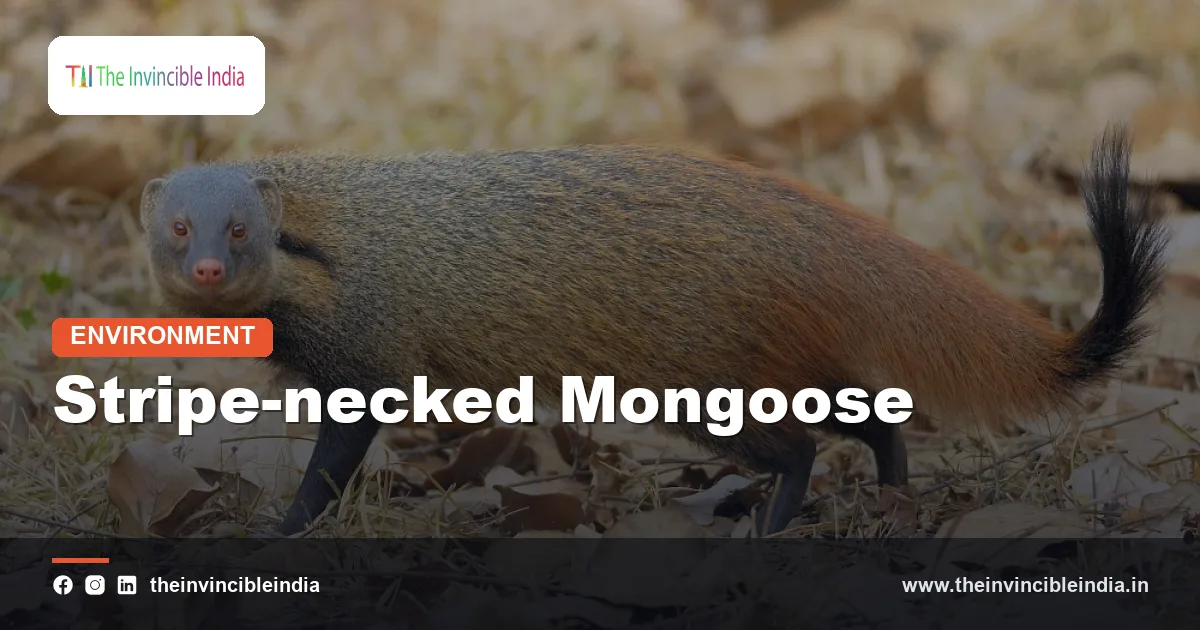
The stripe-necked mongoose (Urva vitticollis) is the largest mongoose in India, a reddish-grey, day-active hunter of the Western Ghats and Sri Lanka that is easily recognised by the dark stripe running down each side of its neck. It lives in forests, plantations and scrub close to streams, where it hunts crabs, frogs, snakes, rodents, birds and insects.
Because the stripe-necked mongoose is shy and lives in dense hill forest, it is far less familiar than the common Indian grey mongoose seen in villages and roadsides. Yet this big, handsome predator is an important part of the Western Ghats food web and a useful sign of healthy forest, and it is still being studied by Indian wildlife biologists.
| Attribute | Detail |
|---|---|
| Common name | Stripe-necked mongoose |
| Scientific name | Urva vitticollis (earlier known as Herpestes vitticollis) |
| Family | Herpestidae (mongooses) |
| Size | Head and body roughly 40 to 50 cm, tail about 30 to 40 cm; weight around 2 to 4 kg |
| Distinctive feature | Black stripe along each side of the neck, from the ear to the shoulder, on a grizzled reddish-grey coat |
| Range | Western Ghats of southern India and Sri Lanka |
| Habitat | Moist forests, plantations and scrub close to streams and wetlands |
| Activity | Mostly diurnal, active in daylight |
| Conservation status | Least Concern on the IUCN Red List; protected under India’s Wildlife (Protection) Act, 1972 |
Key Takeaways
- The stripe-necked mongoose (Urva vitticollis) is the largest of India’s mongooses, reaching a weight of several kilograms and a body length of around half a metre without the tail.
- The stripe-necked mongoose is named for the dark stripe on either side of its neck and is found in the Western Ghats of southern India and in Sri Lanka.
- Unlike most predators of dense forest, the stripe-necked mongoose hunts mainly in daylight, feeding on crabs, frogs, fish, snakes, lizards, rodents, birds, eggs and insects.
- The stripe-necked mongoose is often found close to streams and wet ground, where aquatic prey such as crabs and frogs is plentiful.
- The stripe-necked mongoose resembles the crab-eating mongoose (Urva urva) of north-eastern India, but it is larger, has a dark rather than pale neck stripe, and lives in a different region.
- The stripe-necked mongoose is classed as Least Concern by the IUCN, yet deforestation, road kill and snares in the Western Ghats remain real local threats.
What is the stripe-necked mongoose?
The stripe-necked mongoose is a large, solitary-to-paired carnivore of the mongoose family Herpestidae, and its scientific name is Urva vitticollis. Mongooses are small to medium predators found across Africa, Asia and southern Europe, and India has several species, of which the stripe-necked mongoose is the biggest.
Scientists once placed almost all Asian mongooses in the genus Herpestes. Recent genetic studies led to the Asian species being moved into a separate genus, Urva, so older books and field guides usually refer to the animal as Herpestes vitticollis. Both names refer to the same species.
The word “vitticollis” means “banded neck” in Latin, and refers to the dark stripe that gives the animal its common name.
What does the stripe-necked mongoose look like?
The stripe-necked mongoose looks like a big, shaggy, reddish or greyish-brown mongoose with a long tail, a pointed face and a black stripe along each side of the neck. The coat is coarse and grizzled, which means individual hairs are banded with light and dark shades, giving a speckled or “salt-and-pepper” look.
The stripe starts behind the ear or jaw and runs back to the shoulder. The legs are short and sturdy, and the tail is long, thick at the base and tapering towards the end. The face is slender, and the small rounded ears sit close to the head.
A typical adult is much bulkier than the Indian grey mongoose, and its larger size, heavier build and neck stripe help separate it in the field.
How can you tell it apart from similar mongooses?
The surest identification clues are size, neck stripe and location. The table below summarises the main mongooses of India and how they differ.
| Mongoose | Scientific name | Key identifying feature | Typical region |
|---|---|---|---|
| Stripe-necked mongoose | Urva vitticollis | Large, dark neck stripe, grizzled reddish coat | Western Ghats |
| Crab-eating mongoose | Urva urva | Smaller, with a pale or white stripe from the mouth to the shoulder | North-east India and the Himalayan foothills |
| Indian grey mongoose | Urva edwardsii | Grey, plain coat, common near villages | Most of India |
| Small Indian mongoose | Urva auropunctata | Small, olive-brown, slender | Northern and parts of eastern India |
| Ruddy mongoose | Urva smithii | Reddish coat with black tail tip | Peninsular India |
| Brown mongoose | Urva fusca | Dark brown, forest dweller | Western Ghats |
Where does the stripe-necked mongoose live?
The stripe-necked mongoose lives in the Western Ghats mountains of southern India and in the wet and hill zones of Sri Lanka. Within India, it is mostly recorded from the forests of the southern and central Western Ghats in states such as Kerala, Karnataka and Tamil Nadu, with records extending northwards into Goa and Maharashtra’s forest belts.
The species favours moist forest near water, including evergreen and semi-evergreen forests, moist deciduous forests, forest edges, coffee and tea estates, plantations and scrub close to streams and marshes. It is generally less common in dry open country, where the Indian grey mongoose dominates.
Camera-trap surveys in protected areas of the Western Ghats have recorded the stripe-necked mongoose along forest trails and near streams, usually during daylight hours. This diurnal behaviour makes it one of the few forest carnivores that can be recorded in photographs without needing a night-time camera.
What does the stripe-necked mongoose eat?
The stripe-necked mongoose eats a wide variety of small animals, including crabs, frogs, fish, snakes, lizards, rodents, birds, eggs, insects and some fruit. It is an opportunistic hunter that takes whatever it can catch while foraging along streams and on the forest floor.
Crabs and other freshwater animals are an especially important food, which is why the species is often found near water. In the Western Ghats, freshwater crabs are abundant in streams and wet soil, and a mongoose can catch them in shallow water or among rocks. Rodents and ground-nesting birds are also hunted, and the animal digs into leaf litter and under logs for insects.
Typical prey items
- Freshwater crabs, snails and other water-edge animals.
- Frogs and toads, especially after rain.
- Snakes and lizards, including small venomous species.
- Rats, mice and other small rodents.
- Birds and eggs of ground-nesting species.
- Insects, millipedes and other invertebrates.
- Occasional fruits and carrion.
Does the stripe-necked mongoose really kill snakes?
Yes, the stripe-necked mongoose, like other mongooses, does hunt and eat snakes, although snakes are only one part of its diet. Mongooses have a reputation for fighting cobras, and this reputation partly rests on real biology: mongooses have evolved changes in the nerve receptors that venom targets, which gives them a degree of natural resistance to some snake neurotoxins.
That resistance is not total, and mongooses rely on speed, agility and caution, striking at the head and avoiding direct bites. Researchers caution that a mongoose can still be killed by a large dose of venom. In the Western Ghats, snakes make up a modest share of what the stripe-necked mongoose eats, while crabs, frogs and rodents matter more in daily life.
How does the stripe-necked mongoose behave?
The stripe-necked mongoose behaves as a bold, mostly daytime forager that travels alone or in pairs and moves with a low, gliding walk. It often follows streams, forest tracks and the edges of clearings in search of prey, stopping to sniff, dig or flip stones.
The animal is active mainly in the morning and late afternoon and rests in burrows, tree hollows, rock crevices or dense undergrowth. It will stand on its hind legs to look around, a typical mongoose habit, and it can climb or swim when needed.
Mongooses generally communicate through scent marks and calls. The stripe-necked mongoose is wary of people, and it usually disappears into cover at the first sign of disturbance, which explains why sightings are brief and uncommon.
Foraging is energetic and methodical. The stripe-necked mongoose may wade into shallow water to search under stones for crabs, then carry or crack its catch on hard ground. It also uses its sensitive nose and strong forepaws to dig out insects and small burrowing animals from soft soil. Because it hunts in daylight and covers a lot of ground, its tracks and droppings, often containing crab shell fragments, can sometimes be found along muddy stream banks.
Its daytime habits set it apart from most forest carnivores in India, such as leopard cats, civets and jungle cats, which are largely nocturnal. This difference means the stripe-necked mongoose competes less directly with them for prey, although it is still a target for larger predators such as leopards and pythons.
How does the stripe-necked mongoose breed?
The stripe-necked mongoose breeds in burrows or sheltered dens, and the female usually gives birth to a small litter of two or three young, although detailed breeding data are limited. Very little long-term field research has been done on this forest species, and many details of its reproduction and lifespan are still being documented.
The young are raised in a secure den, protected by the mother until they can follow her on foraging trips. Like other mongooses, the pups learn to hunt by watching adults and practising on small prey.
Because comprehensive population studies are scarce, conservationists rely on camera-trap records, forest-survey data and sightings submitted by naturalists to understand where the species lives and how it is doing.
Is the stripe-necked mongoose endangered?
No, the stripe-necked mongoose is not endangered globally and is classified as Least Concern by the IUCN, but it faces local pressures in parts of its range. The Western Ghats are a biodiversity hotspot under heavy human pressure, and the species depends on forest and wetland habitat that is being lost or fragmented.
- Forest loss: Conversion of forest to plantations, farms, mines and townships removes cover and prey.
- Roads and traffic: Highways through forest belts cause road kills of diurnal mammals such as mongooses.
- Snares and traps: Wire snares set for other animals can catch mongooses by accident.
- Dogs and disturbance: Free-ranging dogs near forest edges attack small carnivores.
- Hunting and trade: Mongooses have been targeted for their hair, which was once used for brushes, even though trade is banned.
In India, mongooses are protected by the Wildlife (Protection) Act, 1972, and the trade in mongoose hair is prohibited. Protected areas across the Western Ghats provide the most secure habitat.
Why does the stripe-necked mongoose matter?
The stripe-necked mongoose matters because it is a mid-sized predator that regulates populations of crabs, frogs, rodents and snakes while also serving as prey for larger carnivores. By occupying a niche as a daytime hunter near streams, it links aquatic and forest food webs.
It also acts as an indicator species. Because the animal needs intact moist forest with clean streams and good prey, its presence suggests a relatively healthy habitat. Records of the species in new areas help scientists redraw its distribution map, which is particularly valuable in the Western Ghats, a UNESCO World Heritage region noted for its endemic wildlife.
The mongoose also helps in the control of rodents in plantation edges, which can reduce damage to crops and stored produce.
How can people help the stripe-necked mongoose?
People can help the stripe-necked mongoose by protecting forest and stream habitat, reducing wildlife road kills, avoiding snares and reporting sightings to scientists. Small everyday actions can add up for a species that is hard to study.
- Support the protection of Western Ghats forests and the creation of wildlife corridors.
- Drive slowly on forest roads, especially in the early morning and late afternoon when diurnal animals cross.
- Keep dogs on a leash and away from forest edges.
- Report sightings and photographs to citizen-science platforms or local forest departments.
- Reject products made from wildlife parts, including mongoose hair brushes.
Bottom Line
The stripe-necked mongoose is India’s largest mongoose and a charismatic, little-studied hunter of Western Ghats streams and forests. Securing forest habitat, safer roads and better survey data will help ensure that this reddish, neck-striped predator keeps patrolling the hills in daylight.
Frequently Asked Questions
Is the stripe-necked mongoose the largest mongoose in India?
Yes, the stripe-necked mongoose is the largest mongoose found in India. Adults commonly weigh around 2 to 4 kilograms and have a head and body length of roughly half a metre.
Where is the stripe-necked mongoose found?
The stripe-necked mongoose is found in the Western Ghats of southern India and in Sri Lanka. It prefers moist forest, plantations and scrub close to streams.
What does the stripe-necked mongoose eat?
The stripe-necked mongoose eats crabs, frogs, fish, snakes, lizards, rodents, birds, eggs and insects, and sometimes fruit. It is an opportunistic hunter that forages mostly during the day.
How is the stripe-necked mongoose different from the crab-eating mongoose?
The stripe-necked mongoose (Urva vitticollis) lives in the Western Ghats and is larger, while the crab-eating mongoose (Urva urva) lives in north-eastern India and the Himalayan foothills and is smaller. Both have a stripe on the neck, but the stripe-necked mongoose has a dark one and the crab-eating mongoose a pale one, so stripe colour and location are the easiest clues.
Is the stripe-necked mongoose active during the day or night?
The stripe-necked mongoose is mainly active during the day. It forages in the morning and late afternoon and rests in burrows or dense cover at other times.
Is the stripe-necked mongoose protected in India?
Yes, the stripe-necked mongoose is protected under India’s Wildlife (Protection) Act, 1972, which prohibits hunting and trade in mongoose products. Globally, it is classed as Least Concern by the IUCN.
{“@context”:”https://schema.org”,”@graph”:[{“@type”:”FAQPage”,”mainEntity”:[{“@type”:”Question”,”name”:”Is the stripe-necked mongoose the largest mongoose in India?”,”acceptedAnswer”:{“@type”:”Answer”,”text”:”Yes, the stripe-necked mongoose is the largest mongoose found in India. Adults commonly weigh around 2 to 4 kilograms and have a head and body length of roughly half a metre.”}},{“@type”:”Question”,”name”:”Where is the stripe-necked mongoose found?”,”acceptedAnswer”:{“@type”:”Answer”,”text”:”The stripe-necked mongoose is found in the Western Ghats of southern India and in Sri Lanka. It prefers moist forest, plantations and scrub close to streams.”}},{“@type”:”Question”,”name”:”What does the stripe-necked mongoose eat?”,”acceptedAnswer”:{“@type”:”Answer”,”text”:”The stripe-necked mongoose eats crabs, frogs, fish, snakes, lizards, rodents, birds, eggs and insects, and sometimes fruit. It is an opportunistic hunter that forages mostly during the day.”}},{“@type”:”Question”,”name”:”How is the stripe-necked mongoose different from the crab-eating mongoose?”,”acceptedAnswer”:{“@type”:”Answer”,”text”:”The stripe-necked mongoose (Urva vitticollis) lives in the Western Ghats and is larger, while the crab-eating mongoose (Urva urva) lives in north-eastern India and the Himalayan foothills and is smaller. Both have a stripe on the neck, but the stripe-necked mongoose has a dark one and the crab-eating mongoose a pale one, so stripe colour and location are the easiest clues.”}},{“@type”:”Question”,”name”:”Is the stripe-necked mongoose active during the day or night?”,”acceptedAnswer”:{“@type”:”Answer”,”text”:”The stripe-necked mongoose is mainly active during the day. It forages in the morning and late afternoon and rests in burrows or dense cover at other times.”}},{“@type”:”Question”,”name”:”Is the stripe-necked mongoose protected in India?”,”acceptedAnswer”:{“@type”:”Answer”,”text”:”Yes, the stripe-necked mongoose is protected under India’s Wildlife (Protection) Act, 1972, which prohibits hunting and trade in mongoose products. Globally, it is classed as Least Concern by the IUCN.”}}]}]}


