

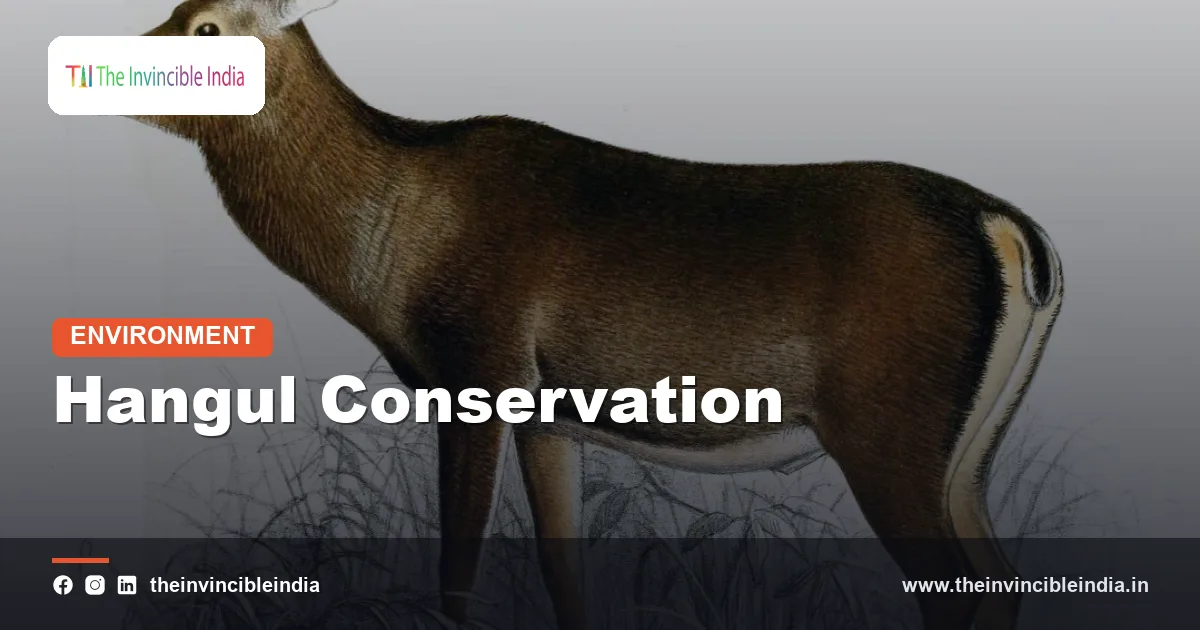
The Hangul, also known as the Kashmir stag, is a large, majestic deer that is native to the mountain forests of Jammu and Kashmir. It is the only surviving subspecies of red deer found in India, and it is the state animal of Jammu and Kashmir. Mature males carry broad, branching antlers that make them one of the most recognisable deer in South Asia, and their autumn bellowing in the forests of the Kashmir valley is one of the region’s great wildlife experiences.
The Hangul is also one of India’s most precarious conservation stories. A population that was once numbered in the thousands in the early twentieth century fell to a few hundred animals within decades, and almost the entire surviving group now lives in and around a single protected area, Dachigam National Park, close to Srinagar. This article explains what the Hangul is, how it lives, why it declined, what threatens it today, and what has been done to rescue it.
Quick Facts
| Feature | Details |
|---|---|
| Common names | Hangul, Kashmir stag |
| Scientific name | Cervus hanglu hanglu (formerly treated as Cervus elaphus hanglu) |
| Family | Cervidae (deer) |
| Distribution | Kashmir Himalaya, India (historically also a few adjacent valleys) |
| Main stronghold | Dachigam National Park, near Srinagar |
| IUCN status | Critically Endangered |
| Legal status in India | Schedule I, Wildlife (Protection) Act, 1972 |
| Special programme | Project Hangul, launched in 1970 |
| State animal of | Jammu and Kashmir |
What Is the Hangul?
The Hangul is a subspecies of the red deer, a group of large deer that ranges across Europe, North Africa, western and Central Asia. The Kashmir population is distinct because it has been isolated in the Himalayan valleys for a very long time. Zoologists describe it as a regional form with its own features, and it is the only red deer to survive in India. Some other subspecies live in the mountains of Central Asia to the north, but they are separated from the Hangul by high ranges and long distances.
The name “Hangul” comes from the local Kashmiri language. In older English writing, the animal is called the Kashmir stag, and sporting literature of the colonial period often refers to it by that name. It occupies an unusual place among India’s large mammals, since its range is at the northern edge of the country, where temperate forest, alpine meadows and snow-bound peaks meet.
Taxonomy and classification
Classification of the red deer has changed over the years. For a long time all red deer were treated as one species, Cervus elaphus, with many subspecies, among them the Hangul. More recent genetic work has led several authorities to split the group, and the Kashmir stag is now frequently placed within a Central Asian species, Cervus hanglu. For general readers, the key point is unchanged: the Hangul is the Indian representative of the red deer family and a unique genetic lineage.
Appearance, Diet and Behaviour
An adult Hangul stag is a large, strongly built deer with a dark brown coat that appears greyish in winter, and a pale patch around the tail. The male’s antlers are the animal’s most striking feature. Each year they are shed and regrown, and fully developed antlers can have many tines, often described by field naturalists as an eleven-point or larger rack, with a distinct crown at the top in older males. Females are smaller and do not carry antlers.
Food
The Hangul is a herbivore, which grazes and browses. It feeds on grasses, herbs, leaves, shoots and the bark of some shrubs. In summer, it favours alpine meadows with abundant fresh grass, and in winter, when higher areas are covered by snow, it forages on the forest floor and on browse in lower slopes.
Breeding season
The breeding season, known as the rut, takes place in autumn, usually from September into October. Males call loudly, a deep roar or bellow that carries across the valley, and compete for the attention of females. Fawns are generally born in late spring or early summer after a gestation of about eight months, normally one at a time. The fawn is hidden in vegetation during its first days, which protects it from predators but also makes it difficult to monitor.
Habitat and Seasonal Movements
The Hangul lives in temperate and subalpine forests and in alpine pastures at altitudes between roughly 1,600 and 3,500 metres or higher. Its habitat consists of dense stands of conifers, such as fir, spruce and pine, mixed with broad-leaved trees such as oak and maple in places, and open glades and meadows.
The animal makes a seasonal migration which is vital to its survival.
- Summer: herds move up to the high-altitude pastures of the upper reaches, where grass is abundant and the weather is cool.
- Winter: as snow covers the heights, they descend to the lower valley and forests, where food is more available and temperatures are milder.
Why corridors matter
This vertical migration requires uninterrupted paths between high and low ground. Where roads, fences, settlements, orchards or heavy grazing block these paths, the animals lose access to key seasonal resources. Conservation of the Hangul is therefore not only about the park itself but about the landscape corridors that surround it.
Dachigam National Park: The Last Stronghold
Dachigam National Park is located about 20 kilometres from Srinagar, in the Zabarwan range, and covers roughly 140 square kilometres. The name is often interpreted as “ten villages”, a reference to the villages that were relocated when the area was set aside. In the early twentieth century, the area was kept as a protected reserve, partly to safeguard the catchment of the water supply for Srinagar and partly as a hunting preserve of the ruler of the princely state. It was notified as a national park in 1981.
The park is divided into two sections, called Lower Dachigam and Upper Dachigam. Lower Dachigam is the lower-elevation area which is accessible to visitors and the main wintering ground for Hangul. Upper Dachigam is a high-altitude zone of meadows and rocky slopes, where the animals spend the summer months, and it is more difficult to access.
Other wildlife
Dachigam is known for more than the Hangul. The park shelters the Himalayan black bear, the Himalayan brown bear, the leopard, the musk deer, the Himalayan serow and the Himalayan goral. It is also a bird-watching area with species such as monal pheasants and several kinds of Himalayan thrushes and finches. The Dagwan stream flows through the park and supplies water to the area.
The Dramatic Population Decline
Historical accounts suggest that the Hangul was widespread in the valleys and forests of Kashmir, and that it also occurred in some neighbouring areas such as Chamba in the Himalaya. In the early twentieth century, the population is often cited as being in the thousands. By the middle of the century, numbers had dropped significantly, and by the 1960s and 1970s surveys indicated that only a few hundred animals remained, concentrated in Dachigam and a few other locations.
| Period | General situation |
|---|---|
| Early twentieth century | Population believed to be in the thousands and spread across several valleys |
| Mid-twentieth century | Sharp decline because of hunting, habitat loss and disturbance |
| 1970 | Project Hangul launched by the state government with international conservation partners |
| 1980s onwards | Dachigam notified as a national park; populations fluctuate at low levels |
| Recent decades | Counts of a few hundred animals, with occasional modest increases and decreases |
Population estimates vary between surveys and methods, and numbers reported over the years should be regarded as approximate. What is beyond doubt is the scale of the overall collapse in the past century, from a widespread species to a small, concentrated remnant.
Threats to the Hangul
A combination of historical and ongoing factors explains the Hangul’s decline. Conservation biologists generally highlight the following threats.
- Poaching and hunting: the animal was a prized trophy and a source of meat, and illegal hunting contributed significantly to the decline in the twentieth century, especially in periods of weak enforcement.
- Habitat fragmentation and loss: felling of forests, expansion of orchards and settlements, and construction of roads reduced the area available to the species and cut off migration routes.
- Livestock grazing: in the high pastures, seasonal herds of sheep and goats, along with their herders and dogs, compete for forage and cause disturbance.
- Predation: leopards, bears and feral dogs take adult animals and fawns; with very small herds this natural pressure matters more.
- Low fawn survival and skewed sex ratio: in some years surveys have recorded few fawns per hundred females, and too few adult males relative to females, which limits breeding success.
- Small, isolated population: a single main population is vulnerable to disease, severe winters or other shocks, and has limited genetic diversity.
The problem of one population
Having nearly all of the animals concentrated in one park is risky from a conservation point of view. If an epidemic, fire or other disaster were to strike Dachigam, the species could suffer a catastrophic loss. For this reason, managers have long emphasised the need to establish additional populations in other suitable locations.
Legal Protection and Conservation Status
The Hangul is assessed as Critically Endangered on the IUCN Red List, one step away from being extinct in the wild. In India it is listed in Schedule I of the Wildlife (Protection) Act, 1972, which prohibits hunting and provides stringent penalties for offences. Dachigam, which is its main habitat, has the status of a national park, the strongest category of area protection under the same law.
Several other protected areas in Jammu and Kashmir also have historical or potential links with the species, including Overa-Aru Wildlife Sanctuary and Kishtwar High Altitude National Park, as well as conservation reserves and sanctuaries in the Kashmir valley such as the Tral area. Protecting this wider network is important for the long-term recovery of the animal.
The role of the state department
Protection is carried out principally by the Wildlife Protection Department of Jammu and Kashmir, with support from scientific institutions and conservation organisations. Anti-poaching patrols, habitat management, regular census operations and community outreach are the core activities in the field.
Project Hangul and Conservation Efforts
Project Hangul was launched in 1970 by the Government of Jammu and Kashmir, with the cooperation of the International Union for Conservation of Nature (IUCN) and the World Wildlife Fund (WWF). It was among the earliest species-specific recovery programmes in India, coming only a few years before Project Tiger in 1973. It aimed to stop the decline of the Hangul by strengthening protection of Dachigam, surveying the population, reducing livestock pressure and improving habitat.
Several measures have been tried or proposed since then.
- Population monitoring: periodic censuses in Dachigam and surrounding areas, using methods such as direct counts and sign surveys.
- Habitat management: controlling grazing, removing disturbance, maintaining meadows and protecting key winter areas.
- Relocation of grazers and settlements from the park’s interior, in order to reduce competition and disturbance.
- Conservation breeding: a breeding centre at Shikargah in the Tral area was established to maintain a captive group of animals and, in principle, to supply individuals for the establishment of new populations.
- Research: studies by scientific institutions on genetics, movement, diet and fawn survival, to guide management.
Challenges in Recovery
Progress has been slow and uneven. The number of Hangul has risen in some years and declined in others, and it has never returned to its historical level. Recovery efforts face a number of practical difficulties.
Ecological and logistical difficulties
The animal lives in rugged mountain terrain, which makes surveys expensive and hard to repeat consistently. Fawns are hidden and rarely seen, so survival data are uncertain. The captive-breeding approach requires sufficient founders and careful handling to ensure that animals can be released successfully, and conservation breeding of deer has its own technical and genetic requirements.
Social and security factors
Local communities depend on forests and pastures for their livelihoods, and effective conservation requires their participation. Periods of unrest in the region have in the past limited access, monitoring and enforcement, and have allowed disturbance and illegal activity to rise. Better livelihoods, alternative pastures and cooperation with local people are important parts of a lasting solution.
Ecological and Cultural Significance
As a large herbivore, the Hangul has an important role in the mountain ecosystem. It influences vegetation through grazing and browsing, it disperses seeds, and it is a prey animal for leopards and bears. Its presence also signals that large tracts of forest and meadow are still functioning in the Kashmir Himalaya. Conserving it brings benefits to many other species with which it shares its habitat.
The deer also has a prominent place in the identity of the region. It is the state animal of Jammu and Kashmir, features in local conservation campaigns, and attracts nature tourists to Dachigam. Its name is familiar to wildlife enthusiasts well beyond the valley, and it represents the natural heritage of Kashmir as strongly as the lakes and gardens that visitors associate with the region.
Conclusion
The story of the Hangul shows how swiftly a widespread large mammal can be reduced to a single remnant population, and how difficult it is to reverse that process. At the same time, the survival of the species through the last century, thanks to Dachigam National Park, Project Hangul and sustained protection, demonstrates that conservation can work. Long-term recovery will depend on secure habitat corridors, controlled grazing, the creation of additional populations, careful research on fawn survival and the support of local people. If these steps succeed, the Kashmir stag may once again be seen across the forests and meadows of the Himalayan valleys.
Frequently Asked Questions
What is the Hangul?
The Hangul, or Kashmir stag, is a subspecies of red deer found in the Kashmir Himalaya. It is the only surviving red deer in India and the state animal of Jammu and Kashmir. Males are known for their large, branching antlers.
Where is the Hangul found?
Almost the entire remaining population lives in and around Dachigam National Park, about 20 kilometres from Srinagar. Small numbers may also occur in a few neighbouring forests of the Kashmir valley and nearby ranges.
Why is the Hangul critically endangered?
The species declined because of hunting, loss and fragmentation of habitat, competition with livestock, predation and low fawn survival. Because nearly all animals live in one area, the population is also at risk from disease and other sudden shocks.
What is Project Hangul?
Project Hangul was launched in 1970 by the Jammu and Kashmir government with the support of IUCN and WWF. It aimed to protect the Hangul and its habitat in Dachigam through monitoring, habitat management and reduction of disturbance.
When is the best time to see the Hangul?
The animals descend to the lower parts of Dachigam during the cold months, which makes winter and the autumn breeding season the usual times for sightings. In summer, they move to the high pastures and are harder to spot. Visits require permission from the park authorities.
Is the Hangul protected by law?
Yes. It is listed in Schedule I of the Wildlife (Protection) Act, 1972, and its main habitat is a national park. Hunting or trading the animal is a punishable offence, and the IUCN classifies it as Critically Endangered.
{“@context”:”https://schema.org”,”@graph”:[{“@type”:”FAQPage”,”mainEntity”:[{“@type”:”Question”,”name”:”What is the Hangul?”,”acceptedAnswer”:{“@type”:”Answer”,”text”:”The Hangul, or Kashmir stag, is a subspecies of red deer found in the Kashmir Himalaya. It is the only surviving red deer in India and the state animal of Jammu and Kashmir. Males are known for their large, branching antlers.”}},{“@type”:”Question”,”name”:”Where is the Hangul found?”,”acceptedAnswer”:{“@type”:”Answer”,”text”:”Almost the entire remaining population lives in and around Dachigam National Park, about 20 kilometres from Srinagar. Small numbers may also occur in a few neighbouring forests of the Kashmir valley and nearby ranges.”}},{“@type”:”Question”,”name”:”Why is the Hangul critically endangered?”,”acceptedAnswer”:{“@type”:”Answer”,”text”:”The species declined because of hunting, loss and fragmentation of habitat, competition with livestock, predation and low fawn survival. Because nearly all animals live in one area, the population is also at risk from disease and other sudden shocks.”}},{“@type”:”Question”,”name”:”What is Project Hangul?”,”acceptedAnswer”:{“@type”:”Answer”,”text”:”Project Hangul was launched in 1970 by the Jammu and Kashmir government with the support of IUCN and WWF. It aimed to protect the Hangul and its habitat in Dachigam through monitoring, habitat management and reduction of disturbance.”}},{“@type”:”Question”,”name”:”When is the best time to see the Hangul?”,”acceptedAnswer”:{“@type”:”Answer”,”text”:”The animals descend to the lower parts of Dachigam during the cold months, which makes winter and the autumn breeding season the usual times for sightings. In summer, they move to the high pastures and are harder to spot. Visits require permission from the park authorities.”}},{“@type”:”Question”,”name”:”Is the Hangul protected by law?”,”acceptedAnswer”:{“@type”:”Answer”,”text”:”Yes. It is listed in Schedule I of the Wildlife (Protection) Act, 1972, and its main habitat is a national park. Hunting or trading the animal is a punishable offence, and the IUCN classifies it as Critically Endangered.”}}]}]}


