

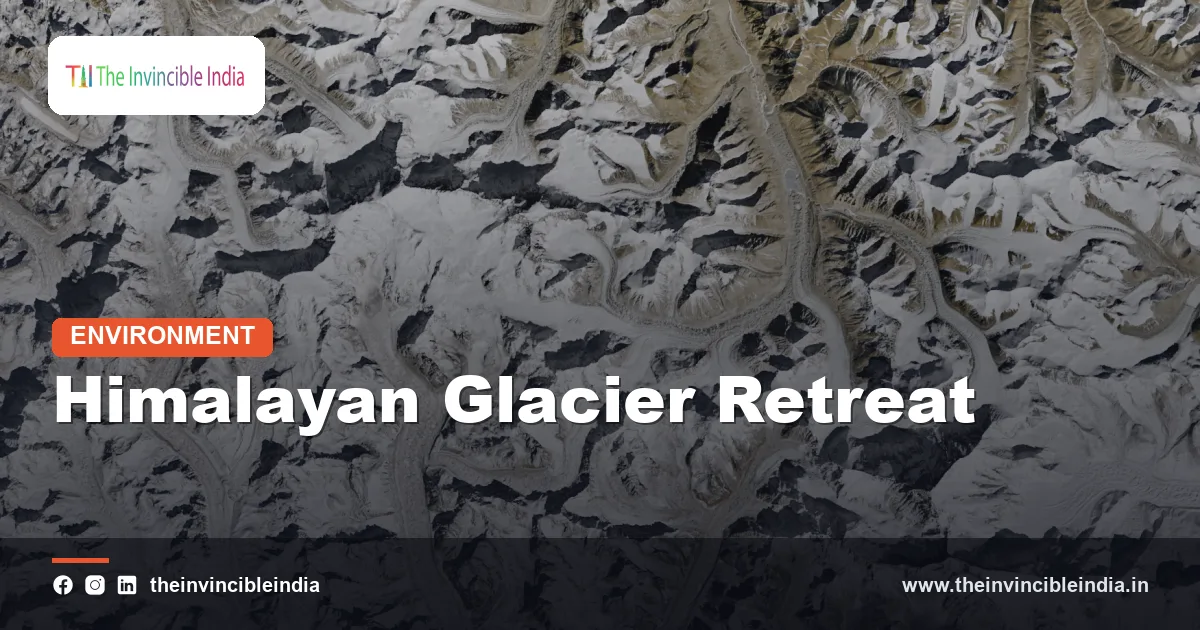
Himalayan glaciers are the vast stores of frozen water in the mountain arc from the Hindu Kush to Arunachal Pradesh, feeding the Indus, Ganga and Brahmaputra river systems that support hundreds of millions of people, and most of them are now thinning and retreating as the climate warms. Together with the Tibetan Plateau, the high mountains hold more ice than any region outside the polar caps, which is why scientists call them the “Third Pole” and the “water towers” of Asia.
The retreat of Himalayan glaciers matters to India because the melt supports rivers in the dry season, the retreating ice creates unstable lakes and slopes that threaten mountain communities, and the long-term loss of ice will change water supplies for farms, cities and hydropower. The science is clear on the general direction, but the speed, the local differences and the downstream consequences remain subjects of active research and honest uncertainty.
| Quick Facts | Details |
|---|---|
| Region | Hindu Kush Himalaya (HKH), plus the Karakoram, across eight countries including India |
| Nickname | “Third Pole”, the largest ice store outside the Arctic and Antarctic |
| Rivers fed | Indus, Ganga (via Bhagirathi, Alaknanda), Brahmaputra and their tributaries |
| Indian glacier states and territories | Ladakh, Jammu and Kashmir, Himachal Pradesh, Uttarakhand, Sikkim and Arunachal Pradesh |
| Well-known glaciers | Gangotri, Siachen, Zemu, Pindari, Milam, Drang-Drung |
| Main trend | Overall mass loss and retreat since the mid-nineteenth century, with faster loss in recent decades |
| Notable exception | The “Karakoram anomaly”, where some glaciers were stable or advancing in the early 2000s |
| Key hazards | Glacial lake outburst floods (GLOFs), avalanches, changing river flows |
| Indian monitoring bodies | Geological Survey of India, Wadia Institute of Himalayan Geology, National Centre for Polar and Ocean Research, Central Water Commission and others |
Key Takeaways
- Himalayan glaciers form part of the Hindu Kush Himalaya, the largest store of snow and ice outside the polar regions, and feed the Indus, Ganga and Brahmaputra river systems.
- Most Himalayan glaciers have been losing mass and retreating for more than a century, and studies of satellite data indicate that the rate of ice loss has increased in recent decades.
- Glaciers in the Himalaya do not behave uniformly: debris-covered glaciers, high-altitude glaciers and the Karakoram’s glaciers respond differently to warming.
- Black carbon and dust that settle on snow and ice darken the surface, absorb more sunlight and add to melt, alongside the main driver of rising air temperature.
- Glacial lake outburst floods and ice-rock avalanches are growing mountain hazards linked to glacier retreat, as shown by the 2021 Chamoli disaster in Uttarakhand and the 2023 South Lhonak lake outburst in Sikkim.
- Scientists agree that Himalayan ice will keep shrinking in a warmer world, but the exact timing of “peak water”, the point after which glacier runoff declines, and the effect on each river basin remain uncertain.
What Are Himalayan Glaciers and Why Are They Called the “Water Towers” of Asia?
Himalayan glaciers are slow-moving rivers of ice formed from compacted snow at high altitude, and they are called the “water towers” of Asia because they store water as ice and snow in winter and release it gradually through the warm season. This stored water supports rivers in months when rain is scarce.
The Hindu Kush Himalaya spans about 3,500 kilometres across Afghanistan, Pakistan, India, China, Nepal, Bhutan, Bangladesh and Myanmar. The region contains thousands of glaciers, which together feed ten major river systems. Together with snow cover, permafrost and seasonal ice, this frozen store influences the water supply of a population of well over a billion people in the downstream basins.
In India, glaciers lie in the Himalaya of Jammu and Kashmir, Ladakh, Himachal Pradesh, Uttarakhand, Sikkim and Arunachal Pradesh, and in the Karakoram range in Ladakh, where the Siachen Glacier, one of the longest glaciers outside the polar regions, is situated.
Which Indian Rivers Depend on Himalayan Glaciers?
The Indian rivers that depend on Himalayan glaciers include the Indus and its tributaries, the Ganga with its headstreams, and the Brahmaputra, although each river relies on glacier melt to a very different degree. The Ganga’s main headstream, the Bhagirathi, begins at the snout of the Gangotri Glacier at Gaumukh in Uttarakhand, and the Alaknanda gets meltwater from glaciers such as those near Satopanth and Bhagirathi Kharak.
The reliance on glacier melt differs by basin.
- Indus basin: The upper Indus, in a cold and dry region with little monsoon rain, depends strongly on snow and glacier melt, particularly in summer. This makes the basin the most sensitive to glacier change.
- Ganga basin: Glaciers feed the upper reaches in the mountains, but downstream the monsoon rains and groundwater dominate the flow. Glacier melt is still valuable in the dry months before the monsoon.
- Brahmaputra basin: Snow and glacier melt contributes along the Tibetan and eastern Himalayan sections, while monsoon rain dominates much of the flow in Assam.
Scientists caution against simple claims that “the Ganga will dry up”. The monsoon, groundwater and rainfall supply most of the water in the Ganga plains, while glacier melt is an important buffer in the upper basins and in dry years.
How Fast Are Himalayan Glaciers Retreating?
Himalayan glaciers are retreating at different speeds depending on the glacier, with most losing ice and shrinking in length, and satellite studies showing that the pace of mass loss has risen since the early 2000s. Estimates of retreat rates range from near zero for some glaciers to tens of metres a year for others.
The differences in measurement make exact figures uncertain. Glaciers can lose ice by thinning without retreating much at the snout, particularly if they are covered with rocky debris. Records based on field surveys are sparse because many glaciers lie in remote, high and dangerous terrain, and satellite measurements need careful processing.
A major assessment of the Hindu Kush Himalaya by the International Centre for Integrated Mountain Development (ICIMOD), released in 2019, concluded that even if global warming is limited to the Paris Agreement goal, a significant share of the region’s ice, roughly a third, could be lost by 2100, and that much larger losses would occur under high emissions. A follow-up report in 2023 indicated that ice loss in the 2010s was faster than in the previous decade. These are model-based estimates with ranges, and they are updated as new data arrive.
What Is Causing the Retreat of Himalayan Glaciers?
The retreat of Himalayan glaciers is caused mainly by rising air temperatures from human-driven climate change, which increase melting in summer and reduce the share of precipitation that falls as snow. Several other factors modify how quickly each glacier responds.
- Warming air: The Himalaya has warmed along with the global climate, and some studies suggest that high mountains warm faster than lower regions, a pattern called elevation-dependent warming.
- Changing snowfall: Glaciers grow where snowfall exceeds melt. A shift from snow to rain, or a fall in winter snowfall, reduces the supply of new ice.
- Black carbon and dust: Soot from burning wood, crop residue, diesel and industry, much of it from the Indo-Gangetic plain, travels up the mountains and settles on snow, darkening the surface and increasing the absorption of sunlight.
- Glacial lakes: Meltwater collecting at the glacier’s end can warm the ice front and speed up its breakup.
- Debris cover: A thick layer of rock insulates ice, while thin debris or exposed cliffs and ponds on the surface accelerate melting.
Natural year-to-year variability in monsoon and winter storms also affects glaciers. Long-term observation is needed to separate this noise from the signal of climate change.
What Is the Role of Black Carbon in Glacier Melt?
Black carbon contributes to glacier melt by darkening snow and ice, which makes the surface absorb more sunlight rather than reflect it, so that melting begins earlier and proceeds faster. Black carbon is fine soot produced by incomplete burning of fuels and biomass.
Sources in South Asia include cooking fires, brick kilns, diesel engines, burning of crop residue and forest fires. Winds carry the soot from the Indo-Gangetic plain up valleys to the high mountains, where it is deposited with snow or as dry particles. Natural dust from deserts adds to the effect. Research indicates that black carbon makes a measurable contribution to the melting of snow, especially in spring before the monsoon, but that global greenhouse warming remains the larger driver of long-term glacier loss.
The importance of black carbon is that it can be reduced faster than carbon dioxide, since cleaner cookstoves, better brick kilns and less burning of crop residue offer both health and climate benefits.
Do All Himalayan Glaciers Behave the Same Way?
All Himalayan glaciers do not behave the same way, because their response depends on altitude, climate zone, size, slope and the amount of rock debris on the surface. The clearest example is the Karakoram anomaly.
| Region or type | Typical behaviour | Main reason |
|---|---|---|
| Eastern and central Himalaya | Rapid thinning and retreat | Monsoon-fed glaciers are sensitive to warming and to the loss of snow |
| Western Himalaya | Thinning, with moderate retreat | Mix of winter snowfall from western disturbances and summer melt |
| Karakoram | Near-balanced or slightly gaining mass in the early 2000s, with some surging glaciers | Winter snowfall from westerlies and cool summers; the anomaly may be weakening |
| Debris-covered glaciers | Thin, slow to retreat at the snout, with ponds and lakes forming | Rock cover insulates ice, but ice cliffs and ponds melt faster |
| Clean-ice glaciers | Quick response to temperature | Direct exposure to sun and air |
The Karakoram anomaly refers to the finding that some glaciers in the Karakoram range, which includes Siachen and Baltoro, were stable or even gaining mass in the 2000s, unlike most glaciers around the world. Scientists link this to increased winter snowfall carried by westerly winds and to cool, cloudy summers. Several more recent studies suggest the Karakoram has begun to lose mass as well, although this is debated, and surging glaciers there remain a hazard because they can advance rapidly and block rivers.
What Are Glacial Lakes and GLOFs?
Glacial lakes are bodies of meltwater that collect in front of, on top of or beside a retreating glacier, and a glacial lake outburst flood (GLOF) is a sudden release of that water when the natural dam of ice or loose rock fails. GLOFs can send walls of water, mud and boulders down valleys, travelling long distances at great speed.
Retreat creates many new lakes and enlarges existing ones, so the number and area of glacial lakes in the Himalaya has grown. Triggers include avalanches or landslides falling into the lake, heavy rainfall, earthquakes and the melting of ice that supports the dam.
Events that illustrate the range of hazards include the following.
- Kedarnath, Uttarakhand, June 2013: Extreme rainfall caused a catastrophic flood. Scientists regard extreme rain as the main trigger, and the possible role of a glacial lake and loose debris in the upper catchment was also studied.
- Chamoli, Uttarakhand, February 2021: A large rock and ice avalanche fell into the Rishiganga valley and sent a debris flood down the Rishiganga and Dhauliganga, destroying hydropower works and killing many people. It was not a classic GLOF, but it showed the danger of unstable high-mountain slopes.
- South Lhonak lake, Sikkim, October 2023: The lake burst, reportedly after an avalanche or landslide-linked failure of its moraine dam, and the flood surged down the Teesta, damaging the Chungthang dam and many downstream areas.
What Does Glacier Retreat Mean for India’s Water Security?
Glacier retreat means that India’s mountain rivers will carry more water for a time as ice melts faster, and then less once the ice shrinks, a pattern known as “peak water”. The date of peak water differs by river basin, and the impacts depend on how much of the river’s flow comes from glaciers in the first place.
The important implications are listed below.
- Dry-season flows: Late-spring and early-summer flows in glacier-fed rivers, especially in the Indus basin, may eventually decline, affecting irrigation and drinking water before the monsoon arrives.
- Hydropower: India has built and planned many hydropower projects in the Himalaya. Changing flows and the risk of floods and sediment affect their design and safety.
- Mountain communities: Villages that depend on glacier-fed streams for drinking water and irrigation, such as in Ladakh, Spiti and Sikkim, already see changing supplies.
- Floods and sediment: Meltwater surges, GLOFs and heavy rain on unstable slopes increase flood and sediment risk.
- Cross-border dimension: Rivers such as the Indus and Brahmaputra flow across borders, so changes in glacier melt carry diplomatic and treaty implications.
Water experts point out that India’s greatest present water stress in the plains comes from groundwater depletion and heavy demand rather than glacier loss. Glacier change is a long-term risk that adds to these existing pressures.
What Is India Doing to Study and Manage the Risk?
India is studying and managing glacier-related risks through scientific monitoring, national missions on climate and the Himalaya, hazard mapping and disaster-management guidelines. Several institutions measure and map glaciers, using field surveys and satellite data.
- The Geological Survey of India and the Wadia Institute of Himalayan Geology carry out glacier inventories and field studies.
- The National Centre for Polar and Ocean Research (NCPOR) runs the Himansh research station in the Chandra basin of Himachal Pradesh, near the Chhota Shigri glacier, and conducts long-term mass-balance studies.
- The National Mission for Sustaining the Himalayan Ecosystem, one of the missions under the National Action Plan on Climate Change launched in 2008, supports research and capacity building.
- The National Disaster Management Authority (NDMA) has issued guidance on the management of glacial lake outburst floods, including mapping of risky lakes, early-warning systems and engineering to lower lake levels.
- Early-warning systems, automatic weather stations and lake monitoring using satellites and sensors are being installed in vulnerable valleys.
Experts say that gaps remain. Long-term field measurements cover only a few glaciers, and local communities often have little warning of upstream hazards. Better data sharing across the Himalayan countries is also a priority.
Bottom Line
Himalayan glaciers are shrinking, and their loss will reshape river flows, mountain hazards and water planning in India for generations. The broad trend is clear, but rates differ from glacier to glacier, and the Karakoram shows that local conditions matter. Reducing greenhouse gases and soot, improving monitoring, and preparing mountain communities for floods are the realistic responses.
Frequently Asked Questions
Why are Himalayan glaciers called the Third Pole?
Himalayan glaciers are called the Third Pole because the Hindu Kush Himalaya and Tibetan Plateau hold the largest store of ice and snow outside the Arctic and Antarctic. This frozen reserve feeds major rivers that support hundreds of millions of people. The nickname highlights how important and how vulnerable the region is.
Are all Himalayan glaciers melting?
Most Himalayan glaciers are losing mass and retreating, but not all behave the same way. Some glaciers in the Karakoram were stable or gaining ice in the early 2000s because of increased winter snowfall and cool summers, though more recent studies suggest this may be changing. Debris-covered glaciers also respond differently from clean-ice glaciers.
Will the Ganga dry up if Himalayan glaciers disappear?
The Ganga will not dry up if Himalayan glaciers disappear, because most of its water in the plains comes from monsoon rain and groundwater. Glacier melt is more important in the upper reaches and in the dry months before the monsoon. The Indus basin depends much more heavily on glacier and snow melt than the Ganga does.
What is a glacial lake outburst flood?
A glacial lake outburst flood, or GLOF, is a sudden release of water from a lake held back by ice or loose rock at a glacier’s edge. The flood can race down valleys and destroy bridges, roads, homes and hydropower plants. The 2023 South Lhonak lake flood in Sikkim is a recent example.
How does black carbon affect Himalayan glaciers?
Black carbon darkens snow and ice so that the surface absorbs more sunlight and melts earlier. The soot comes from burning of fuels, wood and crop residue, and winds carry it up from the plains to the mountains. Black carbon speeds up melting, but rising global temperatures from greenhouse gases remain the main long-term cause of glacier loss.
How much of the Himalayan ice could be lost by 2100?
A major regional assessment found that roughly a third of the Hindu Kush Himalaya’s ice could be lost by 2100 even if warming is held to the Paris Agreement target, and far more under high emissions. These are projections with wide ranges and depend on future emissions and how glaciers respond. The assessments are revised as new satellite and field data become available.
{“@context”:”https://schema.org”,”@graph”:[{“@type”:”FAQPage”,”mainEntity”:[{“@type”:”Question”,”name”:”Why are Himalayan glaciers called the Third Pole?”,”acceptedAnswer”:{“@type”:”Answer”,”text”:”Himalayan glaciers are called the Third Pole because the Hindu Kush Himalaya and Tibetan Plateau hold the largest store of ice and snow outside the Arctic and Antarctic. This frozen reserve feeds major rivers that support hundreds of millions of people. The nickname highlights how important and how vulnerable the region is.”}},{“@type”:”Question”,”name”:”Are all Himalayan glaciers melting?”,”acceptedAnswer”:{“@type”:”Answer”,”text”:”Most Himalayan glaciers are losing mass and retreating, but not all behave the same way. Some glaciers in the Karakoram were stable or gaining ice in the early 2000s because of increased winter snowfall and cool summers, though more recent studies suggest this may be changing. Debris-covered glaciers also respond differently from clean-ice glaciers.”}},{“@type”:”Question”,”name”:”Will the Ganga dry up if Himalayan glaciers disappear?”,”acceptedAnswer”:{“@type”:”Answer”,”text”:”The Ganga will not dry up if Himalayan glaciers disappear, because most of its water in the plains comes from monsoon rain and groundwater. Glacier melt is more important in the upper reaches and in the dry months before the monsoon. The Indus basin depends much more heavily on glacier and snow melt than the Ganga does.”}},{“@type”:”Question”,”name”:”What is a glacial lake outburst flood?”,”acceptedAnswer”:{“@type”:”Answer”,”text”:”A glacial lake outburst flood, or GLOF, is a sudden release of water from a lake held back by ice or loose rock at a glacier’s edge. The flood can race down valleys and destroy bridges, roads, homes and hydropower plants. The 2023 South Lhonak lake flood in Sikkim is a recent example.”}},{“@type”:”Question”,”name”:”How does black carbon affect Himalayan glaciers?”,”acceptedAnswer”:{“@type”:”Answer”,”text”:”Black carbon darkens snow and ice so that the surface absorbs more sunlight and melts earlier. The soot comes from burning of fuels, wood and crop residue, and winds carry it up from the plains to the mountains. Black carbon speeds up melting, but rising global temperatures from greenhouse gases remain the main long-term cause of glacier loss.”}},{“@type”:”Question”,”name”:”How much of the Himalayan ice could be lost by 2100?”,”acceptedAnswer”:{“@type”:”Answer”,”text”:”A major regional assessment found that roughly a third of the Hindu Kush Himalaya’s ice could be lost by 2100 even if warming is held to the Paris Agreement target, and far more under high emissions. These are projections with wide ranges and depend on future emissions and how glaciers respond. The assessments are revised as new satellite and field data become available.”}}]}]}


