

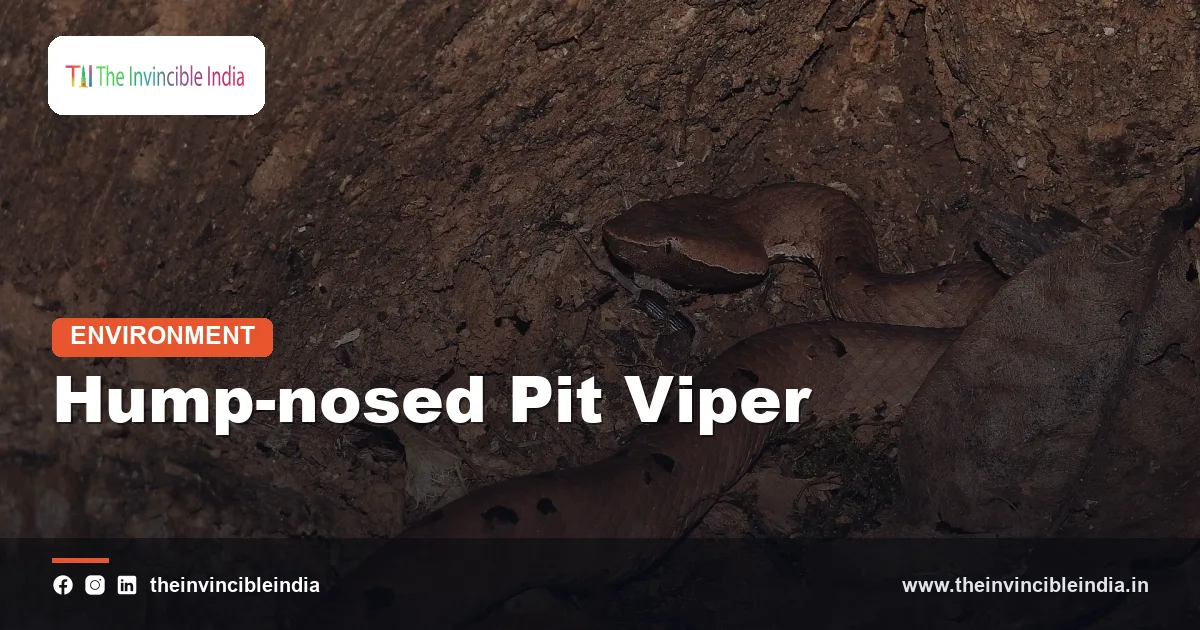
The hump-nosed pit viper (Hypnale hypnale) is a small, stout, venomous snake of the Western Ghats and Sri Lanka, recognised by its upturned, hump-like snout, and its bite, once dismissed as minor, can cause serious illness including kidney injury. It lives on the forest floor and in plantations, where it lies motionless among leaf litter and ambushes frogs, lizards and other small animals.
Because the hump-nosed pit viper is small, well camouflaged and often found near homes, estates and farmland in Kerala, Karnataka and Tamil Nadu, human encounters are common. Its bite is not covered by the standard Indian polyvalent antivenom, which makes accurate identification and early hospital care especially important.
| Attribute | Detail |
|---|---|
| Common name | Hump-nosed pit viper, also called the hump-nosed viper |
| Scientific name | Hypnale hypnale |
| Family | Viperidae, subfamily Crotalinae (pit vipers) |
| Typical length | About 30 to 45 cm, rarely longer |
| Distinctive features | Upturned, hump-like snout, triangular head, heat-sensing pit between eye and nostril, keeled scales |
| Range | Western Ghats and adjoining lowlands of southern India, and Sri Lanka |
| Habitat | Leaf litter in forests, plantations, gardens and farmland |
| Reproduction | Live-bearing (viviparous) |
| Medical importance | Bites can cause local tissue damage, bleeding problems and kidney injury; not covered by the common Indian polyvalent antivenom |
Key Takeaways
- The hump-nosed pit viper (Hypnale hypnale) is a small venomous snake of the Western Ghats and Sri Lanka that is identified by its raised, hump-like snout and triangular head.
- The hump-nosed pit viper is not part of India’s traditional “big four” venomous snakes, yet its bite can cause severe local swelling, bleeding disorders and acute kidney injury.
- The standard Indian polyvalent antivenom is not designed for hump-nosed pit viper bites, so treatment relies on hospital supportive care and monitoring, and people bitten should go to a hospital without delay.
- The hump-nosed pit viper is nocturnal and well camouflaged, resting in leaf litter and ambushing frogs, lizards and small animals, which explains why bites often happen when people step on it unseen.
- The hump-nosed pit viper is frequently mistaken for a harmless snake or for another pit viper, and wrong identification has historically led to its bites being underestimated.
- Wearing footwear, using a torch at night and clearing leaf litter carefully are the most effective ways to avoid a hump-nosed pit viper bite in estates and gardens.
What is the hump-nosed pit viper?
The hump-nosed pit viper is a small species of pit viper in the genus Hypnale, and it is the pit viper found in the Western Ghats of southern India and in Sri Lanka. Pit vipers are a group of venomous snakes that have a heat-sensing pit on each side of the face, and the family also includes the bamboo pit viper and Malabar pit viper of the Western Ghats.
The genus Hypnale has three recognised species. Hypnale hypnale occurs in India and Sri Lanka, while the other two, Hypnale nepa and Hypnale walli, are found in Sri Lanka. The name “hump-nosed” refers to the raised, upturned tip of the snout, which gives the head a curved, hooked look when seen from the side.
For many years the snake was poorly studied and often considered mildly venomous. Clinical studies in Sri Lanka and southern India during the last few decades have shown that this view was wrong.
What does the hump-nosed pit viper look like?
The hump-nosed pit viper looks like a short, thick-bodied brown or grey snake with a flat triangular head, a snout that tilts upwards at the tip, and rough, keeled scales. It is usually about 30 to 45 centimetres long, which is quite small for a viper.
Colour and pattern vary. The upper body may be brown, reddish-brown, grey or pinkish, patterned with darker blotches, bands or a zigzag line along the back. A dark streak often runs from the eye to the corner of the mouth. The underside is usually pale with dark speckles or mottling. Its camouflage against dry leaves is excellent.
Features to look for
- A raised, upturned snout tip, giving the “hump-nosed” look.
- A distinct, triangular head wider than the neck.
- A small heat-sensing pit between the eye and the nostril.
- Vertical, cat-like pupils.
- A thick body that tapers abruptly into a short tail.
- Keeled, rough-looking scales on the back.
A photograph taken from a safe distance can help a doctor or a snake expert confirm identification, but a person should never try to capture or kill the snake to show it.
Where does the hump-nosed pit viper live in India?
The hump-nosed pit viper lives along the Western Ghats and adjoining lowlands of southern India, mainly in Kerala, Karnataka and Tamil Nadu, with records extending northwards along the Ghats. It also occurs widely in Sri Lanka, where it is a major cause of snakebite.
Its habitat includes moist and semi-evergreen forests, forest edges, rubber, coconut, coffee, tea and cashew plantations, gardens and agricultural land. It prefers places with deep leaf litter, rocks, logs and damp ground, where it can hide. It is found from the coastal plains to mid-elevation hills, and dense human populations in these regions mean contact with people is common.
Plantations and village gardens give the snake rodents, frogs and lizards to eat and plenty of cover, which is why many bites occur on farms, estates and around homes.
How does the hump-nosed pit viper hunt and live?
The hump-nosed pit viper hunts by ambush, lying still on the forest floor and striking quickly when prey comes within reach. It is mainly active at night and during dusk and dawn, resting by day under leaf litter, logs, stones or in burrows.
Its diet includes frogs, lizards, small snakes, small rodents, large insects and centipedes. Heat-sensing pits help it detect warm-blooded prey in the dark, and its mottled colour hides it from both prey and predators.
The species is viviparous, which means females give birth to live young rather than laying eggs. Litter sizes are modest, and the newborns are tiny, fully venomous replicas of the adults. In the wet season, when frogs are abundant, activity often increases, and so do bites.
How dangerous is a hump-nosed pit viper bite?
A hump-nosed pit viper bite is potentially dangerous, causing local pain and swelling in most cases and, in some victims, bleeding disorders and acute kidney injury. Deaths are uncommon but have been recorded, and many people suffer prolonged local effects.
Typical effects of a bite include:
- Immediate burning pain and swelling at the bite site.
- Blistering and, in some cases, tissue damage or necrosis, which can lead to ulcers.
- Bleeding problems, because the venom can interfere with blood clotting.
- Kidney injury in a minority of patients, which needs hospital monitoring.
- Swelling and pain in the limb that can last for days or even weeks.
Most bites are on the feet and ankles because the snake lies hidden on the ground. The severity of a bite depends on the amount of venom injected, the bite location, the person’s age and health, and how quickly care begins.
Why was the hump-nosed pit viper bite once thought to be minor?
The hump-nosed pit viper bite was once thought to be minor because the snake is small, often yields only a little venom, and its effects can be delayed, so early reports described mild illness. Misidentification also played a part, as bites were often blamed on other snakes or went unrecorded.
More careful hospital studies, especially in Sri Lanka and in southern India, showed that the venom could cause kidney injury, blood-clotting problems and severe local damage. This changed medical understanding, and the species is now treated as medically important in the regions where it lives.
A key difficulty is that standard blood-clotting tests and the common Indian antivenom do not match the effects of this particular venom well, so doctors needed region-specific knowledge to recognise the syndrome.
Is there an antivenom for the hump-nosed pit viper?
There is no widely available, specific antivenom for hump-nosed pit viper bites in India, because the common Indian polyvalent antivenom is made against the “big four” snakes and does not reliably neutralise this venom. Doctors therefore treat patients mainly with supportive care.
The “big four” snakes are the spectacled cobra, common krait, Russell’s viper and saw-scaled viper. Hump-nosed pit viper bites are managed by:
- Monitoring symptoms, blood tests, urine output and kidney function.
- Treating pain and wound complications and giving tetanus protection.
- Supporting the kidneys, including dialysis in severe cases.
- Giving blood products when serious bleeding occurs.
Research groups in India and Sri Lanka have worked on specific antivenoms for Hypnale venoms, but availability and clinical use remain limited. India’s National Action Plan for Prevention and Control of Snakebite Envenoming, launched in 2024, aims to halve snakebite deaths by 2030 and highlights the need for better data on neglected species like this one.
What should you do after a suspected hump-nosed pit viper bite?
After a suspected hump-nosed pit viper bite, you should stay calm, keep the limb still, remove rings and tight items, and get to a hospital with intensive care facilities as fast as possible. Do not waste time on traditional remedies.
- Keep the person calm and the bitten limb still and at about heart level.
- Remove rings, bangles and tight clothing before swelling begins.
- Do not cut the wound, suck the venom, apply ice or use herbal pastes.
- Do not tie a tight tourniquet, since it can worsen tissue damage.
- Take a clear photograph of the snake only if this can be done safely from a distance.
- Go to the nearest hospital and tell staff the time of the bite and the location, so they can monitor for delayed effects.
Because kidney problems can appear a day or more after the bite, patients should stay under observation even if they feel well at first.
How can you avoid hump-nosed pit viper bites?
You can avoid hump-nosed pit viper bites by wearing closed shoes or boots, using a torch at night, and being careful where you put your hands and feet in leaf litter. Most bites happen when someone steps on or reaches near a hidden snake.
- Wear sturdy footwear and long trousers while working in plantations, gardens or forests.
- Carry a torch after dark and watch the ground on paths.
- Use a stick to move leaf litter, logs and stones before touching them.
- Keep surroundings clear of rubbish, woodpiles and tall weeds.
- Control rodents, which attract snakes.
- Do not sleep on the floor in snake-prone areas, and use a bed or mosquito net.
Is the hump-nosed pit viper protected?
Yes, snakes in India are legally protected under the Wildlife (Protection) Act, 1972, and killing or capturing a hump-nosed pit viper is not allowed. This protection exists because snakes control rodents and other pests, even though some, like this one, are medically significant.
The hump-nosed pit viper is common in much of its range and is not considered to be at high risk of extinction, but it is affected by habitat loss and by being killed on sight. If a snake appears near a home, calling a trained local snake rescuer or the forest department is safer than attempting to remove it.
The species also helps ecosystems by feeding on frogs, lizards and rodents, and by serving as prey for birds of prey, mongooses and larger snakes.
How does the hump-nosed pit viper compare with other pit vipers of the Western Ghats?
The hump-nosed pit viper is smaller, ground-dwelling and brown, whereas other Western Ghats pit vipers such as the Malabar pit viper are mostly arboreal and green or colourful. The comparison below shows how to separate them.
| Snake | Scientific name | Lifestyle | Appearance |
|---|---|---|---|
| Hump-nosed pit viper | Hypnale hypnale | Ground-dwelling, leaf litter | Small, brown or grey, upturned snout |
| Malabar pit viper | Craspedocephalus malabaricus | Shrubs and low trees | Variable colours, often green, brown or yellow |
| Bamboo pit viper | Trimeresurus gramineus | Bamboo and shrubs | Bright green with a pale stripe |
| Russell’s viper | Daboia russelii | Ground-dwelling, open country | Large, chain-like blotches, one of the “big four” |
Bottom Line
The hump-nosed pit viper is a small snake with a serious bite, and its danger lies in being hidden, common near people and absent from the usual antivenom. Learning to recognise it, wearing footwear and seeking hospital care quickly are the best defences in the Western Ghats region.
Frequently Asked Questions
Is the hump-nosed pit viper poisonous or venomous?
The hump-nosed pit viper is venomous, not poisonous, because it injects venom through its fangs when it bites. Its venom can cause local tissue damage, bleeding disorders and kidney injury.
Where is the hump-nosed pit viper found in India?
The hump-nosed pit viper is found in the Western Ghats and adjoining lowlands of southern India, mainly in Kerala, Karnataka and Tamil Nadu. It is also found in Sri Lanka.
Is there an antivenom for a hump-nosed pit viper bite?
No widely available specific antivenom exists for hump-nosed pit viper bites in India, and the common polyvalent antivenom does not reliably cover this species. Treatment relies on hospital care, including monitoring of the kidneys and blood clotting.
Can a hump-nosed pit viper bite kill you?
Yes, a hump-nosed pit viper bite can occasionally be fatal, usually through kidney failure or severe bleeding, although most victims survive with timely hospital care. The risk is higher when treatment is delayed.
How big is a hump-nosed pit viper?
A hump-nosed pit viper is small, usually about 30 to 45 centimetres long. It has a thick body, a triangular head and an upturned snout.
What should I do if bitten by a hump-nosed pit viper?
If bitten by a hump-nosed pit viper, keep the limb still, remove tight items and go to a hospital immediately. Do not cut the wound, suck out venom or tie a tight tourniquet.
{“@context”:”https://schema.org”,”@graph”:[{“@type”:”FAQPage”,”mainEntity”:[{“@type”:”Question”,”name”:”Is the hump-nosed pit viper poisonous or venomous?”,”acceptedAnswer”:{“@type”:”Answer”,”text”:”The hump-nosed pit viper is venomous, not poisonous, because it injects venom through its fangs when it bites. Its venom can cause local tissue damage, bleeding disorders and kidney injury.”}},{“@type”:”Question”,”name”:”Where is the hump-nosed pit viper found in India?”,”acceptedAnswer”:{“@type”:”Answer”,”text”:”The hump-nosed pit viper is found in the Western Ghats and adjoining lowlands of southern India, mainly in Kerala, Karnataka and Tamil Nadu. It is also found in Sri Lanka.”}},{“@type”:”Question”,”name”:”Is there an antivenom for a hump-nosed pit viper bite?”,”acceptedAnswer”:{“@type”:”Answer”,”text”:”No widely available specific antivenom exists for hump-nosed pit viper bites in India, and the common polyvalent antivenom does not reliably cover this species. Treatment relies on hospital care, including monitoring of the kidneys and blood clotting.”}},{“@type”:”Question”,”name”:”Can a hump-nosed pit viper bite kill you?”,”acceptedAnswer”:{“@type”:”Answer”,”text”:”Yes, a hump-nosed pit viper bite can occasionally be fatal, usually through kidney failure or severe bleeding, although most victims survive with timely hospital care. The risk is higher when treatment is delayed.”}},{“@type”:”Question”,”name”:”How big is a hump-nosed pit viper?”,”acceptedAnswer”:{“@type”:”Answer”,”text”:”A hump-nosed pit viper is small, usually about 30 to 45 centimetres long. It has a thick body, a triangular head and an upturned snout.”}},{“@type”:”Question”,”name”:”What should I do if bitten by a hump-nosed pit viper?”,”acceptedAnswer”:{“@type”:”Answer”,”text”:”If bitten by a hump-nosed pit viper, keep the limb still, remove tight items and go to a hospital immediately. Do not cut the wound, suck out venom or tie a tight tourniquet.”}}]}]}


