

The Indo-Greek kingdoms were a series of Hellenistic states that took shape in the northwestern parts of the Indian subcontinent after Greek rulers from Bactria crossed the Hindu Kush. Emerging in the political vacuum that followed the weakening of the Maurya Empire, these rulers governed regions such as Gandhara, Taxila, and the Punjab, blending Greek traditions with Indian religion, language, and administration. Known in Indian sources as the Yavanas, they left behind remarkable coinage, memorable royal names, and a cultural legacy that found its clearest expression in the Greco-Buddhist art of Gandhara. Their story is a reminder that ancient India was never isolated from the wider world.
Quick Facts
| Detail | Information |
|---|---|
| Also Known As | Yavana kingdoms of northwestern India |
| Region | Gandhara, Punjab, and neighboring areas of the northwest |
| Origin | Greek rulers expanding from Bactria across the Hindu Kush |
| Best-Known Ruler | Menander, remembered as Milinda in Buddhist tradition |
| Cultural Legacy | Bilingual coinage and Greco-Buddhist art of Gandhara |
| Successor Powers | Sakas, Parthians, and eventually the Kushans |
Hellenistic Roots in Central Asia
The story of the Indo-Greek kingdoms begins in Central Asia, where Greek settlers and soldiers established communities in the wake of Alexander’s campaigns. Over time, a Greek-ruled kingdom took shape in Bactria, a fertile region to the north of the Hindu Kush, where Hellenistic language, coinage, and city life flourished far from the Mediterranean. These communities kept their Greek identity while living alongside Iranian and Central Asian populations. It was from this base that ambitious rulers later looked southward toward the rich lands of the subcontinent. The Bactrian Greek world therefore forms the essential background to the Indo-Greek story, supplying the rulers, the traditions, and the ambitions that crossed the mountains.
Expansion Across the Hindu Kush
The movement of Greek power into the Indian northwest came about when Bactrian rulers extended their authority across the Hindu Kush into the valleys of Kabul, Gandhara, and the Punjab. This expansion was made possible in part by the political fragmentation that followed the decline of Mauryan authority in these frontier regions. Rather than a single sweeping conquest, the process appears to have unfolded over time through campaigns by several ambitious kings. The newly acquired territories became a second heartland for Greek rule, eventually developing into kingdoms with a distinctly Indian character. This southward expansion marked the moment when a Central Asian Greek state became, in effect, an Indian one as well.
Who Were the Yavanas?
In Indian literature and inscriptions, the Greeks of the northwest were commonly called Yavanas, a term derived from the name of the Ionian Greeks that had earlier reached Persian and Indian ears. The word appears in a range of Sanskrit, Prakrit, and Pali sources, where it refers to foreigners from the northwest who possessed notable military skill and distinctive customs. Over centuries the meaning of the term broadened to include other peoples of the west, but in the early period it clearly pointed to the Greek rulers and settlers of the frontier. The prominence of the word in Indian texts shows that these newcomers made a real impression on contemporary society. The Yavana label thus preserves the Indian view of the Greek presence.
Political Geography of the Kingdoms
The Indo-Greek world was not a single unified empire but a shifting mosaic of kingdoms, often ruled by rival kings who held different cities and territories at the same time. Centers such as Taxila, Sagala, and the Kabul valley served as important seats of power, each commanding fertile land and valuable trade routes. Different dynasties and royal lines competed for influence, and the fortunes of individual kings rose and fell with their military successes. This fragmentation is reflected in the sheer variety of royal names preserved on coins, many of whom are known from little else. The Indo-Greek kingdoms are therefore best understood as a family of related states rather than a centralized realm.
Menander and the Milinda Tradition
Among all Indo-Greek rulers, Menander is the best remembered, and his name survives in both Greek and Indian traditions. In Buddhist literature he appears as King Milinda, the royal questioner in the Pali text known as the Milindapanha, or Questions of Milinda. This work presents a thoughtful dialogue between the king and the Buddhist monk Nagasena on subjects such as the self, rebirth, and the nature of reality. Whether or not every detail reflects history, the text shows that Menander was regarded as a sophisticated ruler who engaged seriously with Indian philosophy. His memory in Buddhist tradition reveals how a foreign king could become part of India’s intellectual heritage.
Coinage and Its Distinctive Features
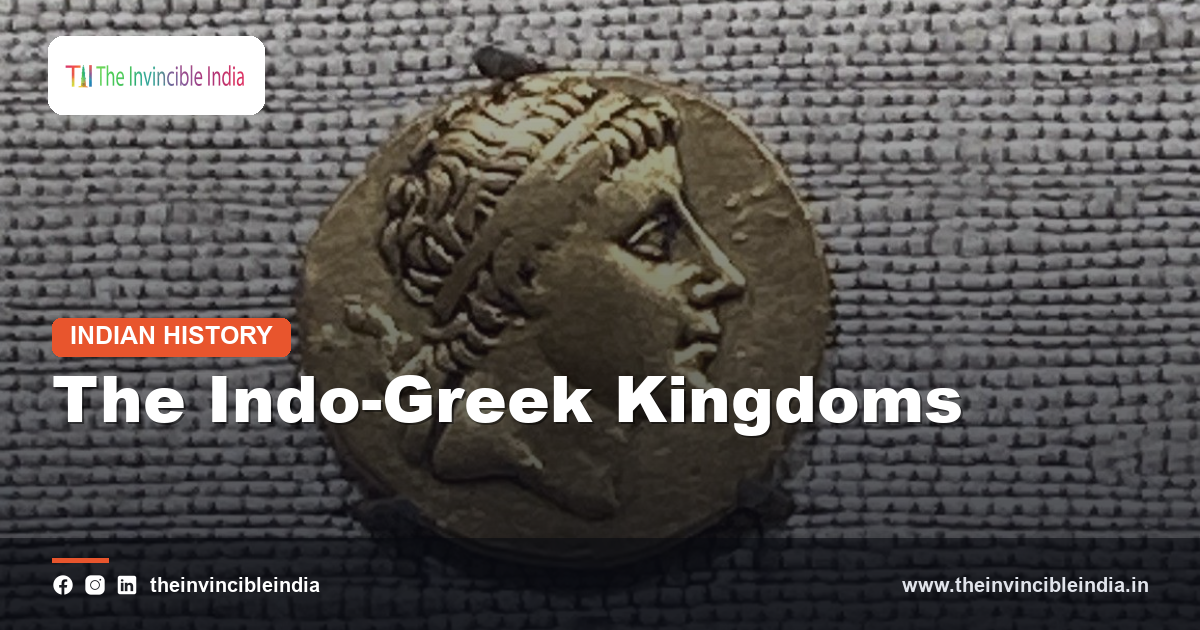
The coinage of the Indo-Greek kings is among the most informative and artistically accomplished legacies of the period. Many coins carry a lifelike royal portrait on one side and a Greek deity or symbol on the other, rendered with considerable skill. Much of what is known about individual rulers, their titles, and even their relative sequence comes from these small metal records. Because Greek historians wrote little about this frontier world, coins serve as the primary source for reconstructing its political history. Their craftsmanship also reflects the continued vitality of Hellenistic artistic traditions in a distant setting. Indo-Greek coinage thus stands as both a historical document and a work of art.
Bilingual Legends and Indian Scripts
A striking feature of many Indo-Greek coins is their bilingual inscriptions, with a Greek legend on one face and an Indian-language legend on the other. The Indian side was commonly written in the Kharosthi script, which was widely used in the northwest, and sometimes in Brahmi in other regions. This practice shows a deliberate effort to address the local population in a language and script they could read. It also reflects a pragmatic form of governance in which rulers communicated across cultural lines. The use of two languages on a single coin is a vivid symbol of the cultural blending that defined these kingdoms. It stands as tangible proof of a conscious bridge between Greek and Indian worlds.
Weights, Shapes, and Monetary Practice
Beyond their inscriptions, Indo-Greek coins show an interesting mix of Greek and Indian monetary practices. Some issues followed Hellenistic weight standards and round shapes familiar from the Greek world, while others adopted square or rectangular forms and local standards that were already common in the subcontinent. This flexibility allowed the coinage to circulate comfortably among a diverse population accustomed to existing systems of exchange. It also suggests that the rulers understood the importance of trade and wished to integrate their kingdoms into local economic life. The adaptability of their money mirrors the wider pattern of cultural accommodation that characterized their rule. Monetary practice thus reveals a government attentive to local custom as well as Greek tradition.
Religion and Royal Patronage
The religious world of the Indo-Greek kingdoms was notably diverse, shaped by Greek deities, Buddhist communities, and emerging devotional traditions. Coins sometimes depict Greek gods such as Zeus or Athena, while others carry symbols associated with Indian religious life, including the wheel and animals linked to Buddhism. Some rulers appear to have extended patronage to Buddhist institutions, and Buddhism continued to flourish in the northwest during this period. Rather than imposing a single faith, the kings generally operated in a setting of religious coexistence. This openness helped Greek rulers earn acceptance among subjects of many beliefs. Religious diversity was therefore a defining feature of Indo-Greek public life.
The Heliodorus Pillar at Besnagar
One of the most famous monuments connected with the Greek presence in India is the Heliodorus pillar at Besnagar, near modern Vidisha in central India. An inscription on the pillar records that it was set up by Heliodorus, a Greek envoy from the court of a king in the northwest, in honor of the deity Vasudeva. The inscription describes Heliodorus as a devotee of the Bhagavata tradition, an early form of devotional worship centered on Vishnu and Krishna. The monument is celebrated as evidence that foreigners could adopt Indian religious practice with genuine devotion. It shows contact between the northwestern Greek kingdoms and the heart of India. The pillar remains a powerful symbol of cultural exchange.
Gandhara and Greco-Buddhist Art
The cultural meeting of Greek and Indian traditions reached one of its richest expressions in the art of Gandhara. Sculptors working in the northwest combined Hellenistic ideas of naturalistic anatomy, flowing drapery, and portraiture with Buddhist subject matter, producing images of the Buddha and his life that became enormously influential. Wavy hair, carefully modeled robes, and balanced proportions reflect techniques that had Mediterranean roots but served Indian spiritual ends. The most developed phase of this tradition came somewhat later under other dynasties, yet its foundations were laid in the cosmopolitan atmosphere created by the Greek kingdoms. Gandhara art therefore stands as the finest artistic offspring of Indo-Greek contact.
Trade and the Cosmopolitan Northwest
The northwest of the subcontinent has long been a crossroads, and under the Indo-Greek kings it became a lively meeting place of merchants, travelers, and ideas. Cities in the region lay along routes that connected the Indian plains with Central Asia, Iran, and the wider Hellenistic world. Goods, coins, and cultural influences moved along these paths, enriching local markets and urban life. The kingdoms benefited from this commerce through taxation, coin issue, and the prosperity of their cities. Their position at the intersection of several civilizations made them natural centers of exchange. Trade was therefore both a source of wealth and a channel for cultural interaction in the Indo-Greek world.
Relations with Neighboring Powers
The Indo-Greek kings lived in an active and often competitive political environment. To the east lay Indian dynasties that had risen in the wake of Mauryan decline, and Greek rulers sometimes clashed and sometimes interacted with these powers. Indian sources preserve memories of Yavana military activity that reached far into the Gangetic region, though details are often debated. At the same time, internal rivalry among Greek kings weakened their collective strength. Diplomacy, such as the dispatch of envoys, also formed part of their dealings with other courts. These varied relations show that the Indo-Greeks were full participants in the political life of ancient India, not merely outside observers.
Decline and Absorption
The Indo-Greek kingdoms gradually lost their independence as new peoples moved into the northwest from Central Asia. Groups such as the Sakas and Parthians took over many of the territories once held by Greek kings, and later the Kushans established a far larger and more enduring empire in the region. Internal division among Greek rulers made it difficult to resist these pressures, and one kingdom after another passed under new control. Yet the departure of Greek political rule did not erase their influence, since later dynasties inherited coinage practices, artistic traditions, and urban centers they had shaped. The end of the kingdoms was therefore a transition rather than a complete break.
Influence on Later Dynasties
Many cultural habits that began under the Indo-Greek kings were carried forward by the powers that followed. The practice of issuing portrait coins with inscriptions in multiple scripts continued under the Sakas and was developed further by the Kushan Empire, which also became a great patron of Gandhara art. Buddhist monastic centers in the northwest kept thriving, and the artistic vocabulary of the region remained deeply Hellenistic in flavor. Ideas about kingship, urban planning, and craft production also passed from one dynasty to the next. The Indo-Greeks thus served as a cultural bridge, handing on a combined heritage that shaped the northwest for centuries.
Sources and Scholarly Challenges
Reconstructing the history of the Indo-Greek kingdoms is a notable challenge because direct narrative sources are scarce. Greek and Roman writers said little about this distant region, and Indian texts mention the Yavanas only in passing or in later literary traditions. As a result, historians rely heavily on coins, inscriptions, and archaeological finds to piece together a picture. Different scholars interpret the evidence in different ways, and many questions about the order of kings and the extent of their territories remain open. This uncertainty is an honest feature of the subject rather than a weakness. The study of the Indo-Greeks continues to evolve as new discoveries and analyses refine understanding.
The Indo-Greek Kingdoms Today
Today, the Indo-Greek kingdoms are remembered as a fascinating chapter in the long history of cultural contact across Asia. Their coins fill museum collections, their names echo in texts such as the Milindapanha, and their artistic heritage lives on in the sculptures of Gandhara. The story of Greek rulers who adopted local scripts, patronized local faiths, and engaged with Indian thought challenges any simple idea of civilizations as sealed worlds. Instead, it shows how exchange and adaptation have always been central to Indian history. The Indo-Greek kingdoms endure as a powerful example of how diverse peoples can create something new together.
Sources & Further Reading
- Archaeological Survey of India (asi.nic.in).
- Ministry of Culture, Government of India (indiaculture.gov.in).
Frequently Asked Questions
Who were the Indo-Greeks?
The Indo-Greeks were Hellenistic rulers who governed parts of northwestern India after expanding from Bactria across the Hindu Kush. They are called Yavanas in Indian sources.
Who was Menander in Indian history?
Menander was among the best-known Indo-Greek kings. He is remembered in Buddhist tradition as King Milinda, who engages in philosophical dialogue with the monk Nagasena in the Milindapanha.
Why are Indo-Greek coins important?
Coins are the main source for reconstructing Indo-Greek history, since few written accounts survive. Their bilingual legends and portraits reveal rulers’ names, titles, and cultural blending.
What is the Heliodorus pillar?
It is a stone pillar at Besnagar, near Vidisha, erected by a Greek envoy named Heliodorus in honor of Vasudeva. It shows that foreigners adopted Indian devotional traditions.
What led to the end of the Indo-Greek kingdoms?
Internal rivalry among Greek kings and pressure from groups such as the Sakas, Parthians, and later the Kushans gradually ended Greek political rule in the northwest.


