

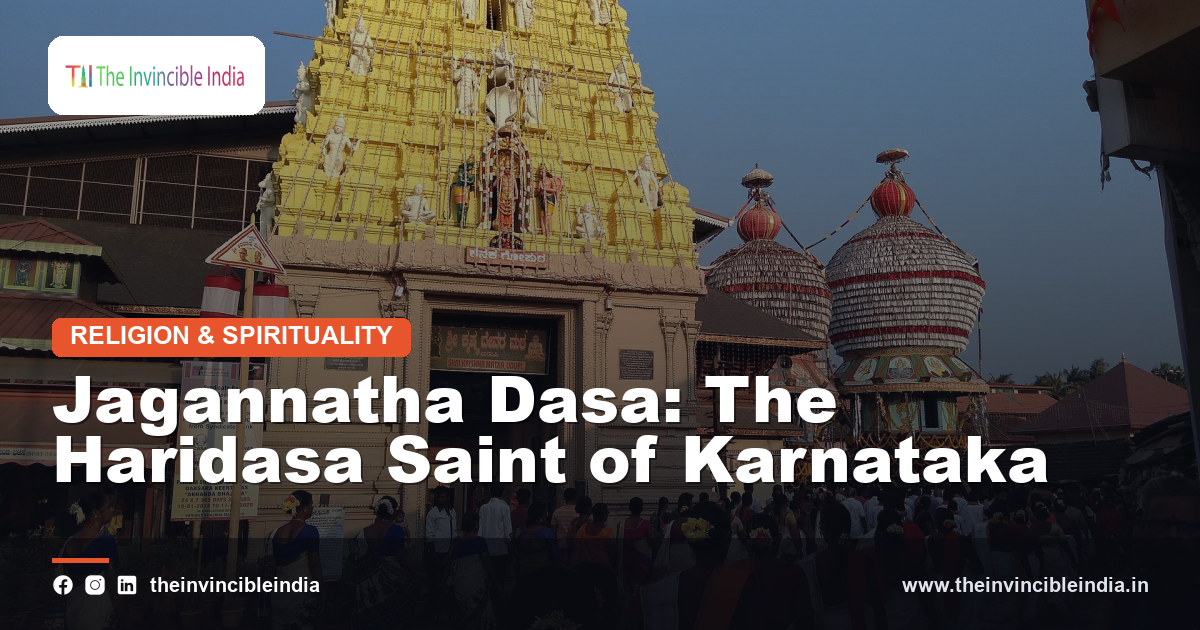
Jagannatha Dasa, also called Jagannatha Vittala after his signature name in verse, is a Haridasa saint and Kannada poet of Karnataka, remembered above all for the devotional work Harikathamritasara. The Haridasas were wandering singers who praised Hari, a name of Vishnu, in the Kannada language, and their body of songs is known as Dasa Sahitya. Jagannatha Dasa belongs to the later generation of this movement and is honoured in the Dvaita tradition of Madhvacharya. His life and writing show how scholarship and song met in the wider story of Vaishnavism in southern India.
Quick answer: Jagannatha Dasa is a Haridasa saint and Kannada poet of Karnataka, honoured in the Dvaita Vaishnava tradition and best known for composing the devotional work Harikathamritasara. He wrote under the signature name Jagannatha Vittala and is remembered as one of the later great figures of Dasa Sahitya, the body of Kannada devotional literature created by the Haridasas. His writings are studied and sung in Karnataka to this day.
Key Takeaways
- Jagannatha Dasa is a Haridasa saint-poet of Karnataka, associated with the Dvaita tradition of Madhvacharya.
- He is best known for Harikathamritasara, a long devotional poem in Kannada traditionally credited to him.
- His signature name in verse, called the ankita, is Jagannatha Vittala.
- The Haridasas created Dasa Sahitya, a large body of Kannada devotional songs and poems.
- Tradition places him in the later period of the movement, after Purandara Dasa and Kanaka Dasa.
- His work combines philosophical teaching with the warmth of bhakti and is still recited and studied.
The sections below explain the life, works, teachings and continuing legacy in more detail.
Quick Facts
| Detail | Information |
|---|---|
| Also known as | Jagannatha Vittala (ankita) |
| Tradition | Haridasa movement, Dvaita Vaishnavism |
| Language | Kannada |
| Best-known work | Harikathamritasara (traditionally credited) |
| Region | Karnataka, India |
| Era | Later Haridasa period (traditionally the eighteenth century) |
| Form | Devotional poetry and song |
| Significance | Major figure of Dasa Sahitya |
Who Was Jagannatha Dasa?
Jagannatha Dasa was a saint and poet of Karnataka who belonged to the Haridasa tradition and wrote devotional works in Kannada. He is remembered as a learned devotee of Hari who combined the study of Dvaita philosophy with the singing of praise. His writings carry the signature Jagannatha Vittala, a name by which the poet addresses the Lord within the verse.
Details of his biography come mainly from devotional tradition, and the dates and incidents of his life are given differently in different accounts. For that reason, the careful approach is to rely on what is widely accepted, namely his place in the Haridasa lineage, his authorship tradition and his lasting influence. What emerges is the portrait of a scholarly saint of deep faith.
What Is the Haridasa Movement?
The Haridasa movement is a devotional tradition of Karnataka in which saints known as Haridasas, or servants of Hari, composed songs in Kannada praising Vishnu and his forms. The movement drew on the teachings of Madhvacharya and the later scholar Jayatirtha, and it was strengthened by figures such as Sripadaraja and Vyasatirtha. Its songs were meant to be sung in public and in temples.
Two of its best-known early voices are Purandara Dasa, often called the father of Carnatic music, and Kanaka Dasa, a poet-saint of great humility. Later Haridasas such as Vijaya Dasa, Gopala Dasa and Jagannatha Dasa carried the tradition forward. The movement made philosophy accessible by putting it into the language of the people.
What Is Dasa Sahitya?
Dasa Sahitya is the body of Kannada devotional literature created by the Haridasas, consisting of songs, hymns and longer poems on the praise of Hari. It includes several forms, among them the kirtana, the suladi and the ugabhoga, each with its own musical or poetic character. Many of these compositions were passed down orally before they were written.
The literature is notable for its simple speech, its moral teaching and its range of feeling, from joyful praise to sober reflection on worldly life. It is also an important source for the history of Kannada language and for the development of Karnataka music. Jagannatha Dasa contributed to this literature through works that tradition regards as among the most substantial of the later period.
What Is Harikathamritasara?
Harikathamritasara is a long devotional poem in Kannada that tradition credits to Jagannatha Dasa and that is regarded as his masterpiece. The title can be understood as the essence of the nectar of the stories of Hari. The work is organised into sections called sandhis and uses a verse form known as bhamini shatpadi, a six-line metre common in Kannada literature.
It sets forth in poetic form the teachings of Dvaita Vedanta, describing the supremacy of Vishnu, the order of divine beings and the path of devotion. Devotees recite it regularly as an act of worship, and some households read it in a fixed daily or weekly order. Its standing in Karnataka resembles that of a household scripture for many Madhva families.
How Is the Work Structured and Recited?
The structure of Harikathamritasara follows a sequence of sandhis, each dealing with a theme such as the glory of the Lord, the nature of the soul or the remembrance of divine acts. Within each sandhi, the six-line verses move steadily from teaching to praise. This design makes the work suited to chanting in a measured rhythm.
Recitation is a common practice at temples, mathas and homes, and many devotees learn passages by heart. Group readings are held on special occasions, and the text is often studied with commentary. The enduring habit of reciting it shows how a scholarly poem became a living part of daily devotion.
What Does Dvaita Philosophy Teach in His Work?
Dvaita philosophy, also called Tattvavada, teaches that the individual soul and the Supreme Being are eternally distinct, and that liberation comes through devotion to Vishnu and his grace. Jagannatha Dasa’s verses express this view in the language of song and praise. They emphasise knowledge of the Lord, surrender to him and the ordering of beings in relation to him.
Madhvacharya, the founder of this school, is traditionally placed in the thirteenth century, and his teaching shaped the Haridasa movement. Jagannatha Dasa’s work translates the system into poetry for lay devotees. In doing so, it keeps the philosophical outline intact while making it emotionally accessible.
How Did Jagannatha Dasa Fit Into the Haridasa Lineage?
Jagannatha Dasa fits into the Haridasa lineage as a later poet who inherited and enriched the legacy of earlier saints. Tradition associates him with the circle of the Haridasas who followed Purandara Dasa, including teachers such as Vijaya Dasa and Gopala Dasa. The exact relationships between these figures are described in devotional biographies and can vary between sources.
What is consistent is that he stands in a lineage that values devotion, learning and humble service. The Haridasa tradition regards itself as a chain in which each generation passes on song and teaching to the next. Jagannatha Dasa is honoured as one of the strong links in that chain.
What Is the Meaning of His Signature Name Jagannatha Vittala?
The signature name Jagannatha Vittala is the ankita that the poet places in his verses, naming both himself and the Lord whom he addresses. Haridasas customarily used such a name, which served as a mark of authorship and as an offering. Vittala is a form of Vishnu, and the name echoes the Vitthal worshipped in Pandharpur.
In this way, the ankita expresses humility, because the poet presents himself as servant and the Lord as master. It also helps scholars and singers identify the works attributed to him. Each Haridasa had a distinct ankita, and the practice forms a recognisable feature of Dasa Sahitya.
Where Is the Haridasa Tradition Practised?
The Haridasa tradition is practised mainly in Karnataka, with associations extending to neighbouring regions of the Deccan where Kannada devotional culture has influence. Temple towns and mathas, especially those connected with the Madhva tradition, have long been centres of Haridasa song. Udupi, the famed seat of the Krishna temple associated with Madhvacharya, is a leading centre of this heritage.
Hampi and the surrounding region are also linked to the history of the movement through the age of Vijayanagara patronage. Pilgrims, scholars and singers visit these places to hear and study the songs. The geography of the tradition reflects the spread of Dvaita devotion across southern India.
How Does the Haridasa Heritage Relate to Carnatic Music?
The Haridasa heritage relates closely to Carnatic music, since the songs of the Haridasas were set to melody and became part of the repertoire of classical musicians. Purandara Dasa is widely honoured for organising early lessons of Carnatic music, and his songs are still taught to beginners. Later Haridasa compositions continue to be sung in concerts and devotional gatherings.
This link shows the way in which devotion and art have shaped each other in Karnataka. The songs are valued for their literary quality as well as for their melodies. Jagannatha Dasa’s verses belong to this larger stream, even though he is remembered more for his long poem than for individual songs.
Why Is Jagannatha Dasa Important?
Jagannatha Dasa is important because he gave Dvaita teaching a poetic and devotional form in Kannada that ordinary people could recite. His main work brought together philosophy, praise and moral guidance in a single text. It continues to serve as a reference point for those who study the Haridasa tradition.
He is also important as a link between the early Haridasas and the later community of devotees. His writing helped keep the Dvaita outlook alive in popular religious life. For students of Karnataka literature, he is a valuable example of how religious thought shaped the Kannada language.
What Values Do His Verses Emphasise?
His verses emphasise devotion to the Lord, humility, detachment from worldly pride and steady practice of virtue. They treat remembrance of Hari as the centre of life and present knowledge as a servant of devotion. The tone is earnest and instructive, with the warmth of one speaking to fellow seekers.
Such themes are shared across the Haridasa tradition, which urges people to live honestly and to serve others while keeping the Lord in mind. The emphasis on practical ethics along with philosophy makes the verses relevant outside strictly academic circles. Many readers value them as guidance for ordinary conduct.
How Do the Dasas Compare With Other Bhakti Poets?
The Dasas share much with other Bhakti poets of India, including a preference for the vernacular, a rejection of rigid hierarchy and an emphasis on personal devotion. Like the Varkari saints of Maharashtra and the Alvars of Tamil Nadu, they sang in the language of the people and travelled to bring their message to communities. Together they form part of the wider Bhakti movement.
The Haridasas stand apart in their close link with Dvaita philosophy and their contribution to Carnatic music. Each regional tradition has its own flavour, and the Kannada Dasa Sahitya has a distinctive balance of theology and song. Comparison highlights both the unity and the diversity of Indian devotion.
How Can Readers Approach His Writing Today?
Readers can approach his writing through Kannada editions with commentary, through translations and through recitations available in devotional settings. Beginning with an overview of the Haridasa movement and Dvaita ideas makes the verses easier to follow. Listening to recitation also helps, since the metre is designed to be heard.
Because attributions in old devotional literature are sometimes debated, readers do well to consult scholarly introductions and respected editions. Approaching the text with patience and respect rewards the effort. The result is a closer understanding of one of the major voices of Karnataka devotional literature.
Jagannatha Dasa Today
Jagannatha Dasa today is remembered through the recitation of Harikathamritasara, through temple and matha traditions and through the study of Dasa Sahitya in universities and cultural bodies. His verses are heard at devotional gatherings in Karnataka and among Kannada communities elsewhere. The tradition he served continues to attract singers, scholars and devotees.
His enduring appeal lies in the union of learning and love that his poetry expresses. As interest in regional spiritual literature grows, his name is increasingly known beyond the circle of specialists. The Haridasa saint of Karnataka remains a respected voice of devotion and philosophy.
Sources & Further Reading
- Ministry of Culture, Government of India (indiaculture.gov.in).
- Sangeet Natak Akademi, India’s National Academy of Music, Dance and Drama (sangeetnatak.gov.in).
Frequently Asked Questions
Who was Jagannatha Dasa?
Jagannatha Dasa was a Haridasa saint and Kannada poet of Karnataka, honoured in the Dvaita Vaishnava tradition. He is best known for Harikathamritasara and wrote under the signature name Jagannatha Vittala.
What is Harikathamritasara?
Harikathamritasara is a long devotional poem in Kannada that tradition credits to Jagannatha Dasa. It sets out Dvaita teachings in the bhamini shatpadi metre and is widely recited by devotees.
What are the Haridasas?
The Haridasas are devotional saints of Karnataka who composed songs and poems in Kannada praising Hari, a name of Vishnu. Their works form the body of Dasa Sahitya and include figures such as Purandara Dasa and Kanaka Dasa.
What does Jagannatha Vittala mean?
Jagannatha Vittala is the signature name, or ankita, that the poet uses in his verses to name himself and the Lord. Vittala refers to a form of Vishnu, and the practice expresses the poet’s humility as a servant of God.
Which philosophy does Jagannatha Dasa follow?
Jagannatha Dasa follows Dvaita Vedanta, the school founded by Madhvacharya, which teaches that the soul and the Supreme Being are eternally distinct. His verses express this view through praise and devotion to Vishnu.
How is Dasa Sahitya related to Carnatic music?
Dasa Sahitya is closely related to Carnatic music because many Haridasa songs were set to melody and became part of the classical repertoire. Purandara Dasa in particular is honoured for his role in early Carnatic teaching.


