

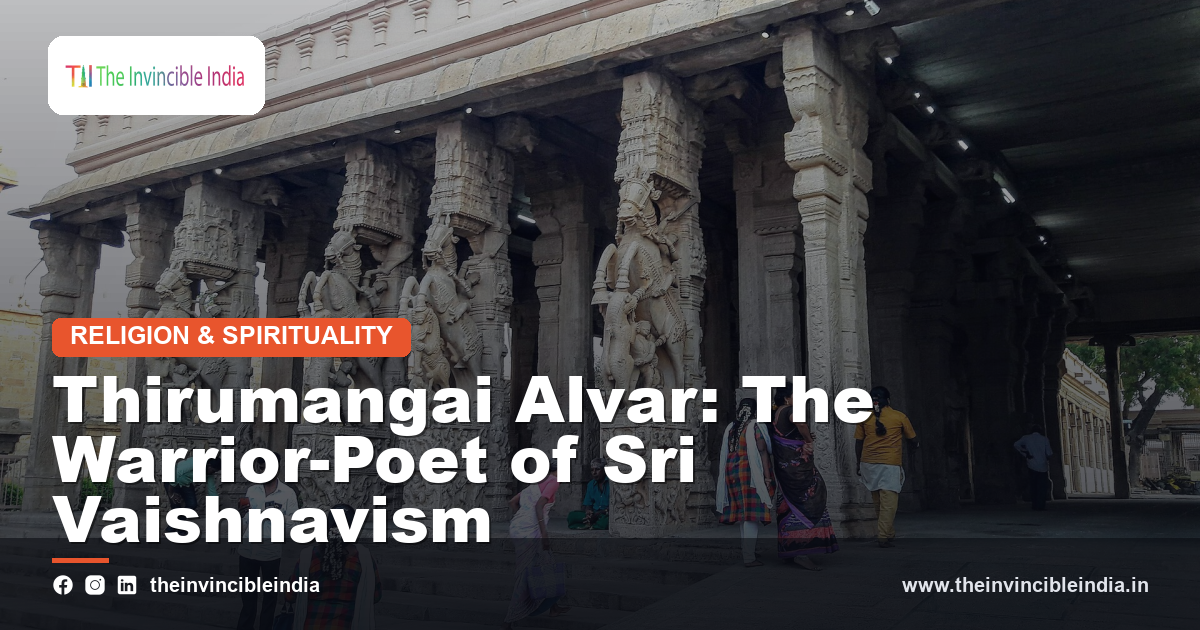
Thirumangai Alvar, also spelled Tirumangai Alvar and known by the names Kaliyan and Parakala, is one of the twelve Alvars, the Tamil saint-poets of Vaishnavism, and is remembered in tradition as a chieftain and warrior who became a devotee of Vishnu. His hymns, gathered in works such as the Periya Tirumoli, praise the Lord at dozens of sacred temples and form a large part of the Tamil devotional canon. His life, as told in tradition, is one of the most colourful in the story of Vaishnavism, mixing martial exploits, romance and conversion.
Quick answer: Thirumangai Alvar is one of the twelve Alvars, the Tamil poet-saints of Sri Vaishnavism, and is traditionally described as a warrior chieftain from the Chola country who became a devotee of Vishnu. He composed a large body of Tamil hymns, including the Periya Tirumoli, that praise Vishnu at many Divya Desam temples. He is also associated in tradition with the strengthening of the Srirangam temple and is often counted among the last of the Alvars.
Key Takeaways
- Thirumangai Alvar is one of the twelve Alvars, the Tamil saint-poets of Sri Vaishnavism.
- He is also known as Kaliyan and Parakala, names linked with his warrior past in tradition.
- His hymns include the Periya Tirumoli, the longest work in the Nalayira Divya Prabandham.
- He sang in praise of Vishnu at a great number of the Divya Desams, the sacred Vaishnava temples.
- Tradition associates him with the Srirangam temple and with building work there.
- His story, with its tales of conversion and feeding of devotees, is told as sacred legend within Sri Vaishnava tradition.
The sections below explain the life, works, teachings and continuing legacy in more detail.
Quick Facts
| Detail | Information |
|---|---|
| Also known as | Tirumangai Alvar, Kaliyan, Parakala |
| Tradition | Sri Vaishnavism (Tamil Vaishnava Alvars) |
| Language | Tamil |
| Major works | Periya Tirumoli and other prabandhams |
| Collection | Nalayira Divya Prabandham |
| Region | Tamil Nadu, India |
| Era | Early medieval period (exact dates debated) |
| Significance | Poet-saint of the Divya Desams |
Who Was Thirumangai Alvar?
Thirumangai Alvar was a Tamil saint-poet of the Vaishnava tradition who is counted among the twelve Alvars and is among the most prolific of them. In devotional tradition he is described as the chieftain of a region called Thirumangai, from which his name is taken. His songs are sung as part of the daily liturgy of many Vaishnava temples.
Most of what is told of his early life comes from hagiographical sources composed some time after the Alvars, and these are mixed with legend. Modern scholars treat the exact century as uncertain, though they generally place the Alvars in the early medieval period. What remains firm is his authorship tradition and his central place in Sri Vaishnavism.
Who Are the Alvars?
The Alvars are twelve poet-saints of the Tamil country who devoted their lives to Vishnu and composed hymns in Tamil. The word Alvar is often explained as one immersed in the divine. They came from various backgrounds, and their songs were later gathered in the Nalayira Divya Prabandham, the four thousand verses.
Among them are Poigai Alvar, Bhutattalvar, Peyalvar, Tirumalisai Alvar, Nammalvar, Madhurakavi Alvar, Kulasekhara Alvar, Periyalvar, Andal, Tondaradippodi Alvar, Tiruppan Alvar and Thirumangai Alvar. Their hymns shaped Vaishnava worship in the south and influenced the later philosophy of Ramanuja. Thirumangai Alvar is often described as the last of the twelve.
What Does Tradition Say About His Birth and Early Life?
Tradition says that he was born in the village of Tirukkuraiyalur and rose to become a commander or chieftain under a Chola king. He is described as a skilled soldier of fierce character, which is why he carries the epithets Kaliyan and Parakala. His early years are presented as those of a powerful man not yet turned towards devotion.
These details are part of hagiography and are not confirmed by independent records. They serve a teaching purpose, since the contrast between the warrior and the saint illustrates the transforming power of grace. The story has been retold in many forms in Tamil literature and temple lore.
What Is the Story of Kumudavalli?
The story of Kumudavalli is a tradition that tells how Thirumangai wished to marry a maiden of that name, raised by a Vaishnava physician. She is said to have set a condition that he should feed a thousand Vaishnava devotees every day for a year and become a follower of Vishnu. He accepted, and the marriage followed once he had kept his promise.
The tale is told with affection in Sri Vaishnava tradition as a story of conversion through love. It also shows the high regard in which service to devotees is held. Readers should treat the specific numbers and details as traditional and not as historical record.
What Is the Legend of the Robbery and the Divine Couple?
The best-known legend about him says that when his wealth ran out in feeding devotees, he took to robbing the rich to continue his service. The tradition adds that Vishnu, in the form of a bridegroom with his consort, appeared as a wedding party to be robbed at a place near Tirunangur. When Thirumangai tried to remove the bridegroom’s toe ring, he is said to have failed to lift it, and the Lord then taught him a sacred mantra.
This account is cherished as a narrative of grace overcoming pride and wrongdoing. It is a tradition and must be read as devotional storytelling. Its message is that the Lord seeks out even the most unlikely devotee and transforms the heart.
What Is the Periya Tirumoli?
The Periya Tirumoli is the great collection of hymns attributed to Thirumangai Alvar and is the longest work in the Nalayira Divya Prabandham. Its title means the Great Sacred Utterance. It is arranged in sections called tirumoli and praises Vishnu at numerous sacred temples across India.
The hymns combine vivid description of landscape, temple and festival with personal surrender to the Lord. They are rich in imagery of rivers, groves and city streets. Singers and scholars value the work for its poetic strength and for its devotional intensity, and it is chanted in Vaishnava temples.
What Are His Other Works?
Besides the Periya Tirumoli, Thirumangai Alvar is credited with several shorter works, among them the Tirukkurundandakam, the Tirunedundandakam, the Tirueluk Kurrirukkai, the Siriya Tirumadal and the Periya Tirumadal. Together with the Periya Tirumoli, they make up six prabandhams attributed to him. The Madal poems follow a Tamil convention in which a lovelorn lover threatens to ride a palmyra-stem horse.
The variety of forms shows the poet’s command of Tamil literary technique. Each work contributes to the overall picture of an author who was both a learned poet and an ardent devotee. The collection forms a major part of Tamil devotional literature.
What Are the Divya Desams?
The Divya Desams are the one hundred and eight sacred temples of Vishnu that are praised in the hymns of the Alvars. Most of them are in Tamil Nadu, with others in Kerala, Andhra Pradesh, Karnataka and northern India, and two are traditionally described as celestial. They are central to Sri Vaishnava pilgrimage.
Thirumangai Alvar is believed to have sung of a large share of these shrines, more than any other Alvar, and his hymns thus act as a poetic map of Vaishnava India. Devotees use his verses to visit and recall each temple in turn. The idea of the Divya Desams ties together geography, worship and poetry.
What Is His Connection to the Srirangam Temple?
Thirumangai Alvar is associated in tradition with the Ranganathaswamy temple at Srirangam, on an island in the Kaveri river near Tiruchirappalli, and is said to have supported its development. Tradition credits him with building or strengthening one of its enclosing walls, which is sometimes named after him. Srirangam is the foremost of the Divya Desams, and he praised it in his hymns.
The temple is among the largest in India and remains a major centre of Sri Vaishnavism. Its festivals include recitation of the Alvars’ hymns, in which his verses have a prominent place. Details of his building work are traditional and are best regarded as part of temple lore.
How Does Thirumangai Alvar Express Devotion in the Nayika Mood?
Thirumangai Alvar expresses devotion in the nayika mood, in which the devotee speaks in the voice of a woman longing for her divine beloved. This convention, drawn from older Tamil love poetry, was widely used by the Alvars. It conveys the soul’s yearning for the Lord in the language of human love.
In some hymns the poet adopts the persona of a mother, a friend or a heroine of the household, and describes the feelings of separation and union. The device shows the flexibility of Tamil poetic tradition when applied to religious experience. It also contributes to the emotional force of the verses.
Why Is Thirumangai Alvar Called the Last of the Alvars?
Thirumangai Alvar is often called the last of the Alvars because, in traditional lists, he comes at or near the end of the sequence of twelve and is thought to have lived later than most of them. His long body of work is also treated as a kind of culmination of the Alvar output. The order of the list is traditional and does not always follow strict chronology.
The description therefore carries both a sense of time and a sense of completion. It does not diminish the standing of the other Alvars, each of whom is revered. It simply marks the tradition’s feeling that his hymns bring the Alvar age to a rich close.
How Is He Worshipped and Honoured?
Thirumangai Alvar is honoured in Vaishnava temples through images, festivals and the recitation of his hymns. In many temples, a shrine to the Alvars holds his figure, shown as a warrior with a sword and shield. Special observances take place in the month and star associated with his remembrance.
At Srirangam and other places, festivals in his honour include processions and the chanting of the Periya Tirumoli. These observances preserve the memory of the saint and bind the community in shared worship. Participants regard the rites as a way of receiving the grace of the Alvar.
How Did the Alvars Influence Sri Vaishnavism?
The Alvars influenced Sri Vaishnavism by supplying its devotional canon in Tamil, which the later teacher Ramanuja and his successors treated with great respect. The tradition speaks of the Tamil hymns as equal in spiritual weight to the Sanskrit Vedas, an idea expressed in the term Dravida Veda. The Divya Prabandham is therefore sung together with Sanskrit scripture.
This blend of Tamil poetry and Sanskrit philosophy is a hallmark of the Sri Vaishnava tradition. Thirumangai Alvar’s large contribution helped to make Tamil the language of temple liturgy in the Vaishnava south. The influence extends to music, dance and temple practice.
How Does He Connect to Other Vaishnava Traditions?
Thirumangai Alvar connects to other Vaishnava traditions because the devotion to Vishnu that he expressed also appears in the Bhakti movements of other regions. The wider Vaishnava world includes the Gaudiya tradition of Bengal, the Dvaita Haridasas of Karnataka and the Varkaris of Maharashtra. Each uses its own language and style.
Readers interested in comparison can read about the Dashavatara, the ten forms of Vishnu that appear in many traditions. The diversity of Vaishnava devotion reflects the many ways in which communities have approached the same divine figure. Thirumangai Alvar is one of the ancient voices in that conversation.
How Can Pilgrims Follow the Trail of His Hymns?
Pilgrims can follow the trail of his hymns by visiting the Divya Desams that he praised, beginning with Srirangam and continuing through Tamil Nadu and beyond. Many guidebooks and temple committees list the shrines with the relevant verses. The journey combines devotion, travel and the appreciation of temple architecture.
Such pilgrimages are part of the broader tradition of sacred journeys in India. Travellers are advised to plan around festival days, temple timings and local customs, and to dress and behave respectfully. The practice keeps the hymns alive as a living map of sacred places.
Thirumangai Alvar Today
Thirumangai Alvar today is remembered through temple worship, through the chanting of the Divya Prabandham and through the continuing interest of scholars in Tamil devotional literature. His hymns are sung in Vaishnava households, and his story is retold in books, dance dramas and discourses. Srirangam and the other Divya Desams keep his memory in stone and ritual.
His enduring appeal rests on the vivid humanity of his tradition, in which a warrior becomes a saint and a poet gives voice to the sacred landscape. The warrior-poet of Sri Vaishnavism remains a powerful symbol of transformation and devotion.
Sources & Further Reading
- Ministry of Culture, Government of India (indiaculture.gov.in).
- Archaeological Survey of India (asi.nic.in).
Frequently Asked Questions
Who was Thirumangai Alvar?
Thirumangai Alvar was a Tamil saint-poet and one of the twelve Alvars of Vaishnavism. Tradition describes him as a warrior chieftain who became a devotee of Vishnu and composed the Periya Tirumoli and other hymns.
What is the Periya Tirumoli?
The Periya Tirumoli is the longest work in the Nalayira Divya Prabandham and is attributed to Thirumangai Alvar. It praises Vishnu at many sacred temples and is chanted in Vaishnava worship.
How many Alvars are there?
There are twelve Alvars, the Tamil poet-saints of Vaishnavism, including Nammalvar, Andal, Periyalvar and Thirumangai Alvar. Their hymns are collected in the Nalayira Divya Prabandham.
What are the Divya Desams?
The Divya Desams are the one hundred and eight Vishnu temples praised in the hymns of the Alvars. Most lie in Tamil Nadu, and Srirangam is regarded as the foremost of them.
Why is he called Kaliyan and Parakala?
Kaliyan and Parakala are epithets given to Thirumangai Alvar in tradition, linked to his warrior character before his conversion. Parakala is often explained as one who is a destroyer of opponents.
What is his link with Srirangam?
Thirumangai Alvar is linked with Srirangam through his hymns in praise of the Ranganatha temple and through the tradition that he supported building work there. The details of the construction are part of temple lore.


