

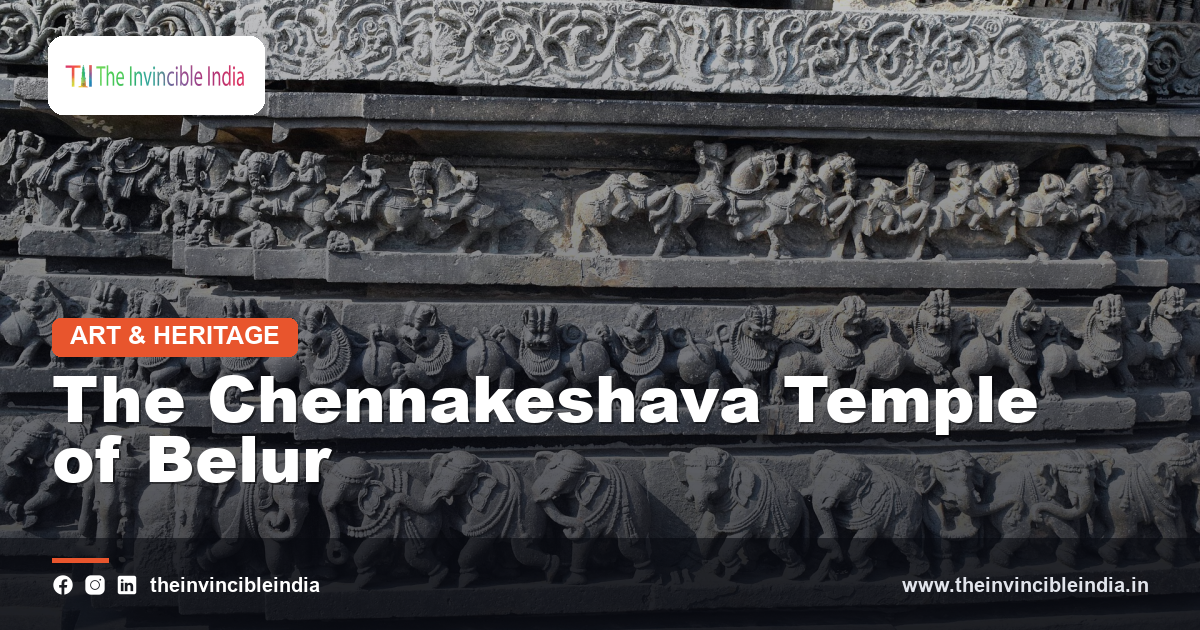
The Chennakeshava Temple of Belur, also spelled Channakeshava and sometimes called the Keshava or Vijayanarayana Temple of Belur, is a celebrated Hoysala temple of Vishnu in the Hassan district of Karnataka. It stands on the bank of the Yagachi river in the ancient town of Belur, once called Velapura, and was begun in the early twelfth century under Hoysala patronage. Unlike many medieval monuments, it remains a living place of worship, and its carved walls, pillars and bracket figures are admired as masterworks of the dynasty. It shares a stylistic family with the temples described in the guide to Dravidian temple architecture. This guide explains its history, design and meaning.
Quick answer: The Chennakeshava Temple of Belur (also spelled Channakeshava) is a twelfth-century Hoysala temple dedicated to Vishnu at Belur in Hassan district, Karnataka, India. Built of soapstone on a star-shaped plan, it is known for its sculpted bracket figures, intricately carved pillars and perforated stone screens. It is still an active temple and is part of the UNESCO-listed Sacred Ensembles of the Hoysalas.
Key Takeaways
- The Chennakeshava Temple is a Hoysala temple of Vishnu at Belur, in Hassan district, Karnataka, built in the early twelfth century.
- Tradition links its founding to the Hoysala king Vishnuvardhana, and work on the complex continued over a long period.
- The temple is built of soapstone and rises from a raised, star-shaped platform with carved friezes running around its walls.
- Its graceful female bracket figures, known as madanikas or shilabalikas, are among the most admired sculptures of the Hoysala period.
- Unlike many medieval temples, it remains in daily worship and hosts an annual chariot festival.
- The temple is part of the Sacred Ensembles of the Hoysalas, a UNESCO World Heritage listing that includes Somnathpur and Halebidu.
The sections below explain how the temple came to be, how it is arranged and why it holds such an important place in Indian art.
Quick Facts
| Detail | Information |
|---|---|
| Location | Belur, Hassan district, Karnataka |
| Also known as | Channakeshava Temple, Keshava Temple of Belur, Vijayanarayana Temple |
| Dynasty | Hoysala |
| Approximate era | Early twelfth century CE onward |
| Deity | Vishnu as Chennakeshava, the handsome Keshava |
| River | Yagachi |
| Material | Fine-grained soapstone |
| Heritage status | Part of the UNESCO listing for the Sacred Ensembles of the Hoysalas |
What Is the Chennakeshava Temple of Belur?
The Chennakeshava Temple of Belur is a Hoysala temple of Vishnu that has been in continuous use for many centuries. The name Chennakeshava means handsome Keshava, and it refers to the form of Vishnu enshrined in the main sanctum. The temple is built entirely of soapstone and stands within a large walled enclosure that holds several other shrines and a number of subsidiary buildings. Its fame rests on the abundance and quality of its sculpture, from the elaborately carved doorway to the delicate figures set under the eaves. Because it is a functioning temple, rituals, music and festivals continue to animate the space. The Chennakeshava Temple therefore combines the roles of a masterpiece of medieval art and a centre of living faith.
Where Is Belur Located?
Belur is a town in Hassan district of Karnataka, situated on the right bank of the Yagachi river in the Malnad foothills of the southern Deccan. It lies a short distance from Halebidu, the later Hoysala capital, and the two places are traditionally visited together. In ancient times the town was known as Velapura, and inscriptions refer to it by that name. The surrounding region is a green landscape of hills, coffee estates and farmland, which makes the journey pleasant as well as historically rewarding. Belur is reached by road from Hassan and from the coastal and plateau routes that cross Karnataka. Its position near Halebidu and Shravanabelagola makes it a natural gateway for exploring the heritage of the Hoysala heartland.
Who Built the Chennakeshava Temple and Why?
The Chennakeshava Temple is traditionally associated with the Hoysala king Vishnuvardhana, who is said to have founded it in the early twelfth century. Popular tradition connects the foundation with a notable military victory and with the king’s embrace of Vaishnava devotion, although the exact motives are discussed by historians. Inscriptions at the site record grants and additions by various rulers and officials over time, which shows that the temple continued to be supported long after its first consecration. Work on such large temples often continued through generations, and later patrons added shrines, mandapas and gateways. The temple was thus both a royal statement and a community project. The foundation of the Chennakeshava Temple reflects how political authority, religious devotion and artistic ambition came together in Hoysala Karnataka.
When Was the Temple Built, and How Did It Grow?
The main temple dates to the early twelfth century, and the surrounding complex grew gradually afterward through the efforts of later Hoysala rulers and, in time, the Vijayanagara kings. The central shrine and its hall belong to the earliest phase, while smaller temples, the courtyard shrines and the great entrance gateway were added in later periods. This layered development gives the enclosure a varied character, with different styles and scales standing side by side. Specific year counts are best taken from inscriptions and scholarly studies rather than from loose tradition. What is clear is that the temple was never a single frozen creation but an evolving sacred precinct. The growth of the complex shows that Belur remained an important religious centre across several centuries.
What Is the Architecture of the Main Temple?
The main temple stands on a raised platform and follows a star-shaped, or stellate, plan with many projecting corners that catch light and shade. It consists of a sanctum, a vestibule and a large pillared hall, and the roof over the sanctum once rose in a stepped tower. The platform is edged with a path for circumambulation, and the outer walls are divided into horizontal bands of ornament. Visitors enter through a richly carved doorway that guards the hall and prepares them for the sculpture within. The design balances horizontal layers of carving with the vertical thrust of pillars and projections. This careful composition makes the Chennakeshava Temple a classic example of the early Hoysala approach to temple building.
What Are the Madanikas, or Bracket Figures?
The madanikas, also called shilabalikas, are small sculpted female figures that serve as brackets beneath the eaves of the temple. They represent dancers, musicians and women engaged in graceful activities, and each figure is carved with a distinct pose, costume and jewellery. Some are shown adjusting a garment or holding a mirror, while others play instruments or dance with raised arms. The figures are carved almost in the round, so they seem to step out from the wall. They are among the best known symbols of Hoysala art and attract the attention of nearly every visitor. The madanikas of Belur show how the sculptors observed human movement and transformed it into permanent, refined beauty.
Why Are the Pillars of the Temple Famous?
The pillars of the main hall are famous for their variety, their polish and their craftsmanship. Hoysala artisans shaped them with a lathe-like technique and carved the surfaces with circular bands, tiny figures and floral motifs. Among them, one pillar is traditionally associated with Narasimha, and local lore says that it was once designed to turn on its base, a story told with pride though best treated as tradition. The other pillars differ in profile and pattern, so no two feel quite identical. The central ceiling bays above them are carved with deep, ornate domes. The pillars of Belur demonstrate that the Hoysala workshop treated every structural element as an opportunity for artistic expression.
What Do the Perforated Screens and Doorways Show?
The windows of the hall are filled with perforated stone screens, known as jalis, carved with geometric patterns and scenes from the Puranas. These screens allow air and soft light to enter while keeping the interior calm and shaded. The doorways are equally ornate, with framing bands of foliage, mythical creatures and divine attendants. Guardian figures flank the entrances, marking the transition from the outer courtyard to the sacred interior. The detail is so fine that individual leaves, beads and strands of hair can be distinguished. Together the screens and doorways show how the Hoysalas turned functional openings into works of art. Belur’s perforated windows are therefore among the most memorable features of the temple’s design.
What Stories Are Told in the Carvings?
The carvings on the walls and screens tell stories drawn from the Ramayana, the Mahabharata and the Puranas, with a special emphasis on the incarnations of Vishnu. Viewers can find episodes of the epics, gods in procession and mythical animals arranged in continuous friezes. The sculptors often compressed whole episodes into a small panel, relying on gestures and attributes that devotees would recognise. These narrative sequences functioned as a form of visual teaching for pilgrims and townspeople who moved around the temple. The images also expressed devotion through beauty, since the aim was to honour Vishnu with the highest quality of art. The sculpted stories of Belur make the temple a rich source for the study of Hindu iconography and narrative art.
What Else Stands Inside the Temple Complex?
The Chennakeshava Temple stands in a large walled courtyard that contains several other shrines, a pillared cloister and a number of smaller structures. Among them are temples associated with the goddess and with other forms of Vishnu, such as the Kappe Chennigaraya shrine and the Soumyanayaki shrine, each with its own character. A great gateway marks the entrance and rises in several tiers, and this structure is generally understood to belong to a later phase of the complex. A tank and other support buildings once served the needs of worshippers and priests. The arrangement turns the temple into a small sacred town within a wall. The complex at Belur therefore preserves the experience of a medieval temple precinct as a place of worship, gathering and learning.
How Is the Temple Still a Living Place of Worship?
The temple remains a living place of worship, with daily rituals performed by priests and offerings made by devotees from the town and beyond. Festivals punctuate the year, and the best known is the annual chariot festival, in which the deity is drawn in procession through the streets. Music, lamps, flowers and chanting fill the temple on such occasions, and the carved walls take on a different life from the one they have in the quiet hours. The continuity of worship is one of the temple’s most precious qualities, because it links the monument to the community that created it. This living tradition ensures that the temple is understood not just as architecture but as a sacred home. The Chennakeshava Temple thus shows how heritage and devotion can coexist.
How Does Belur Compare With Halebidu and Somnathpur?
The three great Hoysala sites of Belur, Halebidu and Somnathpur show different phases and moods of the dynasty’s art. Belur is generally regarded as the earlier, with its graceful bracket figures and its role as a living Vaishnava temple. Halebidu is known for its monumental twin shrines to Shiva and for its dense and richly detailed wall carving. Somnathpur is the latest and most compact, with its three-shrine plan and fully preserved star-shaped outline. Visiting all three gives a rounded picture of how Hoysala builders refined their ideas over time. The Keshava Temple of Somnathpur forms a natural pair with Belur for anyone who wants to compare these approaches directly.
Why Is the Chennakeshava Temple Important in Indian Art?
The Chennakeshava Temple is important because it stands at the beginning of the mature Hoysala style and demonstrates its principal features in clear form. Its star-shaped plan, soapstone carving and rich sculptural programme influenced later temples across the region. The temple also preserves a large body of figure sculpture that helps scholars study clothing, jewellery, musical instruments and daily life of the period. As an example of royal patronage, it shows how rulers used architecture to express piety and power. Its endurance as a place of worship adds a further layer of significance. The temple therefore holds a prominent place in any survey of South Indian temple architecture and Indian sculpture.
What Is the Heritage Status and Care of the Temple?
The Chennakeshava Temple is protected as a monument of national importance and is cared for by the Archaeological Survey of India in cooperation with the temple community. It is also part of the Sacred Ensembles of the Hoysalas, a UNESCO World Heritage listing that recognises the exceptional value of Hoysala architecture. Conservation work includes cleaning of the soapstone surfaces, monitoring of structural stability and regulation of visitor access. Because the temple is still used for worship, the care of the site must balance conservation needs with ritual practice. Documentation and research help reveal details of the sculpture that may not be easy to see. The protection of Belur shows a shared commitment to keeping a precious monument both preserved and alive.
Chennakeshava Temple Belur Today
The Chennakeshava Temple of Belur today welcomes pilgrims, students, artists and travellers who come to admire its sculpture and to take part in its rituals. It remains one of the most visited heritage sites in Karnataka and a leading symbol of Hoysala achievement. The surrounding town has grown around the temple, and local life is still closely tied to its calendar of festivals and services. Scholars continue to study its carvings, inscriptions and architectural layers, adding to knowledge of medieval South India. For visitors, the experience of walking around the carved platform, entering the pillared hall and watching worship unfold is unforgettable. The temple continues to stand as a living monument of faith, craftsmanship and cultural continuity.
Sources & Further Reading
- Archaeological Survey of India (asi.nic.in).
- UNESCO World Heritage Centre, Sacred Ensembles of the Hoysalas (whc.unesco.org).
Frequently Asked Questions
What is the Chennakeshava Temple of Belur?
The Chennakeshava Temple is a twelfth-century Hoysala temple of Vishnu at Belur in Hassan district, Karnataka. It is built of soapstone and is known for its star-shaped plan, carved pillars and graceful bracket figures. It remains an active place of worship.
Who built the Chennakeshava Temple at Belur?
Tradition credits the Hoysala king Vishnuvardhana with founding the temple in the early twelfth century. Later Hoysala rulers and, in time, the Vijayanagara kings added to the complex. Inscriptions at the site record various grants and additions.
Where is the Chennakeshava Temple located?
The Chennakeshava Temple is located at Belur in Hassan district of Karnataka, on the bank of the Yagachi river. It lies close to Halebidu, another major Hoysala site. Belur is reached by road from Hassan.
What are the madanikas at Belur?
The madanikas, or shilabalikas, are carved female bracket figures placed under the eaves of the Chennakeshava Temple. They depict dancers, musicians and women in graceful poses. They are among the best known sculptures of Hoysala art.
Is the Chennakeshava Temple still used for worship?
Yes, the Chennakeshava Temple is still an active place of worship, with daily rituals and an annual chariot festival. Devotees and visitors alike attend its ceremonies. This living tradition is one of its distinctive features.
Is the Belur temple a UNESCO World Heritage Site?
Yes, the Chennakeshava Temple at Belur is part of the Sacred Ensembles of the Hoysalas, a UNESCO World Heritage listing that also includes the temples at Halebidu and Somnathpur. It is also a protected monument of the Archaeological Survey of India. This recognition supports its conservation.


