

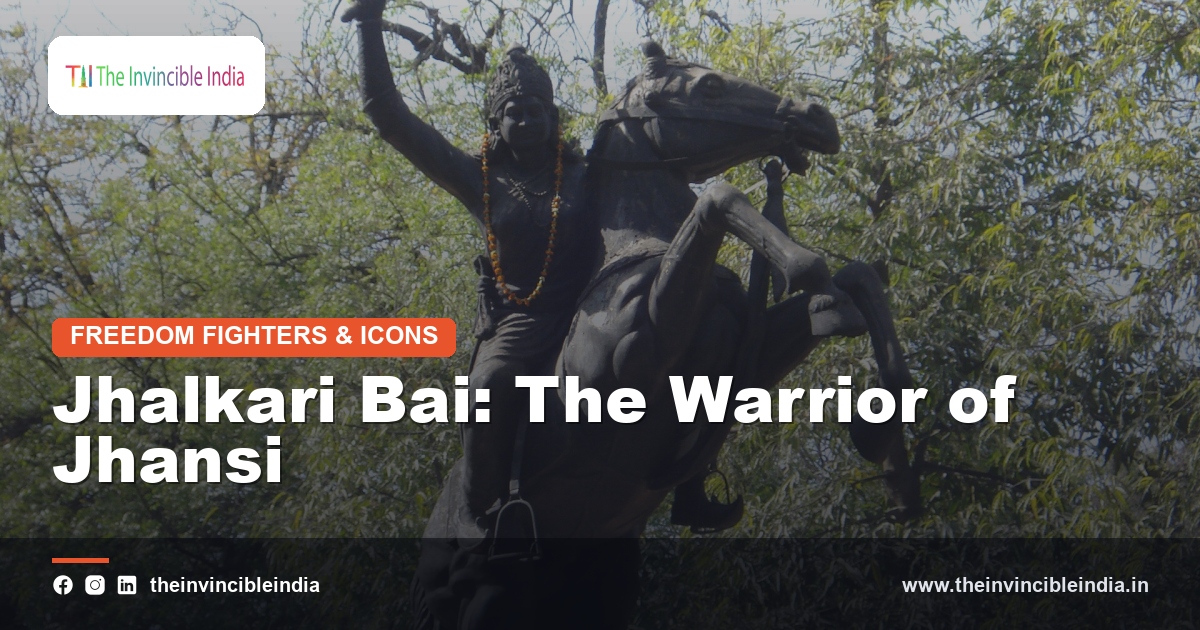
Jhalkari Bai is remembered as one of the most admired women of the Revolt of 1857, a soldier from the countryside around Jhansi who rose to serve in the army of Rani Lakshmibai. Born into a humble family, she became a symbol of how courage in the freedom struggle was not limited to royalty or rank. Popular memory, folk songs and regional tradition describe her as a fearless fighter, a trusted companion of the queen, and a woman whose loyalty to her homeland was absolute. While historians note that some details of her life come from oral tradition rather than formal records, her place in the cultural memory of India is firmly established and widely honoured.
Quick Facts
| Detail | Information |
|---|---|
| Known As | Warrior of Jhansi |
| Region | Jhansi, Bundelkhand |
| Associated Leader | Rani Lakshmibai |
| Associated Event | Revolt of 1857 |
| Community Background | Kori community of Bundelkhand |
| Legacy | Symbol of courage and loyalty among ordinary people |
Origins in the Bundelkhand Countryside
Jhalkari Bai belonged to the countryside near Jhansi, in the historic Bundelkhand region of central India. She was born into a modest family belonging to the Kori community, a group traditionally associated with weaving and labour. Her early life was shaped by village routines, hard work and the strong sense of community that marked rural Bundelkhand in the nineteenth century.
Although she did not come from a privileged background, the region she grew up in had a long tradition of martial pride and local heroism. This setting helped form the character that later made her a trusted member of the Jhansi forces, and it reminds readers that the freedom struggle drew strength from every layer of Indian society.
A Childhood of Courage in Popular Memory
Folk tradition describes Jhalkari Bai as a spirited and fearless girl who learned to handle responsibility early. Stories passed down through generations speak of her bravery in the forests and fields near her village, and these accounts have become an important part of the cultural memory surrounding her. Such narratives are valued for what they say about how her community understood her character.
Historians treat these childhood stories with care, since they come from oral tradition rather than documents of the period. Even so, the consistency of the theme across regional retellings shows how deeply her reputation for courage took root, and how admiration for her began long before she entered the service of the queen.
Training in the Arts of War
Tradition holds that Jhalkari Bai learned the skills needed for military service, including the handling of weapons and the discipline expected of a soldier. In the Jhansi of that era, martial training was not unknown among women of the region, and Rani Lakshmibai herself encouraged women to take part in the defence of the state. This created space for a capable woman from a village background to join the ranks.
Her preparation, whether formal or acquired through circumstance, made her a valued member of the Jhansi forces. The emphasis on training and readiness in her story reflects a broader truth about the period, which is that the defence of Jhansi depended on many individuals who were willing to learn and to serve.
Entering the Service of the Rani
Jhalkari Bai is closely associated with the circle of Rani Lakshmibai, the queen of Jhansi who became one of the great figures of the Revolt of 1857. According to widely repeated tradition, her courage and reliability brought her to the notice of the queen, who welcomed her into the women’s contingent that supported the defence of the fort and the city.
This relationship between a queen and a soldier from a humble background is often cited as a moving example of unity in a time of crisis. It shows that, in the memory of Jhansi, loyalty and ability mattered more than birth, and that the cause of the homeland could bring very different people together.
The Women of the Durga Dal
The women’s force of Jhansi, often remembered under the name Durga Dal, is a significant part of the story of the Revolt in Bundelkhand. Women in this force took on duties linked to the protection of the city and the support of the fighting forces, and tradition places Jhalkari Bai among the most prominent of them. The name itself draws on the image of the goddess Durga, a symbol of strength and protection in Indian culture.
The idea of an organised group of women prepared for defence stands out in nineteenth century India. Through such memories, Jhalkari Bai and her companions are celebrated as evidence that women took an active and visible part in the resistance against colonial rule.
Marriage and a Soldier Household
Popular accounts state that Jhalkari Bai was married to a soldier who served in the army of Jhansi, and that her household was therefore closely tied to the military life of the state. This detail appears in many regional retellings and gives her story a personal dimension, linking family life with public duty in a way that many readers find relatable.
Soldier households in Jhansi were bound to the fortunes of the kingdom, and the fall of the city affected families across the region. The picture of a couple devoted to the defence of their homeland has become a lasting image in local tradition, and it adds to the sense that her service was rooted in lived experience rather than distant ideals.
The Jhansi Crisis and the Doctrine of Lapse
The background to the siege of Jhansi lies in the policies of the East India Company, especially the Doctrine of Lapse, which allowed the Company to annex states where a ruler died without a recognised natural heir. Jhansi was affected by this policy, and the resentment it created became one of the strands that fed into the wider uprising of 1857.
Against this setting, the queen chose to defend her state when the crisis reached Bundelkhand. Jhalkari Bai belonged to the generation that lived through these upheavals, and understanding the political pressures of the time helps explain why so many people, from every background, rallied behind the cause of Jhansi.
Jhansi in the Revolt of 1857
The Revolt of 1857 was a large and complex uprising that spread across northern and central India, and Jhansi became one of its most important centres. The city was drawn into the conflict as the movement gathered strength, and the fort of Jhansi turned into a focal point of resistance under the leadership of the queen.
Within this struggle, soldiers and defenders of every background took their positions. Jhalkari Bai belonged to this wider circle of defenders, and her story is one of many that illustrate how the events of 1857 involved ordinary men and women as well as celebrated leaders and rulers.
The Siege of Jhansi
The siege of Jhansi is among the best known episodes of the Revolt, remembered for the determination with which the fort was defended against a larger and better equipped force. The defenders included soldiers, artillerymen and women who took part in supporting the effort, and the resistance of the city has become a symbol of local courage.
Jhalkari Bai is placed within this defence by tradition, as a woman who stood alongside her companions during the most difficult days. The siege shows how the fate of the city rested on the commitment of many individuals, and her memory is tied to this shared sacrifice rather than to a single act alone.
The Famous Story of the Disguise
The most celebrated tale about Jhalkari Bai says that she bore a notable resemblance to Rani Lakshmibai, and that she used this likeness at a critical moment to help the queen. In the popular version, she took on the appearance of the queen to draw the attention of the opposing force, giving the real queen the chance to leave the fort and continue the struggle elsewhere.
This story is told widely in Bundelkhand and beyond, and it has inspired poems, plays and public commemorations. Historians point out that it rests largely on oral tradition and that versions differ, so it is best understood as a cherished part of cultural memory that expresses admiration for her selfless loyalty.
Folk Songs and Oral Tradition
Much of what is known about Jhalkari Bai survives through folk songs, local legends and community storytelling. In Bundelkhand, the oral tradition has long been a way of preserving the memory of heroes who may not appear prominently in official records. Singers and storytellers carried her name from village to village, keeping her courage alive in everyday cultural life.
This kind of living memory has a value of its own. It shows how communities remembered those who acted on their behalf, and it explains why her image remains so vivid even where written sources are limited. Her story is a reminder that oral history is a vital part of the heritage of India.
Questions Historians Ask
Scholars who study the Revolt of 1857 note that the sources for many ordinary participants are thin, and Jhalkari Bai is no exception. Contemporary records focus mainly on rulers, commanders and officials, while the accounts of soldiers and common people were more often preserved in song and story. As a result, details about her life, and especially about her final years, are not uniform across tellings.
This careful approach does not diminish her importance. It simply acknowledges the difference between documented history and living tradition. Readers are encouraged to appreciate both, understanding that her significance lies in the enduring respect she commands and in what her story reveals about the breadth of participation in 1857.
A Voice for the Marginalised Communities
In recent decades, Jhalkari Bai has become a particularly important figure for communities that were historically placed at the margins of Indian society. Her story is cited as proof that people from every social background contributed to the freedom struggle, even when their names were not recorded in formal histories. For many families, she represents pride and recognition.
This growing attention has led to renewed interest in the lives of lesser known participants in 1857. By honouring Jhalkari Bai, communities assert their share in the shared national heritage, and the wider public is invited to see the struggle for independence as a movement built by countless hands.
Memorials and Public Commemoration
Jhalkari Bai is honoured today through statues, memorials, and annual gatherings in parts of central India, especially in the Jhansi and Gwalior regions. Public commemorations bring together local residents, cultural groups and officials, and her name appears on roads, institutions and community spaces that recall her service.
These tributes help keep alive the memory of a woman whose exact biography is shaped by tradition but whose symbolic meaning is clear. The presence of her image in public places allows new generations to encounter her story, and it reinforces the idea that the memory of the freedom struggle belongs to the entire nation.
Jhalkari Bai in Literature and Performance
Writers, poets and performers have drawn on the story of Jhalkari Bai to create works that celebrate her courage. Regional literature in Hindi and in the dialects of Bundelkhand has retold her story in verse and prose, while community theatre and cultural programmes have brought her to life on stage for audiences of all ages.
These artistic retellings show how heritage is kept alive through creativity. By placing a woman warrior from a village background at the centre of the narrative, literature and performance have helped broaden the picture of the Revolt, and they continue to inspire students and readers who encounter her name.
Lessons of Loyalty and Courage
The story of Jhalkari Bai offers lasting lessons about loyalty, courage and the willingness to place a larger cause above personal safety. Whether read as history or as living legend, her example shows how a single person’s resolve can strengthen the morale of a whole community during a time of crisis and uncertainty.
Her life also teaches that leadership and heroism do not depend on title or status. Across the freedom struggle, women and men of every background offered their service, and Jhalkari Bai stands among those who embody this spirit of selfless commitment to the homeland and to the people who depended on its defence.
Jhalkari Bai Today
Today, Jhalkari Bai is regarded as one of the proud symbols of Jhansi and of the wider story of women in the Indian freedom struggle. Her memory is celebrated in cultural events, textbooks, public monuments and community gatherings, and her name carries a special meaning for people who see their own history reflected in hers.
Visitors to Jhansi who explore the fort and the surrounding heritage sites often encounter her story alongside that of the queen she served. Her enduring presence in national memory confirms that courage, loyalty and sacrifice remain at the heart of how India remembers the Revolt of 1857 and the people who shaped it.
Sources & Further Reading
- Ministry of Culture, Government of India (indiaculture.gov.in).
- Archaeological Survey of India (asi.nic.in).
Frequently Asked Questions
Who was Jhalkari Bai?
Jhalkari Bai was a woman soldier from the Jhansi region of Bundelkhand who served in the forces of Rani Lakshmibai during the Revolt of 1857. She is remembered as a symbol of courage and loyalty, especially among communities that honour her as a heroine of the freedom struggle.
What is Jhalkari Bai famous for?
She is best known for her service in the army of the Rani of Jhansi and for the popular story that she resembled the queen. According to tradition, this likeness helped her act in the queen’s place at a critical moment, though historians note that versions of this tale vary.
Was Jhalkari Bai connected to the Durga Dal?
Tradition places her among the women of the Durga Dal, the women’s force associated with the defence of Jhansi. The group is remembered as an example of how women took an active part in the resistance of 1857.
How reliable are the stories about her life?
Many details come from oral tradition, folk songs and regional legend rather than from formal records. Historians therefore treat some accounts with caution, while recognising that her cultural and symbolic importance is well established.
Where is Jhalkari Bai remembered today?
She is honoured through statues, memorials and community events in Jhansi, Gwalior and other parts of central India. Her story also appears in regional literature, theatre and school education as part of the heritage of the freedom struggle.


